


Put the refrigerator at one end, the sink in the middle and the range at the other end, with counter space between each. Most one wall kitchens run about 8 to 15 feet: 8 feet just fits the three appliances, 12 feet adds a dishwasher, and about 15 feet gives every appliance the full counter space the NKBA recommends. Lily Ann Cabinets' 10-foot and 12-foot cabinet lists below show exactly which ready-to-assemble cabinets fill each run.
- Length: about 8 to 15 feet. Under 8 feet won't fit a refrigerator, sink and range (The Spruce).
- Order: refrigerator at one end, sink in the middle, range at the other end, dishwasher next to the sink.
- Counter space (NKBA): 24" and 18" beside the sink, 12" and 15" beside the range, 15" on the fridge's handle side.
- 10 ft vs 12 ft: 10 feet fits the three appliances plus 27" of base cabinets; the extra 2 feet buy a dishwasher.
- With an island: leave a 42" aisle (48" for two cooks); with seating, plan on close to 12 feet from the back wall.
- Lily Ann Cabinets: real 10-ft and 12-ft lists in Colorado White Shaker, every cabinet in stock as of October 1, 2026, plus a free 3D design.
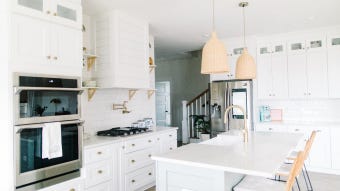
One wall kitchens, as the name suggests, refer to kitchens that are designed with all the elements of the kitchen placed along a single wall. This layout is perfect for homes with limited space as it maximizes the use of the available space. You can see how well it works in the smallest homes in these tiny house kitchen ideas. While one wall kitchens may seem challenging to design, there are several tips that you can use to create an efficient and beautiful kitchen.
Below you'll find how long the wall needs to be, the best order for the sink, range and refrigerator, real 10-foot and 12-foot cabinet lists, and what it takes to add an island. To compare this layout with galley, L-shaped, U-shaped and island kitchens, see our guide to kitchen layouts.
What Is a One Wall Kitchen Layout?
A one wall kitchen (also called a single-wall or straight kitchen) puts the refrigerator, sink, range and all the cabinets in one straight run along a single wall. It needs length, not width, so it suits studios, apartments, small homes and open-plan rooms. The best order is refrigerator at one end, sink in the middle and range at the other end, with counter space between each.
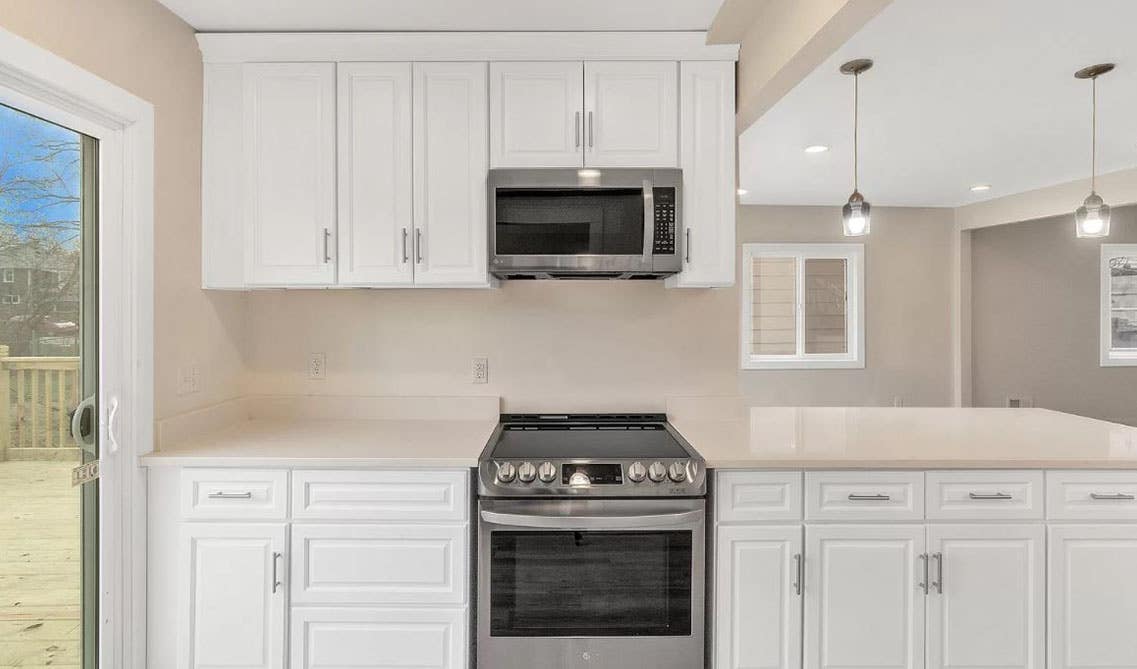
Benefits of One Wall Kitchens
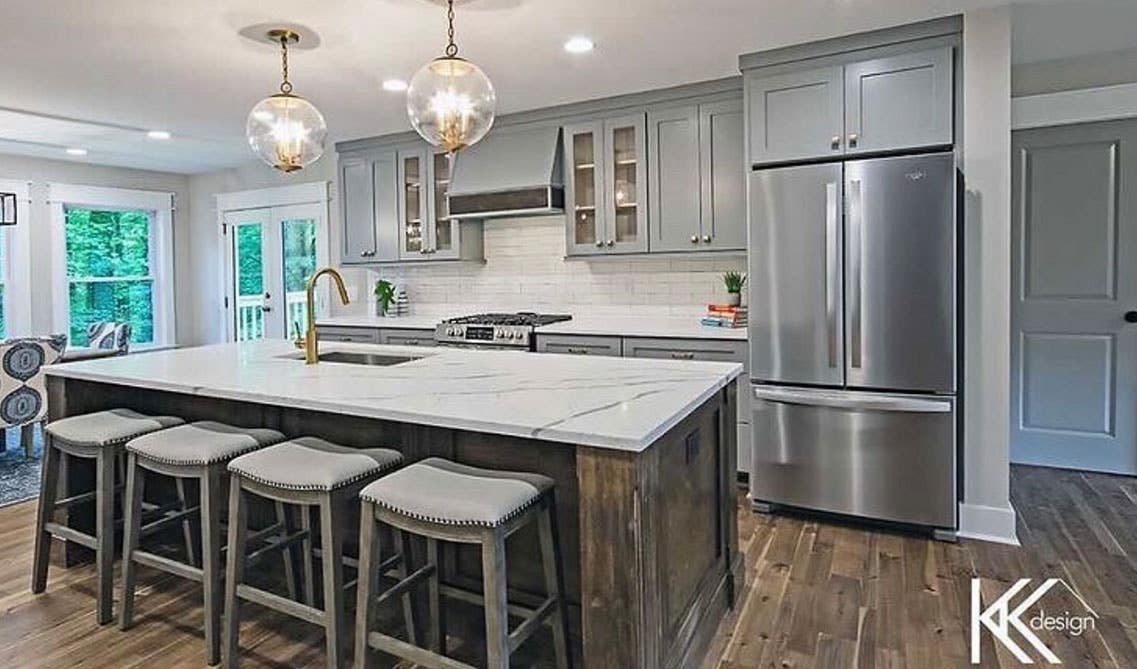
1. Space Saving
One wall kitchens are perfect for small spaces as they help to maximize the use of available space. By placing all the kitchen elements such as the sink, stove, fridge, and cabinets on a single wall, you free up space that can be used for other purposes.
2. Efficient
One wall kitchens are efficient because everything is within easy reach. There's no need to walk across the room to access the stove or sink. The layout also ensures that the kitchen work triangle, which connects the sink, stove, and refrigerator, is well maintained.
Strictly speaking, on one wall the triangle flattens into a straight line, so the spacing between the three matters more than in other layouts. The order section below shows how to get it right.
3. Easy to Clean
One wall kitchens are easy to clean because there are no corners or edges that can accumulate dirt and debris. Cleaning becomes a breeze, and you'll spend less time cleaning up after meals.
Checkout: How to Clean Kitchen Cabinets Step-by-Step
One Wall Kitchen Dimensions: How Long Should the Wall Be?
Most one wall kitchens run about 8 to 15 feet long. The Spruce puts the typical run at around 8 feet and notes that shorter runs can't fit a refrigerator, sink and range. Around 14 to 15 feet is enough to give every appliance the full counter space the NKBA (National Kitchen & Bath Association) recommends.
The short end comes from The Spruce's guide to one-wall layouts. The long end is our math from the NKBA Kitchen Planning Guidelines, using a 30" range, a 33" or 36" sink base and a 30" or 36" refrigerator (all landing areas are listed in the next section). Here's what each length can hold:
| Wall length | What fits | Trade-off |
|---|---|---|
| 8 ft (96") | Refrigerator, sink base and range | Almost no counter between them |
| 10 ft (120") | Refrigerator, sink, range and 27" of base cabinets | No room for a dishwasher if you want counter on both sides of the sink |
| 12 ft (144") | Refrigerator, sink, dishwasher, range and 27" of base cabinets | Counter on both sides of the sink and range, a little short of the full NKBA amounts |
| 14 – 15 ft (171" – 180") | Everything above with full NKBA landing space | The walk from the refrigerator to the range gets long |
Going much past 15 feet adds walking more than it adds work space. The NKBA suggests no single leg between the refrigerator, sink and range be more than 9 feet, with the three legs totaling no more than 26 feet. On a straight wall, that puts the refrigerator and range no more than about 13 feet apart, center to center.
The Best Order for Appliances on One Wall
Put the refrigerator at one end, the sink in the middle and the range at the other end, with counter space between each. The NKBA recommends that a kitchen with one sink place it next to or across from both the cooking surface and the refrigerator, and on a single wall "next to" is the only option, so the sink goes between them.
The NKBA's Kitchen Planning Guidelines also set how much counter, or "landing area," each appliance should have:
- Sink: at least 24" of counter on one side and 18" on the other.
- Range or cooktop: at least 12" on one side and 15" on the other.
- Refrigerator: at least 15" on the handle side.
- Dishwasher: within 36" of the sink. The counter on top of it counts as landing space for the sink.
- Shared counter: when two landing areas meet (for example between the sink and the range), take the larger one and add 12".
- Tall cabinets at the ends: a full-height cabinet, like a tall pantry, shouldn't sit between two work areas. On one wall, put the refrigerator and any pantry cabinet at the end of the run.
Hinge the refrigerator door on the wall side, so the handle side faces the counter and you can set things down straight from the fridge.
10-Foot and 12-Foot One Wall Kitchen Cabinet Lists
Here's what a real 10-foot and 12-foot one wall kitchen looks like in Lily Ann's Colorado White Shaker line, a white shaker finish that also follows the "use light colors" tip below. Both lists assume a 30" refrigerator, a 30" range and a 24" dishwasher, the most common sizes. Every cabinet below showed In stock on October 1, 2026. Check the product page before you order, and get a free design to confirm the plan fits your wall.

Lily Ann Cabinets: Colorado White Shaker
10-foot one wall kitchen (no dishwasher)
| Left to right | Base cabinet | Wall cabinet above |
|---|---|---|
| Refrigerator (30") | — | W3015 (30" x 15") |
| Drawer base | DB15-3 (15") | W1530 (15" x 30") |
| Sink | SB33 sink base (33") | W3330 (33" x 30"), or leave open for a window |
| Base | B12 (12") | W1230 (12" x 30") |
| Range (30") | — | 30" range hood |
Total: 30 + 15 + 33 + 12 + 30 = 120 inches. The refrigerator gets its full 15" landing space and the range gets 12", but the sink only gets 15" and 12", less than the NKBA's 24" and 18". A 24" dishwasher fits only if you give up the drawer base and base cabinet, which leaves almost no counter.
12-foot one wall kitchen (with dishwasher)
| Left to right | Base cabinet | Wall cabinet above |
|---|---|---|
| Refrigerator (30") | — | W3015 (30" x 15") |
| Drawer base | DB15-3 (15") | W1530 (15" x 30") |
| Sink | SB33 sink base (33") | W3330 (33" x 30"), or a window |
| Dishwasher (24") | — | W2430 (24" x 30") |
| Range (30") | — | 30" range hood |
| Base | B12 (12") | W1230 (12" x 30") |
Total: 30 + 15 + 33 + 24 + 30 + 12 = 144 inches. The extra two feet buy a dishwasher right next to the sink, 24" of counter beside the sink (on top of the dishwasher) and counter on both sides of the range.
Also add: a toe kick to cover the bottom of the base cabinets, an overlay wall filler where a cabinet meets a side wall, and a refrigerator end panel if the side of the refrigerator is open. With a 36" refrigerator, add 6" to the run and use a 36"-wide wall cabinet above it.
One Wall Kitchen With an Island
Yes, you can add an island to a one wall kitchen, and it fixes the layout's biggest weakness: too little counter. The NKBA recommends a work aisle of at least 42" between the counter and the island for one cook, or 48" for two. Plan the island before you buy cabinets, because it changes how deep the room needs to be.
From the wall out, an island with seating needs room for each of these (NKBA figures):
- Base cabinets: 24" deep.
- Work aisle: 42" for one cook, 48" for two.
- Island: cabinet depth plus any overhang. At a 36"-high counter, the NKBA recommends a knee space 15" deep and 24" wide for each seat.
- Behind the stools: 32" if nobody walks past, 36" to edge past, 44" to walk past.
For example, 24" of cabinets, a 42" aisle, a 24"-deep island with a 15" overhang and 36" behind the stools add up to 141 inches, about 11 feet 9 inches from the back wall (our math from the NKBA figures). If the room is shallower, a narrow island without seating or a rolling cart gives you extra prep space instead.
Tips for Designing a One Wall Kitchen

Tip 1: Plan Your Layout Carefully
Before designing your one wall kitchen, you need to plan the layout carefully. Consider the location of the sink, stove, and fridge, and ensure that they're all easily accessible. You also need to consider the placement of the cabinets and drawers, as well as the countertop space. If the space you are working with isn’t that limited, you can also try a one wall kitchen with an island for more counter space.
We always recommend getting a professional's opinion on a big ticket item such as cabinetry. Lily Ann Cabinets offers FREE professional 3D designs, so you can visualize your space before you purchase. Their award winning designers can also help you create a functional space that is custom to your wants and needs.
Get your FREE 3D kitchen design today!
Start NowTip 2: Use Light Colors
One-wall kitchens can sometimes feel cramped or claustrophobic, particularly if you have limited space to work with. To combat this, consider using light colors on your walls, cabinets, and countertops. Lighter hues will help to create a sense of openness and brightness, making your kitchen feel larger and more inviting. Additionally, light colors can make it easier to spot spills and messes, helping keep your kitchen clean and tidy.
Tip 3: Incorporate Storage Solutions
In a one-wall kitchen, storage can be a challenge. To make the most of your space, get creative with your storage solutions. For example, consider installing a pull out pantry or spice rack to maximize your storage capacity without taking up valuable floor space. If you go for a one wall kitchen with an island, the island can be used for extra space. Additionally, using magnetic knife strips, hanging fruit baskets, and other clever storage solutions can help you keep your kitchen organized and clutter-free.
With only one run of base cabinets, wall storage matters more than in any other layout. Taking the wall cabinets up to the ceiling adds storage across the whole run.
Tip 4: Optimize Lighting
Lighting is key in any kitchen, but it's imperative in a one-wall kitchen where natural light may be limited. Consider installing a combination of overhead and under cabinet lighting to ensure that your kitchen is well-lit and easy to work in. Additionally, adding a mirror or two can help to reflect light and make your kitchen feel brighter and more spacious.
Tip 5: Choose Your Appliances Wisely
One wall kitchens have limited space, so it's essential to choose your appliances wisely. Opt for smaller appliances that are designed for small spaces. You can also choose appliances that are multifunctional, such as a stove that also doubles as an oven.
Checkout: How to Match Cabinets and Appliances in Your Kitchen
In Conclusion…
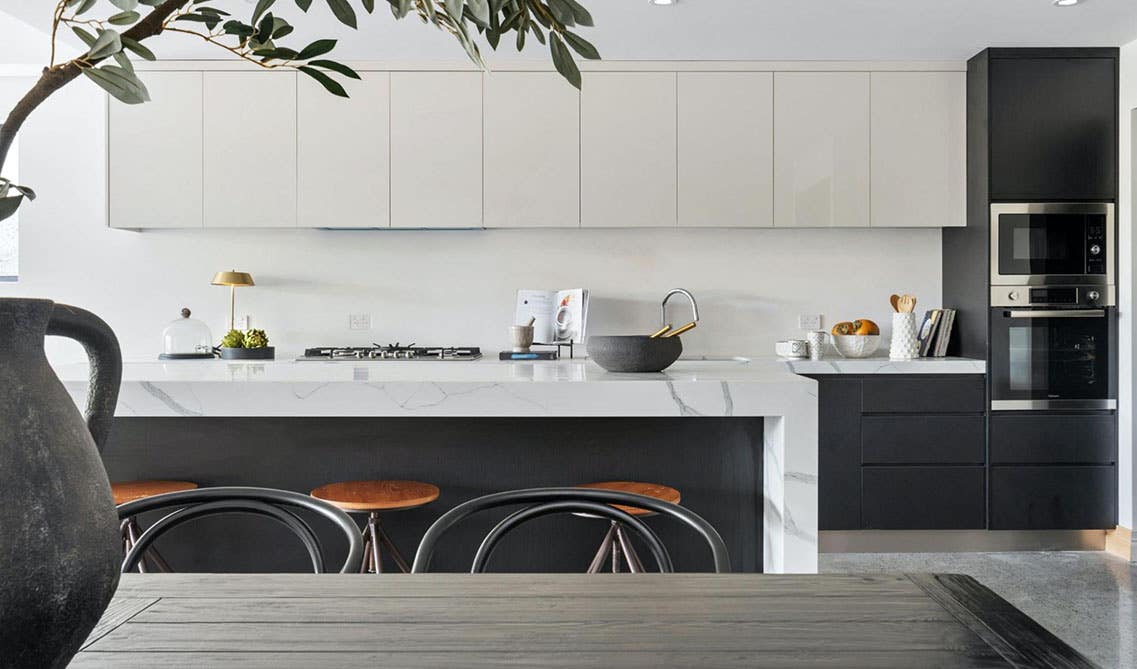
A one wall kitchen layout is an excellent option for homes with limited space. By following the tips provided in this blog, you can design a functional and stylish one wall kitchen that meets all your needs. With careful planning, you can create a space that's efficient, easy to clean, and a joy to cook in.
Want to see what a one wall kitchen layout will look like in your home? Work with our experts and get a FREE 3D design and quote today. Lily Ann Cabinets also offers a free kitchen visualizer tool to bring your kitchen cabinet ideas to life before making a purchase. This allows clients to experiment with different cabinet styles, colors, and configurations to create the perfect space for their needs. With excellent customer service and a commitment to quality, Lily Ann Cabinets is an excellent choice for anyone looking to upgrade their cabinets and create the kitchen layout of their dreams.
Related Blogs:
- 15 Kitchen Countertop Ideas + Design Trends That Can Truly Revamp Your Kitchen
- 12 Kitchen Drawer Organizers, Trays, and Dividers for a Tidy Space
- 24 Stylish Brick Backsplash to Transform any Kitchen
- Kitchen Shelves: 10 Ways to Style Them
- Small kitchen paint colors: Exploring 10 Tones for Limited Spaces
Frequently Asked Questions
A one wall kitchen layout refers to a kitchen design layout where all the kitchen elements, such as the sink, stove, fridge, and cabinets, are placed along a single wall. This layout is suitable for homes with limited space as it maximizes the use of available space.
Most one wall kitchens run about 8 to 15 feet long. Around 8 feet is the shortest run that fits a refrigerator, sink and range, and about 14 to 15 feet gives each one the full counter space the NKBA recommends. They're often found in apartments and small homes, and some larger homes pair a one wall kitchen with an island.
One wall kitchens can be cheaper than other kitchen layouts, but it depends on several factors, such as the quality of materials, the type of appliances used, and the size of the kitchen. It's essential to work with a professional kitchen designer to determine the most cost-effective options for your specific needs and budget.
Put the refrigerator at one end, the sink in the middle and the range at the other end, with counter space between each. Aim for 24" and 18" of counter on either side of the sink, 12" and 15" beside the range, and 15" on the handle side of the refrigerator, per the NKBA. Put the dishwasher next to the sink.
It's called a one wall kitchen, a single-wall kitchen or a straight kitchen. All three names mean the same thing: every appliance and cabinet sits in one straight run along a single wall.
The pros: it takes the least floor space, costs less because there are fewer cabinets and less countertop, and it's easy to clean. The cons: counter space and storage are limited, and the refrigerator, sink and range sit in a line, so a long run means more walking. An island or tall wall cabinets help with both.
Yes. A refrigerator, sink, dishwasher and range fit on one wall from about 12 feet up, with some counter between each. On a 10-foot wall you can fit the refrigerator, sink and range with a little counter, but usually not a dishwasher too. Keep the sink between the refrigerator and the range.
Yes, and an island is the easiest way to add counter space and seating to a one wall kitchen. Leave at least 42" between the counter and the island for one cook, or 48" for two, per the NKBA. With seating, the room usually needs to be close to 12 feet deep from the back wall.
Add up the base cabinets (24"), the work aisle (42" to 48"), the island and its overhang, and the space behind the stools (32" to 44"). With a 24"-deep island, a 15" overhang, a 42" aisle and 36" behind the stools, that's about 11 feet 9 inches from the back wall.











Comments