

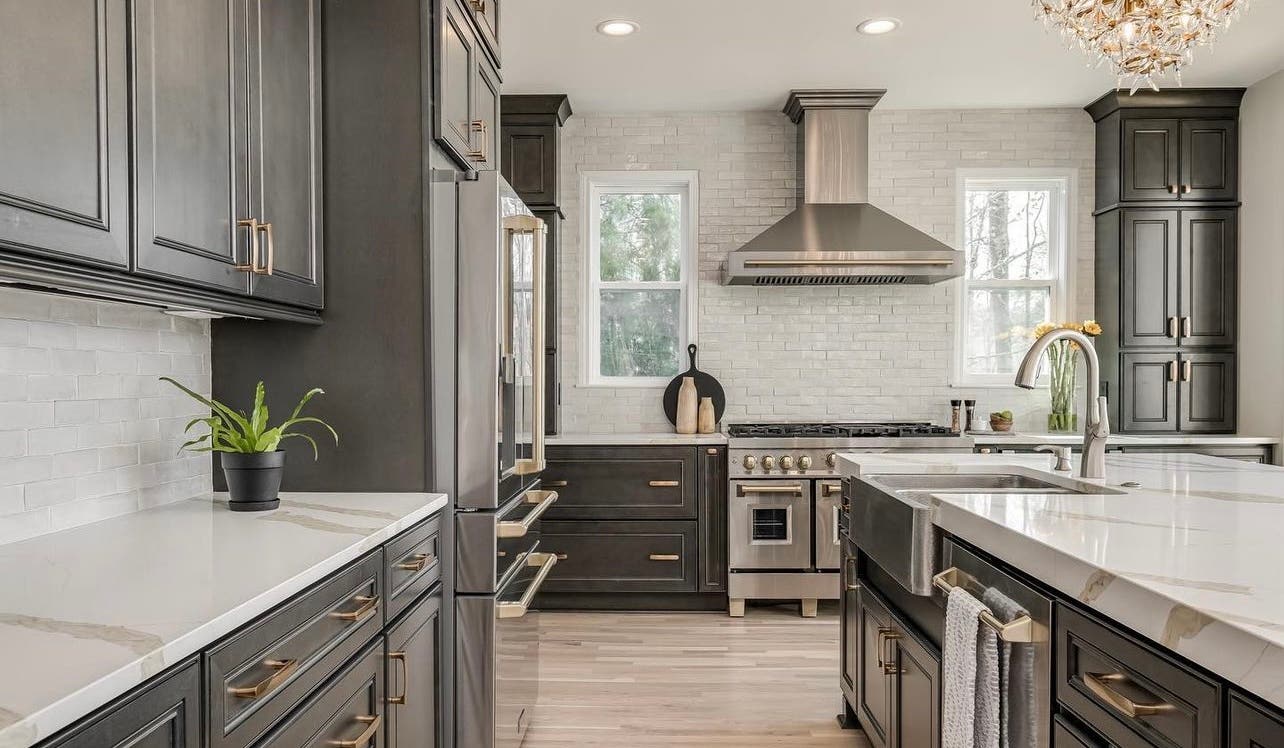
- Modern is the form; rustic is the material. Clean shapes, rough surfaces. Reverse it — ornate shapes in sleek materials — and it reads as neither.
- Aim for roughly 70/30. One style leads and the other punctuates. A 50/50 split is what produces the "themed" look people are trying to avoid.
- Texture does the work colour usually does. Wood grain, stone, matt metal and unlacquered brass carry the interest, which is why the palette stays narrow.
- Shaker and slab doors both work — shaker in a wood finish leans rustic, slab in the same wood leans modern. The door profile is your dial between the two.
- One rough element per surface plane, not three. Reclaimed beams, a stone wall, a live-edge shelf and open rough shelving in one room is a theme, not a style.
- The most common failure is fake texture. Printed woodgrain laminate, faux beams and distressed-look paint read as costume; real wood and real stone are what make it work.
What Modern Rustic Actually Means
Modern rustic pairs contemporary form with natural, textured material. Clean lines and simple cabinet shapes carry surfaces that are visibly wood, stone or raw metal. It is a combination of form and material, not a blend of two aesthetics.
Getting this the right way round is most of the battle. The version that works looks like a modern kitchen built from rustic materials. The version that fails looks like a rustic kitchen with some modern items added — a farmhouse kitchen with stainless appliances and pendant lights, which is a farmhouse kitchen.
The test is to describe the kitchen in two parts:
| Modern rustic | What it is not | |
|---|---|---|
| Cabinet shape | Slab or shaker, flat faces, minimal profile | Raised panel, cathedral, applied moulding |
| Cabinet surface | Visible wood grain, matt paint, honest texture | High-gloss lacquer, printed woodgrain laminate |
| Worktop | Stone with visible character, butcher block, concrete | Uniform speckled composite with no movement |
| Hardware | Matt black, unlacquered brass, aged bronze, simple bar pulls | Ornate cast handles, polished chrome |
| Structure on show | Real beams, real brick, real stone | Faux beams, thin brick slips, distressed paint effects |
| Overall complexity | Restrained — few materials, repeated | Many materials, each used once |
The Ratio: Let One Style Lead

Pick a lead style and give it roughly seventy percent of the room, then use the other for the remaining thirty. An even split is what produces the uncomfortable, themed result.
The reason a 50/50 split fails is that neither style gets to establish itself, so the room reads as unresolved rather than as a deliberate combination. Decide which way round yours goes:
Modern-led (70% modern, 30% rustic)
Flat slab doors in a light painted finish, quiet worktop, minimal hardware — then a reclaimed wood island top, a stone backsplash, or exposed ceiling beams as the rustic thirty percent. This version suits new-build and open-plan rooms where the architecture is already modern, and it is the easier of the two to get right because the rustic elements are additions rather than the whole envelope.
Rustic-led (70% rustic, 30% modern)

Natural or lightly stained wood cabinets throughout, stone or timber surfaces, visible texture everywhere — then modern discipline in the shapes: shaker or slab doors with no ornament, integrated appliances, simple bar pulls, and no decorative moulding anywhere. This suits older houses and rooms that already have real character to work with.
The thirty percent in a rustic-led kitchen is mostly restraint rather than objects. That is the harder version to execute and the more convincing one when it lands.
Cabinets: The Door Profile Is Your Dial

Shaker and slab are the two door profiles that work in modern rustic. Shaker in a wood or matt finish leans rustic; slab in the same finish leans modern. Changing the profile shifts the whole room without changing the colour.
Both doors are flat-faced with no applied ornament, which is what keeps the form modern. The difference is the single shadow line a shaker frame creates — enough to read as traditional craft, not enough to read as decorative. That one line is why shaker is the default choice for this style.
- Shaker in natural or lightly stained wood — the archetypal modern rustic cabinet. Grain provides the texture, the square frame provides the discipline.
- Shaker in a matt muted paint — sage, olive, warm grey, deep green. Reads modern rustic when paired with a wood or stone element elsewhere; reads plainly modern without one.
- Slab in wood — the most contemporary end. Grain runs uninterrupted across the door face, which is the strongest expression of "modern form, rustic material" available.
- Slim shaker — narrower frame, larger panel. A halfway setting on the dial between shaker and slab.
- Two-tone — wood on the base run, painted on the wall cabinets, or the reverse. The most common way to get both styles into one kitchen without a fight.
What does not work: raised panel, cathedral and arched doors. They are ornamental profiles, and ornament is the thing modern rustic removes. A raised-panel door in a rustic wood finish is a traditional kitchen. The full comparison is in cabinet door styles.
Lily Ann builds shaker, slim shaker and slab in both wood and painted finishes — the natural and stained options are in wood cabinets and stained wood cabinets, the muted paints in the grey and dark ranges.
Materials: Real, and Few

Choose a small number of genuine materials and repeat them, rather than a large number used once each. Texture is doing the work that colour does in other styles, so the palette stays narrow and the surfaces stay honest.
The materials that belong:
- Wood with visible grain. Oak and hickory have the strongest grain and the most character; maple and birch are quieter. Light stains show grain better than dark ones. Where the budget allows, walnut is close to the ideal material for this style — dark through its whole thickness, with real figure.
- Stone with movement. Granite, soapstone, honed marble — surfaces with visible variation. A uniform engineered surface with no movement is the one countertop choice that fights this style.
- Butcher block. The most rustic worktop available and the one that most obviously reads as real. It needs oiling and it will mark, which is the trade. Our guide to butcher block countertops: pros, cons and care covers how often to oil it and how to sand marks out.
- Concrete. The most modern-leaning rustic surface — raw texture in a contemporary material.
- Matt and aged metals. Matt black, aged bronze, unlacquered brass that will patinate. Polished chrome is the one finish that consistently reads wrong here.
- Real structural texture. Exposed beams, brick, stone — where the house already has them.

The one rule: one rough element per plane
Floor, walls, worktop, ceiling. Give each at most one strongly textured element. Reclaimed beams overhead, a stone feature wall, a live-edge shelf, rough open shelving and a butcher block island all in one room is four or five competing textures — and that is the point at which a style becomes a theme.
Restraint is what separates the two, and it is almost always the thing to cut rather than add.
The Failure Modes
Three things reliably make a modern rustic kitchen look wrong: fake materials, too many competing textures, and ornamental cabinet profiles.
- Fake texture. Printed woodgrain laminate, faux ceiling beams, thin brick slips, distressed-look paint. Modern rustic is built on material honesty, so a simulated material undermines the whole premise — and it is visible up close in a way it is not in a photograph. If real wood is out of budget, a plain matt paint is a better answer than a printed grain.
- Texture overload. Covered above. The single most common failure, and the easiest to fix, because the fix is subtraction.
- Ornamental profiles. Raised panel doors, decorative corbels, scrolled brackets, applied moulding. These belong to traditional and farmhouse styles. Adding them to a rustic material palette produces a traditional kitchen, not a modern rustic one.
- Polished everything. High-gloss cabinets, polished chrome, a mirror-polished stone worktop. Gloss is the opposite of the matt, tactile quality the style depends on.
- Too much colour. Modern rustic runs on a narrow palette — wood tones, stone, black, white, and one muted colour at most. Several saturated colours turn it into an eclectic kitchen.
Lighting and the Details That Land It

Lighting is where modern rustic is most often decided, because pendants are the most visible non-cabinet object in the room. Simple shapes in matt or aged metal work; ornate lantern-style fixtures pull the room towards traditional farmhouse.
- Pendants: simple geometry — a cone, a dome, a cylinder — in matt black, aged brass or blackened steel. Two or three over an island, hung so the bottom sits roughly at eye level for someone standing.
- Under-cabinet lighting: essential, because wood cabinets absorb more light than painted ones and a wood kitchen without task lighting reads dim rather than warm.
- Bulb temperature: warm-white. Cool white light makes wood look grey and stone look flat, which removes the warmth the whole style is built on.
- Open shelving, sparingly: one run of a real timber shelf, not a wall of them. It is the cheapest way to introduce genuine wood texture into a painted kitchen.
- Hardware: simple bar pulls or plain knobs. This is the detail most often over-thought — in a style built on restraint, quiet hardware is correct.
Is Modern Rustic Still Current?
Rustic elements have been moving steadily toward the modern end for years — lighter woods, less distressing, fewer decorative flourishes — and warm natural wood has been gaining ground against all-white kitchens across that period. The style is evolving rather than disappearing.
Worth saying plainly, since "is rustic outdated?" is one of the questions people actually ask: the version of rustic that dates is the heavily themed one — distressed paint, faux beams, ornate corbels, signs on the wall. That was a moment. Natural wood in simple forms is not a moment; it is close to the oldest thing in kitchens, and its current expression happens to be a modern one.
Which is a reason to build this style from materials rather than from decoration. A kitchen made of real wood and real stone in simple shapes will still read as intentional when the specific styling around it has moved on. A kitchen made of distressed finishes and applied ornament is dated the moment that look stops being current.
Putting It Together

Decide the lead style, choose the door profile that sets the dial, pick two or three real materials, and then remove one thing.
- Lead style. Modern-led if the room is new or open-plan; rustic-led if the house already has character to work with.
- Door profile. Shaker for the middle of the dial, slab for modern-leaning, shaker in wood for rustic-leaning.
- Finish. Natural or lightly stained wood, or a muted matt paint with a wood element elsewhere.
- Two or three materials, repeated. Not six used once each.
- Worktop with visible character. Stone with movement, butcher block or concrete.
- Matt hardware and simple pendants.
- Then take one textured element out. There is almost always one too many.
Because wood finishes are the hardest thing to judge on a screen — grain depth and undertone both disappear in photographs — free door samples are the sensible next step before ordering. Everything ships flat from the RTA kitchen cabinet range.
Two related pages worth reading alongside this: what "solid wood" really means, since this style depends on real wood and the term is used loosely, and kitchen layouts, because the island that carries most modern rustic kitchens has to fit before it can be styled.





Comments