


LVP stands for luxury vinyl plank. It is waterproof vinyl flooring made in long planks that look like wood, built in layers: a clear wear layer, a printed design layer, a core and often a backing pad. LVT, or luxury vinyl tile, is the same material in tile shapes. Most LVP sold today has a rigid core and clicks together without glue, which makes it a common choice for kitchens, bathrooms and basements.
- What it is: LVP means luxury vinyl plank, a layered, waterproof vinyl floor printed to look like wood.
- LVP vs. LVT: same material, different shape. Planks look like wood boards; tiles look like stone or ceramic.
- Core types: flexible (all vinyl), WPC (softer rigid core) and SPC (dense rigid core). Most LVP sold now is rigid core.
- LVP vs. engineered hardwood: LVP is waterproof and can't be refinished. Engineered hardwood has a real wood top layer that can sometimes be refinished once or twice.
- Cost: Family Handyman (Sept 2024) puts rigid core LVP at $1.70 to $8 per sq. ft. and engineered hardwood at $3 to $10.
- Cabinets: with click-together LVP, set the base cabinets first and floor up to the toe kick, per This Old House.
- Lily Ann Cabinets sells SPC rigid core LVP: four SPC planks in stock on October 5, 2026.
Shop for a new floor and you run into a wall of letters: LVP, LVT, SPC, WPC, EVP. Most of them describe the same family of product, and the differences are smaller than the labels make them look.
This guide explains what LVP flooring is, how LVP and LVT differ, and how LVP stacks up against engineered hardwood and solid hardwood. It also covers a question cabinet buyers ask us a lot: does the floor go in before or after the cabinets? Facts from outside sources are named and linked where they appear.
What Is LVP Flooring?
LVP stands for luxury vinyl plank. It is vinyl flooring made in long planks that look like wood, built in layers: a clear wear layer on top, a printed design layer, a core, and often a backing pad. It is waterproof and usually clicks together without glue, which is why it's common in kitchens, bathrooms and basements.
Consumer Reports splits vinyl flooring into two kinds. Traditional vinyl comes in rolls and is glued down. Luxury vinyl is thicker and more rigid, has more protective top layers, and typically comes in tiles or planks that click together. Both are made of polyvinyl chloride (PVC).
You'll see LVP sold under several names: luxury vinyl plank, vinyl plank, rigid core, and engineered vinyl plank (EVP). According to Family Handyman, most LVP sold today is the rigid core kind.
What LVP Is Made Of

Lily Ann Cabinets: 9" x 60" Rustic Brown SPC Flooring
A plank is a stack of thin layers pressed into one piece. From the top down:
- Wear layer. A clear coating you walk on. It takes the scratches and scuffs so the picture below doesn't.
- Design layer. A printed vinyl film that gives the plank its wood, stone or tile look.
- Core. The body of the plank. Older LVP is flexible vinyl all the way through. Newer rigid core LVP uses a stiff composite.
- Backing or pad. Many planks have a thin cork or foam pad attached to soften the feel and the sound.
The layer list follows Family Handyman's rigid core guide and the Resilient Floor Covering Institute (RFCI), the trade group for this kind of flooring.
LVP vs. LVT: What's the Difference?
The difference between LVP and LVT is shape. LVP (luxury vinyl plank) comes in long planks that look like wood boards. LVT (luxury vinyl tile) comes in square or rectangular tiles that usually look like stone or ceramic. The material, the layers and the care are the same.
The industry itself often uses "LVT" for both. The RFCI describes luxury vinyl tile as flooring "produced in either tiles or planks." So when a label says LVT, check the shape before you assume it's a tile.
| LVP | LVT | |
|---|---|---|
| Stands for | Luxury vinyl plank | Luxury vinyl tile |
| Shape | Long, narrow planks | Squares or rectangles |
| Usually looks like | Wood boards | Stone, ceramic or patterned tile |
| Material and layers | The same: wear layer, design layer, core, optional pad | |
| How it installs | Both come as glue-down, click-together floating, or loose-lay products (RFCI) | |
| Waterproof | Both. Vinyl flooring is waterproof (Consumer Reports) | |
| What sets the price | Brand, core type, thickness and wear layer, not the shape | |
How to choose: pick by the look you want. If you want the floor to read as wood, buy planks. If you want a stone or tile look without grout lines to scrub, buy tiles. Both work in the same rooms.
Is "vinyl plank" the same as LVP?
In a store, yes. "Vinyl plank" and "luxury vinyl plank" are used for the same product, and "luxury" is not an official grade. What separates a good plank from a weak one is on the spec sheet: the wear layer, the core and the overall thickness.
Types of LVP: Flexible, WPC and SPC
The core is the main thing that changes from one LVP to the next. There are three kinds.
- Flexible LVP. Vinyl all the way through. Family Handyman notes that the original LVP and LVT were made this way. It is thinner and bends, and it comes in glue-down, click-together and loose-lay versions.
- WPC rigid core. A lighter, thicker core that the RFCI says gives more comfort underfoot and good sound control.
- SPC rigid core. A dense, solid core. The RFCI says SPC resists dents better and stays more stable as temperature changes.
SPC is the type Lily Ann Cabinets sells. Our SPC flooring guide covers the stone-core type in detail, so we won't repeat it here.

Lily Ann Cabinets: 7" x 48" Washed Oak SPC Flooring
LVP vs. Engineered Hardwood
LVP is waterproof vinyl printed to look like wood. Engineered hardwood is a thin layer of real wood over a plywood or composite base. Choose LVP for wet or busy rooms and a lower price. Choose engineered hardwood when you want a real wood surface and can keep water off it. LVP can't be refinished; some engineered hardwood can, once or twice.
Here is how the two compare, with solid hardwood alongside. Sources: Consumer Reports' flooring buying guide and Family Handyman's guides to rigid core flooring and engineered vs. solid hardwood.
| LVP | Engineered hardwood | Solid hardwood | |
|---|---|---|---|
| What it is | PVC-based plank with a printed wood look under a clear wear layer | A thin veneer of real wood over plywood or a composite board | One solid piece of wood, typically 3/4 inch thick when new |
| Water | Waterproof. Good for kitchens and baths | Handles humidity better than solid wood and moves less, but it is still wood | Swells and shrinks with humidity. A poor choice for basements and baths |
| Scratches and dents | Resists wear, dents, scratches and stains well. Scratch resistant, not scratch proof | Tested about the same as solid wood for dents and wear | Can dent easily |
| Refinishing | Can't be refinished. Worn planks get replaced | Depends on the veneer: some once or twice, some not at all | Can be sanded and refinished several times |
| How long it lasts | Warranties generally run 20 to 25 years | About 20 to 40 years | Up to 100 years with refinishing |
| Look and feel | Close to wood from standing height; still vinyl up close | Real wood surface. Good ones look just like solid wood | Real wood all the way through |
| Install | Usually click-together and floating. DIY friendly | Glued down or floated. Many click together | Nailed or glued down, usually by a pro |
| Cost of the flooring | $1.70 to $8 per sq. ft., about $4 on average | $3 to $10 per sq. ft. | About $4 to $12 per sq. ft. |
Cost note: the LVP and engineered figures are from Family Handyman's rigid core guide (updated September 2024). Its engineered vs. solid hardwood guide (updated August 2024) quotes a contractor who has seen engineered wood as low as $2.50 and solid hardwood from $4 to $12 per square foot. Neither article says whether installation is included, so treat these as rough ranges and get local quotes. Consumer Reports adds that top-of-the-line luxury vinyl can cost as much as the best solid wood, though it costs less to install.

Lily Ann Cabinets: 7" x 48" Royal Oak SPC Flooring
Can engineered hardwood be refinished?
Sometimes. It depends on how thick the real-wood top layer is. Consumer Reports, citing the National Wood Flooring Association, says a top layer under 2.5 mm can usually be recoated but not fully sanded and refinished. Family Handyman adds that floating floors can't be refinished at all. If refinishing matters to you, ask about the veneer thickness before you buy.
Which one should you choose?
- Kitchens, bathrooms, laundry rooms and basements: LVP. Water is the deciding factor.
- Homes with pets and kids: LVP, for the scratch and stain resistance and the easy cleanup.
- Living rooms and bedrooms where you want real wood: engineered hardwood.
- A floor you plan to keep for decades and refinish: solid hardwood, or engineered hardwood with a thick veneer.
- A tight budget or a DIY weekend: LVP.
For more on the wood side, see our hardwood flooring guide and hardwood vs. laminate flooring. If you're weighing vinyl against laminate instead, read vinyl vs. laminate flooring.
Should LVP Go Under Kitchen Cabinets?
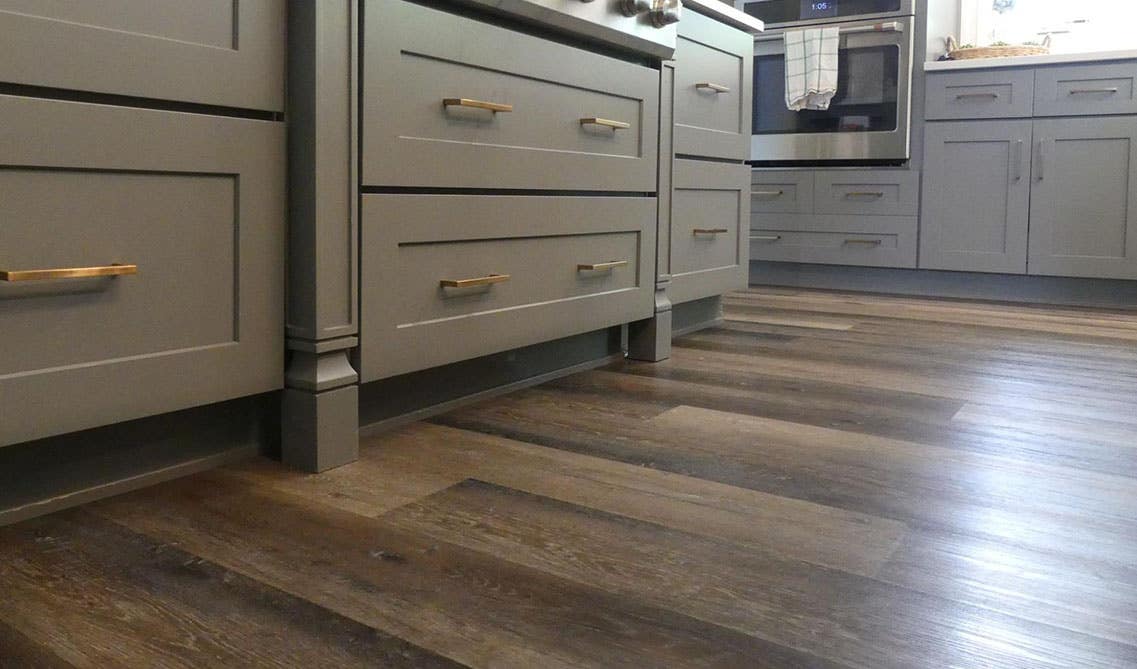
With click-together LVP, usually not. A floating floor has to be free to expand and contract, and it can't do that with heavy cabinets sitting on it. The common method is to set the base cabinets first, then lay the floor up to the toe kick and cover the small gap with trim.
That's the advice This Old House's Tom Silva gives a reader who asked about putting new cabinets on a floating floor. His tips:
- If the toe kicks come off, remove them and run the flooring a little way under the cabinet.
- If they don't, stop the flooring within about 1/2 inch of the toe kick and hide the gap in the finish step.
- Nail shoe molding or quarter round to the wall, never to the floating floor.
Two things to plan for. First, height: base cabinets set straight on the subfloor end up lower than the finished floor by the thickness of the flooring, which can pinch a dishwasher or range. This Old House's fix is to set the cabinets on plywood strips a little thicker than the flooring, so they sit at finished-floor height. Second, glue-down vinyl is fixed to the subfloor and may follow different rules. In every case, the flooring's own install guide decides. The RFCI says the maker's requirements for expansion space should govern the job.
Our kitchen remodeling guide says flooring usually goes in before the cabinets, and notes that some installers do the reverse. A floating, click-together floor is the main case for doing the reverse.
Our guides on how to install kitchen cabinets and cabinet toe kicks cover the cabinet side of this step.
Where LVP Works Best, and Where It Doesn't
- Kitchens. Spills and dropped pans are why people pick it. See SPC vinyl flooring for your kitchen for color ideas.
- Bathrooms and laundry rooms. A wood look that can take a wet floor. Our laundry room flooring guide compares it with tile.
- Basements. Family Handyman calls rigid core a great choice below grade, where other floors would warp. Fix any damp problem first. Water that gets under vinyl plank can lead to mold, and the EPA says the key to mold control is moisture control.
- Rooms with strong direct sun. Vinyl can fade over time in direct sunlight, so use blinds or curtains.
- Where real wood matters to you. Consumer Reports puts it plainly: even the best luxury vinyl still looks like vinyl up close.
LVP Pros and Cons
Pros
- Waterproof
- Resists wear, dents, scratches and stains
- Click-together planks suit a DIY install
- Softer and warmer underfoot than tile
- Wide range of wood and stone looks
- Easy to clean with a broom and a damp mop
Cons
- Can't be sanded or refinished
- Scratch resistant, not scratch proof
- Can fade in direct sunlight
- Won't outlast hardwood or ceramic tile
- Looks like vinyl up close
These points come from Consumer Reports' flooring buying guide and Family Handyman's rigid core guide.
What to Check Before You Buy LVP
- Core type. Flexible, WPC or SPC. This changes how the floor feels and how it handles dents.
- Wear layer. Given in mil (thousandths of an inch) or millimeters. Use it as a first filter only. In Consumer Reports' tests, two vinyl floors with the same 20 mil wear layer scored very differently for foot-traffic wear.
- Thickness and pad. A thicker plank or an attached pad mostly changes feel and sound.
- Install type. Click-together floating, glue-down or loose lay.
- Emissions label. Consumer Reports notes that vinyl floors with FloorScore certification emit relatively low levels of volatile organic compounds.
- Warranty and care guide. Read both. The care guide tells you what cleaners are allowed.
LVP at Lily Ann Cabinets

Lily Ann Cabinets: 9" x 60" White Oak SPC Flooring
Lily Ann Cabinets sells one kind of LVP: SPC rigid core planks. We don't sell flexible LVP, WPC, engineered hardwood or solid hardwood. On October 5, 2026, these four were in stock in our SPC flooring section:
- White Oak: 9" x 60" planks, 5.5 mm thick, 30 mil wear layer, Uniclick locking
- Rustic Brown: 9" x 60" planks, 5.5 mm thick, 30 mil wear layer, Uniclick locking
- Washed Oak: 7" x 48" planks, 6.5 mm thick, 0.5 mm wear layer, 5G click
- Royal Oak: 7" x 48" planks, 6.5 mm thick, 0.5 mm wear layer, 5G click
All four are floating, click-together floors with an embossed, low-gloss surface, and each listing marks them 100% waterproof and suitable for homes and commercial spaces. Check the product page for current stock and price before you order.
The Takeaway
LVP is luxury vinyl plank: waterproof, layered vinyl flooring shaped and printed to look like wood. LVT is the same material in tile shapes. Against engineered hardwood, LVP wins on water, price and easy care, and loses on refinishing and the feel of real wood. If your LVP clicks together, plan to set the cabinets first and floor up to them.
Planning cabinets and a floor together? Get a free 3D kitchen design and see how the finishes look side by side.
Frequently Asked Questions
In stores, there usually isn't one. "Vinyl plank" and "luxury vinyl plank" (LVP) are used for the same product, and "luxury" is not an official grade. The older, different product is traditional sheet vinyl, which comes in rolls and is glued down. To judge quality, look at the wear layer, the core type and the thickness instead of the name.
Neither is cheaper by default. LVP and LVT are the same material in different shapes, so the shape doesn't set the price. Brand, core type, thickness and wear layer do. Compare two products by price per square foot and by their spec sheets, not by whether they are planks or tiles.
The main downsides are that LVP can't be refinished, it can fade in direct sunlight, and it still looks like vinyl up close. Its surface is scratch resistant, not scratch proof, so heavy traffic and pet nails wear it over time. When it's worn out, the only fix is to replace planks.
LVP is the better pick for wet rooms. Laminate is built on a dense fiberboard core, which is wood-based, while vinyl is waterproof. Laminate can make sense in dry rooms, and Consumer Reports notes the best laminates resist scratches very well. For kitchens, baths, laundry rooms and basements, choose LVP.
Get LVP for kitchens, bathrooms, basements and homes with pets or kids, because it is waterproof and costs less. Get engineered hardwood for living rooms and bedrooms where you want a real wood surface and can keep water off it. LVP can't be refinished, while some engineered hardwood can be refinished once or twice.
Engineered hardwood can't be refinished as many times as solid wood, and some products can't be refinished at all. Deep scratches and gouges are hard to repair, and it is still wood, so standing water can damage it. Family Handyman puts its lifespan at about 20 to 40 years, shorter than solid hardwood.
With click-together (floating) LVP, usually not. This Old House's Tom Silva says a floating floor has to be free to expand and contract, and it can't with heavy cabinets resting on it. Set the base cabinets first, then run the flooring up to the toe kick and cover the gap with trim. Always check the flooring's install guide, since glue-down products can differ.
Yes, with a damp mop. Sweep or vacuum first, then use a flat microfiber mop that has been wrung out, with warm water or a pH-neutral cleaner labeled safe for vinyl. Don't soak the floor, because water can get into the seams and under the planks, and don't use a steam mop unless the flooring maker approves it.
Yes, if moisture gets trapped under it. The planks are waterproof, but water can reach the subfloor through seams, along walls or up through a damp concrete slab. The EPA says the key to mold control is moisture control and that wet areas should be dried within 24 to 48 hours. Fix leaks and damp problems before you install, and wipe up spills quickly.
Yes, mostly in rooms where water rules out wood, such as kitchens, bathrooms, laundry rooms and basements. Consumer Reports notes that top-of-the-line luxury vinyl can cost as much as the best solid wood. It also says even the best still looks like vinyl up close, which is why many owners keep real wood in the main living areas.















