


- Walnut is priced at the top of the common cabinet hardwoods. Its colour is genuinely unique; its cost is the main reason most walnut kitchens are walnut islands.
- It gets lighter with age, not darker. Cherry deepens, walnut mellows toward honey-brown. Plan for the kitchen you will have in ten years.
- The pale sapwood streaks are the wood, not a defect. Steamed walnut evens the colour out; unsteamed shows more contrast. Ask which you are getting.
- It is softer than maple and oak. Beautiful, and it marks more easily on the edges that take daily knocks.
- An island in walnut with painted perimeter cabinets is how most real walnut kitchens are actually built — the effect at a fraction of the cost.
- Lily Ann does not sell walnut. This guide names the closest real alternatives rather than pretending otherwise.
What Walnut Actually Looks Like
American black walnut is a deep chocolate brown, often with purple or grey undertones, streaked with pale cream sapwood. It is the only common domestic hardwood that is naturally dark — everything else that looks dark in a kitchen has been stained.
That distinction is the whole argument for walnut, and it is worth understanding physically. A stained oak or maple cabinet is a light wood with pigment sitting in and on its surface; the colour is a layer. A walnut cabinet is dark all the way through. When it is scratched, the wood underneath is the same colour as the surface — which is why a walnut kitchen ages differently from a dark-stained one.
| Property | Walnut | What it means |
|---|---|---|
| Natural colour | Chocolate brown, purple-grey undertones | Dark without stain; scratches do not reveal pale wood |
| Sapwood | Pale cream, often streaked through the board | High contrast unless steamed — a look, or a problem, depending on taste |
| Grain | Straight to wavy, medium-open, often figured | Real character; occasional burl and curl in premium boards |
| Hardness | Softer than maple, oak and hickory | Dents more readily on door edges and drawer fronts |
| Colour change | Lightens with age and light | Opposite to cherry — mellows toward honey-brown |
| Relative price | Highest of the common cabinet hardwoods | The main constraint for most kitchens |
The Colour Change Runs the Wrong Way
Almost every hardwood darkens with age — cherry famously so. Walnut lightens. Over years of light exposure it mellows from deep chocolate toward a warmer, softer honey-brown, losing some of the purple undertone.
This is genuinely counter-intuitive and it has practical consequences nobody warns about at the point of sale:
- The kitchen you see on installation day is the darkest it will ever be. If you chose walnut specifically for its depth, that depth softens.
- Uneven light exposure shows. A door shaded by a tall appliance, or the inside of a cabinet versus its face, will lighten at different rates. Over a decade that becomes visible.
- Replacement doors will not match. A door ordered five years later starts dark while its neighbours have mellowed — the reverse of the problem with maple, and equally awkward.
- UV-inhibiting finishes slow it but do not stop it. Worth asking about if the kitchen has a lot of direct sun.
Many people prefer the aged colour. The point is to choose walnut knowing it is a wood that changes, rather than expecting the showroom sample to be permanent.
Sapwood: The Streaks Are Not a Defect

Walnut heartwood is dark; walnut sapwood — the outer growth ring — is pale cream. Boards frequently contain both, which produces the light streaking characteristic of the wood. It is natural, and how a manufacturer handles it is a real specification question.
Three approaches, and you should know which you are buying:
- Steamed walnut. The lumber is steam-treated after milling, which drives colour from the heartwood into the sapwood and evens the board out considerably. Most commercial walnut cabinetry is steamed. More uniform, less dramatic.
- Unsteamed / air-dried walnut. Keeps the full contrast between dark heartwood and pale sapwood. Prized by furniture makers, more variable door to door, and more expensive because more of the board is rejected.
- Sapwood-free (heartwood select). Boards selected to exclude sapwood entirely. The most uniform and the most expensive, because yield per log drops sharply.
If you are looking at photographs of walnut kitchens and some look uniform while others look strongly streaked, this is why. Ask the question before ordering, because two "walnut" kitchens can look meaningfully different.
Walnut Is Softer Than You Expect
Walnut is a hardwood, but it is on the softer end of the cabinet hardwoods — noticeably softer than hard maple, oak or hickory. On a kitchen cabinet, that shows up as dents on the edges that take daily contact.
Where it matters:
- Drawer front edges, which meet hip bones, saucepans and children.
- Door bottom rails on base cabinets, which meet feet.
- Island end panels, which meet everything.
It is not fragile, and it is not a reason to rule walnut out — plenty of walnut furniture is a century old. But if the argument for choosing walnut is that it is a premium wood, it is worth knowing that "premium" here means colour, grain and rarity rather than hardness. Maple and oak are both harder, and cost less.
One consolation: because walnut is dark all the way through, a dent or scratch does not expose pale wood underneath the way it does on a dark-stained light hardwood. The damage is less visible even though it happens more readily.
Where Walnut Belongs in a Kitchen
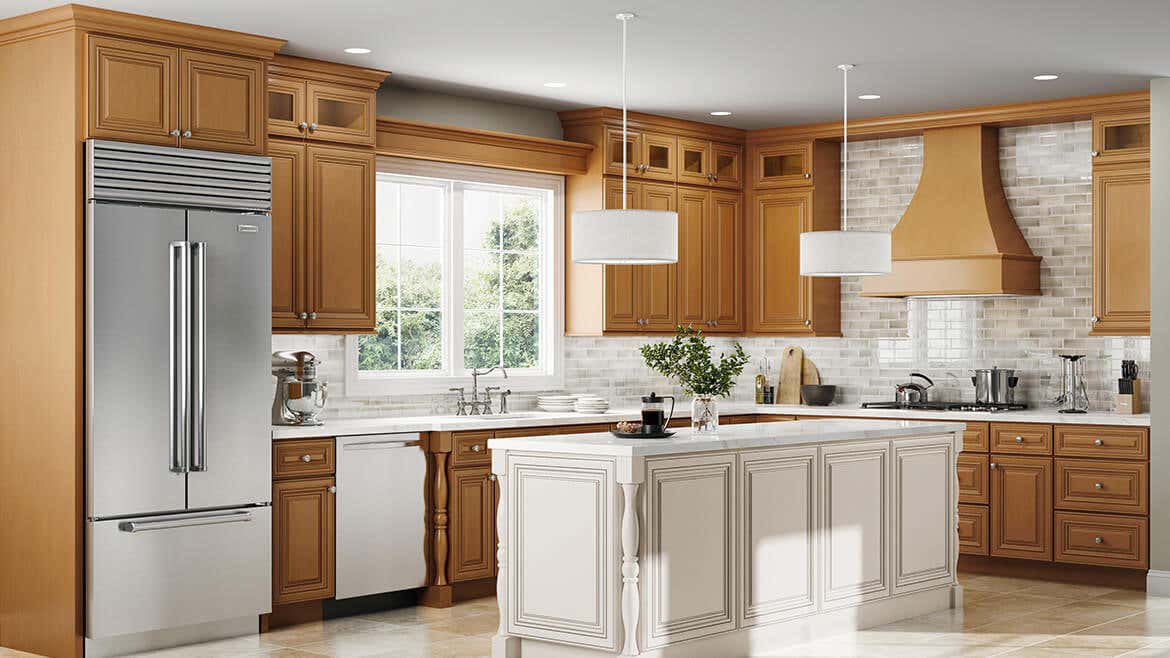
Most real walnut kitchens are not all walnut. The common — and financially sensible — approach is walnut on one element, usually the island, with painted or lighter cabinets around it.
The reasoning is both aesthetic and practical. A whole kitchen in a dark, richly-figured wood is a lot of visual weight, and in a room with average light it closes the space down. A white countertop is the simplest way to lighten it; here's how to pick a white for dark wood cabinets. Walnut used as an accent gives you the wood's character where it is seen most, at a fraction of the material cost.
Configurations that work:
- Walnut island, painted perimeter. The standard. Light or white perimeter cabinets keep the room bright; the island carries the wood.
- Walnut on the wall cabinets only, with painted bases. Less common, and effective in a room with plenty of natural light.
- Walnut open shelving or a single run, with everything else painted. The cheapest way to introduce it.
- Walnut worktop rather than cabinets. A walnut butcher-block island top gives the wood at its most tactile — accepting that it needs oiling and will mark.
- Full walnut, in a large, well-lit, open-plan kitchen where the budget is genuinely not the constraint.
The two-tone approach is a well-established design decision rather than a compromise — see the two-toned cabinet look. And in a modern rustic kitchen, walnut is close to the ideal material — clean forms, deeply textured natural surface.
Getting Close to Walnut for Less

If the appeal is the colour rather than the species, a dark-stained mid-tone hardwood gets visually close for considerably less. What you do not get is walnut's specific grain and its purple undertone — and in a slab door, the difference is subtle.
Being direct about what transfers and what does not:
| What you want from walnut | Does an alternative deliver it? |
|---|---|
| Deep dark brown colour | Yes — a dark stain on cherry, birch or maple reads similarly at room distance |
| Warm, non-black darkness | Yes — a warm mid-brown stain, not a cool espresso |
| Visible grain character | Partly — oak gives more grain, cherry and maple give less |
| Purple-grey undertone | No — this is specific to walnut |
| Pale sapwood streaking | No |
| Dark through the whole thickness | No — a stained wood is pale under the finish |
| Ages by lightening | No — stained woods generally hold or deepen |
The practical read: on a slab door, where there is a large uninterrupted face and the grain is the only visual event, walnut's character is most visible and hardest to substitute. On a shaker door, where the frame breaks the face up, a well-finished dark stain is much closer than most people expect.
Lily Ann's closest finishes in colour terms are in the dark cabinets, brown cabinets and stained wood collections — mocha, espresso, charleston cherry and saddle tones. None of them is walnut, and this article is not going to pretend otherwise. They are dark-stained hardwoods that occupy a similar visual space at a different price.
Living With Walnut
Walnut needs no special maintenance beyond what any wood cabinet needs — mild soap and water, no abrasives, no solvents. The two things worth planning for are UV exposure and the softness.
- Direct sunlight accelerates the lightening. If one run of cabinets gets strong afternoon sun and another does not, they will diverge. A UV-inhibiting finish slows this.
- Oiled versus lacquered. An oil finish shows walnut's depth best and is repairable in place — a scratch is oiled out rather than refinished. A lacquer or conversion varnish is tougher and harder to repair invisibly. Most factory cabinetry is the latter.
- Cutting boards and trivets, always. Softer wood, so a dropped pan leaves more of a mark.
- Refinishing is possible on solid walnut, less so on veneer. A veneered walnut panel is common and legitimate for wide surfaces — but it can be sanded roughly once.
Before You Buy
Five questions, and the first two are specific to walnut.
- Steamed or unsteamed? This decides how much sapwood contrast you get, and it is the biggest visual variable in walnut.
- Solid or veneer? Veneer on wide panels is normal and more stable; solid refinishes more times. Both are legitimate — you just need to know.
- What is the box made of? Plywood, ideally 1/2 inch. A walnut door on a particleboard box is a very expensive front on a cheap cabinet.
- How are the drawer boxes joined? Dovetailed solid wood.
- Is there a UV-inhibiting topcoat? Relevant given the lightening.
For the broader construction question the species does not answer, see what "solid wood" really means. For how walnut compares with the woods that are widely available in RTA cabinetry, see maple kitchen cabinets and oak kitchen cabinets.
A note on what this page is: Lily Ann Cabinets does not sell walnut cabinetry. This guide exists because the walnut question is a real one and deserves a straight answer, including where our own range does and does not fit. If the colour is what you are after, free door samples of the dark and stained finishes will tell you far more than a screen can — and if it is specifically walnut you want, a specialist supplier is the right answer.
















Comments