


For kitchen and bathroom cabinets, undermount slides are usually the better pick. They hide under the drawer, leave a little more width inside it and normally come with full extension and soft-close. Side-mount slides are easier to fit, cost less and come in heavy-duty versions, so they suit shop, garage and very heavy drawers. Most Lily Ann Cabinets lines list a full-extension, soft-close under-mount glide on their spec tables (checked October 6, 2026).
- Undermount: hidden under the drawer box, usually full extension and soft-close, and a little more room inside the drawer.
- Side-mount: fixed to the drawer sides, visible when open, easier to fit, usually cheaper, with many heavy-duty versions.
- Space: side-mount slides usually need 1/2" on each side. Undermount slides need about 5/16" per side plus about 1/2" under the drawer bottom.
- Ball-bearing vs. epoxy: ball-bearing slides roll on steel balls and can open fully. Epoxy roller slides are the budget kind and usually open 3/4 of the way.
- Soft-close is a feature, not a type: a damper slows the drawer at the end. It is common on undermount slides and found on some side-mount slides.
- Replacing slides: stay with the type your drawer was built for. Switching types usually means new drawer boxes.
- Lily Ann Cabinets: 27 of 31 kitchen lines list a "Full Extension, Soft Close Under-Mount" glide, including Colorado White Shaker and Craftsman White Shaker (spec tables read October 6, 2026).
Open a kitchen drawer and look at its sides. If you see a metal track, the drawer runs on side-mount slides. If the sides are clean wood and the drawer still glides out smoothly, the slides are hidden underneath. Those are undermount slides.
Both do the same job. They differ in looks, in the space they take up, in how much they hold and in how hard they are to fit. This guide compares the two, explains where ball-bearing, epoxy and soft-close fit in, and shows which drawer glide each Lily Ann Cabinets line lists on its spec table. We read those tables on October 6, 2026.
Undermount vs. Side-Mount Drawer Slides at a Glance
Undermount slides mount under the drawer box and are hidden when the drawer is open. Side-mount slides mount on the sides of the drawer box and show when it is open. Undermount slides usually come with full extension and soft-close, and they leave a little more width inside the drawer. Side-mount slides are easier to fit, usually cost less and come in many heavy-duty versions.
| Undermount | Side-mount | |
|---|---|---|
| Where it mounts | Under the drawer box, one runner on each side | On the outside of each drawer side |
| Seen when the drawer is open? | No | Yes |
| Space it needs | About 5/16" beside each drawer side, plus about 1/2" under the drawer bottom | Usually 1/2" on each side, so the drawer box is about 1" narrower than the opening |
| How far it opens | Usually full extension | 3/4, full or over-travel on ball-bearing slides; usually 3/4 on epoxy roller slides |
| Soft-close | Commonly built in | On some ball-bearing models. Epoxy slides are self-closing, not soft-close. |
| Load | Everyday kitchen loads; heavy-duty versions exist | Everyday kitchen loads; many heavy-duty versions |
| Fitting | The drawer must be built to the slide's exact sizes, with holes or notches at the back | Forgiving; fits most drawer boxes |
| Cost | Usually higher | Usually lower |
Sources: clearances and fitting from Nancy Hiller, 3 Kinds of Furniture Drawer Slides: Pros and Cons, Popular Woodworking. Extension, soft-close and load from Rockler's "Choosing the Right Drawer Slide" guide. Always check the spec sheet for the exact slide you buy.
What Is an Undermount Drawer Slide?
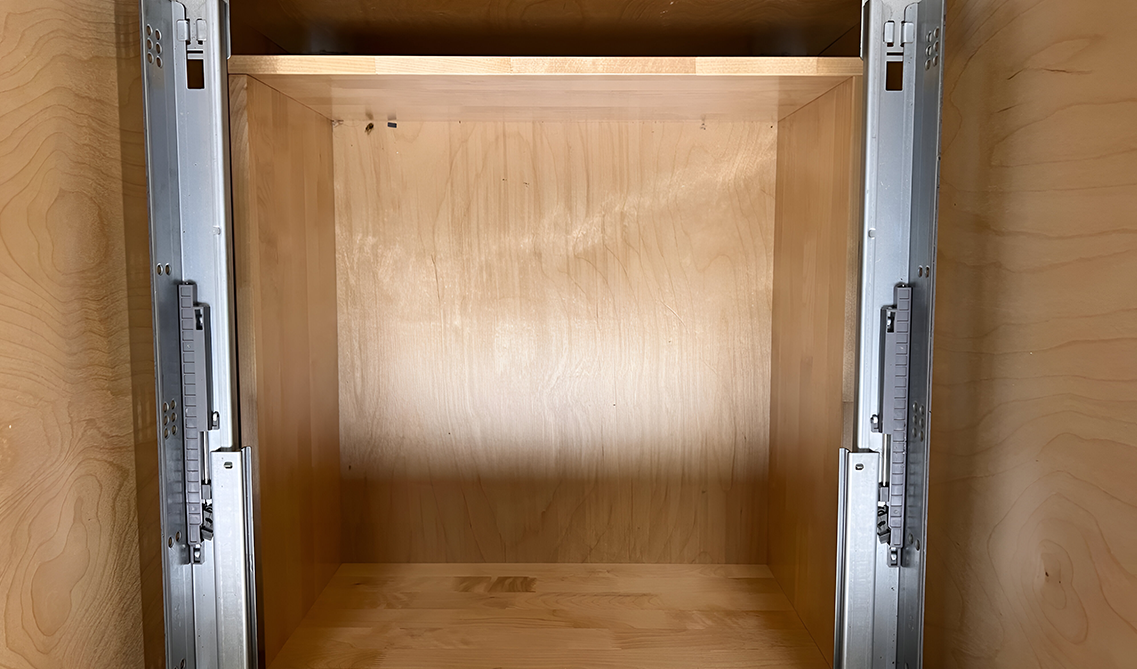
An undermount slide is a pair of metal runners fixed to the cabinet, below the drawer. The drawer box sits on top of the runners and clicks onto them with a small locking clip under its front. Because the hardware is underneath, the drawer sides stay clean. That shows off the wood and the corner joints. See our guide to dovetail drawers for what those joints tell you.
Lily Ann's own glossary puts the difference in one line: "While you can see a sidemount glide when the drawer is open, undermount glides are not visible."
What's good about undermount slides
- Hidden hardware. You see wood, not metal, when the drawer is open.
- A little more room inside. They need less space beside the drawer, so the drawer box can be wider.
- Full extension and soft-close are the norm. You can reach the back of the drawer, and it closes without a bang.
- Easy fine-tuning. With the right locking clips, the drawer front can be nudged up, down, sideways or tilted. That helps the gaps between drawer fronts line up.
What to watch for
- They cost more than a basic side-mount slide.
- You lose a little height inside the drawer, because the runners need space under the drawer bottom.
- The drawer has to be made for them. The slide sets the drawer's width, its length, how far the bottom is set up from the lower edge, and the holes at the back.
What Is a Side-Mount Drawer Slide?
A side-mount slide has two parts. One screws to the outside of the drawer side. The other screws to the inside wall of the cabinet. The two parts run along each other as the drawer moves. You see them on kitchen cabinets, desks, tool chests and shop cabinets.

What's good about side-mount slides
- Easy to fit. The main rule is drawer width: the box has to fit the space left between the two slides. The slide can sit almost anywhere up and down the drawer side.
- Lower cost, with a wide choice of lengths and features.
- Strong options. Heavy-duty versions are made for file drawers, tool drawers and big pull-outs.
What to watch for
- You can see them whenever the drawer is open.
- They use width. Most need 1/2 inch on each side, so the drawer box is about an inch narrower than the opening.
- They are not silent. Ball-bearing slides make a light metal-on-metal sound as they move.
Ball-Bearing vs. Epoxy (Roller) Slides
"Side-mount" tells you where a slide goes. "Ball-bearing" and "epoxy" tell you how it rolls. Side-mount slides come in both kinds.
| Ball-bearing slide | Epoxy (roller or "Euro") slide | |
|---|---|---|
| How it rolls | Rows of small steel balls between telescoping steel rails | A nylon wheel that rides in an epoxy-coated steel track |
| How far it opens | 3/4, full or over-travel | Usually 3/4 |
| Closing | A catch holds the drawer shut; some models add soft-close | Self-closing over the last bit of travel |
| Load | Higher, with heavy-duty versions | Lighter duty |
| Cost | More | The budget choice |
Ball bearings are not only for side-mount slides. Undermount slides use bearings too. So "ball-bearing vs. undermount" is not a real choice. Pick where the slide mounts first, then how it rolls.
Is Soft-Close a Type of Drawer Slide?
No. Soft-close is a feature, not a mounting type. A small damper inside the slide slows the drawer over the last inch or two and pulls it shut. You can find it on undermount slides and on some side-mount ball-bearing slides.
It helps to know three closing features apart:
- Self-close: the slide pulls the drawer shut at the end, but without slowing it.
- Soft-close: the slide catches the drawer, slows it and closes it quietly.
- Push-to-open: you press the drawer front and a spring pops it open, so the drawer needs no handle.
For what soft-close does for noise, wear and safety, read why soft-close hinges and drawer slides matter. Door hinges are a separate part with their own types; our cabinet hinge guide covers them.
Extension: How Far the Drawer Opens
- 3/4 extension: about a quarter of the drawer stays inside the cabinet. It is the most basic option.
- Full extension: the whole drawer box comes out, so you can see and reach the back.
- Over-travel: the drawer comes out about an inch past the cabinet front. It is handy under a countertop that overhangs.
Epoxy slides are usually 3/4 extension. Side-mount ball-bearing slides come in all three. Undermount slides are usually full extension. In a base cabinet, full extension matters most for deep drawers of pots and pans, where the things you need end up at the back.
How Much Space Does Each Type Need?
This is the part that decides whether a slide will fit a drawer you already have.
- Side-mount: usually 1/2 inch between the drawer box and the cabinet on each side. A drawer box for a 15-inch-wide opening is about 14 inches wide.
- Undermount: about 5/16 inch on each side for the slides Popular Woodworking describes, plus a 1/2-inch space under the drawer bottom for the runners. Lily Ann's glossary gives the same 1/2-inch figure. The drawer also needs holes or notches at the back, and its length has to match the slide.
That is why the two types don't swap freely. A drawer built for side-mount slides is too narrow for undermount slides, and its bottom usually sits too low. Fitting new slides? Our step-by-step guide on how to install drawer slides covers both types. Rockler's guide gives the simple rule: when you replace slides, stay with the type you have. If you want to change types, plan on new drawer boxes.
Replacing slides? Measure these three things first:
- The width of the cabinet opening and the width of the drawer box. The difference tells you which type the drawer was built for.
- The length of the drawer box, front to back. Slides are sold by length.
- The space under the drawer bottom, from the bottom panel down to the lower edge of the drawer side.
Which Drawer Slides Do Lily Ann Cabinets Use?
Lily Ann calls them drawer glides. Each cabinet line lists its glide in the Key Features table on the line page. We read 31 line pages on October 6, 2026. Here is what they list, word for word:
| Drawer glide, as listed | Cabinet lines | Stock on October 6, 2026 |
|---|---|---|
| Full Extension, Soft Close Under-Mount | Colorado White Shaker, Craftsman White Shaker, Craftsman Off-White Shaker, Craftsman Black Shaker, Craftsman Natural Shaker, Craftsman Lily Green Shaker, Grey Shaker Elite, Navy Blue Shaker, Shaker Off-White, Off-White Slim Shaker, Mocha Shaker, Mocha Slim Shaker, Key Largo White, York Linen, York Driftwood Grey | In stock. Some Navy Blue Shaker pieces were out of stock. |
| 3/4 Extension, Steel Epoxy Under-Mount | Summit Shaker White | The drawer base we checked was out of stock and marked Final Sale |
| Side-Mount Epoxy | Madison Chocolate, Madison Linen, Madison Toffee | The drawer bases we checked were out of stock and marked Final Sale |
Twelve more lines list the same full-extension, soft-close under-mount glide but were on clearance, marked Final Sale or partly out of stock that day: the Bristol, Charleston, Shaker Espresso, Shaker Cinnamon, White Shaker Elite, York Chocolate and York Saddle lines. Check stock on the line page before you plan a kitchen around one.
All 31 pages also list the drawer box as 5/8-inch solid wood with dovetail construction. For a closer look at one cabinet, the Colorado White Shaker 24-inch three-drawer base showed in stock that day, and the rest of the line's drawer bases are in its base cabinets section. Most of the lines above are shaker cabinets.

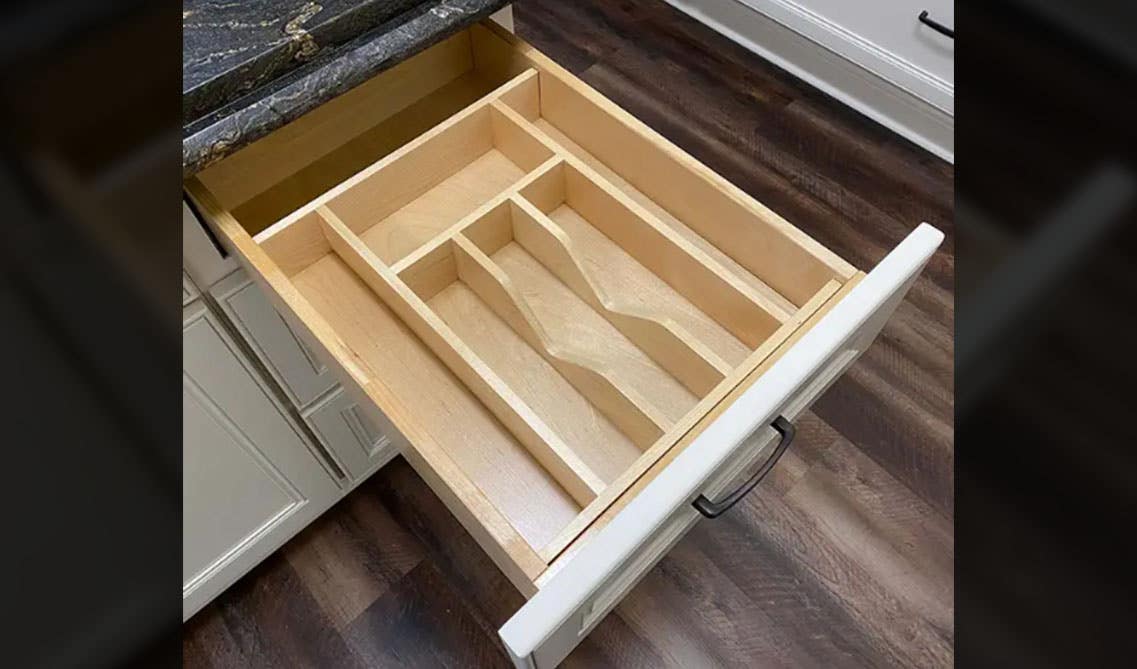
Some organizers bring their own slides. The 2 Tiered Cutlery Drawer, for example, is listed with BLUMOTION soft-close slides and is made to fit a 30-inch drawer base. You'll find more ideas in our list of kitchen drawer organizers.

Which Should You Choose?
- New kitchen or bathroom cabinets: undermount, full extension, soft-close. It is the cleanest look and the easiest to live with, and it is what most Lily Ann lines list.
- Replacing worn slides in drawers you are keeping: stay with the type the drawer was built for.
- Very heavy drawers, like tools, files or a big pantry pull-out: a heavy-duty side-mount ball-bearing slide.
- Garage, laundry or shop cabinets on a budget: a basic side-mount slide does the job.
- No handles: look for push-to-open slides.
When you compare cabinets, don't stop at the slide. Open a drawer, pull it all the way out and push it shut. Then look at the box. Our guide to 7 ways to tell true cabinet quality lists what else to check.
How to Tell Which Slides Your Drawers Have
- Open the drawer and look at the side. A metal rail on the drawer side means side-mount.
- If the side is clean, look underneath. Two runners under the edges, with a small plastic clip behind the drawer front, mean undermount. One rail down the middle means center-mount, an older style.
- Close it gently. If the drawer slows down and pulls itself shut, the slide is soft-close.
The Short Version
Undermount slides hide under the drawer, give you a bit more room inside and usually come with full extension and soft-close. Side-mount slides are simpler, cheaper and come in tougher versions for heavy loads. For kitchen and bathroom cabinets, undermount is the better everyday choice. Most Lily Ann lines list a full-extension, soft-close under-mount glide with a 5/8-inch dovetailed solid wood drawer box.
Planning a kitchen? Get a free 3D design, or order free door samples to see a finish in your own light.
Frequently Asked Questions
For kitchen and bathroom cabinets, undermount slides are usually better. They are hidden, they leave a little more width inside the drawer, and they normally come with full extension and soft-close. Side-mount slides are better when you need an easy fit, a lower cost or a heavy-duty rating, as in a shop or a garage. If you are replacing slides in drawers you already have, the better choice is the type the drawer was built for.
In a kitchen you use every day, yes. You get clean drawer sides, a drawer that opens all the way and a soft, quiet close. The costs are a higher price and a drawer that has to be built to the slide's sizes. On new cabinets that work is already done for you. Most Lily Ann Cabinets lines list a full-extension, soft-close under-mount glide as standard, so there is nothing to add.
No. They are different hardware and they attach in different places. A side-mount slide screws to the drawer side. An undermount slide carries the drawer from below and locks to a clip under the drawer front. Undermount slides also need a 1/2-inch space under the drawer bottom and holes at the back of the drawer. To switch types, you usually need new drawer boxes.
Most side-mount slides need 1/2 inch of space on each side, between the drawer box and the cabinet. That makes the drawer box about 1 inch narrower than the opening. The exact number is on the slide's spec sheet, so check it before you build or order a drawer. Too tight and the drawer binds. Too loose and the slide can pull apart.
On the outside of each drawer side, with the matching part on the inside wall of the cabinet at the same height. The two slides must be level and parallel to each other. The height on the drawer side is flexible, which is one reason these slides are easy to fit. In a cabinet with a face frame, the slide may need a spacer or a rear bracket so it sits flush with the frame opening.
It depends on the drawer. For everyday kitchen and bathroom drawers, full-extension, soft-close undermount slides are the best mix of looks and feel. For heavy tool, file or pantry drawers, heavy-duty side-mount ball-bearing slides are the stronger pick. For light drawers on a tight budget, epoxy roller slides are enough. Whatever the type, choose a load rating above what the drawer will hold.
By where they mount, the three types are side-mount, undermount and center-mount. Side-mount slides attach to the drawer sides. Undermount slides sit under the drawer, one on each side. A center-mount slide is a single rail under the middle of the drawer. It is an older style with a lower weight limit, and it is mostly sold today as a replacement part.
There isn't one. "Drawer glide," "drawer slide" and "drawer runner" are three names for the same part. Hardware stores mostly say slides. Lily Ann Cabinets' spec tables say "Drawer Glide," as in "Full Extension, Soft Close Under-Mount." Some people keep "runner" for the old wooden strips a drawer used to ride on.
Heavy-duty side-mount ball-bearing slides. Standard metal slides are typically rated for about 75 to 100 pounds, which covers normal kitchen drawers. Heavy-duty slides use thicker steel and more bearings to carry more, for things like large file drawers, tool drawers and pantry pull-outs. Check the load rating on the package, and remember that a full drawer of pots weighs more than you think.
"Bottom mount" usually means an epoxy roller slide that wraps under the lower edge of the drawer side. You can still see it from the side, and it often opens only 3/4 of the way. Some people also use the term for a single center rail under the drawer. An undermount slide is a hidden pair of runners under the drawer box, usually with full extension and soft-close. The two are not the same, and one does not replace the other.
















Comments