


They can be if you want a backsplash with no outlet covers: the plugs move to a strip under your wall cabinets. The catch is planning. Outlet type, location and GFCI protection are set by local electrical code, so a licensed electrician has to plan and install them. Decide at the same time where your under-cabinet lights and their power supply go, and whether light rail molding will hide the strip.
- Under cabinet outlets move plugs off the backsplash to the underside of your wall cabinets, usually as a long outlet strip.
- Code decides, not us. Outlet type, location and GFCI protection are set by local electrical code. A licensed electrician should plan and install them.
- Plan them with your lights. Lily Ann's linkable LED fixtures are 4 inches shorter than the cabinet they fit, from 5 inches (9-inch cabinet) to 35 inches (39-inch cabinet).
- The lights need power too. The 12W power supply covers 5 feet of under-cabinet lighting; the 75W with a junction box covers up to 18 feet. Both are pictured with a plug.
- Light rail molding hides what's underneath. It's 1 or 1-1/4 inches high on Lily Ann's listings, so check the strip and lights against that.
- An appliance garage is the other route to fewer cords on the counter. It usually has an outlet inside, which your electrician adds.
- Lily Ann doesn't sell outlet strips. Every light, cable and molding named here links to a live Lily Ann listing checked on September 14, 2026.
What Are Under Cabinet Outlets?
Under cabinet outlets are electrical outlets mounted on the underside of your wall cabinets instead of on the backsplash wall. They usually come as a long outlet strip, sometimes called a power strip, that runs along the bottom of the cabinet.
People add them for one main reason: a backsplash with no outlet covers breaking up the tile or stone. The plugs are still right above the countertop, just tucked under the cabinets.
There are two very different products that look alike:
- A permanent outlet strip is wired into your home's electrical system, like any other outlet. It is part of the house.
- A plug-in power strip has a cord that plugs into an outlet that is already there. It is a portable accessory, not new wiring.
One thing to know up front: Lily Ann Cabinets does not sell outlet strips or power strips. We sell the things that share the same few inches under your wall cabinets: under-cabinet LED lights and their power supplies, light rail molding that hides what is mounted there, and an appliance garage. This guide is about planning all of it together, so nothing has to be torn out later.
Code Comes First: What Your Electrician Decides
Where kitchen outlets can go, what type they must be, and whether they need GFCI (ground-fault) protection are all set by electrical code. Local rules can differ, so a licensed electrician who knows your local code should plan and install any new outlet, including an under-cabinet strip.
We are not going to quote code rules in this article. Rules change and are applied locally, and your electrician is the person who has to sign off on the work. What you can do is show up with the right questions:
- Can outlets go under my wall cabinets in my area, and do they count toward the countertop outlets my kitchen needs?
- Should the strip be hardwired, and does it need GFCI protection?
- Where will the wiring come out of the wall, and can it be reached later for repairs?
- Does this work need a permit?
- Where should the power supply for my under-cabinet lights plug in or connect?
Ask these before the backsplash goes on. Once tile is up and cabinets are hung, moving wiring means opening finished surfaces.
Plan Outlets and Under-Cabinet Lighting Together
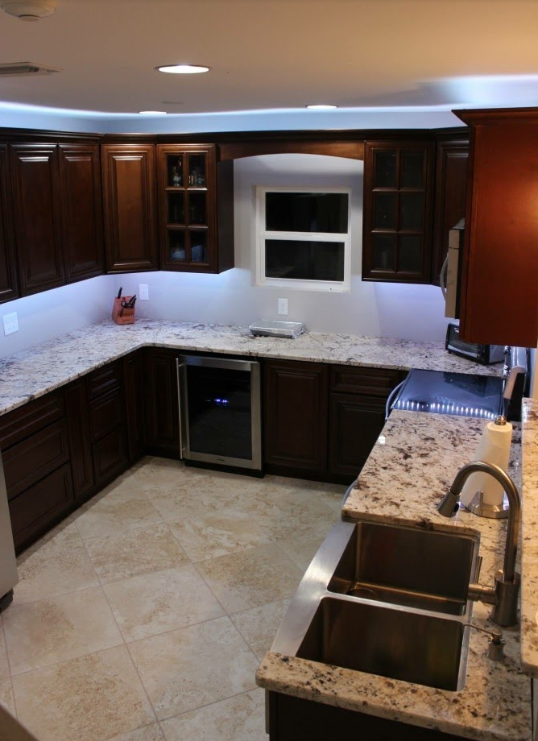
The underside of a wall cabinet is a small space. If you want both an outlet strip and lights there, decide on both at the same time, so the lights, the strip and the wiring each get their own spot.
Match Each Light to Its Cabinet Width
Lily Ann's linkable LED under-cabinet fixtures are each listed as fitting best under one cabinet width. In every size, the fixture is 4 inches shorter than the cabinet it is made for. That leaves room at the ends of each cabinet.
| Wall cabinet width | Fixture listed as fitting best |
|---|---|
| 9 in. | 5-inch linkable LED fixture |
| 12 in. | 8-inch linkable LED fixture |
| 15 in. | 11-inch linkable LED fixture |
| 18 in. | 14-inch linkable LED fixture |
| 21 in. | 17-inch linkable LED fixture |
| 24 in. | 20-inch linkable LED fixture |
| 27 in. | 23-inch linkable LED fixture |
| 30 in. | 26-inch linkable LED fixture |
| 33 in. | 29-inch linkable LED fixture |
| 36 in. | 32-inch linkable LED fixture |
| 39 in. | 35-inch linkable LED fixture |
Sizes and "fits best in" widths come from each product's name, checked on Lily Ann's product pages on September 14, 2026. The listings say the fixtures are for mounting underneath or on top of a cabinet.

Know Where the Power Supply Will Go
The fixtures run from a power supply. Lily Ann lists two:
- 12W Power Supply: for one light run. The listing says it is good for 5 feet of under-cabinet lighting, or 9 feet of inside-cabinet lighting.
- 75W Power Supply with Junction Box: has a 10-slot junction box for several light runs from one power supply, up to 18 feet of lighting.
Both power supplies are shown in their product photos with a plug on the cord. So the lighting needs power it can reach: an outlet, or a hookup your electrician sets up. Decide where the power supply will sit before the electrician plans the outlets, not after.

Cable length decides how far apart things can be. A 60-inch or 120-inch power cable extension runs from the power supply to the first light. 12-inch and 40-inch interconnect cables link one light to the next, for example across a gap over a range or window.
A quick example: a 36-inch cabinet and a 30-inch cabinet side by side take a 32-inch and a 26-inch fixture. That is 58 inches of lighting, just under the 5 feet (60 inches) the 12W power supply is listed for. A longer run, or lights on more than one wall, points to the 75W power supply with its junction box.
Not sure which kind of under-cabinet light you want? Our under cabinet lighting ideas compare strips, pucks, bars and more, and our guide on how to install under cabinet lighting walks through mounting and connecting them.
Hide the Strip and the Lights With Light Rail Molding
Light rail molding is a narrow strip of trim fastened along the bottom front edge of wall cabinets. Lily Ann's glossary describes it as designed to hide the fixtures of under-cabinet lighting. It can be added after the cabinets are installed, too, if you add lighting later.
Light rail molding comes in the same finish as the cabinet line it belongs to. Two shapes are on Lily Ann's product pages:
- Light rail molding: 8 feet (96 inches) long, 1-1/4 inches high and 1-1/2 inches deep, for example in Charleston Saddle and Charleston Cherry.
- Angle light rail molding: 96 inches long. The Grey Shaker Elite listing gives its size as 1 inch high and 1-1/2 inches deep. It is also listed in Colorado White Shaker, Craftsman Black Shaker and White Shaker Elite.

Planning tips:
- Compare heights. The molding is 1 or 1-1/4 inches high. Check the height of the light fixture and of the outlet strip your electrician plans to use. Anything taller than the molding will show below it.
- Leave room for plugs. Hiding the strip should not make it hard to plug in. Ask your electrician where the strip will sit, and follow the strip maker's instructions.
- Count your pieces. Each piece is 96 inches. Add up the width of the wall cabinets that need molding and divide by 96, then round up.
- Match the line. Order the light rail molding in the same cabinet line and finish as your wall cabinets.
Or Keep Small Appliances Plugged In Inside an Appliance Garage
If the goal is fewer cords on the counter, an appliance garage is another option. Lily Ann's glossary describes it as a countertop compartment that hides small appliances like coffee makers, and notes that you will usually find a dedicated electrical outlet inside.
That outlet is the part that needs planning. Like an under-cabinet strip, an outlet inside a cabinet is your electrician's decision under local code, and it has to be wired before the cabinet goes in.
Lily Ann lists one appliance garage on its product pages: the Hickory Shaker Appliance Garage, 24 inches wide by 18 inches high, without a shelf. Measure the appliances you want to keep in it, including any lid that opens upward, and compare them with that size before you order.
Backsplash Outlets vs Under Cabinet Strip vs Appliance Garage
| Question | Outlets on the backsplash | Under cabinet outlet strip | Appliance garage |
|---|---|---|---|
| Where you plug in | On the wall above the counter | Under the wall cabinets | Inside the cabinet |
| What shows on the backsplash | Outlet covers | No outlet covers | The garage itself |
| Hidden by light rail molding | No | Depends on the strip's height | Not needed |
| Who plans the power | Licensed electrician | Licensed electrician | Licensed electrician |
| What Lily Ann sells for it | Nothing (the outlets come from your electrician) | LED lights, power supplies, light rail molding | Hickory Shaker Appliance Garage 24 x 18 in. |
Planning Checklist Before Your Cabinets Arrive
- List what plugs in on the counter, and where: coffee maker, toaster, phone chargers, mixer.
- Pick your under-cabinet lights by wall cabinet width, using the table above.
- Choose a power supply and decide where it will sit. Check that your power cable extension and interconnect cables reach.
- Meet with a licensed electrician before the backsplash goes on. Bring the questions from the code section and your lighting plan.
- Measure the strip and the lights against the 1- or 1-1/4-inch light rail molding if you want them hidden.
- Order light rail molding in your cabinet line, in 96-inch pieces.
- Measure your appliances if you are adding an appliance garage, and plan its outlet with the electrician.
Lily Ann's free 3D kitchen design service can help you lay out the cabinets before you decide where the lights and power go.
Shop Cabinet Lighting and Trim at Lily Ann Cabinets
Browse all cabinet lighting, including the linkable LED fixtures, power supplies and cables above. To hide them, add light rail molding in your cabinet line. For more on choosing a light, see what makes the best under-cabinet lighting.








Comments