


Six wood joints do most of the work in a kitchen cabinet: butt, miter, rabbet, dado, pocket hole, and mortise and tenon, plus the dovetail on drawers. Dados and rabbets hold the cabinet box together. Pocket holes or mortise-and-tenon joints build the face frame and door frames. Dovetails join the drawer corners. A plain butt joint is the simplest and weakest of the group.
- Butt joint: two square ends pushed together. Simplest and weakest; it always needs screws, dowels or nails.
- Miter joint: two 45-degree cuts that hide the end grain. Used on crown molding corners and some door frames.
- Rabbet: an L-shaped step on an edge. It holds the cabinet back panel and the glass in a glass door.
- Dado: a U-shaped slot across the grain. It holds fixed shelves, cabinet bottoms and dividers. Cut along the grain, it's called a groove.
- Pocket hole: a screw through an angled hole, usually about 15 degrees. The usual face frame joint today.
- Mortise and tenon: a tab in a slot. The traditional joint for face frames and door frames, and one of the strongest.
- Lily Ann Cabinets: every line's Key Features table we read on October 6, 2026 lists 5/8" dovetailed solid wood drawers. Five lines list Sliding Dovetail assembly; Key Largo White and Summit Shaker White list Metal Clip.
Open a cabinet door and you're looking at a box made of flat panels. What keeps those panels together for twenty years of slammed doors and heavy plates is the joints: the places where one piece of wood meets another.
Most lists of wood joints are written for people who build furniture. This one is for people buying or assembling cabinets. It covers the six joints you'll run into most (butt, miter, rabbet, dado, pocket hole, and mortise and tenon), shows where each one sits in a cabinet box, face frame, door or drawer, and ends with what Lily Ann Cabinets' own spec tables say about joints, checked on October 6, 2026.
Wood Joints in a Cabinet at a Glance
Six wood joints do most of the work in a kitchen cabinet. Rabbets and dados hold the box together. Pocket holes or mortise-and-tenon joints build the face frame and the door frame. Miters turn the corners on trim. Butt joints show up wherever two parts simply meet. The seventh, the dovetail, joins the drawer corners.
| Joint | What it is | Where you'll find it in a cabinet |
|---|---|---|
| Butt | Two square-cut pieces pushed together | Face frame parts before they're screwed, back panels nailed on flat, fillers |
| Miter | Two ends cut at an angle, usually 45 degrees | Crown molding and light rail corners, some door frames |
| Rabbet | An L-shaped step cut along an edge | The recess that holds the back panel, glass door frames, some drawer boxes |
| Dado | A U-shaped slot cut across the grain | Fixed shelves, cabinet bottoms and dividers set into the sides |
| Pocket hole | An angled hole with a screw driven through it | Face frames, and the frame-to-box joint |
| Mortise and tenon | A tab on one piece fits a slot in the other | Face frames and door frames in traditional work |
| Dovetail | Wedge-shaped fingers that lock together | Drawer box corners, and the panel joints on some ready-to-assemble cabinets |
Table built from Family Handyman's joint guides, Bob Vila's "7 Best Types of Wood Joints to Know" and Wikipedia's joinery entries, all read October 6, 2026. The "where you'll find it" column is our summary of those sources.
Where Joints Sit in a Cabinet: Box, Face Frame, Door and Drawer
A cabinet has four parts that need joints, and each part asks for something different.
- The box. Two sides, a top or stretchers, a bottom and a back. These are wide plywood panels, so the joints are long slots and steps: dados and rabbets. Our guide to plywood grades for cabinets covers the panels themselves.
- The face frame. A flat frame of narrow boards on the front of the box. The upright pieces are called stiles and the cross pieces are called rails. The joints are small and sit where a rail meets a stile. See framed vs. frameless cabinets if you're not sure which kind you have.
- The door. A shaker or raised-panel door is another frame, with a panel held in the middle. It also has rails and stiles.
- The drawer. A small open-top box that gets pulled and pushed all day. Its four corners take the most stress of any joint in the kitchen.
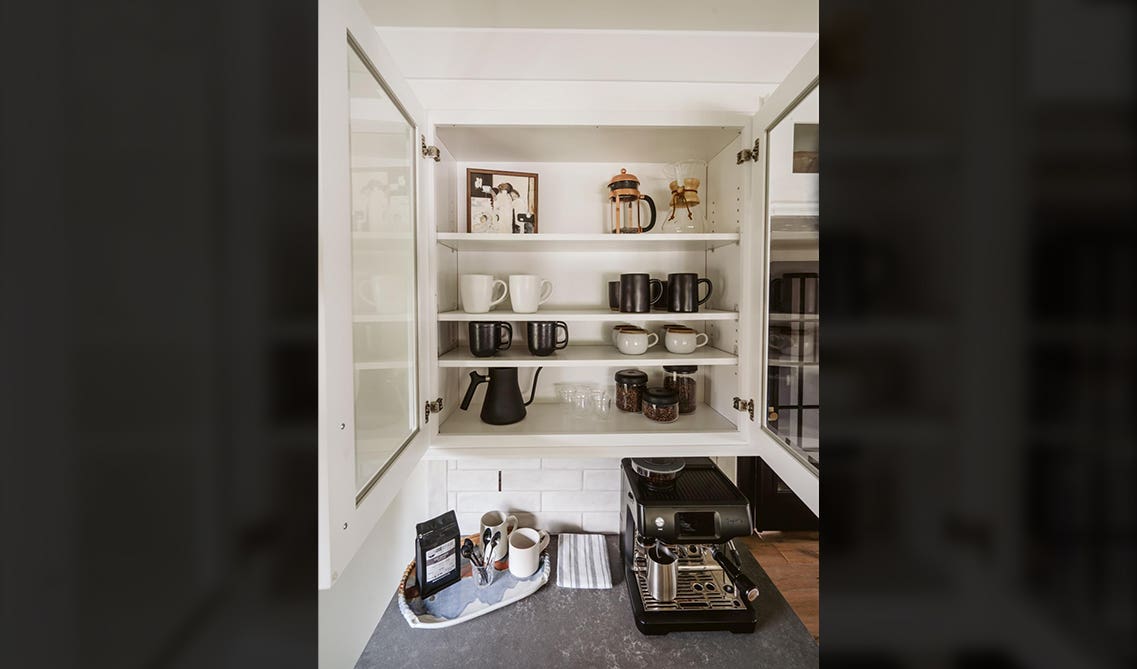
1. Butt Joint
A butt joint is two pieces of wood cut square and pushed together, end to face or end to edge. It's the simplest wood joint and, with nothing added, the weakest. It always needs help from screws, nails, dowels or brackets.
The weak point is the glue. One of the two surfaces is end grain, the cut end of the board, and end grain soaks up glue like a sponge. Family Handyman's joint guide says plainly that glue alone isn't enough for a butt joint.
Where it shows up in a cabinet:
- Face frame rails butted against stiles, then held with pocket screws (see joint 5).
- A thin back panel nailed flat onto the back of the box instead of being set into a recess.
- Fillers and end panels fastened against a cabinet side.
- On lower-cost cabinets, box panels that simply meet at the corner and are held with staples, screws or brackets.
A butt joint isn't a bad sign by itself. What matters is what reinforces it.
2. Miter Joint
A miter joint is two pieces cut at matching angles, usually 45 degrees each, so they meet in a clean 90-degree corner. It hides the end grain, which is why it's used where looks matter most. It isn't a strong joint without reinforcement.
Bob Vila's guide gives picture frames and door casing as the classic examples. Family Handyman notes that, because both faces are end grain, glue usually isn't enough, and that a small error in the saw angle shows as a gap.
Where it shows up in a cabinet:
- Corners of cabinet crown molding, light rail and other trim where a run turns.
- Mitered door frames, where the frame corners meet on a diagonal instead of a straight line.
- Decorative end panels and island wraps where two finished faces meet at an outside corner.
3. Rabbet Joint
A rabbet is an L-shaped step cut along the edge or end of a board. A second piece sits in the step. Seen from the side it looks like a capital L. In British English it's called a rebate.
Family Handyman explains why it beats a butt joint: the step gives more surface for glue, and its one wall stops the second piece from leaning that way. The same guide says that if you look inside a kitchen or bathroom cabinet you'll probably see rabbets. They still usually need fasteners as well as glue.
Where it shows up in a cabinet:
- The back panel. A rabbet along the back edges of the sides makes a recess, so the thin back panel sits flush and out of sight.
- Glass doors. The inner lip that holds a pane of glass in a frame is a rabbet.
- Some drawer boxes. The front and back sit in rabbets cut in the sides. It's a step up from a butt joint and a step below a dovetail.
4. Dado Joint (and the Groove)
A dado is a U-shaped slot cut across the grain of a board, with a flat bottom and two walls. The end of another board fits into it. The same slot cut along the grain is called a groove. In the UK a dado is called a housing.
The dado is the joint cabinet boxes are built around. Because the slot has two walls, the piece sitting in it is supported from above and below. Family Handyman says a tight dado can sometimes hold with glue alone. It also notes the limit: a dado isn't as strong as a mortise and tenon, and enough twisting force on the far end of the board can work it loose. Their full explainer is The Basics of Dado Joints.
Where it shows up in a cabinet:
- Fixed shelves and cabinet bottoms. The panel slides into dados in both sides, so the weight rests on wood, not just on screws.
- Dividers. Upright partitions inside a wide cabinet or a drawer.
- Drawer bottoms. The bottom panel slides into a groove near the lower edge of the four sides.
- Door panels. The center panel of a shaker door sits in a groove around the inside of the frame.
Adjustable shelves are different. They rest on small pins set into rows of holes, with no joint at all.
Dado vs. rabbet
A dado sits in from the edge and has two walls (a U). A rabbet sits on the edge and has one wall (an L). Builders often combine them: a narrow dado in one panel and a rabbet on the end of the other, so a tongue fits the slot.
Through dado vs. stopped dado
A through dado runs the full width of the board, so you can see the slot at the front edge. A stopped dado ends short of the front, which hides the joint. On a framed cabinet the face frame covers the front edge either way.
One more thing: a "dado rail" is not a joint. It's a strip of wall molding, also called a chair rail.
5. Pocket Hole Joint
A pocket hole joint is a butt joint held by a screw driven through an angled hole, usually about 15 degrees. The hole is drilled into the back of one piece with a jig, and a self-tapping screw pulls the two pieces tight.
It's fast, it needs few clamps, and it's the usual way a face frame goes together today. Family Handyman's face frame tips put it this way: a mortise and tenon might feel more like craftsmanship, but only the builder will know the extra time was spent.
Where it shows up in a cabinet:
- Face frames. The holes are drilled in the back of each rail, so nothing shows from the front.
- Box panels. Some builders screw plywood sides to the bottom with pocket holes every 8 to 12 inches along the edge, plus glue.
- Not doors. Pocket holes show even when they're plugged, so they're a poor fit for a door, where both faces are seen.
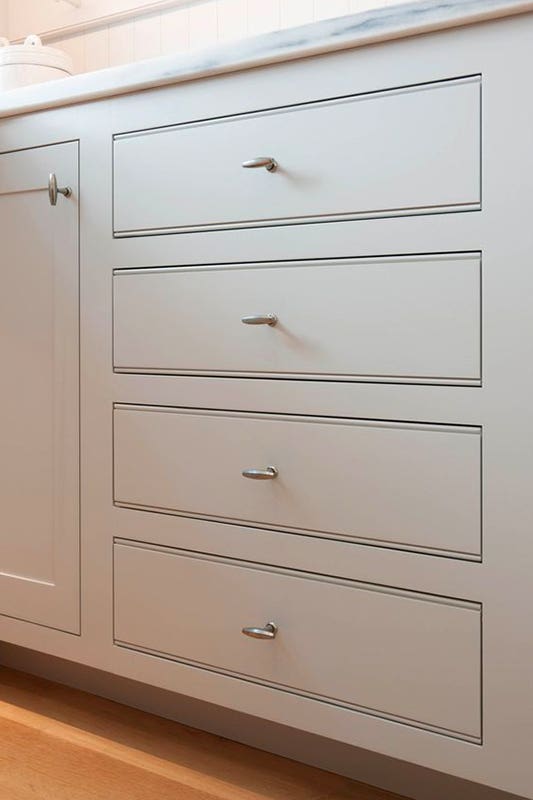
The photo above shows a face frame clearly: it's the flat border you can see around and between the drawers. On full overlay cabinets the doors and drawer fronts cover most of it.
6. Mortise and Tenon Joint
A mortise and tenon is a tab on the end of one piece (the tenon) that fits into a matching slot in another (the mortise). The shoulders around the tab press against the face of the second piece and stop the joint from racking. It's one of the oldest and strongest wood joints.
Family Handyman calls it extremely strong, with or without glue or pins, and notes it isn't suited to very thin stock. Most cabinet versions are "blind" or "stub" tenons: the slot doesn't go all the way through, so the end of the tab is hidden.
Where it shows up in a cabinet:
- Face frames on traditional and custom cabinets, in place of pocket screws.
- Door frames. A five-piece door is two stiles, two rails and a center panel. The rails can join the stiles with a mortise and tenon. On most factory doors today the joint is a "cope and stick": a short profiled tongue on the end of each rail fits the groove that runs along the stile. It's quicker to machine, and it's strong enough for a normal cabinet door.
Either way, the center panel isn't glued. It floats in its groove so it can swell and shrink with the seasons without cracking the frame. That floating panel is the reason frame-and-panel doors exist. Our guide to cabinet door styles shows what the different frames look like from the front.
Dovetail: The Drawer Joint
The dovetail is the joint most cabinet buyers already know by name. Wedge-shaped fingers on one board lock into matching sockets on the other, so the corner can't pull apart in the direction a drawer gets pulled.
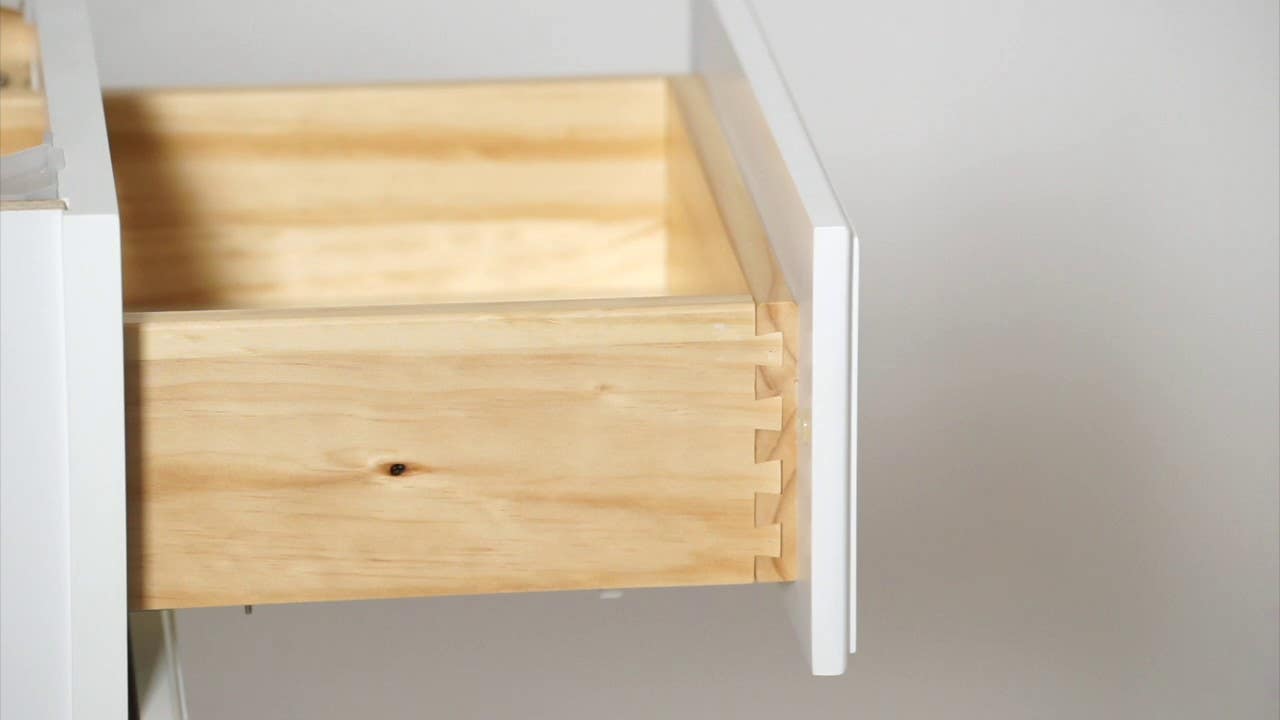
We have a full guide to it, so we won't repeat it here: see dovetail drawers: what they are and how to check one. It covers the through, half-blind and sliding types, dovetail vs. box joint, and how to inspect a drawer in a showroom.
One version matters for ready-to-assemble cabinets. A sliding dovetail is a dovetail-shaped tongue along one panel that slides into a matching slot in the next. It joins whole cabinet panels, not just drawer corners. Our article on dovetail assembly in RTA cabinets explains why that matters.
Which Wood Joint Is Strongest?
There's no single strongest wood joint, because each one resists a different kind of force. For frames, the mortise and tenon is the benchmark. For drawer corners, it's the dovetail. For shelves and box panels, a snug dado does the job. A bare butt joint is the weakest of the group.
Here is how Family Handyman's guides compare them, joint by joint:
| Joint | How it compares |
|---|---|
| Butt | Weak by itself. Needs dowels, screws or other reinforcement. |
| Miter | A little stronger than a butt joint and better looking. Still needs reinforcement. |
| Rabbet | Stronger than a butt joint: more glue surface, plus a wall to lean on. Usually needs fasteners too. |
| Dado | Stronger than a rabbet. A tight one can hold with glue alone. Not as strong as a mortise and tenon. |
| Pocket hole | Makes strong, tight joints quickly. The limit is looks, not strength: the holes show. |
| Mortise and tenon | Extremely strong, glued or not. |
| Dovetail | Strong, and shaped to resist being pulled apart. |
Source: Family Handyman, "13 Types of Wood Joints and Their Uses Explained," "Wood Joinery Basics," "The Basics of Dado Joints," "Rabbet Joint Guide," "Learn How to Use Pocket Screws" and "What Are Mortise-and-Tenon Joints Used For?" (read October 6, 2026). Wording is ours. No strength numbers are given because those sources give none.
For the full list beyond cabinets, including biscuit, bridle, half-lap and tongue-and-groove joints, Family Handyman's 13 Types of Wood Joints is a good next read.
Which Joints Do Lily Ann Cabinets Use?
We'll only say what Lily Ann's own spec tables say. Each kitchen line page has a Key Features table. On October 6, 2026 we read that table on seven lines. Two rows name a joint: "Drawer Construction" and "Assembly Method."
| Cabinet line | Drawer Construction | Assembly Method |
|---|---|---|
| Colorado White Shaker | 5/8" Dovetailed Solid Wood | Sliding Dovetail |
| Grey Shaker Elite | 5/8" Dovetailed Solid Wood | Sliding Dovetail |
| Craftsman White Shaker | 5/8" Dovetailed Solid Wood | Sliding Dovetail |
| Craftsman Natural Shaker | 5/8" Dovetailed Solid Wood | Sliding Dovetail |
| York Driftwood Grey | 5/8" Dovetailed Solid Wood | Sliding Dovetail |
| Key Largo White | 5/8" Dovetailed, Solid Wood | Metal Clip |
| Summit Shaker White | 5/8" Dovetailed Solid Wood | Metal Clip |
Copied from each line's Key Features table on lilyanncabinets.com, October 6, 2026. All seven also list "Box Construction: 1/2" Solid Plywood (Birch)."
What that tells you:
- Drawers: all seven lines list dovetailed solid wood drawer boxes, 5/8 inch thick.
- Cabinet box: five lines list a Sliding Dovetail assembly. Key Largo White and Summit Shaker White list Metal Clip, which is a metal connector, not a wood joint.
- Doors and drawer fronts: the tables call them "5-Piece," which means a frame-and-panel build. They don't name the joint that holds the frame together.
The tables also don't say whether box panels sit in dados or rabbets, or how the face frame is joined. We haven't guessed. If you want to see a joint before you order, order a sample door, or watch the dovetail assembly video to see how the panels slide together. Lily Ann Cabinet Assembly 101 walks through the steps.
Most of the lines above are shaker cabinets. You can see every ready-to-assemble line at RTA kitchen cabinets.
How to Check the Joints Before You Buy Cabinets
You don't need to know how to cut a joint to judge one. Four quick checks, in a showroom or on a spec sheet:

- Pull a drawer all the way out and look at the corner. Interlocking fingers mean a dovetail. A flat seam with staples means a butt or rabbet joint.
- Look at the back of the box. A back panel set into a recess is better supported than one stapled flat on the surface.
- Look inside the corners. Plastic brackets and cam locks do the work a wood joint would otherwise do. They're common on flat-pack cabinets.
- Read the spec table. Look for the rows that name a joint: drawer construction, assembly method and box construction. If a row is missing, ask.
Joints are one of several things to check. Our guide to 7 ways to tell true cabinet quality covers the rest, from hinges to finish.
The Takeaway
Cabinet joints come down to matching the joint to the job. Dados and rabbets hold the box. Pocket holes or mortise-and-tenon joints build the frames. Miters dress the trim. Dovetails take the abuse at the drawer corners. A butt joint is fine where it's reinforced and a warning sign where it isn't.
When you compare cabinets, look for the joints named in the spec table, then pull a drawer and check. Planning a kitchen? Get a free 3D design and see your layout before you order.
Frequently Asked Questions
Ten common wood joints are the butt, miter, rabbet, dado, tongue and groove, half-lap, pocket hole, mortise and tenon, box (finger) joint and dovetail. Lists differ a little: some add the biscuit, dowel, bridle or scarf joint. In a kitchen cabinet you'll mostly meet six of them, plus the dovetail on the drawers.
The butt joint is the simplest wood joint. Two pieces are cut square and pushed together, with no shaping at all. It's also the weakest unless it's reinforced, because one face is end grain, which soaks up glue. That's why butt joints are almost always backed up with screws, nails, dowels or biscuits.
There isn't one winner, because joints are built to resist different forces. The mortise and tenon is the usual benchmark for frames, and the dovetail for corners that get pulled, like drawers. Family Handyman describes the mortise and tenon as extremely strong and the dovetail as strong and resistant to being pulled apart. A plain butt joint is the weakest.
Cabinet joints depend on the part. Cabinet boxes use dados and rabbets to hold the sides, bottom and back. Face frames use pocket screws or mortise-and-tenon joints. Frame-and-panel doors use a cope-and-stick or mortise-and-tenon frame around a floating panel. Drawer boxes use dovetails on better cabinets and rabbet or butt joints on cheaper ones. Ready-to-assemble cabinets may also use sliding dovetails, metal clips or cam locks to join the panels.
A dado is a slot cut in from the edge of a board, with a bottom and two walls, so it looks like a U from the side. A rabbet is cut on the edge or end, with a bottom and only one wall, so it looks like an L. In a cabinet, dados hold shelves and bottoms, and a rabbet holds the back panel. The two are often combined in a rabbet-and-dado joint.
A dado joins the end of one board to the face of another at a right angle and supports it along its whole width. Because the slot has two walls, a shelf or cabinet bottom sitting in it rests on wood instead of hanging from screws. It also lines the parts up during assembly, which is why cabinet and bookcase builders rely on it.
Yes. A router with a straight bit, guided by a straightedge or a jig clamped to the panel, is one of the two most common ways to cut a dado. The other is a table saw fitted with a dado blade set. For a wide dado, Family Handyman suggests two straightedges so the walls stay parallel. This matters if you build cabinets yourself; factory cabinets arrive with every joint already cut.
Both are strong corner joints, and Family Handyman says they can do the same structural job. The difference is shape. A box joint has straight fingers and depends on glue. A dovetail has wedge-shaped fingers that lock mechanically in one direction, so the corner resists being pulled apart. That is why the dovetail is the usual choice for drawer fronts.
In the US and Canada it's pronounced DAY-doh. The word names the slot itself: a three-sided channel cut across the grain. In the UK the same joint is called a housing, and in parts of Europe a trench. Don't confuse it with a dado rail, which is a strip of wall molding also known as a chair rail.
















Comments