


The main types of bathroom sinks are undermount, drop-in, vessel, integrated, pedestal and wall-mount. The first four sit in or on a vanity top, and each needs a different one. An undermount sink needs a solid, waterproof top such as quartz or stone. A drop-in works with any top, including laminate. A vessel sink needs a top with only a small drain hole. An integrated sink is molded as part of the top. Pedestal and wall-mount sinks need no vanity top at all.
- Six main types: undermount, drop-in, vessel, integrated, pedestal and wall-mount. The type is how the sink mounts, not its material.
- Undermount: attached under the counter. Needs a solid, waterproof top like quartz, granite or solid surface. Not a match for laminate.
- Drop-in: rests on its rim. Works with any top and is the easiest to install or swap.
- Vessel: sits on the counter. Needs a top with only a drain hole and a tall or wall-mount faucet. Adds height.
- Integrated: the sink and the top are one piece, with no seam. You can't replace one without the other.
- Pedestal and wall-mount: no top and no cabinet. They save floor space but give up storage.
- Lily Ann Cabinets sells the cabinet under the sink: bathroom vanities with sink bases 21 inches deep and 34-1/2 inches tall. It lists no separate bathroom sinks, and its quartz vanity tops with undermount sinks showed out of stock on October 7, 2026.
Most people pick a bathroom sink by how it looks. Then the countertop shop asks a question they didn't expect: what kind of sink is it? The answer changes the hole that gets cut, the faucet that fits, and sometimes whether you need a vanity top at all.
This guide covers the six main types of bathroom sinks, the vanity top each one needs, and what each means for the vanity cabinet underneath. Kitchen sinks are a different topic, so see our guide to the types of kitchen sinks for those. Lily Ann sizes and stock below were checked on the live site on October 7, 2026.
What Are the Main Types of Bathroom Sinks?
The main types of bathroom sinks are undermount, drop-in, vessel, integrated, pedestal and wall-mount. The first four sit in or on a vanity top. Pedestal and wall-mount sinks stand alone and need no vanity. The type is about how the sink is mounted, not what it's made of, and the mount decides which vanity top will work.
Family Handyman, This Old House and Consumer Reports all sort bathroom sinks this way, by mount. Shapes like corner and trough sinks, and materials like porcelain or glass, come in more than one mount type. We cover those further down.
Bathroom Sink Types and the Vanity Top Each Needs
| Sink type | How it mounts | Vanity top it needs | Faucet | Cabinet below |
|---|---|---|---|---|
| Undermount | Attached under the counter | A solid, waterproof top (quartz, granite, marble, solid surface) with a finished cutout | Mounts in holes drilled in the top | Vanity sink base |
| Drop-in | Dropped in from above; the rim rests on the counter | Any material, including laminate | Often mounts in holes in the sink itself | Vanity sink base |
| Vessel | Sits on top of the counter | Any solid top with only a small drain hole | Tall vessel faucet or wall-mount faucet | Vanity sink base; check the finished height |
| Integrated | Sink and top are one piece | It is the top | Mounts in holes that come in the top | Vanity sink base that matches the top's size |
| Pedestal | Basin on a column, fixed to the wall | None | Mounts in the sink | None |
| Wall-mount | Hung on the wall | None | Mounts in the sink or on the wall | None |
Mount details in this table come from Family Handyman's guide to bathroom sink types, This Old House and the Consumer Reports sink buying guide. The cabinet column is ours.
1. Undermount Sinks
An undermount sink is attached to the underside of the countertop. You see the counter's cut edge and then the bowl, with no rim on top. Family Handyman explains that it's held up with silicone adhesive and brackets.

The vanity top it needs: a solid, waterproof one. The edge of the cutout is on show and gets wet, so it has to be a material that can be polished and that water won't hurt. That means quartz, granite, marble or solid surface. Consumer Reports says undermount sinks should be used with a waterproof countertop. Family Handyman points people with laminate counters toward a drop-in sink.
Good to know:
- You can wipe water and toothpaste straight from the counter into the bowl.
- The faucet holes are drilled in the vanity top, so the top and the faucet have to match. Our bathroom faucet types guide covers hole counts and spreads.
- Consumer Reports notes the bowl sits up to 1-1/2 inches lower than a top-mounted one.
- It's harder to install than a drop-in, and it usually costs more to buy and fit.
2. Drop-In Sinks
A drop-in sink (also called top-mount or self-rimming) is lowered into a hole in the counter. Its rim rests on the countertop and covers the cut edge. Clips hold it from below and a bead of caulk seals the rim.
The vanity top it needs: almost any. Because the rim hides the cutout, the edge doesn't have to be finished or waterproof. Consumer Reports says top-mount sinks work with any countertop material and are fairly simple to install, which makes them a good fit for a tight budget.
Good to know:
- It's the easiest type to swap. A new drop-in can go into the old hole if the size matches.
- The rim is a spot where grime builds up, and you can't sweep water over it into the bowl.
- Many drop-in sinks have the faucet holes in the sink itself. Count them before you buy a faucet.
3. Vessel Sinks
A vessel sink is a bowl that sits on top of the counter. It's made to be seen. Family Handyman calls it a throwback to the days of a pitcher and a wash bowl.
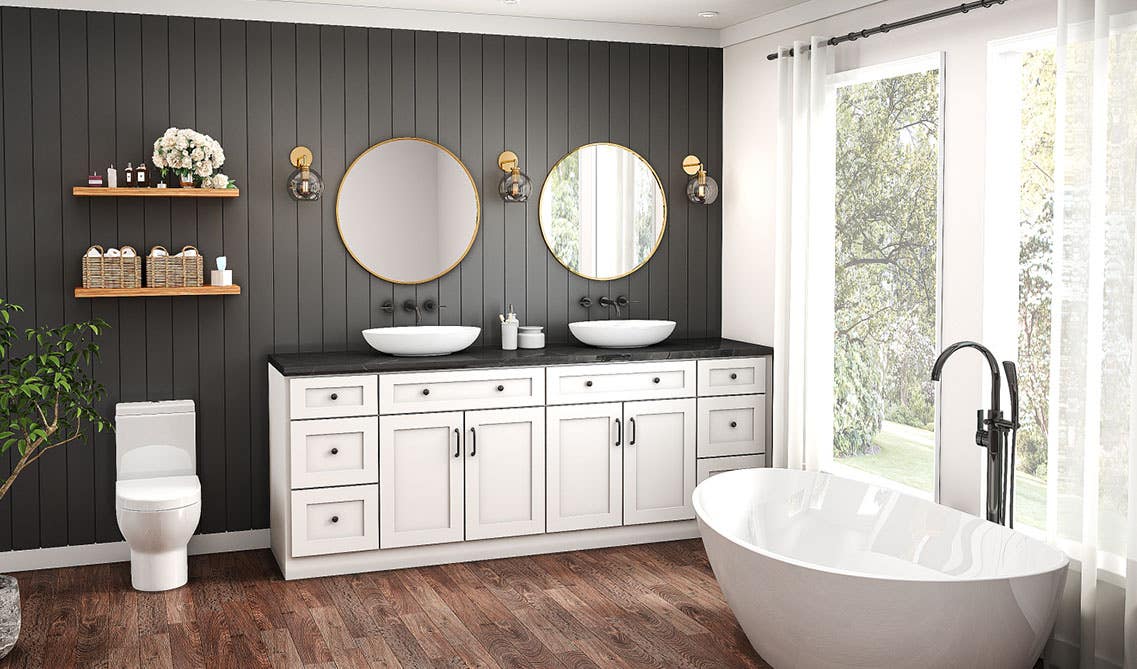
The vanity top it needs: a solid top with just a small hole for the drain. This is the catch if you're remodeling: Family Handyman notes a vessel can't easily go onto a counter that already has a big hole cut for a drop-in or undermount sink.
Good to know:
- It needs a tall vessel faucet or a wall-mount faucet. Consumer Reports says to make sure the spout reaches well over the bowl.
- The rim sits several inches above the counter. Family Handyman points out the raised height can affect accessibility, and This Old House says it can be less practical for children. See our bathroom vanity height guide before you pick the cabinet.
- The base of the bowl is one more place to clean around.
4. Integrated Sinks (a Vanity Top With the Sink Built In)
An integrated sink is molded as part of the countertop. The top and the bowl are one piece, with no seam between them. Family Handyman says cultured marble is the most common material for these. Consumer Reports describes solid-surface versions, where a fabricator joins a sink and counter of the same material.
The vanity top it needs: none. It is the top. You buy it by the size of your vanity cabinet, and it comes with the faucet holes already in it.
Good to know:
- There's no rim and no joint to catch dirt, so it's the easiest type to wipe down.
- This Old House notes the trade-offs: fewer sink shapes to choose from, and a heavy piece to lift into place.
- The sink and top can't be swapped separately. If one is damaged, both go.
- In Consumer Reports' tests, solid surfacing resisted stains but was marked by heat, including a hot curling iron.
You'll also see the words "vanity top with sink" used for a stone or quartz top that comes with an undermount bowl already attached. It's sold as one piece like an integrated top, but the bowl is a separate part glued and clipped underneath.
5. Pedestal Sinks
A pedestal sink is a basin on a column. Family Handyman describes it as a wall-mounted sink with a decorative stand that adds support and hides the pipes.
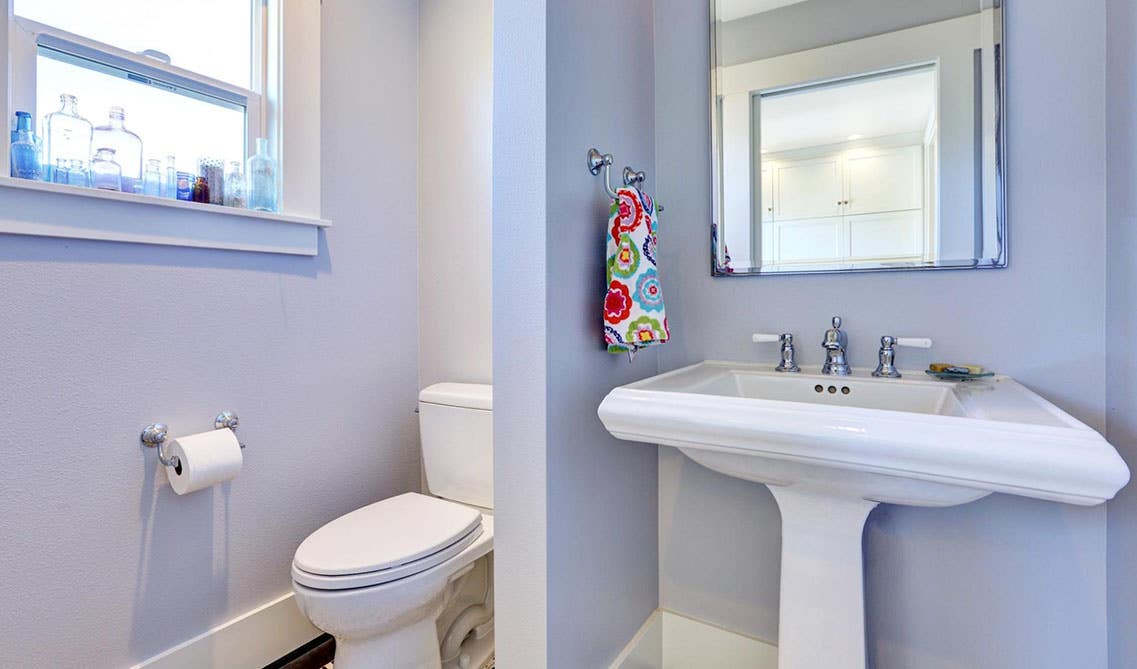
The vanity top it needs: none, and no vanity cabinet either. That's the point. It takes up very little floor, so it suits a powder room or a tight bathroom.
Good to know: you give up the storage under the sink and the counter space beside it, as Consumer Reports points out. If you need a place for towels and supplies, a small vanity may serve you better. Our powder room vanity guide compares the two.
6. Wall-Mount Sinks
A wall-mount sink hangs from a bracket on the wall, with open floor below. The plumbing under it is in view, so the drain parts become part of the look.
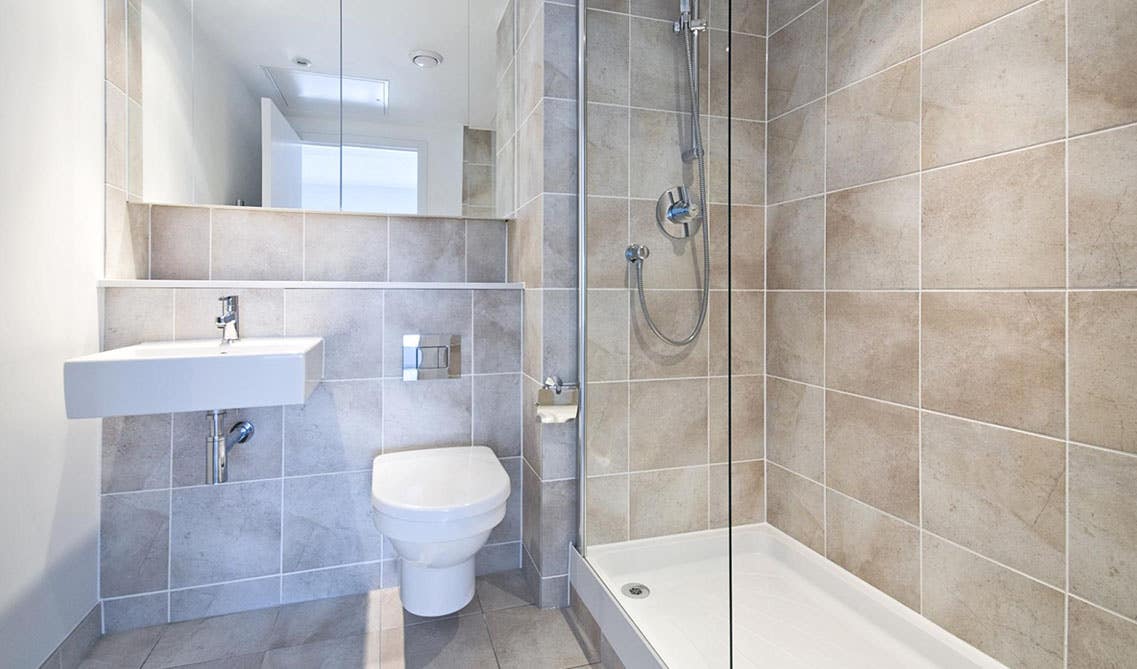
The vanity top it needs: none. Like a pedestal, it replaces the vanity.
Good to know: This Old House notes a wall-mount sink may need extra support inside the wall, and that it offers little counter space. It does make a small floor easy to clean. If you like the open floor but want drawers, look at a floating vanity instead.
Other Shapes: Corner and Trough Sinks
These are shapes, not mount types.
- Corner sinks are cut to fit into a corner. Family Handyman says they come in drop-in, undermount, wall-mount and pedestal versions, and are mostly used in very small half baths. A corner bathroom vanity is the cabinet version of the same idea.
- Trough sinks are one long basin, sometimes with two faucets, used in place of two separate sinks.

Lily Ann Cabinets: Colorado White Shaker
For two sinks side by side, This Old House suggests at least a 5-foot run of counter. Our single vs. double vanity guide covers when a second sink is worth the space.
Sink Materials at a Glance
Any mount type can come in several materials. Consumer Reports has tested bathroom sinks for stains, heat and dropped objects. Here's what it found:
| Material | What Consumer Reports found |
|---|---|
| Vitreous china (porcelain) | Still the common choice. Chipped when a small pointed object was dropped on it. |
| Enameled cast iron or steel | Easy to clean. In bathroom tests, enameled steel resisted stains better than enameled cast iron, which chipped from small dropped objects. |
| Tempered glass | Shrugged off drain cleaner and nail-polish remover, but shattered when a pointed object was dropped from 20 inches. |
| Solid surface | Resisted stains. Marked by heat, such as a hot curling iron. |
| Fireclay | Held up to stains, scouring and heat. Chipped from small pointed objects. |
| Stainless steel | Top-rated in its bathroom sink tests, though far more common in kitchens. |
Stone sinks are a separate case. Family Handyman notes that stone is porous, so it should be sealed to avoid stains.
Which Vanity Cabinet Does Each Sink Need?
Undermount, drop-in, vessel and integrated sinks all sit on a vanity sink base. That's a cabinet with doors and an open inside, so the bowl and the pipes have room. Budgeting for the job? See what it costs to install a bathroom sink.

Lily Ann's vanity sink bases are listed at 21 inches deep and 34-1/2 inches tall before the top goes on. In the Colorado White Shaker line they come in several widths, including 24 inches, 30 inches and 36 inches, all in stock on October 7, 2026. If you want drawers as well as a sink, the 36-inch vanity base with drawers has two doors, two drawers and one false drawer front.
How the sink type changes the cabinet plan:
- Undermount, drop-in and integrated: the bowl hangs down into the cabinet, so the space right under the counter has to stay open. That's why a sink base has a false drawer front at the top instead of a working drawer.
- Vessel: the bowl sits above the counter, so add its height to the cabinet and top when you check how high the rim will be.
- Any type: match the top to the cabinet. A vanity top is usually a little wider and deeper than the cabinet it sits on. Our bathroom vanity sizes guide has the standard widths.
- Pedestal and wall-mount: no cabinet at all, so plan storage somewhere else in the room.
What Lily Ann Sells for the Sink Area
Here's what the live site showed on October 7, 2026:
- Vanity cabinets: yes. Bathroom vanities in many lines, including Colorado White Shaker.
- Vanity tops with a sink: four quartz tops are listed, each with a white undermount sink already fitted, a backsplash, and one faucet hole. They're 31, 37 and 49 inches wide and 22 inches deep, made to fit 30, 36 and 48-inch vanities that are 21 inches deep. All four showed Out of Stock on October 7, 2026, so check the quartz tops page or call before you plan around one.
- Separate bathroom sinks: none are listed. The site's sink category is stainless steel kitchen sinks. If you want a vessel, drop-in or pedestal sink, you'll buy it elsewhere and pair it with the cabinet.
- Bathroom faucets: two bathroom faucets are listed, both single-hole, such as the B231 in brushed nickel. A single-hole faucet is the type the quartz tops are drilled for.

For more on top materials and replacing a top on its own, see our guide to bathroom vanity tops.
How to Choose the Right Type
- Keeping your countertop? Match what's there. A drop-in replaces a drop-in. An undermount hole can't take a vessel without a new top.
- Laminate top? Choose a drop-in.
- Busy family bathroom? An undermount or integrated sink is the quickest to wipe clean.
- Tiny powder room? A pedestal or wall-mount sink saves floor. A small single sink vanity saves the storage.
- Want a showpiece? A vessel sink, with a tall faucet and a top drilled only for the drain.
- Buying everything new? Pick the sink type first, then the top, then the faucet. The cabinet width sets the size of all three.
The Takeaway
Bathroom sink types come down to how the sink meets the counter. Undermount sinks need a solid, waterproof top. Drop-ins work with any top. Vessels need a top with only a drain hole and a taller faucet. Integrated sinks are the top. Pedestal and wall-mount sinks skip the vanity completely.
Whichever you choose, the cabinet comes first, because its width and depth set the size of the top. Browse Lily Ann's bathroom vanities, or get a free 3D design for your bathroom layout.
Frequently Asked Questions
By how they meet the counter, the three main types are drop-in, undermount and vessel. A drop-in sink is lowered in from above and rests on its rim. An undermount sink is attached below the counter. A vessel sink sits on top of it. Bathrooms add a few more that don't use a counter the same way: integrated sinks molded into the top, and pedestal and wall-mount sinks with no vanity at all.
Neither is better for everyone. Family Handyman says the choice mostly comes down to preference and your countertop. An undermount sink gives a cleaner look and lets you wipe the counter straight into the bowl, but it needs a solid, waterproof top and is harder to install. A drop-in sink is easier to fit, works with any top including laminate, and suits a tighter budget. Decide early, because the choice changes how the countertop is cut.
The best type depends on the room and the countertop. For a bathroom used every day, an undermount or integrated sink is the easiest to keep clean. For a laminate top or a small budget, a drop-in is the practical pick. For a tiny powder room, a pedestal or wall-mount sink saves floor space. A vessel sink is the choice when looks come first. This Old House suggests weighing space, how many people use the sink, upkeep and storage.
We couldn't find a sales ranking to cite, so we won't name a single winner. Family Handyman calls the drop-in a staple found in homes across the country, and Consumer Reports says vitreous china (porcelain) is still popular for bathroom sinks. Undermount sinks are the usual partner for stone and quartz tops. Lily Ann's own quartz vanity tops are listed with undermount sinks.
Yes, if easy cleaning matters most to you. An integrated sink is one piece with the countertop, so there's no rim or joint to trap dirt. This Old House lists the downsides: fewer sink shapes, a heavy piece to install, and a higher price than some separate sink-and-counter setups. You also can't replace the bowl without replacing the top. In Consumer Reports' tests, solid-surface sinks resisted stains but were marked by heat.
An undermount sink is harder to install and limits your choice of countertop. It needs a solid, waterproof top with a finished cutout, so it's not a match for laminate. Consumer Reports says undermount sinks cost more to buy and install. Family Handyman notes the gap where the sink meets the underside of the counter needs regular cleaning. The bowl also sits a little lower, up to 1-1/2 inches by Consumer Reports' measure.
An undermount sink is a separate bowl attached under a hole in the countertop. An integrated sink is formed as part of the countertop itself. With an undermount there is a joint where the bowl meets the counter, held with adhesive and brackets. With an integrated sink there is no joint at all. An undermount bowl can be a different material and color from the top. An integrated one always matches, and the two can't be replaced separately.
It depends on the material. This Old House says vanity tops with integrated sinks can cost more than buying a sink and counter separately. On the other hand, Family Handyman notes the most common integrated tops are cultured marble, a manufactured material. Compare the full cost both ways: an integrated top is one purchase, while a separate sink also needs a countertop, a cutout and fitting. We don't quote prices here because they vary by size and material.











Comments