


- The grades describe flexibility and lead time, not build quality. A stock cabinet with a plywood box beats a custom cabinet with a particleboard one, every time.
- Stock cabinets come in 3-inch width increments — 9", 12", 15", 18" and so on. The gaps between your walls and those increments are closed with filler strips.
- Filler strips are the real cost of stock, and they are usually invisible. A run that needs two inches of filler at each end looks identical to a custom run to anyone who is not measuring.
- Semi-custom's value is depth and modification, not size. A 24-inch-deep base reduced to 15 inches for a tight walkway is the kind of change that genuinely needs it.
- Custom earns its money in odd rooms — sloped ceilings, exposed chimney breasts, non-standard heights. In a rectangular room it mostly buys you the absence of filler strips.
- Lead time is the difference people underestimate. Stock ships in days to a few weeks; custom commonly runs 8–14 weeks industry-wide, which decides more renovation schedules than price does.
What the Three Grades Actually Mean
Stock, semi-custom and custom describe how much of the cabinet you can change before it is made. They do not describe what it is made of, how it is joined, or how long it will last — which is why the grade is a poor proxy for quality.
This is the misunderstanding the whole category runs on. "Custom" sounds like a quality tier and "stock" sounds like a compromise, so people assume a price ladder where each rung is better built than the one below. It is not that. It is a flexibility ladder, and the materials are a separate question you have to ask separately.
| Stock | Semi-custom | Custom | |
|---|---|---|---|
| Sizes | Fixed, usually 3" increments | Standard sizes plus modifications | Any dimension |
| Finishes | Set range | Wider range, some special orders | Anything, including matched to a sample |
| Depth changes | No | Usually yes | Yes |
| Lead time | Days to a few weeks | Several weeks | Commonly 8–14 weeks industry-wide |
| Filler strips needed | Yes, routinely | Fewer | Rarely |
| Relative price | Lowest | Middle | Highest |
| Build quality | Not determined by the grade. Ask about the box, drawers and hardware separately. | ||
The row that matters most is the last one, and it is the row nobody puts in the table.
Stock Cabinets: Fixed Sizes, Fast Shipping
Stock cabinets are manufactured ahead of demand in standard sizes and held in inventory. Because they already exist when you order, they ship in days or a few weeks rather than months — and because they are made in volume, they cost less per unit.
The standard widths run in 3-inch increments: 9, 12, 15, 18, 21, 24, 30, 33, 36 inches and so on. Base cabinets are typically 24 inches deep and 34.5 inches high before the countertop; wall cabinets are typically 12 inches deep in heights of 30, 36 or 42 inches. Those numbers are close to universal across the industry, which is why stock cabinets from different makers can usually sit in the same run.
What you give up is the ability to hit an exact wall measurement. A wall that measures 118 inches cannot be filled precisely with cabinets that come in 3-inch steps, so the remainder is closed with a filler strip — a matching finished piece of timber cut on site.
Filler strips are not a defect
This is worth being clear about, because it is the single most misunderstood thing about stock cabinetry. A filler strip is a normal, planned part of a cabinet installation. It is finished in the same colour as the doors, it is usually one to three inches wide, and once the run is installed with a countertop over it, most people cannot identify where it is.
Fillers are also functionally useful: they provide the clearance a door or drawer needs to open fully next to a wall or an adjacent appliance. An installation with zero fillers can have a corner drawer that fouls the wall — which is a real problem, unlike a two-inch strip nobody notices.
"Prefab" and "builder grade" mean roughly this
Two adjacent terms worth untangling. Prefab (prefabricated) is used almost interchangeably with stock — cabinets built before you ordered them. Builder grade is different: it describes the specification level a developer fits as standard in a new build, which is usually the cheapest acceptable option available. Builder grade is normally stock, but stock is not necessarily builder grade — and the difference is exactly the materials question the grade does not answer. See custom vs. builder-grade cabinets for that comparison in detail.
Semi-Custom: Standard Sizes, Modified
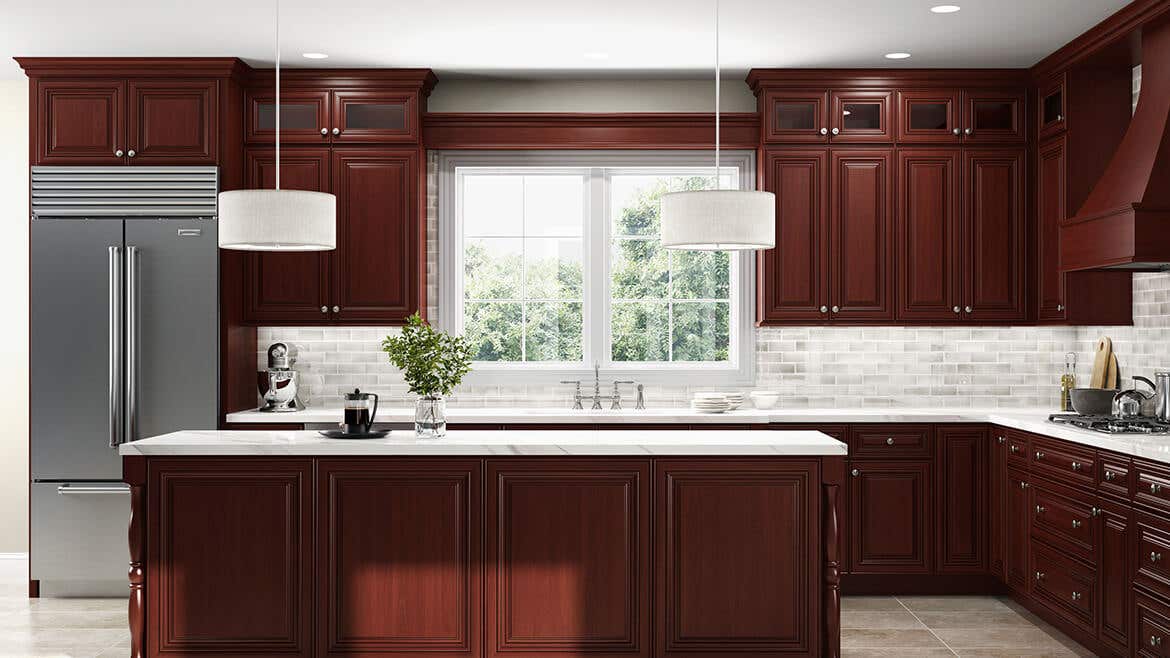
Semi-custom starts from the same standard sizes as stock but allows changes to be made before manufacture — most usefully depth reductions, finish options and some dimensional adjustment. It is the middle rung on both price and lead time.
The modifications that genuinely earn the premium:
- Reduced depth. A 24-inch base cabinet cut to 15 or 18 inches for a narrow walkway or a peninsula that would otherwise block a route. This is the single most valuable semi-custom modification and the hardest to work around with stock.
- Non-standard height. Wall cabinets sized to meet a ceiling that is not 8 feet, so there is no dust gap and no soffit.
- Wider finish choice. More colours, sometimes a specialty finish or a glaze.
- Interior configuration. Drawer arrangements, roll-out shelves, specific organiser fit-outs specified at order.
The modifications that usually are not worth it: small width adjustments to eliminate a filler strip. Paying a semi-custom premium across a whole kitchen to avoid two inches of trim that nobody will see is the most common way people overspend in this category.
Custom: Built to the Room
Custom cabinets are made to your measurements with no size constraints at all. They earn their premium in rooms that are genuinely irregular, and considerably less in rooms that are rectangular.
Where custom is the right answer:
- Sloped or vaulted ceilings. Cabinets that follow a slope cannot be assembled from rectangular stock units.
- Chimney breasts, structural columns, bay windows. Anything the run has to wrap or accommodate.
- Non-standard ceiling heights where a full-height run is the design intent.
- Genuine furniture pieces — a built-in dresser, a curved island, a piece that has to match existing joinery.
- An exact finish match to something already in the room.
Where it mostly buys the absence of filler strips: a rectangular kitchen with standard 8-foot ceilings and no obstructions. That describes most kitchens. In that room, custom delivers a result a good stock installation delivers too, at several times the price and several times the lead time.
And the lead time is the part people underestimate. Custom cabinetry commonly runs 8 to 14 weeks industry-wide — a figure quoted consistently across cabinet manufacturers — before installation even begins. In a renovation where the kitchen is unusable until the cabinets arrive, that is often the binding constraint rather than the budget.
The Question the Grade Does Not Answer

Whether a cabinet is stock, semi-custom or custom tells you nothing about what it is made of. Ask about the box material, the drawer construction and the hardware separately — those determine how long it lasts. Our guide to the types of wood joints used in cabinets shows what to look for at the box, face frame and drawer corners.
Six questions that get you a real specification, in any grade:
- What is the cabinet box made of, and how thick? Plywood is what you want; 1/2" is a good figure. "Furniture board" and "engineered wood" generally mean particleboard, which loses screw-holding strength and swells permanently if it gets wet.
- What are the doors and face frames? Solid hardwood for a stained finish; MDF centre panels are genuinely better for painted doors.
- How is the drawer box made? Dovetailed solid wood is expensive to manufacture and hard to fake. A stapled particleboard drawer under a solid-wood front tells you where the money was saved.
- Are the glides full-extension, soft-close and under-mount?
- Are the hinges concealed, soft-close and six-way adjustable?
- What are the back panel and shelves? This is where corners get cut, because nobody looks.
A stock cabinet that answers all six well will outlast a custom cabinet that answers them badly. The grade is about the shape of the order; these six are about the object.
RTA: A Fourth Thing, and Not a Grade
Ready-to-assemble is a shipping and assembly method, not a quality tier. RTA cabinets are almost always stock-sized, and they ship flat as pre-cut, pre-finished parts you assemble where they will be installed.
The saving comes from freight and warehousing rather than from cheaper materials. A flat pack occupies a fraction of the volume of an assembled cabinet, so a container holds several times as many. That is a real structural cost difference, and it is passed on.
What it costs you is assembly time — roughly 15 to 25 minutes per cabinet once you have done a few, so a full day for a sixteen-cabinet kitchen. What it can gain you, besides price, is access: a flat pack goes round a tight stair turn or through a narrow doorway that an assembled 36-inch cabinet does not always manage.
Assembly is covered step by step in RTA cabinet assembly — including the toe kick, which is fitted last and is the piece most often mismatched when a stock kitchen is ordered without its finishing parts.
How to Decide
Start with the room, not the budget. Irregular rooms narrow the options for you; rectangular rooms leave the choice open, at which point specification and lead time decide it.
- Is the room irregular? Sloped ceiling, structural obstruction, non-standard height, or a run that has to match existing joinery. If yes, custom or heavily-modified semi-custom. If no, continue.
- Do you need a depth change? A base run that must be shallower than 24 inches to keep a walkway usable is the clearest semi-custom case there is.
- How soon do you need them? If the kitchen has to be usable within a few weeks, custom is out on lead time regardless of budget.
- Now ask the six specification questions of every quote you have, in whatever grade.
- Compare like with like. A stock plywood cabinet against a semi-custom particleboard one is not a grade comparison — it is a materials comparison wearing a grade's clothes.
Where Lily Ann Sits

Lily Ann Cabinets builds stock-sized, ready-to-assemble cabinets — fixed standard sizes, shipped flat. The specification underneath is the part worth comparing: 1/2" plywood boxes, solid-wood doors and face frames, 5/8" dovetailed solid-wood drawer boxes, full-extension soft-close under-mount glides and soft-close adjustable concealed hinges.
That is the argument this whole article is making, applied to ourselves: the grade is stock, and the specification is not what "stock" implies. If you are comparing quotes, run the six questions above against a Lily Ann cabinet and against whatever else you are considering — the answers are the comparison, not the label.
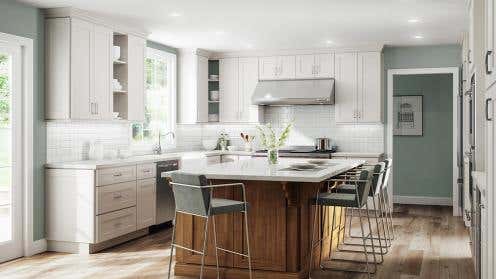
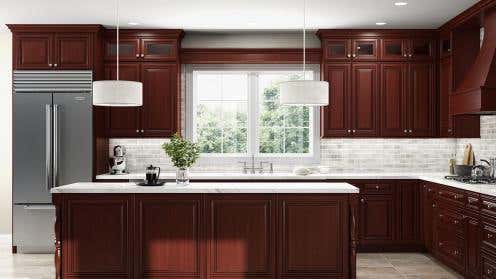
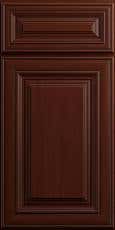
The full range is at RTA kitchen cabinets, with finishes grouped by shaker, wood, white and dark. Because finish is the hardest thing to judge from a screen, free door samples are the sensible first step.
Two related decisions: what "solid wood" really means covers the box-and-door materials question in depth, and kitchen layouts comes first — the layout determines which sizes you need before the grade question arises at all.










Comments