


- "Solid wood" is a marketing phrase, not a specification. Ask which components are solid wood — doors, drawers, face frame, box — because the answer differs enormously between cabinets sold under the same label.
- Plywood boxes are better than solid-wood boxes. Cross-laminated layers cancel out seasonal wood movement; a wide solid panel in a kitchen expands, contracts, and eventually checks or splits.
- Doors and drawer fronts are where solid wood earns its money. Narrow stiles and rails move little, take a stain beautifully, and can be sanded and refinished decades later.
- Solid wood is not automatically more durable. It dents about as easily as plywood, moves more than plywood, and costs more — its real advantages are refinishability and grain.
- Dovetailed drawer boxes are the honest quality tell. A 5/8" solid-wood dovetailed drawer is expensive to make and hard to fake; a stapled particleboard drawer under a solid-wood front is not.
- Lily Ann builds the combination that actually holds up: 1/2" plywood boxes, solid-wood doors and face frames, 5/8" dovetailed solid-wood drawer boxes — not an all-solid box, and deliberately so.
What "Solid Wood Cabinets" Actually Means in a Showroom
There is no legal or industry definition of a "solid wood cabinet." The phrase is used to describe cabinets ranging from all-hardwood construction to a particleboard box with a hardwood door on the front — and both are advertised the same way.
This is why searching for solid wood cabinets is so frustrating. Two cabinets at wildly different prices carry the same label, and the specification sheets — where they exist — describe different components. One lists "solid wood doors"; another lists "all-plywood construction with solid wood face frames"; a third just says "solid wood" and stops.
A kitchen cabinet has five parts that can each be made from different material:
| Component | Common materials | What you want |
|---|---|---|
| Door and drawer front | Solid hardwood, MDF, thermofoil, veneered plywood | Solid hardwood if stained; MDF is genuinely fine if painted |
| Face frame | Solid hardwood, engineered wood | Solid hardwood — it takes every knock |
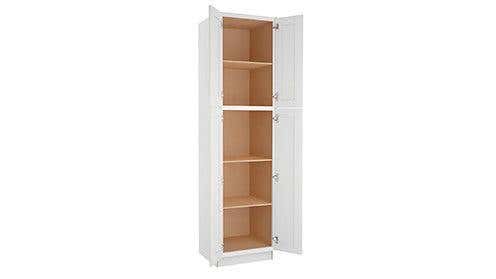
| Cabinet box (sides, top, bottom) | Plywood, particleboard, MDF, solid wood | Plywood — better than solid wood here |
| Drawer box | Dovetailed solid wood, stapled plywood, particleboard | Dovetailed solid wood |
| Back panel and shelves | Plywood, particleboard, hardboard | Plywood |
A cabinet can be "solid wood" on one row of that table and particleboard on four. When you ask a supplier about solid wood, ask about the rows — not the label.
Why Plywood Boxes Beat Solid Wood Boxes

Wood expands and contracts across the grain as humidity changes. Plywood is built from thin layers glued at alternating grain directions, so each layer's movement is restrained by the ones above and below it. That is why a plywood cabinet side stays flat and a wide solid-wood one does not.
This is the single most counter-intuitive fact in cabinet buying, and it is the reason the Reddit thread asking for "plywood-free, 100% solid wood" cabinets ranks third on this search. The instinct is understandable — plywood sounds like the cheap option because particleboard is also a sheet good. But plywood and particleboard have almost nothing in common besides shape.
A kitchen is a hostile environment for a wide solid panel. Humidity swings with the seasons, with cooking, with the dishwasher door opening. A 24-inch-wide solid wood cabinet side will move meaningfully across that width over a year, and it is fixed at its edges by the joinery — so the movement has nowhere to go except into stress. Over enough cycles that shows up as cupping, or as a check running with the grain.
Plywood does not do this. The cross-laminated layers mean any given layer's expansion is opposed by its neighbours, and the net movement across a sheet is a small fraction of solid wood's. In a cabinet box — which must stay square, stay flat, and hold a door alignment for decades — that stability is worth more than the romance of a solid panel.
Plywood is not particleboard
Worth stating plainly because the two get grouped together. Plywood is thin sheets of real wood, cross-laminated. Particleboard is wood chips and resin pressed into a sheet — it has no grain direction, far less screw-holding strength, and it swells irreversibly if it gets wet. If a cabinet's box is a sheet good, plywood is the one you want. For the full comparison, see particle board vs. plywood cabinets.
Where Solid Wood Genuinely Wins: Doors, Frames and Drawers

Solid hardwood belongs in the narrow components: door stiles and rails, face frames, and drawer boxes. These are narrow enough that seasonal movement is negligible, and they are the parts that get handled, knocked and eventually refinished.
Three real advantages, and they are worth paying for:
- Refinishability. A solid wood door can be sanded back and refinished several times over its life. If you only want a darker color and would rather not strip the doors, see how gel stain on kitchen cabinets works and where it falls short. A veneer can be sanded roughly once before you are through it; a thermofoil or laminate face cannot be refinished at all. If you expect to change the kitchen's colour in fifteen years without replacing the cabinets, this is the argument.
- Grain and depth. Stain on solid hardwood has real grain to sit in, and the variation between doors is what makes a stained kitchen look like wood rather than like a colour. A printed or laminated grain repeats; a real one does not.
- Repairability. A dent in solid wood can be steamed, filled or sanded. A dent that has punctured a veneer or laminate is permanent.
The drawer box is the honest quality tell
If you only inspect one thing when comparing cabinets, pull a drawer all the way out and look at its corners. A dovetailed solid-wood drawer box — interlocking pins and tails at each corner — is expensive to manufacture and effectively impossible to fake with a cheaper material. A drawer box that is stapled, or made from particleboard with a solid-wood front screwed on, tells you where the manufacturer decided to save money, regardless of what the front looks like.
Lily Ann's drawer boxes are 5/8" dovetailed solid wood on every line, running on full-extension soft-close under-mount glides.
The Case Against All-Solid Cabinets
An all-solid-wood cabinet costs substantially more, weighs more, moves more with humidity, and is not measurably more durable in daily use than a plywood-box cabinet with solid wood doors and drawers.
The honest downsides, stated as a buyer should hear them:
- Cost. Hardwood is the most expensive material in the cabinet, and an all-solid box uses a great deal more of it. The money buys stability you already had from plywood.
- Movement. Covered above. In a kitchen, more solid panel area means more seasonal movement to design around.
- Weight. A solid-wood wall cabinet is heavier than the plywood equivalent, which matters for what it is hanging on. Wall cabinets carry their entire load through fasteners into studs.
- Dent resistance is a wash. Hardwood dents. Plywood dents. The face veneer on a good cabinet-grade plywood is real hardwood, so the surface hardness is similar. Nobody's cabinet fails from a dent anyway — they fail at joints, hinges and water damage. A worn or broken hinge is the easiest of the three to fix; here is how to swap a cabinet hinge.
- Water is the real enemy, and solid wood is not immune. Under-sink leaks destroy cabinets. Solid wood tolerates a wetting better than particleboard, roughly comparably to plywood, and no material survives a slow leak left running for a month.
Which Hardwood? Maple, Oak, Birch, Cherry and Hickory

Species affects grain, colour and how the wood takes a stain far more than it affects durability. Every hardwood used in cabinetry is hard enough for the job — the choice is aesthetic and, to a lesser extent, about how evenly it stains.
| Species | Grain | Best for |
|---|---|---|
| Maple | Fine, subtle, close-grained | Painted finishes and light modern stains — the smooth face is why it is the most common paint-grade hardwood |
| Oak | Strong, open, pronounced | Anyone who wants the grain to be the feature; hides wear well |
| Birch | Fine, close to maple | Value alternative to maple; also the standard face on cabinet-grade plywood |
| Cherry | Smooth, fine, warm | Rich traditional stains; darkens naturally with age and light exposure |
| Hickory | Dramatic, high colour variation | Rustic and farmhouse kitchens where variation between doors is the point |
One species-specific caution: maple and birch are both close-grained, which means they can blotch under a dark stain if not conditioned first. That is a finishing question, and it is handled at the factory — but it is why maple is more often painted and oak more often stained.
What to Ask Before You Buy
Six questions get you a real specification instead of a label. Ask them of any supplier, including this one.
- What is the cabinet box made of, and how thick? The answer you want is plywood, and 1/2" is a good figure. "Furniture board" and "engineered wood" usually mean particleboard.
- What are the doors and face frames made of? Solid hardwood, and which species.
- What is the drawer box made of, and how is it joined? Dovetailed solid wood is the answer that costs a manufacturer real money.
- Are the glides full-extension and soft-close, and are they under-mount? Under-mount glides are invisible and do not eat drawer width.
- Are the hinges concealed, soft-close and adjustable? Six-way adjustable hinges are what let a door be aligned after installation.
- What is the back panel and shelf material? This is where corners are cut most often, because nobody looks.
Those six questions cut across every cabinet grade — stock, semi-custom and custom alike — which is the argument made at length in stock vs. semi-custom vs. custom cabinets.
If a supplier answers all six with specifics, the cabinet is probably what it claims. If the answers are adjectives — "premium", "all-wood", "heavy-duty" — that is the answer.
What Lily Ann Cabinets Builds

Every Lily Ann line uses 1/2" plywood box construction with solid-wood doors and face frames, and 5/8" dovetailed solid-wood drawer boxes on full-extension soft-close under-mount glides. It is not an all-solid cabinet, and that is the design intent rather than a cost saving.
The reasoning is exactly the argument above: plywood in the box for stability, solid hardwood in the components where solid wood genuinely performs better. Every finish across the range shares that construction, so choosing a colour does not change what is behind it.
You can browse the stained and natural finishes at wood cabinets, the darker end at stained wood cabinets and medium wood cabinets, or the birch-faced construction directly at birch wood cabinets. Everything ships ready to assemble from the RTA kitchen cabinet range.
Because stained wood is the finish most distorted by screen photography — grain depth and undertone both shift — free door samples are worth ordering before committing to a species. And if you are weighing wood against a painted engineered door, MDF vs. solid wood covers that comparison directly.











Comments