


Quartz is the better choice for a busy kitchen: it is harder, more scratch-resistant, handles more heat and looks more like natural stone. Solid surface (such as Corian) usually costs less, has nearly invisible seams, can have a built-in sink, and lets you sand out scratches and small burns. Neither needs sealing. Solid surface works best where heat and knives are rare, like a bathroom vanity top.
- What it is: mineral powder (mostly ATH) bound in acrylic or polyester resin. Corian, from 1967, is the original brand.
- Best traits: nearly invisible seams, integrated sinks, no sealing, and scratches that sand out.
- Main downsides: scratches more easily than quartz, and hot pans can scorch it (fine to 212°F, some products deform around 250°F).
- vs. quartz: quartz is harder, more heat-tolerant and more stone-like; solid surface is cheaper in most guides and easier to repair.
- Cost: The Spruce lists $50 to $140 per sq. ft. installed (April 2024); Bob Vila $35 to $85 (2021). Get real quotes.
- Lily Ann Cabinets doesn't sell countertops, but sells the cabinets they sit on: bathroom vanities 21" deep and kitchen base cabinets 24" deep, both 34-1/2" tall before the top (checked October 2, 2026).
Solid surface countertops, best known by the brand name Corian, were the "upgrade from laminate" for decades. Then quartz arrived, and solid surface got a reputation as the plain, plasticky option. The truth is in between. Solid surface has real strengths, like seamless joints, integrated sinks and scratches you can sand out yourself, and real weaknesses, mainly heat and scratches.
This guide covers what solid surface is, its pros and cons, how it compares with quartz, granite and laminate, what it costs, and where it works best, including bathroom vanity tops. Lily Ann Cabinets doesn't sell countertops. We sell the cabinets they sit on, so we've added what to check on the cabinet side too.
What Is a Solid Surface Countertop?
A solid surface countertop is a man-made slab of mineral powder bound in acrylic or polyester resin. The mineral is mostly alumina trihydrate (ATH), a fine white powder. The color and pattern run all the way through the material, it is nearly non-porous, and pieces can be joined with seams that are almost invisible.
DuPont introduced the first solid surface material, Corian, in 1967. When its patent expired, other makers followed, so today you'll see brands like Hi-Macs, Staron, Hanex, Avonite and Formica Solid Surfacing (source: Wikipedia; The Spruce). The most common thickness is 1/2 inch, and fabricators usually build up the front edge so it looks thicker.
There are two main types. Acrylic solid surface is easier to join seamlessly and can be heated and bent into curves. Polyester solid surface costs less and gives brighter colors, but is a little more brittle. Many products blend the two, so check the maker's spec sheet if it matters to you.
Are Corian and Solid Surface the Same?
Corian is one brand of solid surface, the original one. "Solid surface" is the name of the whole material category, the same way "quartz" covers many brands. Corian, Hi-Macs, Staron and the others all use the same basic recipe of minerals, resin and pigment, though the resin mix and quality vary by brand.
Pros of Solid Surface Countertops
- Seamless look. Joints are bonded and sanded smooth, so a long run or an L-shaped counter can look like one piece.
- Integrated sinks. The sink can be made from the same material and fused to the top, with no rim for grime to collect in.
- Nearly non-porous. It doesn't need sealing, and it resists stains and bacteria. That's why hospitals use it around sinks and on walls.
- Easy to repair. Light scratches and small burns can be sanded out with fine sandpaper and an orbital sander, because the color goes all the way through.
- Curves and shapes. Acrylic solid surface can be heated and formed into curved fronts and coved backsplashes.
- Lower cost than stone and quartz in most price guides (see the cost section below).
Disadvantages of Solid Surface Countertops
The main disadvantages of solid surface countertops are that they scratch more easily than quartz or granite, and that high heat can scorch or warp them. They handle boiling water, but a hot pan set straight on the counter can damage it. They also look less like natural stone than quartz does, and they are hard for a DIYer to fabricate.
- Scratches. It's a relatively soft material, so knives will mark it. Use a cutting board every time. Scratches tend to show white, so lighter colors hide wear best in a busy kitchen.
- Heat. According to The Spruce, solid surface can handle 212°F (boiling water), but some products start to deform not far above that, around 250°F. Always use a trivet for pots and pans.
- Looks less like stone. It has a smooth, uniform, usually matte look. It can imitate granite or marble, but it lacks the depth of real stone or quartz.
- Shine wears. A glossy finish shows scratches faster, so most solid surface is matte. A worn top can be buffed back, but that's a periodic job.
- Not DIY-friendly. Brand-name sheets are often sold only through authorized fabricators, and invisible seams take special tools and skill.
- Neutral for resale. The Spruce notes it doesn't hurt a home's resale value, but it doesn't add to it either.
Solid Surface vs. Quartz
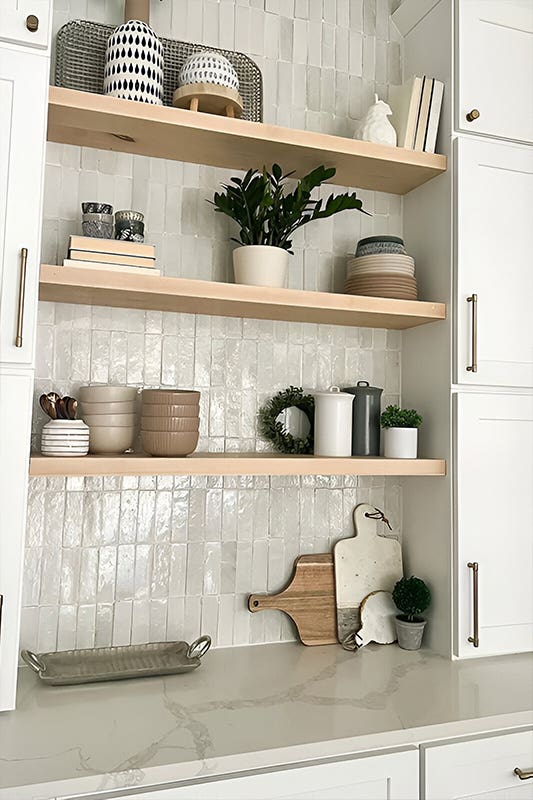
Quartz is harder, more scratch-resistant, more heat-tolerant and looks more like natural stone. Solid surface usually costs less, has nearly invisible seams, can have a built-in sink, and is easier to repair, because scratches and small burns sand out. Neither one needs sealing.
| Solid surface | Quartz | |
|---|---|---|
| What it's made of | About two-thirds mineral (ATH) and one-third acrylic or polyester resin | About 90% ground quartz stone, the rest resin and pigment |
| Scratches | Scratches fairly easily, but sands out | Much harder to scratch |
| Heat | OK to 212°F; hot pans can scorch or warp it | Handles more heat, but makers still advise trivets |
| Seams | Nearly invisible | Visible, filled with epoxy |
| Sinks | Can be integrated, one piece with the top | Undermount or drop-in |
| Sealing | None | None |
| Look | Smooth, uniform, usually matte | Stone-like depth, usually polished |
| Repair | Easy: sand and buff | Rarely needs it, but harder to fix at home |
| Cost | Lower in most guides | Higher |
The composition figures come from The Spruce (solid surface about 33% resin, 66% minerals; quartz about 10% resin) and Wikipedia, which puts the ATH share at about 70%. Quartz makers describe their product as at least 90% quartz.
Choose quartz if you cook a lot, set things down without thinking, and want a stone look that stays sharp. Choose solid surface if you want a seamless counter with a built-in sink, a lower price, or a top you can refresh yourself, which is why it's so common on bathroom vanities. For quartz care, see our guide on how to clean quartz countertops.
Solid Surface vs. Granite and Laminate
- vs. granite: Granite is natural stone. It is harder, handles heat better and every slab is unique, but it needs sealing and can stain if the seal wears. Solid surface needs no sealing and repairs more easily, but it can't match granite's heat resistance or depth. If you're weighing the stone options, our quartz vs. granite comparison covers that matchup.
- vs. laminate: Laminate is a thin plastic layer glued over particleboard. It costs less, but chips can't be repaired and water can swell the core at the seams. Solid surface is the same material all the way through, so it can be sanded and repaired, and it can have an integrated sink. That's why it's usually described as the step up from laminate.
Comparing every option? Our countertop materials guide covers granite, quartz, marble and laminate side by side.
How Much Do Solid Surface Countertops Cost?
Price guides put solid surface in the middle of the market: above laminate, below most quartz, granite and marble. For the lowest-cost tops in order, see the cheapest kitchen countertop options ranked by installed cost. Two published ranges, per square foot:
- The Spruce (updated April 2024): $10 to $80 for the material, or $50 to $140 installed. It lists granite and marble at about $50 to $200 installed.
- Bob Vila (updated December 2021): $35 to $85, compared with $45 to $200 for granite and $75 to $250 for marble.
These are national ballparks from different years, not quotes. Your price depends on the brand, the color, how many seams and cutouts there are, the edge profile, and whether an integrated sink is included. Polyester-based solid surface is usually cheaper than acrylic. Get two or three fabricator quotes on the same drawing.
Solid Surface for Bathroom Vanity Tops

The bathroom is where solid surface makes the most sense. A vanity top doesn't see knives or hot pans, so its two big weaknesses mostly drop away. What's left are its strengths: no sealing, a seamless top, and the option of a sink and backsplash formed in one piece with the counter, so there's no rim or seam for water and soap to sit in.
Our guide to bathroom vanity top materials ranks solid surface alongside quartz, granite, marble and cultured marble for bathroom use. Don't confuse solid surface with cultured marble: cultured marble is a different cast product with a clear gel coat on the surface, and that guide notes it can dull and yellow with age.
On the cabinet side: Lily Ann vanity sink bases are 21 inches deep and 34-1/2 inches tall before the top, in widths from 24 to 42 inches, like our Craftsman White Shaker vanities. Order the top to the cabinet's measured width and depth plus your overhang, and add the top's thickness to the cabinet height to get your finished counter height. For more vanity looks, see our modern bathroom vanity ideas.
Which Cabinets Go With Solid Surface Countertops?
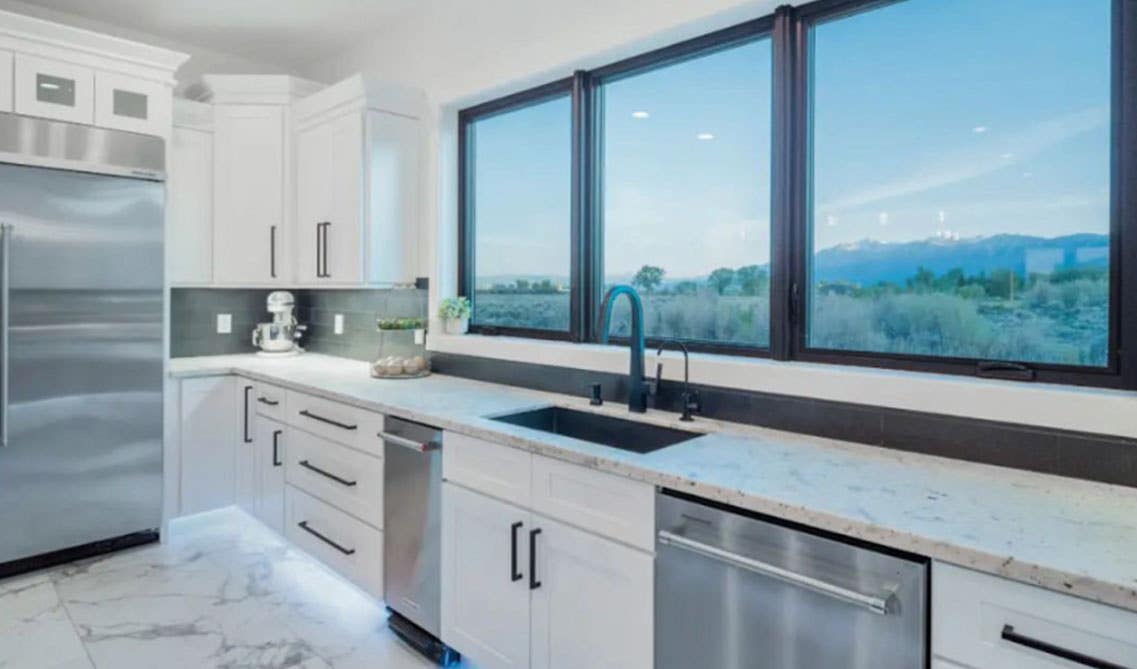
Because solid surface is usually plain and matte, it suits clean-lined cabinets. A few pairings that work:
- White or off-white top with wood cabinets. The plain top lets the wood grain stand out.
- White top with navy, black or green cabinets. High contrast, and the matte top keeps the look modern.
- Warm grey or beige top with white cabinets. A soft, low-contrast kitchen that hides crumbs and wear.
Whatever the top, it needs a level, square, firmly fastened run of base cabinets. The fabricator templates the counter from the top of your installed cabinets, so finish the cabinets first. Lily Ann's kitchen base cabinets are 24 inches deep and 34-1/2 inches tall before the countertop, as in our Colorado White Shaker kitchen cabinets.
How to Care for Solid Surface Countertops
- Daily: wipe with warm water and mild soap or a non-abrasive cleaner.
- Heat: always use trivets for pots, pans and hot appliances.
- Cutting: always use a cutting board.
- Light scratches: sand with fine-grit sandpaper (The Spruce suggests starting at #220 on an orbital sander), work up to finer grits, and finish with a non-scratch pad. Avoid high-speed buffing, which can melt the surface.
- Deep damage or a cracked seam: call a solid surface fabricator. Because the material is the same all the way through, most damage can be repaired in place.
Why Did Corian Go Out of Style?
Mostly because quartz arrived and looked more like stone. In the 1990s and 2000s, solid surface was a common upgrade from laminate. Once engineered quartz became widely available, buyers wanting a stone look moved to it, and solid surface's matte, uniform look started to read as dated. Its habit of scratching in a busy kitchen didn't help. It never went away, though. It is still widely used in bathrooms, hospitals, labs and commercial spaces, where seamless, repairable and hygienic matter more than a stone look.
The Takeaway
Solid surface is a solid, mid-priced choice when you want a seamless counter, an integrated sink, no sealing and easy repairs, and it's at its best on a bathroom vanity. If you want maximum scratch and heat resistance and a real stone look in a hard-working kitchen, quartz is the better pick. Either way, the countertop is only as good as the cabinets under it. Get a free 3D design and we'll lay out the base cabinets your new counters will sit on.
Frequently Asked Questions
Yes, for the right room. Solid surface is nearly non-porous, needs no sealing, can be joined with almost invisible seams, and scratches can be sanded out. Its weak points are heat and scratches, so it is best in bathrooms and lighter-use kitchens, and less ideal for heavy cooking.
Corian is a brand of solid surface, the first one, introduced by DuPont in 1967. "Solid surface" is the whole category, which also includes brands like Hi-Macs, Staron, Hanex and Avonite. They share the same basic recipe of mineral filler, resin and pigment.
They scratch more easily than quartz or granite, and high heat from a hot pan can scorch or warp them. They also look less like natural stone than quartz, a glossy finish shows wear quickly, and they are hard to fabricate yourself. Most of these are manageable with cutting boards and trivets.
Usually, yes. Price guides put solid surface below quartz, granite and marble. The Spruce lists solid surface at $50 to $140 per square foot installed (April 2024), and quartz makers themselves describe quartz as generally more expensive. Brand, color, seams and cutouts change real quotes a lot.
Polyester-based solid surface is generally the most affordable. It costs less than acrylic-based solid surface and gives brighter colors, but it is a little more brittle and harder to seam invisibly. Simple shapes with few seams and a standard edge also keep the price down.
Mainly because engineered quartz became widely available and looked more like real stone. Solid surface's smooth, matte look started to feel dated next to it, and it scratches more easily in a busy kitchen. It is still widely used in bathrooms and commercial spaces, where seamless and repairable matter more.
Quartz is better for a hard-working kitchen: it is harder to scratch, handles more heat and looks more like stone. Solid surface is better when you want a seamless top, an integrated sink, a lower price or easy at-home repairs, which is why it is popular for bathroom vanity tops. Neither needs sealing.
They are worth it if you value a seamless look, no sealing and easy repairs at a mid-range price, especially in a bathroom. They are less worth it if you want a natural-stone look or cook with a lot of hot pans and knives. The Spruce notes they don't add resale value, but they don't hurt it either.
No. Quartz is engineered stone, about 90% ground natural quartz bound with resin. Solid surface is mostly mineral powder (ATH) and resin, with much more resin than quartz. Both are man-made and non-porous, which is why they get mixed up, but quartz is much harder and solid surface is easier to seam and repair.
















Comments