


Soapstone is a soft natural stone that handles hot pans, resists stains and acids, and never needs sealing. The downsides: it scratches and dents easily, it darkens over time (more so when oiled), it comes in a narrow range of grays, greens and blacks, and it usually costs more than granite, at about $55 to $120 per square foot for the stone, per Better Homes & Gardens.
- What it is: a natural, talc-rich stone (steatite); countertop grade is about 50% talc, harder than carving soapstone (The Spruce).
- Best at: heat, stains and acids. Hot pans and lemon juice won't hurt it, and it never needs sealing.
- Weak spot: it scratches and dents, but light scratches sand out and oil blends them in.
- Looks: soft gray to charcoal, sometimes green or blue; it darkens with age and turns near-black when oiled.
- Cost: about $55–$120 per sq. ft. for the stone (BHG), usually more than granite.
- Under it: soapstone is heavy, so set solid, level plywood base cabinets before the fabricator templates.
- Lily Ann Cabinets pairs well with it in lines like Craftsman White Shaker and Craftsman Lily Green Shaker; order free door samples to test them against the stone.
Soapstone is the quiet one in the countertop aisle. It has no glitter and no busy pattern, just soft gray stone that feels smooth under your hand and slowly darkens as you use it. Cooks like it because a hot pan or a splash of lemon juice won't hurt it. Others pass on it because it scratches. Both camps are right.
This guide covers what soapstone is, its real pros and cons, how it compares with granite and quartz, what it costs, and how to care for it. It ends with the part we know best: the cabinets that sit under it and the colors that suit it. Every number below comes from a named source, linked where it's used.
What Is Soapstone?
Soapstone is a natural stone, also called steatite. It's a metamorphic rock rich in magnesium and the soft mineral talc, the same mineral used to make talcum powder. The talc gives it a smooth, slightly soapy feel, which is where the name comes from. It is quarried and cut into slabs like granite or marble.
Not all soapstone is equally soft. The Spruce explains that the softer "artistic" grade used for carving can be as much as 80 percent talc, while the architectural grade used for countertops is closer to 50 percent talc and is hard enough to cut into slabs. It describes countertop soapstone as somewhat softer than granite but about as hard as some high-end marbles.
Colors stay in a narrow, calm range. Better Homes & Gardens lists shades of gray, black, green, blue and white, usually with soft veins. Most slabs are gray to charcoal, and the stone darkens over time, especially when it's oiled. Much of today's soapstone comes from Brazil and India, according to The Spruce, and some is quarried in the United States.
Soapstone Countertops: Pros and Cons
The pros
- Heat won't hurt it. Soapstone is the stone used for fireplaces, hearths and old school lab tables. House Beautiful says a hot pan or baking tray straight from the oven won't crack or damage it.
- It shrugs off stains. The Spruce calls it nearly impervious to staining, and BHG says it resists stains better than marble or granite.
- No sealing. Soapstone is nonporous, so unlike granite and marble it doesn't need a chemical sealer. BHG adds that it is naturally antimicrobial.
- Acids don't etch it. House Beautiful notes that lemon juice and tomato sauce, which can dull or bleach fussier stones, don't react with it.
- Scratches can be fixed. Light scratches sand out with fine sandpaper, and a coat of mineral oil blends the spot back in.
- It ages well. The stone builds a darker, lived-in patina over the years, which is a big part of its appeal in farmhouse and traditional kitchens.
The cons
- It scratches and dents. Knife marks show, and a dropped can or glass can leave a nick. A stone fabricator quoted by House Beautiful says a hard knock on a corner tends to dent the stone rather than chip it.
- It needs oiling, at least at first. Most owners oil it to darken the color evenly. As oil dries out, the color can lighten unevenly and look patchy, especially in the first year.
- The color changes. A light gray slab can turn almost black once oiled. Some people love that; some don't.
- Few colors. If you want white with gold veins or a bold pattern, soapstone won't give it to you.
- Smaller slabs. The Spruce says large slabs are hard to find, so long runs and big islands usually need seams.
- It costs more than many people expect. See the cost section below.
Soapstone vs. Granite vs. Quartz
Soapstone handles heat as well as granite and far better than quartz, shrugs off food acids, and never needs sealing. Granite is harder and resists scratches better but usually needs sealing. Quartz needs no sealing and resists scratches, but its resin can be damaged by heat above about 300°F. Soapstone usually costs more than granite.
| Soapstone | Granite | Quartz | |
|---|---|---|---|
| What it is | Natural stone, rich in talc | Natural stone | Engineered: about 90–94% ground quartz plus resin and pigment |
| Hot pans | Fine | Fine | Use a trivet; resin can be damaged above about 300°F |
| Sealing | Not needed | Needed, often yearly | Not needed |
| Scratches | Scratches easily, but sands out | Resists scratches | Resists scratches |
| Look | Soft gray to black, quiet veins, darkens with age | Huge range of colors and patterns | Almost any color; consistent pattern |
| Cost per sq. ft. | $55–$120 stone (BHG); $70–$120 slab (House Beautiful) | $45–$110 (BHG) | $50–$150 installed (HomeGuide) |
Sources: soapstone and granite from The Spruce, Better Homes & Gardens and House Beautiful; quartz from HomeGuide. The cost sources don't all count the same things, so treat them as a rough guide, not a quote.
Soapstone vs. granite. Granite is harder, so it shows fewer scratches and dents day to day. But The Spruce notes granite needs sealing, often every year, while soapstone never does, and granite's colors run from quiet to very loud. If you love the soapstone look but not the scratches, a stone fabricator quoted by House Beautiful suggests looking at dark granites such as Absolute Black, Jet Mist or Vermont black, which look similar. Our granite countertop ideas show a range of options, and quartz vs. granite compares those two directly.
Soapstone vs. quartz. Quartz is the low-effort choice: no sealing, no oiling, and a consistent look. Its weak point is heat. HomeGuide says quartz resin can discolor, scorch or crack above about 300°F, so trivets are a must. Soapstone is the reverse. It handles heat and acids, but it marks more easily and changes color over time. If you set hot pots down without thinking, soapstone wins. If you want a counter that looks the same in ten years, quartz does.
How Much Do Soapstone Countertops Cost?
House Beautiful, citing Caesarstone, puts soapstone slabs at about $70 to $120 per square foot. Better Homes & Gardens gives $55 to $120 per square foot for the stone and says installation adds about $90 per square foot. Better Homes & Gardens and The Spruce both put soapstone above typical granite prices.
A few things move the price up or down:
- Talc content. House Beautiful says soapstone with more talc costs less because it's softer, but it shows more wear over time.
- Color. Rarer shades cost more. House Beautiful names blue and green tones; BHG names black and white.
- Slab size and seams. Large slabs are scarce, so a big layout can mean more pieces and more labor.
- Remnants. The Spruce suggests looking for remnant pieces for smaller jobs such as a bathroom vanity, a bar or an island top.
These are national ranges from publishers, not quotes. Your price depends on the slab, your layout and your local fabricator.
Living With Soapstone: Oiling, Scratches and Cleaning
Oiling. Oil isn't a sealer. It darkens the stone and evens out the patina. The Spruce suggests oiling with mineral oil once a week for the first three months, then once a month for the rest of the first year, and after that whenever water leaves dark spots. BHG recommends food-grade mineral oil, rubbed in with a clean cloth, with the extra wiped off. If you'd rather keep the lighter, natural gray, you can skip oiling; House Beautiful notes the stone still darkens slowly over time.
Scratches. Sand light scratches with fine sandpaper, then oil the spot. House Beautiful says you can do the same to reset a patchy patina: sand the darker area and re-oil it. Use a cutting board, as you would on any counter.
Daily cleaning. BHG says warm water and mild soap are all you need. It advises skipping abrasive cleaners, scrub brushes and acidic cleaners such as vinegar or lemon juice. Food acids won't etch soapstone, but there's no reason to clean with them.
Stains. Soapstone resists stains, and BHG says an overnight paste of baking soda and water will lift most marks that do appear.
Before the Stone Goes On: Your Base Cabinets
Soapstone is heavy. BHG says it needs solid, well-supported cabinets underneath and a professional install. So the cabinets matter as much as the slab.
- Box material. Look for plywood cabinet boxes. Lily Ann's Colorado White Shaker, Craftsman White Shaker, Craftsman Lily Green Shaker and Craftsman Natural Shaker lines all list 1/2-inch solid birch plywood box construction.
- Level first. Set, level and fasten every base cabinet before the fabricator comes to measure (template) the counter. A stone top can only sit as flat as the cabinets under it.
- Check your counter height. Lily Ann base cabinets such as the FSB36 below are 34-1/2 inches tall before the top goes on. See standard kitchen counter height for how the slab's thickness adds up.
- Planning an apron-front sink? Soapstone and an apron-front sink are a classic farmhouse pairing. That sink sits in a farm sink base cabinet, such as the Colorado White Shaker 36" farm sink base (WSH-FSB36, 36"W x 34-1/2"H x 24"D, in stock October 2, 2026). The listing notes that additional modification may be required on site. Our farmhouse sink base cabinet guide covers sizing and fit.
Cabinet Colors That Look Great With Soapstone
Soapstone's dark, matte gray works with almost any cabinet, but a few pairings come up again and again. Since the stone darkens over time, plan for how it will look in a year, not just on install day.
Crisp white shaker for contrast
White cabinets and dark soapstone is the classic farmhouse look: high contrast, but soft because the stone isn't shiny. Craftsman White Shaker and Colorado White Shaker both give you a clean white shaker door to play off the stone. For more on the look, see white cabinets with black countertops.
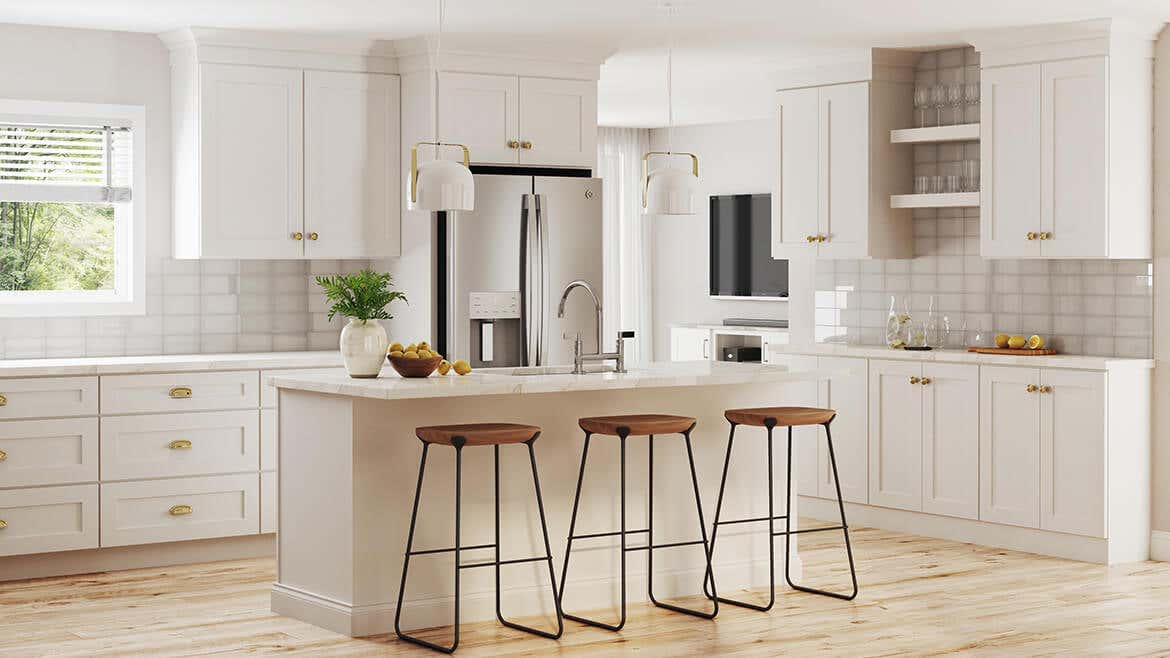
Lily Ann Cabinets Colorado White Shaker
Soft green for a garden feel
Green cabinets and gray stone both come from nature, so they sit together easily. Our green kitchen ideas note that dark stone works best with lighter greens, so the room keeps some contrast. Craftsman Lily Green Shaker is a soft, gray-green shaker that fits that rule. It also comes in a 36" farm sink base (CSG-FSB36, in stock October 2, 2026).
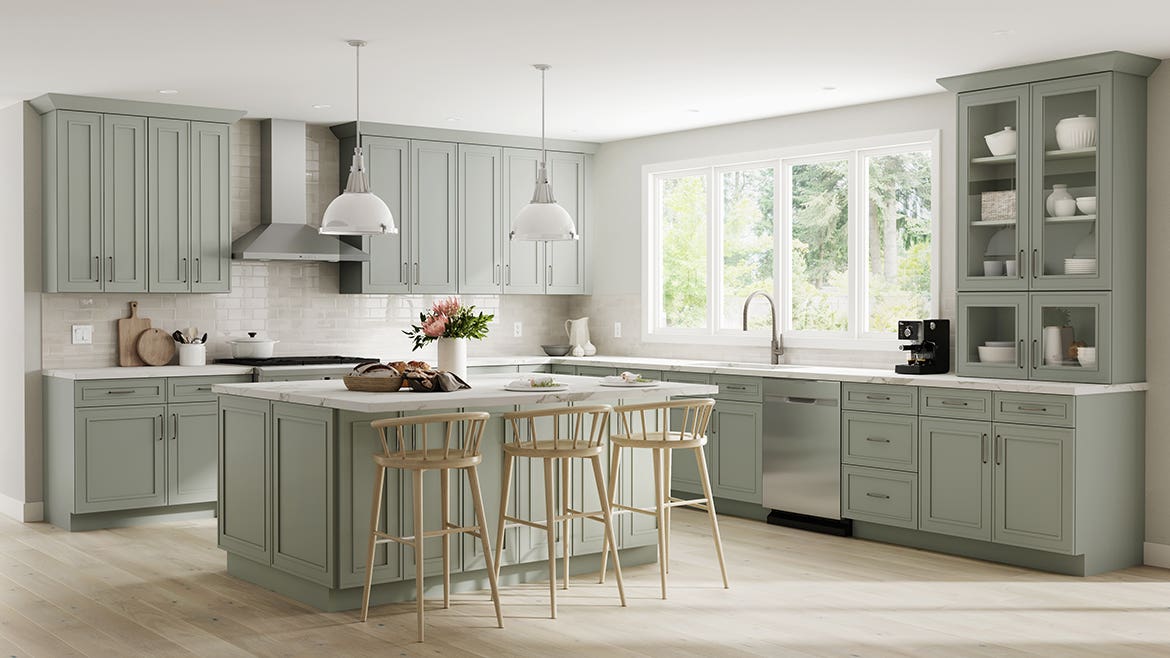
Lily Ann Cabinets Craftsman Lily Green Shaker
Natural wood for warmth
BHG notes that black and white soapstone make a sleek contrast with wood. A warm wood cabinet keeps a soapstone kitchen from feeling cold. Craftsman Natural Shaker shows real wood grain in a warm, natural finish.

Lily Ann Cabinets Craftsman Natural Shaker
Antique and off-white
Warm whites look crisper next to a dark counter. Our guide to antique white kitchen cabinets names soapstone as one of the strongest-contrast tops for that color.
Because soapstone changes color, order free door samples and hold them against a piece of the stone, both dry and oiled. Browse more Shaker cabinets, white cabinets or wood cabinets.
Is Soapstone Right for You?
- Choose soapstone if you cook a lot, set hot pans down without thinking, like a matte, lived-in look and don't mind a few marks. It suits farmhouse, traditional and cottage kitchens especially well.
- Think twice if every scratch would bother you, you want a bright or busy pattern, or you need one huge slab with no seams.
- A middle path: House Beautiful suggests saving soapstone for a lower-traffic counter rather than a busy island, or using a dark granite that looks similar.
Still comparing materials? Our guide to kitchen countertop materials covers granite, quartz, marble and laminate side by side.
The Takeaway
Soapstone is a soft, heat-proof, stain-resistant natural stone that never needs sealing. In exchange, it scratches, it darkens and it costs more than most granite. If you can live with a counter that shows its history, it's one of the easiest stones to cook on. Pair it with solid, level base cabinets and a cabinet color that works with a stone that will keep getting darker.
Planning the whole kitchen? Get a free 3D kitchen design and see your cabinets with the countertop you have in mind.
Frequently Asked Questions
Soapstone scratches and dents more easily than granite or quartz, so knife marks and dropped pans can leave marks. Most owners oil it, and the color can dry out unevenly at first. It comes in a narrow range of grays, greens and blacks, large slabs are scarce, and it usually costs more than granite. Light scratches sand out, which is why many owners accept the trade.
Usually not. Better Homes & Gardens puts soapstone at $55 to $120 per square foot and granite at $45 to $110, and House Beautiful gives $70 to $120 for soapstone slabs. HomeGuide puts installed quartz at $50 to $150 per square foot. The ranges overlap with quartz, so the exact slab, its color and your fabricator decide which is cheaper. Smaller remnant pieces can bring the cost down for a vanity or bar.
It depends on what bothers you more: heat or scratches. Soapstone handles hot pans and acids and never needs sealing, but it scratches and darkens over time. Quartz resists scratches and stains and never needs sealing, but HomeGuide says its resin can be damaged above about 300°F, so you need trivets. Heavy cooks often prefer soapstone; people who want a counter that never changes often prefer quartz.
House Beautiful, citing Caesarstone, puts soapstone slabs at about $70 to $120 per square foot. Better Homes & Gardens gives $55 to $120 per square foot and says installation adds about $90 per square foot. Rare colors and large slabs cost more; softer, high-talc soapstone costs less but wears faster. Get a quote from a local fabricator for your layout.
Enough for normal cooking. House Beautiful says you can set a hot pan or a baking tray straight from the oven on soapstone without cracking or damaging it, and BHG says you can skip the trivet. It's the same stone used for fireplaces and hearths. None of the sources we checked gives an exact temperature limit, so we don't quote one.
Rarely. Soapstone is nonporous, and The Spruce calls it nearly impervious to staining. Oil and water can darken it for a while, which is not a true stain. If a mark does appear, BHG suggests a paste of baking soda and water left overnight, then rinsed off; a stubborn mark may need a few rounds.
It's better not to. Better Homes & Gardens advises against acidic cleaners such as vinegar and lemon juice, along with abrasive cleaners and scrub brushes. Use warm water and mild dish soap for daily cleaning. Spilled food acids such as lemon juice or tomato sauce won't etch soapstone, according to House Beautiful, so a spill isn't a problem.
Nothing is better at everything, but some materials beat soapstone on its weak spots. If scratches bother you, a stone fabricator quoted by House Beautiful suggests dark granites such as Absolute Black, Jet Mist or Vermont black, which look similar and resist scratches better. If you want zero upkeep, quartz needs no sealing or oiling, though it needs trivets.
Mostly soft grays, from light gray to charcoal, often with a green tint. Better Homes & Gardens also lists blue, green, black and white varieties, and House Beautiful and BHG both say the rarer shades usually cost more. All soapstone darkens over time, and oiling turns light gray stone close to black, so see a sample both dry and oiled.
















Comments