


Quarter round is a quarter of a circle, the same height as it is deep, most often 3/4 inch by 3/4 inch. Shoe molding is slimmer and taller, typically about 3/4 inch tall and 1/2 inch deep, so it hugs the baseboard. Use shoe molding for a sleek line over small gaps and quarter round for wider gaps, such as floating floors and the floor line at kitchen cabinets.
- Shape: quarter round is a quarter circle (3/4" x 3/4" is most common); shoe molding is taller than it is deep (about 3/4" x 1/2").
- When to use which: shoe molding for small gaps and a slim look; quarter round for wider gaps, like floating floors.
- vs. baseboard: baseboard is the tall board on the wall; quarter round or shoe molding is the small strip nailed to its foot.
- At kitchen cabinets: a floor that stops at the toe kick leaves a gap. Quarter round in the cabinet finish covers it.
- Install rule: nail into the baseboard or toe kick, never the floor, and caulk only the top joint.
- Lily Ann Cabinets sells 3/4" x 3/4" x 96" quarter round in each line's finish, like Colorado White Shaker and Navy Blue Shaker, plus flooring quarter round (in stock October 1, 2026).
You finish a new floor, step back, and see it: a thin, dark line where the floor stops short of the baseboard, or where it meets the bottom of your kitchen cabinets. A small strip of trim closes that line. The question is which strip: shoe molding or quarter round.
This guide explains the difference, when to use each one, how they compare to baseboard, and how to install quarter round step by step. It also covers the spot most guides skip: the joint where the floor meets your base cabinets. All Lily Ann sizes and stock below were checked on the live site on October 1, 2026.
Shoe Molding vs. Quarter Round: The Short Answer
Quarter round is a quarter of a circle, so it is the same height as it is deep, most often 3/4 inch by 3/4 inch. Shoe molding is a slimmer, taller strip, typically about 3/4 inch tall and 1/2 inch deep, so it sits closer to the baseboard. Use shoe molding for a sleek line over small gaps. Use quarter round when the gap is wider, as with many floating floors.
Both strips do the same job. They cover the gap between the floor and the baseboard (or the cabinet base), hide small dips in the floor, and give the edge a finished look. The difference is mostly shape, how far the strip sticks out into the room, and the gap it can cover.
What Is Quarter Round?
Quarter round is exactly what the name says: one quarter of a round dowel. It has two flat backs that meet at a 90-degree angle, one against the wall and one on the floor, and a rounded face. Because both flat sides are the same width, it sticks out from the wall as far as it stands tall.
Scott Sidler of The Craftsman Blog notes that quarter round usually runs from 1/2 inch to 1 inch, with 3/4 inch the most common size. Besides the floor line, it is used on inside corners of wall panels, outside corners of trim and as part of built-up moldings.

Lily Ann Cabinets: Colorado White Shaker quarter round molding
What Is Shoe Molding?
Shoe molding, also called base shoe, has the same flat backs as quarter round, but its profile is taller than it is deep. It looks like a flattened quarter round. The name comes from where it sits: at the "foot" of the wall, along the bottom of the baseboard.
Because it sticks out less, shoe molding hugs the baseboard and takes up less floor. Its slimmer shape also bends a little more easily over a floor that rises and dips.
Shoe Molding vs. Quarter Round: Side by Side
| Quarter round | Shoe molding | |
|---|---|---|
| Shape | A quarter circle, equal height and depth | Taller than it is deep, a flatter curve |
| Typical size | 3/4" x 3/4" (range about 1/2" to 1") | About 3/4" tall x 1/2" deep |
| How far it sticks out | As far as it is tall | Less; it hugs the baseboard |
| Gap it covers | Larger gaps, like the edge gap of a floating floor | Smaller gaps over solid wood or tile |
| Uneven floors | Stiffer | Bends a little more easily |
| Look | Rounder and more noticeable | Slimmer and quieter |
Sizes are typical retail sizes, not a standard. Lily Ann's own quarter round is 3/4 inch by 3/4 inch by 96 inches, and its flooring quarter round is 1.1 by 1.1 inches (see the table below).

When to Use Quarter Round vs. Shoe Molding
- Choose quarter round when the gap is wide. Floating floors, like click-lock laminate and SPC vinyl, are laid with a gap at the edges so they can move, and quarter round reaches farther across it.
- Choose shoe molding when the gap is small and you want a slim line, most often over nail-down hardwood or tile against a standard baseboard.
- Choose by the baseboard. A flat, modern baseboard usually looks cleaner with slim shoe molding. A traditional profiled baseboard can carry either.
- Keep one per room. Sidler advises against mixing the two in the same room, because the different profiles won't meet cleanly at the corners.
- Match the cabinets at the cabinets. Along the base of kitchen cabinets, use quarter round in the cabinet's own finish so it reads as part of the cabinet, not a patch (more below).
Quarter Round vs. Baseboard: What's the Difference?
Baseboard is the tall board, usually 3 to 6 inches or more, that runs along the bottom of the wall and covers the joint where the wall meets the floor. Quarter round and shoe molding are small strips nailed to the bottom of the baseboard to cover the last gap at the floor. They work together; one does not replace the other.
You may not need either strip if the baseboard was installed after the floor and sits tight to it, or if the baseboard was scribed to follow the floor. Carpenters often add shoe or quarter round because it is quicker than scribing a tall baseboard to a wavy floor. For baseboard profiles and heights, see our guide to baseboard and door casing styles.
Cabinets have their own version of baseboard. The board across the recessed space at the bottom of a base cabinet is the toe kick, covered in our cabinet toe kick guide. On an island, some people add a furniture-style base molding instead; Lily Ann's Colorado White Shaker furniture base molding is 4-1/2 inches tall, 5/8 inch deep and 96 inches long.
Quarter Round at the Base of Kitchen Cabinets
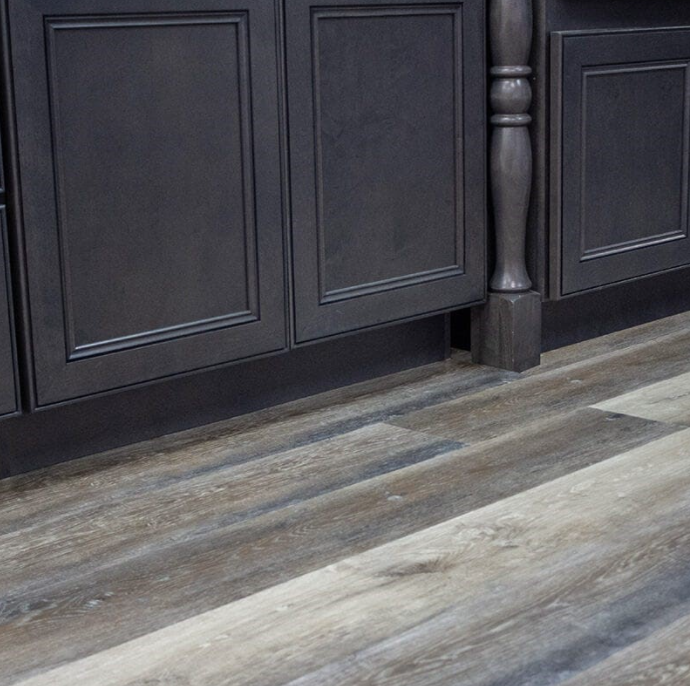
This is the joint most quarter round guides never mention. When a floor goes in after the cabinets, or a floating floor is laid around them, there is a gap along the toe kick and at the sides of the end cabinets. Floating floors are not fastened under fixed cabinets, so they stop short of the toe kick and need room to move. That gap needs trim, just like the gap at a wall.
Lily Ann sells quarter round for exactly this. Its Navy Blue Shaker and Key Largo White listings describe it as "used to cover gaps between flooring and base cabinets." Each cabinet line has its own quarter round in the same finish, so the strip disappears into the cabinet instead of standing out as a white or wood line.
A few tips for the cabinet base:
- Run it along the toe kick, then wrap it around the exposed ends of the cabinet run with a miter at each outside corner.
- End it cleanly at an appliance. Where the run stops at a dishwasher or range opening, finish with a small return (see the steps below) so the end grain doesn't show.
- Nail into the toe kick or cabinet base, never the floor. A floating floor has to move under the trim.
- Use the cabinet finish, not the floor color. Against cabinets, a strip in the cabinet finish blends best. Against walls, match the baseboard or the floor.
- Uneven floor? If the toe kick shows a wavy gap, see how to scribe it in our scribe molding guide.
If you are putting in a new floor and cabinets together, our kitchen floor ideas guide covers which goes in first.
Lily Ann Quarter Round: Sizes and Finishes
Lily Ann sells two kinds of quarter round: cabinet-finish quarter round in each cabinet line's trim section (SKU "QR8"), and flooring quarter round made to go with its SPC floors. These showed In Stock on October 1, 2026:
| Cabinet line | SKU | Size |
|---|---|---|
| Colorado White Shaker | WSH-QR8 | 3/4" x 3/4" x 96" |
| Navy Blue Shaker | BSH-QR8 | 3/4" x 3/4" x 96" |
| Grey Shaker Elite | GSH-QR8 | 3/4" x 3/4" x 96" |
| Craftsman White Shaker | CSW-QR8 | 3/4" x 3/4" x 96" |
| Craftsman Black Shaker | CSB-QR8 | 3/4" x 3/4" x 96" |
| Craftsman Natural Shaker | CSN-QR8 | 3/4" x 3/4" x 96" |
| Craftsman Lily Green Shaker | CSG-QR8 | 3/4" x 3/4" x 96" |
| Off-White (Craftsman Off-White) | MIST-QR8 | 3/4" x 3/4" x 96" |
| Mocha | MOCHA-QR8 | 3/4" x 3/4" x 96" |
| York Linen | YL-QR8 | 3/4" x 3/4" x 96" |
| York Driftwood Grey | YGR-QR8 | 3/4" x 3/4" x 96" |
| Charleston Linen | CL-QR8 | 3/4" x 3/4" x 96" |
| Key Largo White | LW-QR8 | 96" long (profile size not listed on the page) |
White Shaker Elite, Charleston Cherry, Charleston Saddle, Bristol Linen quarter round also showed in stock but marked Final Sale. The Shaker Espresso, Shaker Cinnamon, Charleston Toffee, Bristol Chocolate, York Chocolate and York Saddle versions showed Out of Stock that day, so check before you order those finishes.

Lily Ann Cabinets: Navy Blue Shaker quarter round molding
For the floor itself, Lily Ann lists flooring quarter round in four colors, found in its Flooring & Backsplash section:
| Floor color | SKU | Size |
|---|---|---|
| White Oak | GH1047C-QR8 | 1.1" x 1.1" x 94.5" |
| Chestnut | GH700152-QR8 | 1.1" x 1.1" x 94.5" |
| Driftwood | GH69071KA-QR8 | 1.1" x 1.1" x 94.5" |
| Rustic Brown | GH320104-QR8 | 1.1" x 1.1" x 94.5" |
The flooring quarter round is a hollow, wood-look profile. The White Oak one goes with Lily Ann's 9 x 60 White Oak SPC plank, which is listed as a floating, click-lock floor. You'll find the rest of the line on the SPC flooring page.

How much quarter round do you need?
Measure every run that needs trim, add them up and divide by the stick length. Round up, then add one extra stick for corners and bad cuts. For example, with Lily Ann's 96-inch cabinet quarter round:
- A 10-foot run of base cabinets: 120 inches of toe kick
- Two exposed cabinet ends at 24 inches deep each: 48 inches
- Total: 168 inches, or 1.75 sticks. Round up to 2, plus 1 spare = 3 sticks.
Cabinet trim ships as a separate item, so order it with the cabinets. Browse each line's trim section, for example Colorado White Shaker trim or Navy Blue Shaker trim. Most of these are shaker cabinet lines.
How to Install Quarter Round
Installing quarter round is a beginner-friendly job if you go one piece at a time. These steps follow the method in The Spruce's How to Install Quarter-Round or Shoe Molding Trim and Sidler's tips. The same steps work for shoe molding.
Tools: tape measure, pencil, miter saw (or a hand saw and miter box), coping saw for inside corners, brad nailer (or hammer, finish nails and a nail set), wood filler, paintable caulk, and paint or a touch-up kit.
- Finish the floor first. Trim goes on last, after the flooring and the baseboard or toe kick are in.
- Pre-finish if you can. Painting or staining long strips before you cut them is easier than painting on the floor. Lily Ann's cabinet quarter round already comes in the cabinet finish.
- Measure one piece at a time. Measure, cut and fit each piece before measuring the next. Cut slightly long and trim to fit.
- Cut outside corners at 45 degrees. Stand the strip on the saw the way it sits in the room, flat back against the fence and flat bottom on the saw table, so the angles come out right.
- Cope or miter inside corners. Sidler recommends a coped joint for inside corners, because walls are rarely a perfect 90 degrees and a cope hides the gap better than a miter.
- Join long runs with a scarf joint. If one stick won't reach, join two pieces with matching 45-degree cuts rather than a flat butt joint.
- Nail into the baseboard or toe kick, not the floor. Hold the strip tight to the floor and the baseboard, angle the nail close to level, and drive a brad about every 12 to 18 inches. A floating floor must be free to move.
- Finish open ends with a return. Where the trim stops at a doorway, appliance or cabinet end, cut a small mitered return piece so the end turns back to the wall.
- Fill, caulk and touch up. Fill nail holes, then caulk the top joint between the strip and the baseboard. Do not caulk the bottom joint to the floor. On cabinets, use a matching touch-up kit, like the Navy Blue Shaker touch up kit.
For the rest of the job, from setting base cabinets to hanging the uppers, see our guide to installing kitchen cabinets. For every other piece of cabinet trim, see our types of cabinet trim and molding.
Common Mistakes to Avoid
- Nailing through the floor. It pins a floating floor and can make it buckle or open up at the seams.
- Caulking the floor joint. Sidler warns that caulk at the bottom gets squeezed out as the floor swells. Caulk only the top joint.
- Using MDF where floors get wet. Sidler calls water MDF's "mortal enemy." In kitchens, baths and mudrooms, use wood, PVC or the cabinet-finish strip.
- Mixing profiles in one room. Quarter round meeting shoe molding at a corner never lines up.
- Using a different color at the cabinets. A white strip under a navy cabinet draws the eye to the gap you were trying to hide.
The Takeaway
Shoe molding and quarter round do the same job. Shoe molding is the slimmer choice for small gaps against a baseboard. Quarter round covers more, which is why it is the usual pick for floating floors and along the toe kick of kitchen cabinets. Whichever you choose, nail it to the baseboard or cabinet, never the floor, and caulk only the top.
Planning new cabinets and floors together? Get a free 3D design and we'll include the quarter round, toe kick and fillers your layout needs.
Frequently Asked Questions
Use quarter round when the gap between the floor and the baseboard is wide, as with many floating laminate and vinyl floors, because it reaches farther across the floor. Use shoe molding when the gap is small and you want a slimmer line, most often over solid hardwood or tile. Along the base of kitchen cabinets, quarter round in the cabinet finish is the usual choice. Pick one profile per room so the corners meet cleanly.
Usually not by much. The price of either strip depends far more on the material (pine, MDF, oak, PVC or rubber) and the length than on the profile. Because shoe molding is a little smaller, a flooring guide from Go Flooring says it is often slightly cheaper. Compare the same material and length side by side before you decide.
No, quarter round is still widely used, especially to cover the wider edge gap of floating floors and along kitchen cabinets. Its rounder shape is more noticeable, so many updated and modern rooms use the slimmer shoe molding against the baseboard instead. If your floor sits tight to the baseboard, you can also skip both.
The most common modern alternative is shoe molding, which is slimmer and hugs the baseboard. Another is to skip the small strip entirely: install the baseboard after the floor and scribe it to follow the floor, or use a taller, flat baseboard set tight to the floor. The no-strip look takes more careful work but gives the cleanest line.
Nail it. Most carpenters fasten quarter round with brad nails or finish nails driven into the baseboard, or into the toe kick at cabinets, so it can be removed later. Never nail it into the floor. Glue is only a backup where a nail won't hold, and even then it should go on the baseboard side, not the floor side.
Yes. Use a hammer and thin finish nails, and drive each nail almost flush. Then tap it just below the surface with a nail set and fill the hole. It is slower than a brad nailer but works fine for a room or a run of cabinets. Pre-drilling tiny pilot holes near the ends helps keep the strip from splitting.
It's easier if you do. Painting or staining the long strips before cutting saves you from brushing paint right next to a new floor, and you only touch up nail holes and cut ends afterward. Painting after installing works too, but needs careful taping. Lily Ann's cabinet quarter round comes in the cabinet line's finish, so it only needs touch-up.
Hold the strip tight against the floor and the baseboard, then drive brad nails close to level into the baseboard, about every 12 to 18 inches. Keep the nails out of the floor so a floating floor can still move. Fill the holes, then caulk only the top joint between the strip and the baseboard.
If you must glue, use a construction adhesive or wood glue on the back face that touches the baseboard or toe kick, not the bottom that touches the floor. Glue on the floor side locks a floating floor in place. For most jobs, nails alone are better because the trim can be removed later without damage.
















Comments