


Mount the bottom of a standard hood 20 to 24 inches above an electric cooktop, 24 to 30 inches above a gas cooktop and 18 to 22 inches above induction, per KitchenAid's published height guide. Chimney-style wall-mount and island hoods usually sit higher, 30 to 36 inches, because their own manuals specify it — the Forno Orvieto and Coppito manuals Lily Ann links both give a 30-inch minimum and a 36-inch maximum. Measure from the cooking surface, not the countertop, and if your range's manual asks for more clearance than the hood's, use the larger number. For the range's own width, depth and cabinet cutout, see our standard stove size guide.
- By fuel: gas 24–30 in., electric 20–24 in., induction 18–22 in. above the cooking surface (KitchenAid).
- By hood type: under-cabinet from 18 in.; wall-mount and island chimney hoods 30–36 in.; inserts vary by model — 25.5 in. and 30 in. minimum on the two we sell.
- The tiebreaker: the Forno Bari manual says that if your range specifies a different distance, "use the greater distance of the two."
- Ceiling height doesn't change the hood height — it changes whether the chimney cover reaches. Check the chimney sections against your ceiling before you buy.
- There is no code number. IRC 2021 Section M1503 sets no mounting height; it makes you follow the hood's own listed instructions.
- Lily Ann Cabinets lists "Minimum Height from Cooktop" and "Maximum Height from Cooktop" on most range hood pages, with the install manual linked on the same page.
You have the hood. You have the stove. The only thing left is a pencil line on the wall, and getting that line wrong is the difference between a hood that clears the kitchen in a minute and one that lets steam roll past it onto the ceiling.
This guide gives the real numbers: by cooktop fuel, by hood type, and by what your own install manual says. Every figure below comes from a named source — either a manufacturer's published guide or the install manual linked on the hood's own product page at Lily Ann Cabinets. All Lily Ann specs and stock were checked on the live site on September 23, 2026.
How High Should a Range Hood Be Above the Stove?
For a standard wall or under-cabinet hood, mount the bottom of the hood 20 to 24 inches above an electric cooktop and 24 to 30 inches above a gas cooktop, per KitchenAid's published height guide. Induction sits lower, 18 to 22 inches. Chimney-style wall-mount and island hoods usually sit higher, 30 to 36 inches, because that is what their own manuals call for. Your hood's install manual always wins over any chart.
Two different things are being measured here, and mixing them up is why the numbers online look contradictory. One is the fuel under the hood, which is a heat-and-safety question. The other is the kind of hood, which is a design question decided by the manufacturer. A chimney hood is built to be seen, so its maker specifies a taller gap; an under-cabinet hood hides under a cabinet, so it sits low.
| Cooktop type | Height above the cooking surface |
|---|---|
| Gas | 24–30 in. |
| Electric | 20–24 in. |
| Induction | 18–22 in. |
| Downdraft | Built into the cooktop — no overhead clearance to set |
Source: KitchenAid, "What's the Right Range Hood Height Above a Stove?" KitchenAid adds that this "offers general guidance only" and that your own model's manual decides the exact number.
The Home Ventilating Institute, the trade body that certifies ventilation performance, answers the same question this way: "The hood should be located at the manufacturer-recommended height above the cooking surface. Review of our membership installation instructions show an average range of 20-30"."
Range Hood Height by Hood Type
Under-cabinet hoods sit lowest, from 18 inches. Wall-mount chimney hoods and island hoods sit highest, 30 to 36 inches. Insert liners that drop into a wood hood cover sit between the two, and vary most by model. These are the numbers from the install manuals and product specs for the hoods Lily Ann Cabinets sells, checked September 23, 2026.
| Hood type | Example we sell | Height above the cooktop | Where that number comes from |
|---|---|---|---|
| Under-cabinet | Forno Bari 30" | 18 in. minimum; not more than 25 in. for best performance | Bari (FRHUC5255) install manual, linked on the product page |
| Wall-mount chimney | Forno Orvieto 36" | 30 in. minimum, 36 in. maximum (the 36, 48 and 60 in. models can go to 42 in., with a loss of efficiency) | Orvieto (FRHWM5094) install manual |
| Island | Forno Coppito 48" | 30 in. minimum; 36 in. optimal maximum, up to 42 in. on the wider models | Coppito (FRHIS5129) install manual |
| Insert / liner | Forno Frassanito 30" | 25.5 in. minimum, 30 in. maximum | Product page spec table |
| Insert / liner | Forno Altilia 30" | 30 in. minimum, 36 in. maximum | Product page spec table |
| Recessed ceiling | Forno Arezzo 44" | 30 in. minimum, 72 in. maximum | Product page spec table |
Look at the two insert rows. Same category, same brand, and the minimum is nearly five inches apart. That is the whole argument for reading your own manual instead of a chart: "insert hood" is not a height.

The Forno Bari is an under-cabinet hood: its manual starts at 18 inches above the cooktop.
Gas vs. Electric: Why the Fuel Changes the Number
A gas burner puts an open flame under the hood. Even with nothing in the pan, the flame throws heat straight up at the hood's underside, so gas gets the taller gap. KitchenAid's guide puts it plainly: gas cooktops "produce an open flame and generally, a higher ambient heat output," which is why the recommendation is 24 to 30 inches.
Electric coils and radiant glass tops release less ambient heat, so the same guide allows 20 to 24 inches. Induction releases the least of all, because the heat is generated in the pan rather than at the surface, so it can sit at 18 to 22 inches. Lower is better for capture: the closer the hood is, the less the rising plume can spread before it reaches the filters.
One rule overrides all of this, and it is in the Bari manual in black and white: "The minimum distance from the cooking surface to the range hood is 18" (458 mm). If your range specifies a different distance, use the greater distance of the two." So if you buy a pro-style gas range whose own manual demands 30 inches of clearance, 30 inches is your number, even though the hood would allow 18. Check both manuals and take the bigger figure.
Shopping for both at once? Our cooktops and freestanding ranges list the fuel type on every product page, and each range's own manual sets the clearance it needs.
Hood Width: Match the Cooktop, or Go Wider
A range hood should be at least as wide as the cooktop below it. The Forno Bari manual says the hood "should be approximately the same size as the cook top." Many installers go one size up — a 36-inch hood over a 30-inch range — because a wider canopy catches the plume that drifts sideways off the front burners.
Width does not change your mounting height. KitchenAid's guide is explicit that width and depth "don't directly determine installation height," but they do change how much of the cooktop the hood actually covers. If you have to mount high because of a tall ceiling or a tall cook, a wider hood buys back some of the capture you lose.
Fan power matters here too. KitchenAid notes that a hood with high CFM "may be able to be installed higher up, and vice versa." A 200 CFM hood at 30 inches is doing very little. Our range hood size guide covers width and CFM in detail, and under-cabinet vs. wall-mounted range hoods has a full side-by-side spec table for the two most common types.

Ceiling Height and the Chimney Cover
A taller ceiling does not change how high the hood goes. It changes whether the chimney cover can reach the ceiling. KitchenAid's guide says the clearance to the cooktop "stays the same — typically no more than 36 inches above the cooktop — but taller ceilings may require chimney extensions or different hood styles to reach venting without impacting performance."
This is the number one surprise on a wall-mount or island hood. The hood body hangs at 30 to 36 inches. Everything above it is a decorative cover that hides the duct, and it comes in fixed pieces. The Forno Orvieto ships with two adjustable chimney sections 400 mm high each; the Coppito island hood ships with two chimney pieces and eight support poles at 500 mm each. Both manuals tell you to "check your ceiling height and the range hood height maximum before you install your hood."
If your ceiling is taller than the chimney can cover, you have three options: a hood rated for a taller chimney, a chimney extension kit from the same maker, or a built surround that hides the gap. That last one is why a lot of tall-ceiling kitchens end up with a wood hood cover over an insert liner: the cover is built to your ceiling, and only the liner inside has to meet a height spec.
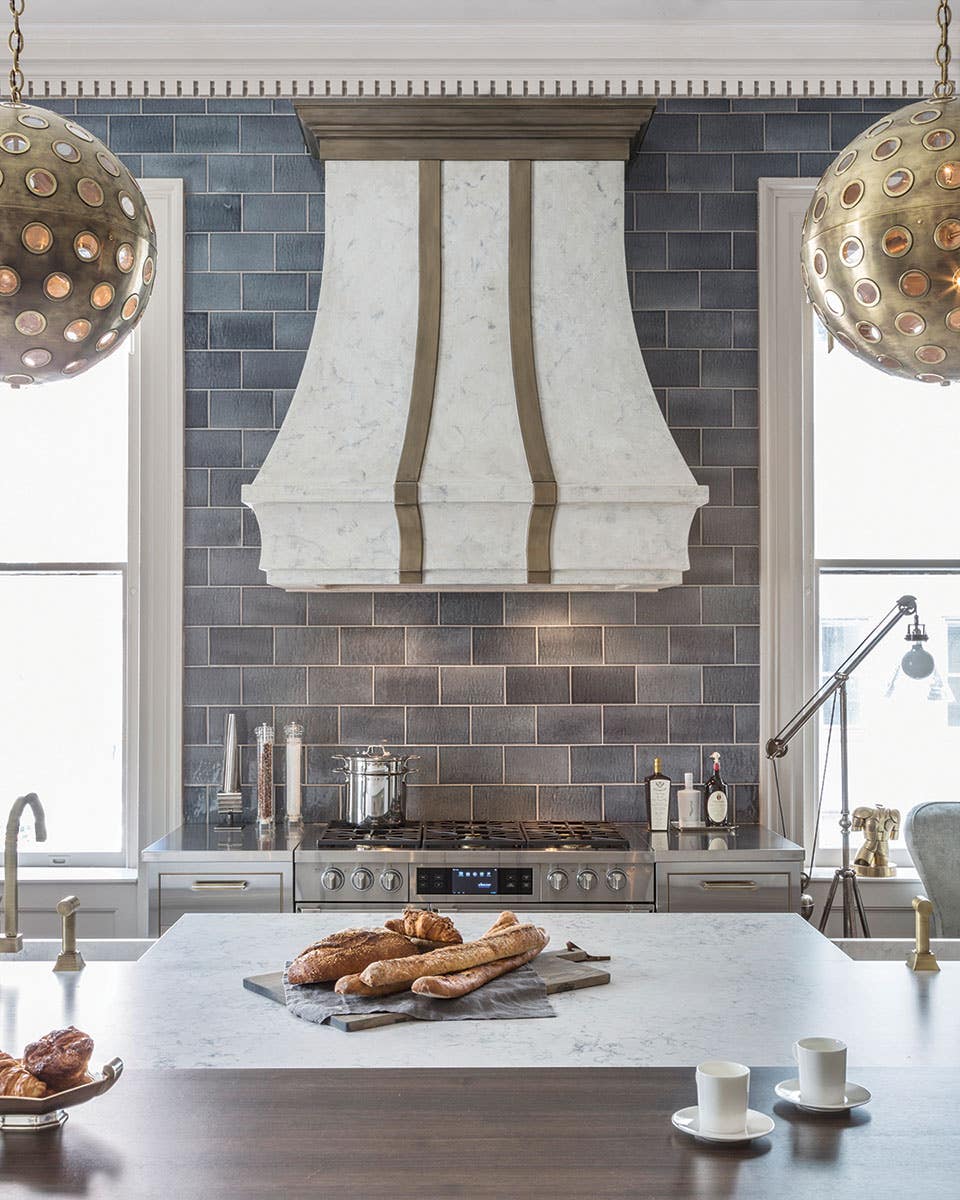
Too Low or Too High: What Actually Goes Wrong
The Orvieto and Coppito manuals use the same sentence for both failure modes: "Hoods mounted too low could result in heat damage and fire hazard; while hoods mounted too high" lose their pull.
- Too low. The hood's underside, filters and wiring sit in the heat. Grease bakes onto the baffles instead of draining. On a gas range the flame can reach the hood. Tall cooks hit their heads on the corners.
- Too high. Steam and smoke spread out before they reach the canopy, so the fan pulls in room air instead of cooking air. The hood ends up sounding louder for what it removes, because you run it on high to compensate.
The Bari manual's own final-check list asks you to confirm "that the distance between the cooktop and the bottom of the range hood is between 458 mm (18 in) and 710 mm (28 in)" — note that its pre-install section says not more than 25 inches for best performance. When a manual gives you two numbers, use the tighter one and you cannot be wrong.
Over-the-Range Microwaves Are a Different Number Entirely
An over-the-range microwave is not mounted at hood height. KitchenAid's guide says to "expect to need about 12 to 13 inches of clearance between your stovetop and an over-the-range microwave," and to check the model's own instructions. That is roughly half the height of a chimney hood.
This matters when you swap one for the other. Pull out a microwave and hang a hood in the same spot and the hood sits far too low; hang a microwave where a hood used to be and you are reaching over your head to stir a pot. Either swap usually means new mounting holes, sometimes a new cabinet above, and often a change in duct size. If you want the microwave out of the sightline entirely, our guide to microwave cabinet ideas covers where else it can live, and we stock microwaves in both styles.
Is There a Building Code for Range Hood Height?
The 2021 International Residential Code sets no mounting height for an ordinary household range hood. Section M1503 covers domestic cooking exhaust and requires listing to UL 507, a duct to the outdoors and metal ductwork, but it never gives a height above the cooktop. The height requirement comes from your hood's listed installation instructions, which is exactly what the code makes you follow.
There are two numbers in that section worth knowing, both from IRC 2021 Chapter 15:
- Open-top broiler units (M1503.2.1) do get a clearance: "A clearance of not less than 24 inches (610 mm) shall be maintained between the cooking surface and combustible material and cabinets. The hood width shall be not less than the width of the broiler unit and shall extend over the entire unit."
- Makeup air (M1503.6): where a home has a fuel-burning appliance that is not direct-vent inside the building's air barrier, "each exhaust system capable of exhausting in excess of 400 cubic feet per minute" must be given makeup air at about the same rate. Plenty of the hoods we sell are over 400 CFM, so this is a real question, not a technicality.
Codes are adopted and amended locally, so the version enforced where you live may differ. Your building department or a licensed HVAC installer can tell you what applies to your house. We sell cabinets and hoods; we are not your inspector.
How to Mark the Height Before You Drill
- Measure from the cooking surface, not the counter. A slide-in range's cooktop usually sits about an inch above the surrounding countertop. Measuring from the counter puts the hood an inch too low.
- Open both manuals. The hood's and the range's. Take the greater of the two minimums, per the Bari manual's instruction.
- Find the center. Draw a vertical line up the wall through the middle of the cooktop. The Orvieto manual has you run this line to the ceiling first, then draw the horizontal line at the chosen height and align the bottom of the hood to it.
- Dry-fit with the range in place. Stand where you cook. If you cannot see the back burners, or your head is near the canopy, adjust within the manual's range before you drill.
- Plan the outlet. The Orvieto manual's note is in capitals for a reason: "PLACE THE POWER OUTLET AND POWER CORD BEHIND THE CHIMNEY." Wire it where the cover will hide it, not below the hood.
- Check the chimney reaches. Measure from the top of the hood to the ceiling and compare it to the chimney sections you actually have in the box.
Our step-by-step range hood installation guide covers the rest of the job, and ducted vs. ductless range hoods covers the venting decision that comes before it. If the hood is going over an island, island range hood ideas has the layout side.

Shopping for a Hood at Lily Ann Cabinets
Every hood on our range hoods page links its own install manual and spec sheet, and most list "Minimum Height from Cooktop" and "Maximum Height from Cooktop" right in the specification table. Read those two rows before you commit to a wall, because they decide whether the cabinet above the range stays or goes.
If you want the hood to disappear into the cabinetry instead of standing out, our arch hoods, square hoods and angle hoods come in cabinet finishes and take an insert liner, so the liner's height spec is the one you follow. All of our kitchen cabinets ship ready to assemble, nationwide.
Frequently Asked Questions
No, not a single national number. The 2021 International Residential Code's Section M1503 covers domestic cooking exhaust equipment and never states a mounting height above the cooktop. What it does require is that the hood be a listed appliance installed to its own instructions, so the manufacturer's manual is effectively the code. One exception: M1503.2.1 requires at least 24 inches between the cooking surface and combustible material for domestic open-top broiler units. Codes are amended locally, so ask your building department.
KitchenAid's published guide recommends 24 to 30 inches above a gas cooktop, 20 to 24 inches above an electric cooktop and 18 to 22 inches above induction. The Home Ventilating Institute says its members' installation instructions average 20 to 30 inches. Chimney-style wall-mount and island hoods are usually specified higher, at 30 to 36 inches. Treat all of these as a starting range and let your hood's own manual set the final number.
Between 18 and 36 inches, depending on the hood and the fuel. The lowest figure among the hoods Lily Ann sells is the Forno Bari under-cabinet hood at 18 inches minimum; the highest normal figure is 36 inches for a wall-mount or island chimney hood. Measure from the cooking surface itself, not from the countertop beside it, because a slide-in range's top usually sits slightly proud of the counter.
Open two manuals: the hood's and the cooktop or range's. The Bari hood manual states the rule directly — the minimum is 18 inches, but "if your range specifies a different distance, use the greater distance of the two." Then check the hood's maximum as well, because most manuals give both. For the Forno Orvieto wall-mount that window is 30 to 36 inches; for the Bari it is 18 to 25 inches for best performance.
For most kitchens with a standard gas range and an under-cabinet or wall hood, somewhere in the 24 to 30 inch band works well, because it clears the flame and still captures the plume. Taller cooks often want the upper end of the manual's range so they are not ducking under the canopy. Going above the manual's maximum is the one thing to avoid, because capture falls off quickly once the plume has room to spread.
No. The hood body hangs at its specified height above the cooktop; the chimney above it is a cover that hides the duct, and it is fine for that cover to stop short on a lower ceiling or to need an extension on a taller one. Under-cabinet, insert and downdraft hoods do not reach the ceiling at all. Only ceiling-mounted island hoods and recessed ceiling units attach up there by design.
At minimum a 30-inch hood, and a 36-inch hood is the common upgrade. The Forno Bari manual's rule is that the hood "should be approximately the same size as the cook top," and going one size wider catches the plume that drifts off the front burners. Width does not change your mounting height, but a wider canopy covers more of the cooktop if you have to mount toward the top of the allowed range.
Ducted is the better install, and the code assumes it. IRC 2021 M1503.3 requires domestic cooking exhaust to discharge outdoors through a duct, with an exception for listed and labeled ductless hoods installed to their instructions where other ventilation exists. The Home Ventilating Institute is blunter: hoods "should be ducted to the outside of the home," and "high BTU gas cooking equipment should always be ducted to the outside."
18 to 22 inches, per KitchenAid's height guide. Induction generates heat inside the pan rather than at the surface, so there is far less ambient heat rising at the hood, and a lower hood captures steam better. As with every other fuel, if the induction cooktop's own manual asks for a taller gap than the hood's minimum, use the taller number.
There is no single floor height. You place the outlet where the hood will hide it. The Forno Orvieto manual puts it in capitals: "PLACE THE POWER OUTLET AND POWER CORD BEHIND THE CHIMNEY." For an under-cabinet hood the supply usually comes through the cabinet above instead, and the Forno Bari manual has it wired to a junction box rather than plugged in. Decide the hood's height first, then have an electrician site the outlet.
















Comments