


For most cabinets, hardwood plywood with a B or C face grade and a 1 or 2 back is the best value. Use A-grade faces only where a panel stays visible with a clear finish. "Cabinet grade" is a trade term, not an official grade, so also check the core type, the thickness (usually 1/2 or 3/4 inch) and whether the interior is finished.
- Grades describe looks, not strength: they rate knots, patches and color on the face and back.
- Hardwood plywood (HP-1): face AA to E, back 1 to 4. A-1 is an A face with the cleanest back.
- Softwood plywood: A to D per side (AC, CDX). Built for construction, not cabinets.
- Baltic birch: its own grades, B, BB, CP and C. B/BB and BB/BB are the common cabinet sheets.
- "Cabinet grade" is not an official grade: ask for the real grade, core, thickness and species.
- Also check: the TSCA Title VI formaldehyde label, a finished interior, and the drawers and hinges.
- Lily Ann fit: every kitchen line we checked lists a 1/2" solid plywood box in birch or birch/poplar on its product page.
What Grade of Plywood Is Best for Cabinets?
For most cabinets, a hardwood plywood with a B or C face grade is the sweet spot: a smooth, sound face at a sensible cost. Save A-grade faces for parts you can see, like finished end panels. For the cabinet box, the core, thickness and interior finish matter more than the face letter, so check those on the spec sheet too.
Most articles about plywood grades are written for people building cabinets in a workshop. This one is for people buying cabinets. You will not pick sheets at a lumber yard, but you still need to know what the letters and numbers mean, which ones matter inside a cabinet box, and what to look for on a product page before you order.

How Plywood Grades Work
A plywood grade describes how the outer layers look: how many knots, patches, splits and color changes are allowed on the face and back. It does not tell you how strong the panel is, what the core is made of, or how thick it is. That is the most important thing to understand before you compare cabinets.
There are three grading systems you will see in the US, and their labels are not interchangeable:
| System | Used for | How the label reads | Example |
|---|---|---|---|
| Hardwood plywood (ANSI/HPVA HP-1) | Cabinets, furniture, built-ins | A letter for the face (AA to E) and a number for the back (1 to 4) | A-1, B-2, C-3 |
| Softwood plywood (PS 1, stamped by groups such as APA) | Construction: subfloors, sheathing, utility shelving | A letter for each side, A to D | AC, BC, CDX |
| Baltic birch | Drawer boxes, cabinet boxes, furniture | Letters for each side: B, BB, CP, C | B/BB, BB/BB |
Kitchen and bath cabinets almost always use hardwood plywood, so that is the system to learn first.
Hardwood Plywood Grades (A-1, B-2 and More)
Hardwood plywood is graded under the ANSI/HPVA HP-1 standard, published by the Hardwood Plywood & Veneer Association, now the Decorative Hardwoods Association. A grade like A-1 means an A face and a number 1 back. The number is not a ply count or a thickness.
Face grades: AA, A, B, C, D, E
| Face grade | What it looks like | Where it makes sense in a cabinet |
|---|---|---|
| AA | The most uniform, best-matched face. Very few natural marks. | High-end clear-finished panels where the grain is the feature |
| A | Smooth, well-matched face with small, limited natural marks | Exposed end panels, open shelving, stained or clear-coated parts |
| B | Sound face with more color and grain variation, small repairs allowed | Cabinet boxes, painted parts, interiors that show when doors open |
| C | More natural marks and repairs, still sound | Cabinet sides that will be covered or finished, painted boxes |
| D and E | Larger repairs and more visible marks | Hidden parts only |
Back grades: 1, 2, 3, 4
The number describes the back side. 1 is the cleanest back and 4 allows the most natural marks and repairs. A back grade of 1 or 2 is what you want when both sides show, such as a cabinet side where the inside is visible every time you open the door.
The Decorative Hardwoods Association points out that a typical hardwood log yields a lot of B and C grade veneer but only a small share of AA, and suggests considering a B or C panel before automatically paying for AA or A. For a cabinet box, that is good advice: a B or C face on a well-built box is a better buy than an A face on a weak one.
Softwood Plywood Grades (A, B, C, D and CDX)
Softwood plywood, usually pine or fir, uses a simpler system. APA explains that veneer grades run from A (smooth and paintable) down to D (utility grade). A label like AC means an A face and a C back.
- A: smooth, paintable face with neat repairs.
- B: solid surface, small repairs and tight knots allowed.
- C: larger knots and small splits allowed. "C-plugged" is an improved C with its openings filled.
- D: the roughest face, with larger knots and holes.
You will often see CDX at home centers. The X refers to the glue being made for exposure during construction, not a veneer grade, and it is not meant for cabinets. If a cabinet listing mentions construction-grade softwood plywood, it is not the same product as hardwood cabinet plywood.
Baltic Birch Plywood Grades
Baltic birch is a type of plywood made entirely of thin birch layers, with no softwood or composite core. It uses its own grading letters:
- B: the cleanest face, usually one piece with few or no patches.
- BB: small, color-matched patches allowed. Very common for cabinet boxes and drawers that will be finished or covered.
- CP and C: more patches and marks, used for hidden or utility parts.
A sheet sold as B/BB has a B face and a BB back. BB/BB is BB on both sides. Because it has more, thinner plies and very few gaps inside, Baltic birch is popular for drawer boxes and exposed-edge furniture. It is also heavier and usually costs more than standard birch plywood.
What Does "Cabinet Grade Plywood" Mean?
"Cabinet grade" and "furniture grade" are trade terms, not official grades. Neither appears as a grade in the hardwood or softwood standards. Sellers usually use them to mean hardwood plywood with a smooth, sound face (often A or B) and a veneer or combination core with few gaps. That is a good description, but it is not a guarantee. Ask for the actual face and back grade, the core type and the thickness.
Grade Is Not the Whole Story: Core, Thickness and Finish
Two panels with the same face grade can perform very differently. For a cabinet box, these checks matter as much as the grade letter:
| What to check | What good looks like | Why it matters |
|---|---|---|
| Core | Veneer core (all wood layers) or a well-made combination core | "Plywood" with an MDF or particleboard core is a thin wood face over a very different middle |
| Voids | Few or no gaps visible at a cut edge | A gap under a hinge or glide screw leaves nothing for the screw to grip |
| Thickness | Stated clearly, usually 1/2 inch or 3/4 inch | Thicker panels flex less; thinner panels rely more on joinery and the back panel |
| Species | A named hardwood such as birch or maple | Affects hardness, screw holding and how the interior looks |
| Interior finish | Finished and sealed, not raw | A raw interior soaks up steam and grease and is hard to clean |
| Formaldehyde label | TSCA Title VI compliant | Required by law for hardwood plywood sold in the US |
That last point is not optional. Under the EPA formaldehyde emission standards for composite wood products, hardwood plywood, MDF and particleboard, and finished goods made with them, must be labeled as TSCA Title VI compliant since March 22, 2019.
For the bigger picture on why the box material matters, read is plywood good for kitchen cabinets and particle board vs. plywood cabinets.
Best Plywood for Cabinets: Birch, Maple and Baltic Birch
| Plywood | Strengths | Watch out for | Best use |
|---|---|---|---|
| Birch plywood | Strong, light in color, holds screws well, smooth for paint | Can look blotchy when stained; thin face veneer can be sanded through | Cabinet boxes and painted parts |
| Maple plywood | Slightly harder, very even grain, clean interior look | Usually costs more than birch; also tricky to stain evenly | Boxes and interiors in higher-end lines |
| Baltic birch | Many thin plies, very few voids, attractive layered edge | Heavier, costs more, often sold in metric thicknesses | Drawer boxes, exposed-edge designs |
| Softwood (pine, fir) | Low cost, widely available | Rougher faces, more voids, not made for fine finishes | Construction and utility shelving, not kitchen cabinets |
Want to compare the solid woods too? Our birch vs. maple, oak and cherry guide has the hardness numbers, and the guide to cabinet materials covers MDF, particleboard and thermofoil.
How to Tell What Plywood Is in the Cabinets You Are Buying
When you buy finished or ready-to-assemble cabinets, you usually cannot inspect a full sheet. Use these steps instead:
- Read the spec sheet. Look for a line such as "Box Construction" that names the material, thickness and species. "All-wood construction" or "wood cabinets" alone does not tell you what the box is.
- Look for a thickness in inches. A stated 1/2 inch or 3/4 inch plywood box is a real spec. No number is a warning sign.
- Look at a cut edge. On a sample or a delivered box, plywood shows clear layers. Particleboard shows chips, and MDF looks like one smooth, dense layer.
- Check the interior finish. A finished, sealed interior (such as a UV-coated wood veneer) is easier to clean and holds up better to steam.
- Ask for the grade if it matters to you. Most cabinet sellers publish the material and thickness, not the HP-1 face grade. If you plan to leave a panel exposed with a clear finish, ask.
- Check the rest of the cabinet. Drawer construction, hinges and glides matter as much as the box. See our guide to dovetail drawer joints.
Independent testing is another signal. The KCMA A161.1 certification program runs 14 tests on finished cabinets, including a 600-pound load test, so it checks how the whole cabinet performs rather than just the plywood face.

What Plywood Is in Lily Ann Cabinets?
Every Lily Ann kitchen cabinet line we checked lists its box construction on the collection page. We copied the "Box Construction" line from 30 collection pages on Sep 17, 2026:
| Box construction listed | Lily Ann lines |
|---|---|
| 1/2" Solid Plywood (Birch) | White Shaker Elite, Colorado White Shaker, Grey Shaker Elite, Navy Blue Shaker, Craftsman White Shaker, Craftsman Lily Green Shaker, Craftsman Black Shaker, Craftsman Natural Shaker, Shaker Espresso, Mocha Shaker, Charleston Cherry, York Linen, Key Largo White, Summit Shaker White, Mocha Slim Shaker, Shaker Cinnamon, York Driftwood Grey, Charleston Linen, Charleston Saddle, Charleston Toffee, Bristol Linen |
| 1/2" Solid Plywood (Birch/Poplar) | Shaker Off White, Craftsman Off White Shaker, Off White Slim Shaker, York Chocolate, Bristol Antique White, Madison Linen, Madison Chocolate, Madison Toffee, Bristol Chocolate |
All of these lines list 5/8" dovetailed solid wood drawers and a UV-coated or laminate interior, and most list soft-close hinges with full-extension soft-close glides. The exceptions: Summit Shaker White lists 3/4 extension epoxy glides and a laminate interior, and the Madison lines list side-mount epoxy glides and 6-way adjustable hinges. Check the full feature list for the exact line you want. You can browse every line on our RTA kitchen cabinets page, or shop by wood on birch cabinets and wood cabinets.
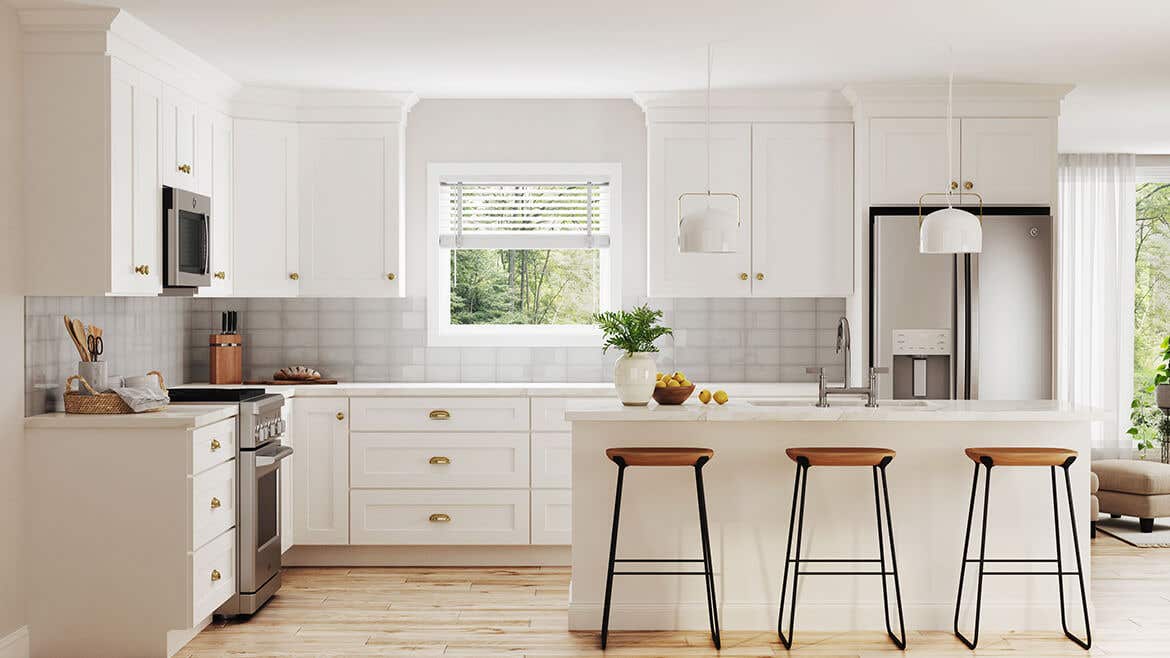
Our product pages list the material, species and thickness. They do not list an HP-1 face and back grade, so we do not claim one here. For exposed ends and islands, Lily Ann also sells finished plywood panels, such as the Craftsman Black Shaker plywood panel (96"W x 42"H x 3/4"D), so the visible side matches the cabinet finish.

The best test is your own eyes. Order free door samples to see the finish up close before you buy.




Comments