


The best pantry lighting is a line of LED light under each shelf, from an LED strip or a slim light bar, plus one ceiling light in a walk-in pantry. Strips and bars spread light evenly, so you can read labels at the back of a shelf. Puck lights make separate pools of light and suit a single small cabinet. Add a motion sensor or door switch so the light comes on when your hands are full.
- Light the shelves, not just the room: one ceiling light leaves the back rows in shadow.
- Strips and bars: an even line of light under each shelf, mounted near the front edge. Look for at least 200 lumens per foot (This Old House).
- Puck lights: small pools of light, best for one cabinet or a dark corner. Most are battery-powered.
- Controls: a motion sensor for a walk-in, a door switch for a reach-in pantry or pantry cabinet.
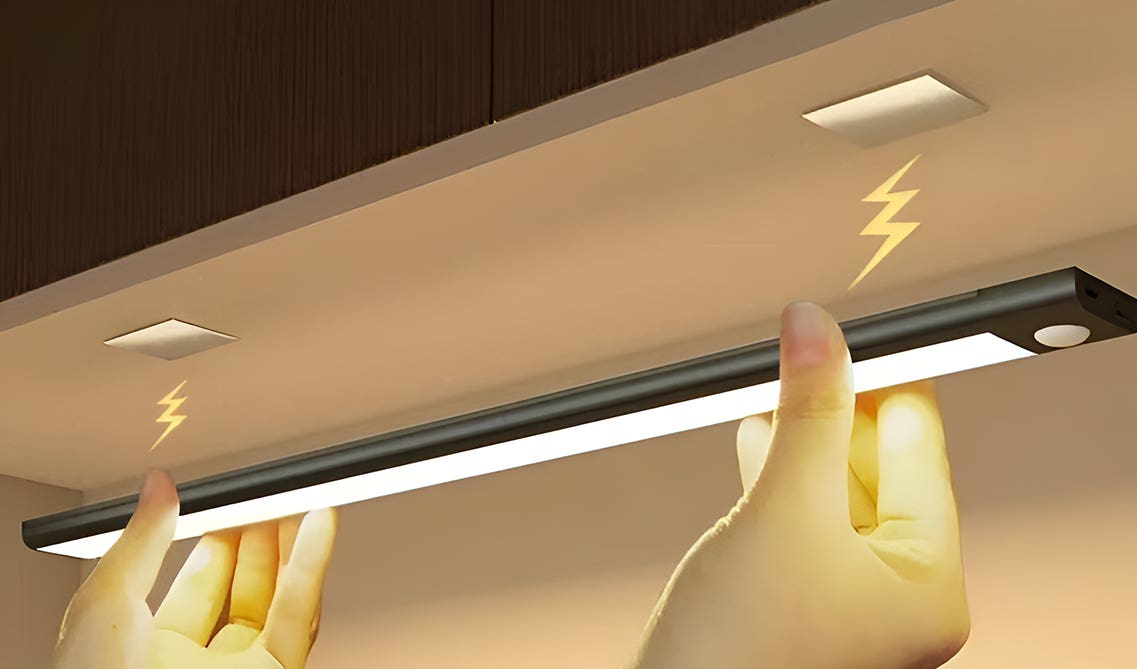
- No wiring: rechargeable motion-sensor light bars stick under a shelf in minutes.
- Color: use one shade of white throughout. ENERGY STAR suggests 4100K and up for a crisp light to read by.
- Lily Ann Cabinets sells pantry cabinets and wired, linkable LED cabinet light fixtures sized to cabinet widths (in stock October 9, 2026).
You open the pantry and the front row is easy to see. Everything behind it is a guess. So you buy a second jar of cumin, and find the first one a month later.
The fix is light in the right place. This guide compares the three small lights people use in a pantry, LED strips, light bars and puck lights, and shows where each one goes. It also covers motion sensors and door switches, ways to add light with no wiring, and how to light a pantry cabinet. Facts come from named sources. Lily Ann sizes and stock were checked on the live site on October 9, 2026.
What Is the Best Type of Lighting for a Pantry?
The best pantry lighting is a line of LED light under each shelf, from an LED strip or a slim light bar, plus one ceiling light if the pantry is a walk-in. Strips and bars spread light evenly along a shelf, so you can read labels at the back. Puck lights make separate pools of light and suit one small cabinet. Add a motion sensor or door switch so the light is on when your hands are full.
The right mix depends on which pantry you have. This table is our own summary of the sections below.
| Pantry type | Main light | Shelf light | Best control |
|---|---|---|---|
| Pantry cabinet (tall cabinet with doors) | None needed inside | Battery or rechargeable light bars or pucks under the shelves | Built-in motion sensor |
| Reach-in pantry closet | One enclosed LED ceiling light | LED strips or bars under each shelf | Door switch or motion sensor |
| Walk-in pantry | Flush or recessed LED ceiling light | LED strips or bars under shelves and under any wall cabinets | Motion sensor wall switch |
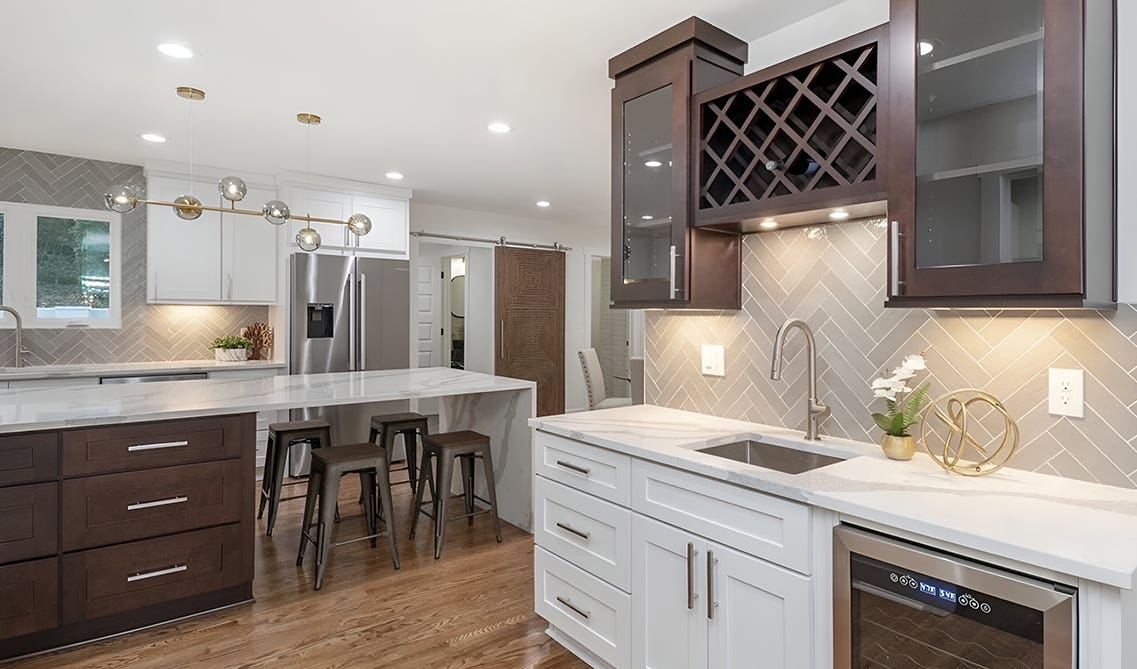
| Butler's pantry with a counter | Ceiling light | Under-cabinet fixtures over the counter; light inside glass-door cabinets | Wall switch with a dimmer |
Why One Ceiling Light Isn't Enough
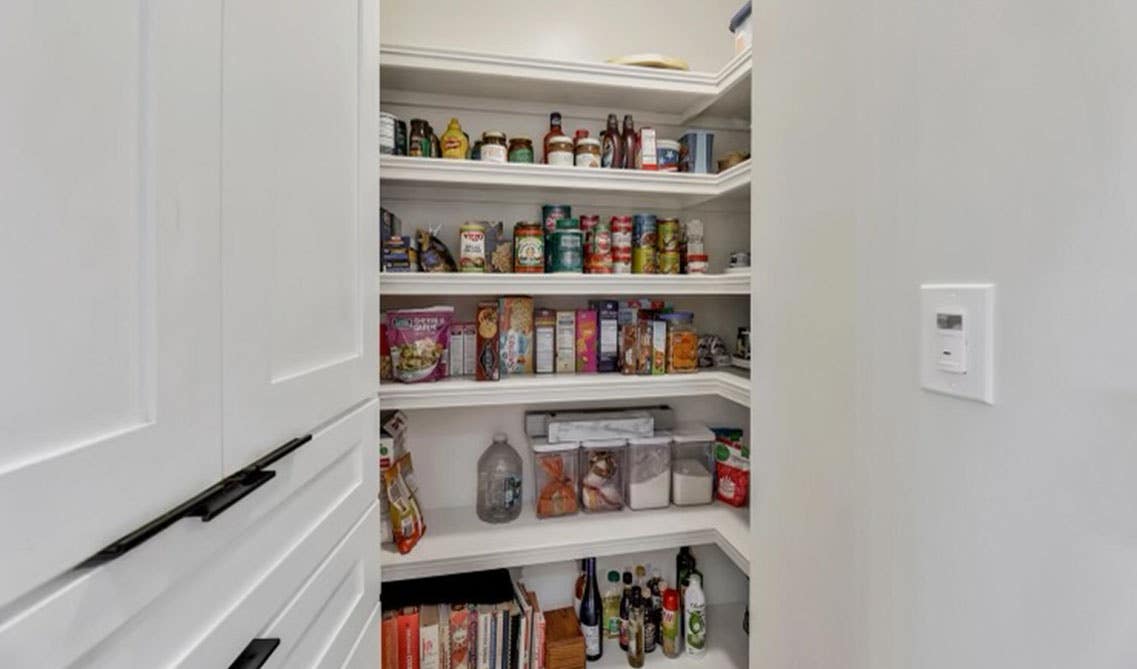
A pantry is a wall of shelves, and every shelf shades the one below it. A light in the middle of the ceiling hits the top shelf and the fronts of the boxes. It can't reach under a shelf to the back row. Step inside and your own head and shoulders block part of it too.
ENERGY STAR's guide to renovating with LED lighting describes how to solve the same problem in a kitchen. It says ceiling fixtures give general light from a central spot and should be backed up with task lighting. It describes under-cabinet fixtures as out of sight, placed to cut down on shadows, and aimed right at the surface you use. A pantry shelf is that same problem, repeated on every level.
LED Strips and Light Bars: An Even Line of Light
Strips and bars are both linear lights. The difference is how they're built. Bob Vila's guide to under-cabinet lighting sums it up:
- Strip lights come on a roll and stick on with adhesive backing. They're flexible and easy to fit to odd layouts, but more fragile.
- Bar lights have an aluminum housing and a cover that spreads the light. They're sturdier, and they generally run 6 to 48 inches long, so you need to measure before you buy.

Where to put them. Mount the strip or bar on the underside of each shelf, near the front, so the light falls down across the labels on the shelf below. Light at the back of a shelf mostly lights the wall. This Old House's guide to installing undercabinet LED lighting uses the same idea under kitchen cabinets: it keeps the strip 1 to 2 inches back from the front frame so the light spreads evenly. Applying that to pantry shelves is our own suggestion.
How bright. The same This Old House guide says to look for LED strips with at least 200 lumens per foot. It also notes that 12-volt and 24-volt systems are the most common, and that the thin low-voltage cable is easy to hide.
Best for: reach-in and walk-in pantries with fixed shelves, and anywhere you want every shelf lit the same.
Puck Lights: Small Pools of Light
A puck light is a small round light about the size of a hockey puck. Bob Vila's guide explains that pucks make spots or pools of light, not an even wash. If you use them for task lighting, they have to be spaced so there's no dark gap between them. Most are battery-powered and stick on with adhesive.
That makes pucks a good fit for small jobs:
- One or two shelves in a pantry cabinet.
- A dark corner that a strip can't reach.
- A rental, where you can't run wires.
Family Handyman's list of ways to add lighting without wires or cords starts with battery puck lights that dim, come with a remote and mount with screws or tape. For a full wall of shelves, though, you'd need a lot of pucks to avoid gaps. Strips or bars do that job with fewer pieces.
Motion Sensors and Door Switches
You usually walk into a pantry carrying something. A light that turns itself on is worth more here than almost anywhere else in the house. There are three ways to control a pantry light. The definitions come from the Pacific Northwest National Laboratory's guide to lighting controls, written for the U.S. Department of Energy's Building America program.
| Control | How it works | Best for |
|---|---|---|
| Motion (occupancy) sensor | Turns the light on when someone enters and off after the space is empty | Walk-in pantries |
| Vacancy sensor | You switch it on by hand; it turns itself off | Pantries that open off a busy hallway, where passing traffic would keep triggering a sensor |
| Door switch (contact closure) | A switch in the door frame. Open the door and the light comes on; close it and the light goes off | Reach-in pantries and pantry cabinets with doors |
Two tips for motion sensors. First, the common kind, a passive-infrared sensor, needs a clear line of sight to the person, according to the same guide. So mount it where an open door or a tall stack of boxes can't block it. Second, the guide lists the door switch as the kind used on closet, cabinet and refrigerator doors. It works like the light in your fridge.
The "best for" column is our own advice. Many battery light bars also have a small motion sensor built in, which is the simplest setup of all.
How to Add Light to a Pantry
There are three ways to add light to a pantry: stick-on battery or rechargeable lights, a plug-in low-voltage LED system, or a hardwired fixture on a switch. Start with the first if you rent or want light today. Choose the second or third if you're remodeling or installing new cabinets.
1. No wiring: battery and rechargeable lights
Family Handyman points out that LEDs draw so little power that they can run for weeks or months on batteries, which is why they work where there's no plug. Stick a motion-sensor bar under each shelf and you're done in an hour. The trade-off is upkeep: you'll recharge them or change batteries.
2. Plug-in: a low-voltage LED system
A low-voltage system has LED fixtures, connecting cables and a power supply that plugs into an outlet. It's the usual choice when the pantry has cabinets, because the cables hide behind the cabinet frames. Our step-by-step guide shows how to install under-cabinet lighting, and under-cabinet outlets explains how to plan the power.
3. Hardwired: a ceiling light on a switch
A walk-in pantry deserves a real ceiling fixture on a wall switch, sensor switch or door switch. New wiring is a job for a licensed electrician, who will also know what your local code requires. Model building codes have a clearance rule for light fixtures in clothes closets (Section E4003.12 of the 2018 International Residential Code). A pantry isn't a clothes closet, so ask your electrician or building department what applies to yours. Either way, choose an enclosed fixture and keep it clear of anything stacked on the top shelf.
Ceiling Lights for a Walk-In Pantry
For the main light, pick a fixture that sits tight to the ceiling. Nothing should hang down where you lift boxes onto the top shelf. A flush LED fixture or recessed lights both work.
Lily Ann sells two round LED ceiling lamps that fit this job. Both are listed at 12 inches wide and 1-1/2 inches high. The LED16W12 ceiling lamp is listed at 2,180 lumens and the LED24W12 ceiling lamp at 3,160 lumens. Both showed in stock on October 9, 2026. Both are listed at 5000K, which is a cool, daylight white. Keep that in mind when you choose shelf lights, because the colors should match (see the next section).
A pendant looks nice in a large pantry with a high ceiling. ENERGY STAR's advice for pendants is to hang them above standing eye level to control glare, and to keep them away from cabinets and from behind where a person stands, so they don't cast shadows.
Light Color and Brightness
In a pantry you're reading small print, so a whiter light helps. ENERGY STAR describes the range from 2700K, a soft, warm glow, to 4100K and up, a whiter, crisper light that it suggests for activities like reading. It also says to use the same shade for all the lights that share a space.
That last tip matters most. A cool ceiling light over warm shelf lights makes the same cereal box look like two different colors. Pick one shade and stay with it. If the pantry opens straight off the kitchen, match the kitchen's under-cabinet lights. Our under-cabinet lighting buyer's guide covers color temperature in more detail, and best under-cabinet lighting compares the fixture types.
Lighting a Pantry Cabinet or a Pantry With Cabinets
A tall pantry cabinet is a dark box with a door. It's also the easiest pantry to light, because the shelves are short. Lily Ann's pantry cabinets are listed as utility cabinets. In Colorado White Shaker, for example, they come 18 inches, 24 inches and 30 inches wide, each 84 inches high and 24 inches deep. All three showed in stock on October 9, 2026.
For a cabinet like this, a battery or rechargeable motion-sensor bar under each shelf is the simple answer. There's no cable to run through the cabinet, and the light comes on when the door opens.
If your pantry has wall cabinets over a counter, as in a butler's pantry, light the counter the way you would in a kitchen. Lily Ann's cabinet lighting category lists rigid, linkable LED fixtures, the cables that join them and the power supplies that run them. It listed no puck lights or stick-on tape when we checked on October 9, 2026.

- Match the fixture to the cabinet. Each under-cabinet fixture is sized to a cabinet width. The 20-inch fixture is listed as fitting best in a 24-inch-wide cabinet, at 583 lumens. The 26-inch fixture fits a 30-inch-wide cabinet, at 764 lumens. By our arithmetic that's about 350 lumens per foot, above the 200 that This Old House suggests as a minimum.
- Know the specs. The listings give these fixtures as 12V DC, dimmable, 5/8 inch thick and 4000K. Sizes from 20 to 35 inches showed in stock on October 9, 2026. The 8-, 14- and 17-inch sizes were out of stock.
- Light glass-door cabinets from inside. Lily Ann also lists thinner fixtures for vertical mounting inside a cabinet. The 31-inch fixture is listed as fitting best in a 36-inch-tall glass door cabinet, one on each side.
- Plan the power. Cables and the power supply are sold separately. The 12W power supply is listed as good for 5 feet of under-cabinet lighting or 9 feet of inside-cabinet lighting. The 75W power supply with junction box is listed for up to 18 feet across several runs.
- Hide the fixture. A strip of trim along the bottom front edge of the wall cabinets hides the light bar. See our light rail molding guide.
Still planning the pantry itself? Our walk-in pantry ideas and walk-in pantry dimensions guides cover layout and shelf depths, and butler's pantry cabinets covers the counter-and-cabinet version.
Pantry Lighting Mistakes to Avoid
This is our own list:
- Relying on the kitchen's light. Light that spills in through the door stops at the first shelf.
- One ceiling bulb and nothing under the shelves. The back rows stay dark.
- Lights at the back of the shelf. They light the wall, not the labels.
- Pucks spaced too far apart. You get bright circles with dark gaps between them.
- A sensor that can't see you. Check that the door or a tall box doesn't block it.
- Mixed light colors. Choose one shade of white for the whole pantry.
- No plan for power. Decide where the plug or power supply goes before the shelves or cabinets are installed.
The Takeaway
Light the shelves, not just the room. Put a strip or bar under the front of each shelf, use pucks only for small spots, and add a motion sensor or door switch so the light is on when your hands are full. Keep every light the same shade of white. If you can't run wires, rechargeable motion-sensor bars get you most of the way there.
Planning new storage? Browse Lily Ann's pantry cabinets, or get a free 3D design and ask the designer to mark where the lights and power supply will go.
Frequently Asked Questions
The best type of lighting for a pantry is linear LED light under each shelf, from an LED strip or a slim light bar, with one ceiling light added in a walk-in. Linear lights spread evenly, so labels at the back of a shelf are readable. Puck lights suit a single small cabinet. Choose one shade of white for every light, and add a motion sensor or door switch.
The fastest way is to stick battery or rechargeable LED lights under the shelves, with no wiring at all. If there's an outlet nearby, a plug-in low-voltage LED system gives steadier light with hidden cables. For a walk-in pantry, have a licensed electrician hardwire a ceiling fixture on a wall switch, motion sensor or door switch. Plan the power before shelves or cabinets go in.
Light a cabinet from the front, not the back. For the counter below a wall cabinet, mount a slim LED fixture under the cabinet, near the front edge, so it shines down on the work surface. For the inside of a glass-door cabinet, mount thin LED fixtures vertically at the sides so every shelf is lit. LEDs are the usual choice because they are thin and use little power.
Yes. Wireless under-cabinet lights run on replaceable or rechargeable batteries and mount with adhesive, magnets or screws. They come as light bars and as puck lights, and many have a built-in motion sensor or a remote. Bob Vila notes that puck lights are most commonly battery-powered stick-on models. The trade-off is upkeep, since you'll recharge them or replace batteries.
For most cabinets, yes. ENERGY STAR says certified LED bulbs and fixtures use 70 to 90% less energy than standard bulbs and last at least 15 times longer. It also notes that LED under-cabinet fixtures are thin and use a small fraction of the electricity of halogen or xenon lights. Thin, efficient and long-lasting is what you want inside a pantry or under a shelf.
Yes. A motion sensor turns the light on as you walk in and off after you leave, which suits a room you enter with full hands for a minute at a time. The common passive-infrared kind needs a clear line of sight to you, so place it where the door or a stack of boxes can't block it. In a reach-in pantry or a pantry cabinet, a door switch does the same job.
Use battery or rechargeable LED lights. Family Handyman explains that LEDs draw so little power they can run for weeks or months on batteries, so they work where there's no outlet. Stick-on light bars and puck lights mount under a shelf in minutes, and many include a motion sensor. Expect to recharge them or change the batteries from time to time.
In a small pantry or a pantry cabinet, skip the ceiling fixture and light the shelves directly. A slim LED bar or strip under each shelf, near the front, does the most with the least. Battery or rechargeable bars with a motion sensor need no wiring. Light-colored shelves and walls also help, because they bounce the light around.















