


Neither is better for every bathroom. A one-piece toilet has the tank and bowl in one piece, so it's easier to clean and has no tank-to-bowl joint to leak, but it costs more and is heavier to carry. A two-piece is cheaper, easier to move and easier to repair, but the gap between tank and bowl collects grime. Either way, match the rough-in, usually 12 inches, to your drain.
- The difference: a one-piece toilet is a single piece of porcelain; a two-piece has a tank bolted to the bowl with a gasket.
- Cleaning: one-piece wins, because there's no gap between tank and bowl.
- Cost: two-piece is usually cheaper; The Spruce puts one-piece at about $500 to $1,100 and two-piece at about $250 to $700.
- Install and repair: a two-piece is easier to carry and a cracked tank or bowl can be replaced alone; a one-piece is heavy but arrives assembled.
- Rough-in: measure wall to drain center; 12 inches is standard, and 10 and 14 inches exist (Family Handyman).
- Plan with the vanity: keep at least 15 inches from the toilet's center to the vanity edge and 21 inches of clear floor in front.
- Lily Ann Cabinets sells two one-piece, 12" rough-in WaterSense toilets, a dual flush and a single flush (in stock September 25, 2026).
Replacing a toilet during a bathroom remodel sounds simple until you see the choices. One of the first is whether to get a one-piece or a two-piece toilet. They flush the same way and fit the same drain, but they differ in how easy they are to clean, what they cost, how heavy they are and how they're repaired.
This guide compares the two side by side, explains the rough-in measurement you need before buying either one, and shows how to plan the toilet around your vanity. For full disclosure: Lily Ann Cabinets sells two one-piece toilets and no two-piece models. We've kept the comparison fair, because a two-piece is the better buy for some bathrooms. Lily Ann specs and stock were checked on the live site on September 25, 2026.
What's the Difference Between a One-Piece and Two-Piece Toilet?
A one-piece toilet has the tank and bowl made as a single piece of porcelain, with no seam between them. A two-piece toilet has a separate tank that bolts onto the bowl, with a rubber gasket sealing the joint. One-piece toilets are easier to clean and have fewer places to leak, while two-piece toilets usually cost less, weigh less per piece and are easier to repair.
| One-piece | Two-piece | |
|---|---|---|
| Build | Tank and bowl are one piece | Tank bolts to the bowl with a gasket |
| Cleaning | Easier: no gap between tank and bowl | Harder: the gap collects dust and grime |
| Leak points | No tank-to-bowl joint | Tank-to-bowl bolts and gasket can leak over time |
| Cost | Usually more | Usually less |
| Carrying it in | Heavy, one piece; plan on two people | Carried in two lighter pieces |
| Setting it | Arrives assembled | Tank must be bolted on and sealed |
| Repairs | A crack means a new toilet | A cracked tank or bowl can be replaced alone |
| Look | Smooth and modern | Classic; many styles |
Both types come in round and elongated bowls, standard and taller seat heights, and water-saving versions. The comparison points above come from The Spruce's one-piece vs. two-piece toilet guide and Family Handyman's toilet buying tips.

Cleaning: The Biggest Everyday Difference
This is the reason most people pick a one-piece. On a two-piece toilet, there's a gap where the tank sits on the back of the bowl. It's hard to reach, and it collects dust, hair and grime. A one-piece has a smooth, continuous shape with no seam there, so a quick wipe gets most of it.
Many one-piece toilets, including both of ours, also have a sleeker body that's easier to wipe down. If you clean the bathroom often, or it's a busy family or guest bath, that difference adds up.
Leaks and Durability
A two-piece toilet is held together with tank-to-bowl bolts, washers and a rubber gasket. Over the years, the gasket can wear and the bolts can loosen or corrode, which is a common source of slow leaks at the back of the toilet. A one-piece has no tank-to-bowl joint, so that leak can't happen.
Both types still have the same inside parts, like the flush valve, the fill valve and a wax ring or seal at the floor. Those wear out on any toilet. The EPA says most toilet leaks come from old or worn flappers, a cheap part that's easy to replace.
Cost: Which Is Cheaper?
Two-piece toilets usually cost less. The Spruce puts typical one-piece toilets at about $500 to $1,100 and two-piece toilets at about $250 to $700, noting that two-piece models are more common and easier to find. Features like dual flush, a soft-close seat or a skirted base push either type up. Installation is extra, and a plumber's rate varies by area.
If you're doing a full bathroom, the toilet is only one line in the budget. Our small bathroom remodel cost guide shows how the pieces add up.
Weight and Installation
A one-piece toilet is heavier in one lump, because the tank and bowl come as a single piece of porcelain. Family Handyman notes one-piece models are "a lot heavier" than a separate tank and bowl. Getting one up stairs and into a small bathroom is a two-person job.
A two-piece is easier to carry, because you bring in the bowl and tank separately. But it takes an extra step once it's in place: you have to bolt the tank to the bowl and seal it evenly. If that step is done wrong, the joint can leak. Once it's on the floor, a one-piece is simpler to set, since it arrives already assembled.
For a DIY install, the hardest part of either one is usually lifting and setting it squarely on the wax ring. Running new drain or water lines is a job for a plumber.
Repairs and Replacement Parts
Most toilet repairs, like a running toilet or a weak flush, involve the parts inside the tank, and both types use them. The difference comes when the porcelain is damaged. According to The Spruce, a crack in a one-piece toilet means replacing the whole toilet, while a two-piece may only need a new tank or a new bowl. A two-piece tank can also be lifted off for easier access to the flush and fill valves.
Rough-In: Measure This Before You Buy Either One
A toilet's rough-in is the distance from the finished wall behind the toilet to the center of the drain, which is also the center of the two bolts that hold the toilet to the floor. Family Handyman says 12 inches is standard, and 10-inch and 14-inch models are also made. Buy a toilet with the same rough-in as your drain, or it won't fit without moving plumbing.
To measure it on your existing toilet:
- Find the two bolt caps at the base of the toilet, one on each side.
- Measure from the wall behind the toilet to the center of one bolt. Measure from the finished wall, not the baseboard, or add the baseboard's thickness back in.
- If you get about 12 inches, a standard 12-inch rough-in toilet fits. If you get about 10 or 14 inches, shop for that size.
Rough-in is the same idea for one-piece and two-piece toilets, so it doesn't decide which type you buy, but it does decide which models you can choose from. As Family Handyman puts it, choosing the same rough-in as your old toilet makes installation much easier. Both Lily Ann toilets are 12-inch rough-in.
Water Use: WaterSense and Dual Flush
Water use has nothing to do with whether a toilet is one-piece or two-piece; both are made in water-saving versions. Here's what to look for:
- WaterSense label. The EPA's WaterSense program certifies toilets that use 1.28 gallons per flush or less, which is 20 percent less than the federal standard of 1.6 gallons, and that also pass performance tests for clearing the bowl. The EPA says toilets are the main source of water use in the home, at nearly 30 percent of indoor use.
- Dual flush. A dual-flush toilet has two flush options: a smaller one for liquid waste and a full one for solids. The EPA notes that choosing the reduced flush saves even more water.
Planning the Toilet Around Your Vanity
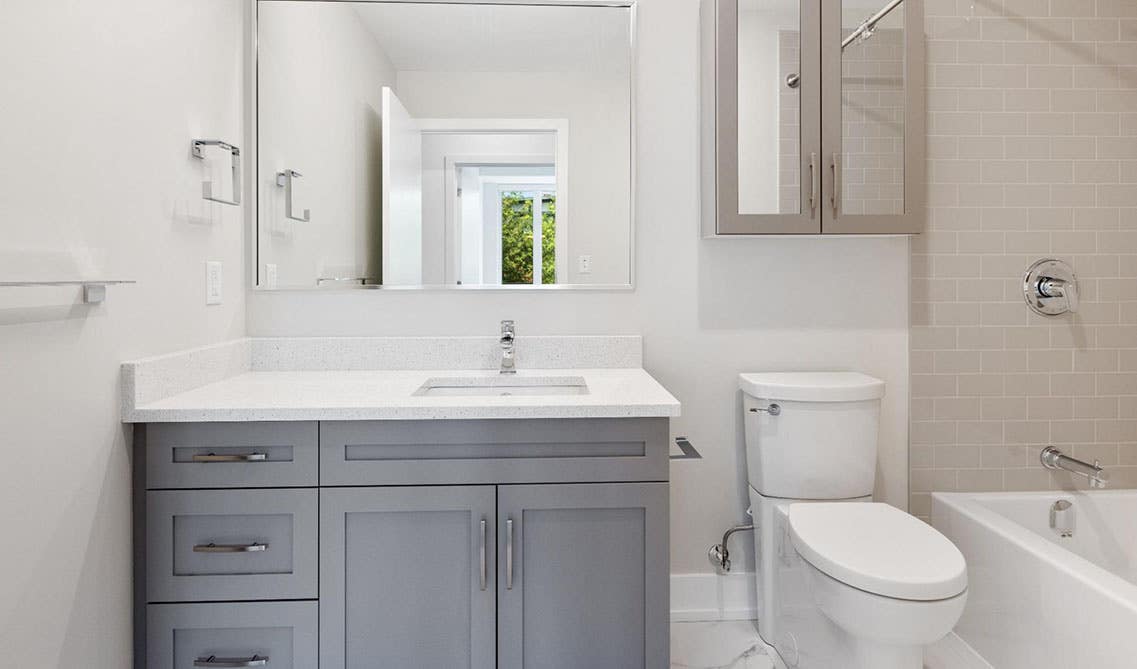
The toilet and the vanity usually share a wall, so plan them together. Building codes set minimum clear space around each fixture; our small bathroom layouts guide covers them room by room. The two that matter most here:
- Side clearance: at least 15 inches from the center of the toilet to a side wall or the edge of a vanity (the NKBA recommends 18 inches for comfort).
- Front clearance: at least 21 inches of clear floor in front of the toilet (the NKBA recommends 30 inches).
Now apply those to real sizes. Both Lily Ann toilets are 28-3/8 inches deep. Add 21 inches of clear floor, and you need at least 49-3/8 inches from the wall behind the toilet to whatever faces it. The toilet also sticks out much farther than the vanity next to it: a Lily Ann vanity like the Colorado White Shaker 24-inch vanity sink base is 21 inches deep, so expect the toilet to stand about 7 inches proud of the cabinet front.
For side clearance, the toilet's width matters too. Our toilets are 15-3/8 and 16-1/2 inches wide, so with the toilet centered 15 inches from the vanity edge, there's roughly 7 inches of open space between the toilet and the cabinet. That's enough to clean, but not much more. Choose a narrower vanity if you can, and see our bathroom vanity sizes guide for standard widths.
Storage above the toilet: a wall cabinet over the tank is a common way to add storage in a small bathroom; our tall bathroom storage cabinet guide compares it with other options. Measure the tank height first (26-3/8 and 27-1/2 inches on our two models), and leave enough room above the lid to lift it off and, on a top-flush toilet, to press the button.
Matching the counter height to the room is a separate choice; our bathroom vanity height guide explains standard and comfort-height vanities.
Lily Ann's One-Piece Toilets
Lily Ann sells two one-piece, elongated WaterSense toilets. Both showed In Stock on September 25, 2026. Specs below are from the product listings:
| Dual Flush (T80) | Single Flush (T113) | |
|---|---|---|
| Type | One-piece, elongated | One-piece, elongated |
| Flush | Dual flush, listed at 1.1 GPF | Single flush, 1.28 GPF |
| Rough-in | 12" | 12" |
| Bowl height (no seat / with seat) | 16-1/8" / 17-1/8" | 16-1/2" / 17-1/2" |
| Size (W x D x H) | 15-3/8" x 28-3/8" x 26-3/8" | 16-1/2" x 28-3/8" x 27-1/2" |
| Flush control | Top center | Left side lever |
| Trapway | 1-7/8" glazed | 1-7/8" glazed |
| Seat | Soft self-closing, quick-release | Soft self-closing, quick-release |
Both are listed as WaterSense models. See them together on our toilets page, or pair one with a vanity from our bathroom vanities.

One-Piece or Two-Piece: Which Should You Choose?
- Choose a one-piece if easy cleaning matters most, you want a smooth modern look, you'd rather not deal with a tank-to-bowl leak later, and you have a second person to help carry it in.
- Choose a two-piece if price matters most, you're installing it alone or up narrow stairs, you want the widest choice of models, or you'd like the option to replace just the tank or bowl if one cracks.
- Either way, match the rough-in to your drain, check the clearances around it, and look for the WaterSense label.
The Takeaway
A one-piece toilet costs more and is heavier to move, but it's easier to clean and has no tank-to-bowl joint to leak. A two-piece is cheaper, easier to carry and easier to repair, but the gap between tank and bowl needs extra cleaning. Measure your rough-in before you shop, then plan the toilet and vanity together so both fit with room to spare.
Planning a bathroom? Browse Lily Ann's bathroom vanities and one-piece toilets.
Frequently Asked Questions
A one-piece toilet usually costs more than a two-piece, and it's heavier to carry because the tank and bowl come as one piece of porcelain, so installing it is typically a two-person job. It's also harder to repair if the porcelain is damaged: a crack in the tank or bowl means replacing the whole toilet, while a two-piece may only need one part.
They can be, if easy cleaning and a smooth modern look matter to you. A one-piece has no gap between the tank and bowl to scrub and no tank-to-bowl gasket to leak. If your budget is tight, or you're installing it alone, a good two-piece toilet flushes just as well for less money. Flush performance depends on the model, not on whether it's one piece or two.
Neither is better for every bathroom. Buy a one-piece if you want the easiest cleaning and fewer leak points. Buy a two-piece if you want the lowest price, easier carrying and the option to replace just the tank or bowl later. Whichever you choose, match the rough-in to your drain and look for the WaterSense label.
There's no single model every plumber recommends. The common advice is practical: buy a toilet with the same rough-in as your existing drain, pick a reliable gravity-flush or pressure-assist design, and choose a WaterSense-certified model so you get lower water use with tested flushing. Family Handyman reports that the plumbers it spoke with rate pressure-assist toilets as strong, water-efficient flushers, though they're pricier and noisier.
Dual-flush toilets are widely recommended for saving water. They give you a smaller flush for liquid waste and a full flush for solids. The EPA notes that with a WaterSense-labeled dual-flush toilet, using the reduced flush saves even more water than a standard WaterSense model.
The main downside is that it only saves water if people use the smaller flush for liquid waste. Pressing the full flush every time erases most of the savings. Dual-flush buttons and valves are also often specific to the model, so keep the model number handy for replacement parts. Otherwise, a WaterSense-certified dual-flush toilet has passed the same flush-performance tests as a single-flush one.
Mostly because of the weight. A one-piece comes as one heavy lump of porcelain, so it's hard for one person to carry and lower squarely onto the wax ring. Once it's in place, though, it's actually simpler than a two-piece, because there's no tank to bolt on and seal.
Yes, as long as the new toilet has the same rough-in and fits the space. Measure from the wall behind the toilet to the center of the floor bolts; 12 inches is standard, and 10- and 14-inch models are also made. Also check the new toilet's depth and width against the clear floor in front and the space beside it.












Comments