


- Red oak and white oak are not the same wood. Red reads pink; white reads grey-brown. That undertone difference is why some oak kitchens look dated and others look current.
- The oak that dates is orange-finished red oak — a 1990s finish choice, not a property of oak. The same wood in a modern finish reads completely differently.
- White oak is more water-resistant because its pores are blocked by tyloses. It is the reason white oak is used for boatbuilding and red oak is not.
- Oak's open grain is the whole point. It is visible under any finish, it hides wear and scratches better than a smooth wood, and it is the wrong choice if you want a flat painted surface.
- Quarter-sawn white oak shows medullary rays — the flecked figure in Craftsman and Mission cabinetry. A cutting choice, not a species.
- If you already have oak, the finish is the lever, not the wood. Refinishing, restaining or painting all cost far less than replacing sound oak cabinets.
Red Oak and White Oak Are Different Woods
Most kitchen conversations treat "oak" as one material. It is at least two, and the difference between them decides most of what people actually notice — the undertone, the grain pattern, and how the wood behaves around water.
This matters practically in two directions. If you are choosing new cabinets, it is the choice you are making whether or not anyone names it. If you have oak already and are deciding whether to keep it, identifying which one you have tells you what your realistic finish options are.
| Red oak | White oak | |
|---|---|---|
| Undertone | Pink to reddish | Brown to grey, more neutral |
| Grain pattern | Strong, wide, pronounced cathedral figure | Tighter, straighter, more uniform |
| Pores | Open — a straw will draw air along the grain | Blocked by tyloses |
| Water resistance | Lower | Higher — used in boatbuilding and barrels |
| Takes grey and modern stains | Fights them — the pink pushes through | Readily |
| Typical era in US kitchens | Dominant pre-2000 | Dominant in current specifications |
| Relative cost | Lower | Higher |
How to tell which one you have
Look at an unfinished or worn area — the inside of a door edge, or the back of a cabinet — in daylight:
- Pink or salmon undertone, very pronounced wide grain → red oak.
- Grey-brown or olive undertone, tighter straighter grain → white oak.
- Flecks or ray figure across the grain → quarter-sawn, most often white oak.
The pores test is the definitive one if you can reach a raw end-grain surface: red oak's pores are genuinely open along the grain, while white oak's are plugged. It is the reason white oak makes watertight barrels and red oak does not.
Oak's Open Grain: The Feature and the Constraint

Oak has large, visible pores that read as texture under any finish. That is what makes an oak kitchen read as wood from across the room — and it is why oak is the wrong choice if you want a smooth painted surface.
Three consequences worth understanding before choosing oak:
- Grain shows through paint. Painted oak does not look like painted MDF or painted maple; the grain telegraphs through the film as visible texture, and it becomes more pronounced over time as the wood moves seasonally. Some people specifically want this. If you do not, oak is the wrong substrate — see maple kitchen cabinets for the paint-grade alternative.
- Oak hides wear extremely well. A scratch across a smooth, uniform surface is a line you notice. A scratch across strong grain disappears into the pattern. In a hard-working family kitchen this is a genuine practical advantage, and it is the most under-stated argument for oak.
- Grain competes with other pattern. Oak doors plus a heavily-veined worktop plus a patterned backsplash is three patterns fighting. If the cabinets are oak, keep the surfaces around them quiet. Soapstone is one quiet option, with soft gray color and gentle veins; see soapstone countertop pros, cons and cost.
Quarter-sawn oak and ray fleck
Quarter-sawing is a cutting method rather than a species: the log is cut radially, which produces a straighter, more stable board and — in white oak particularly — exposes the medullary rays as a distinctive flecked figure across the grain. That fleck is the signature of Craftsman, Mission and Arts and Crafts cabinetry.
It costs more, because quarter-sawing yields less usable board per log. It is also more dimensionally stable than plain-sawn oak, which is a real benefit on a wide panel.
Why Oak Kitchens Got a Reputation — and Why It Was the Finish

The oak kitchen people describe as dated is a specific combination: plain-sawn red oak, in a glossy orange-toned stain, with raised panel or cathedral-arch doors, from roughly 1985 to 2000. Almost none of that is a property of oak.
Unpick which parts are the wood and which were choices:
- The orange: a finish. Red oak's pink undertone under a warm amber stain and a yellowing polyurethane produced the colour. The same wood under a modern neutral or grey-toned finish does not read orange.
- The gloss: a finish. High-gloss polyurethane was standard; matt and satin finishes read completely differently.
- The door profile: a design choice. Raised panel and cathedral-arch doors are period-specific. Shaker or slab doors in the same oak read contemporary.
- The grain: genuinely the wood — and the part that never went out of style. Visible wood grain is a current preference, not a dated one.
This is why the same wood is simultaneously described as dated and specified in new high-end kitchens. Current oak specifications are typically white oak, plain or quarter-sawn, in a neutral or lightly-whitened finish, on a shaker or slab door — and they read as current because every variable except the species was changed.
If you already have oak cabinets in sound condition, that is genuinely good news, and the practical routes are covered in how to make oak cabinets look modern.
Finishing Oak: What Works on Which

White oak accepts grey, greige and neutral modern finishes readily. Red oak fights them, because its pink undertone pushes through anything cool — which is the single most useful thing to know before restaining an existing oak kitchen.
- White oak + light neutral or whitewashed finish. The current specification, and the reason white oak dominates new builds. Its grey-brown base takes a cool finish without a colour fight.
- White oak + natural or clear. The most-photographed oak kitchen of the moment. Grain visible, colour restrained.
- Red oak + warm mid-brown or darker. Working with the pink rather than against it. A deep walnut-toned or espresso stain on red oak looks intentional; a cool grey on red oak usually looks muddy or mauve.
- Red oak + paint. The reliable route for red oak you want to modernise. Paint covers the undertone entirely — accepting that the grain will still telegraph through, which on oak is often the point.
- Either + grain filler. For a genuinely smooth painted oak surface, the pores have to be filled before finishing. It is an extra step, it is what high-end painted oak does, and skipping it is why most painted oak shows texture.
The general rule: going darker on oak is straightforward; going cooler is not, unless you started with white oak.
Oak vs. the Other Cabinet Hardwoods

Oak is the choice when you want the grain visible. Its closest competitors differ mainly in how much figure they show and how they take a finish.
| Species | Grain | Undertone | Choose it when |
|---|---|---|---|
| Red oak | Strong, wide cathedral figure | Pink to red | You want maximum grain and are finishing warm or dark |
| White oak | Tighter, straighter | Brown to grey | You want oak grain with a modern neutral finish |
| Maple | Fine, closed, quiet | Cream | You want a smooth painted surface |
| Hickory | Dramatic, very high colour variation | Mixed light and dark | You want more character than oak, for a rustic kitchen |
| Cherry | Smooth, fine | Warm red-brown | Traditional warmth; darkens with age |
Oak vs. walnut is the other comparison searched for directly, and the honest answer is that they barely compete: walnut is dark through its whole thickness and costs considerably more, while oak is a light wood that takes a stain. See walnut kitchen cabinets for that side of it.
Oak vs. hickory is the comparison worth calling out, because both are "character" woods. Oak's variation is in the grain pattern; hickory's is in colour, with light and dark boards in the same run. Hickory is more dramatic and less predictable — better for a deliberately rustic kitchen, harder to live with if you want consistency.
For the paint-grade comparison from the other side, see maple kitchen cabinets; for the broader material question, what "solid wood" really means.
Keep or Replace? An Honest Answer

If the boxes are sound, the doors are solid oak, and the layout works, refinishing is dramatically cheaper than replacing and produces a better cabinet than most new budget cabinetry. If the boxes are particleboard and swelling, or the layout is wrong, refinishing spends money on a problem it cannot fix.
The honest test, in order:
- Open a door and look at the box. Plywood in sound condition is worth keeping. Particleboard that is swelling or crumbling at the base is not.
- Check the doors are solid oak, not veneer. Solid doors can be sanded and refinished repeatedly. A veneer can usually take one careful sanding at most.
- Is the layout right? If the kitchen's problem is where the cabinets are rather than what colour they are, refinishing does not solve it. See kitchen layouts.
- Check the hardware. Old hinges and glides can often be replaced independently — new soft-close hardware on sound old cabinets is one of the highest-value upgrades available.
- Then decide on finish. Refinish, restain, or paint — and if it is red oak going cooler, plan on paint rather than a grey stain.
An intermediate route worth knowing: replace the doors, keep the boxes. If the boxes are sound plywood and the layout works, new doors and drawer fronts in a current profile change the kitchen almost completely at a fraction of a full replacement. Costs are covered in the cost of replacing kitchen cabinet doors.
Buying New Oak Cabinets
Ask which oak, whether the doors are solid or veneered, and whether the grain has been filled if they are painted. And check the box and drawer construction, which matters more to longevity than the species does.
- Red oak or white oak? This should be stated. If a supplier says only "oak", ask — the undertone difference is the thing you will live with.
- Plain-sawn or quarter-sawn? Quarter-sawn costs more, is more stable, and shows ray fleck in white oak.
- Solid or veneer? Both are legitimate; a veneered wide panel is more stable, a solid door refinishes more times.
- What is the box made of? Plywood, ideally 1/2 inch. This decides how long the kitchen lasts.
- How are the drawer boxes joined? Dovetailed solid wood is the tell that costs a manufacturer real money.
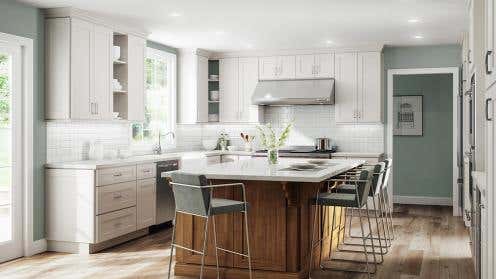
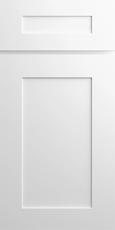
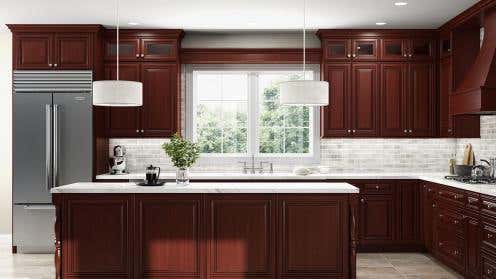
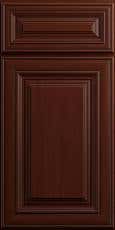
Lily Ann's oak-adjacent and stained wood finishes sit in the wood cabinets, stained wood and medium wood collections, with the full range at RTA kitchen cabinets — 1/2" plywood boxes, solid-wood doors and face frames, 5/8" dovetailed drawer boxes and soft-close hardware across every finish. Oak closet components are at oak closets.
Because oak's undertone is exactly what a screen loses — the pink-versus-grey-brown difference this whole article turns on — free door samples are the only reliable way to judge it.








Comments