


A moody kitchen is a kitchen built around dark, rich colors, like black, charcoal, deep green or navy, and soft, warm light, so it feels cozy and dramatic instead of bright. What keeps it from feeling gloomy is balance: light countertops, natural wood, brass or gold accents, and several layers of lighting. Lily Ann Cabinets sells two ready-to-assemble dark lines for this look, Craftsman Black Shaker and Navy Blue Shaker.
- Moody = dark color + warm light: the dark can be on cabinets, walls or backsplash.
- Colors that work: black, charcoal, deep green, navy, and warm darks like chocolate brown and terracotta.
- Lighting makes it: use under-cabinet, pendant and in-cabinet lights on dimmers, not one bright ceiling fixture.
- Balance it: light counters, warm wood and brass keep a dark kitchen cozy instead of gloomy.
- Start small: designers suggest one move first, like a dark island, one dark wall or new brass pulls.
- Lily Ann Cabinets dark lines: Craftsman Black Shaker and Navy Blue Shaker (checked September 22, 2026).
A moody kitchen is dark on purpose. Instead of bright white everything, it uses deep paint colors, warm light, natural wood and a little metal to make the room feel cozy and calm, especially at night. It is not the same as “a kitchen with dark cabinets.” You can get a moody kitchen with dark walls and light cabinets, and a kitchen with black cabinets can still feel stark if the lighting and materials are wrong.
This guide covers what makes a kitchen feel moody, how to do it without making the room gloomy, and 8 real moody kitchen looks. If you already know you want dark cabinets and just need a color, jump to which dark cabinet color to pick.
What Is a Moody Kitchen?
A moody kitchen is a kitchen designed around dark, rich colors and soft, warm light so it feels cozy and dramatic instead of bright and airy. The dark color can be on the cabinets, the walls, the backsplash, or all three. What makes it “moody” rather than just dark is the mix: deep color balanced with natural wood, stone, metal accents like brass, and layered lighting.
Designers quoted by House Beautiful in its 2026 guide to moody kitchens point to earthy dark tones, like mossy green, chestnut brown and terracotta, as well as the classic navy, plum and maroon. Better Homes & Gardens’ designers name forest green, dark navy, charcoal and black as the usual starting colors.
Is a Dark Kitchen a Good Idea?
A dark kitchen is a good idea if the room gets decent natural light or you are willing to add good lighting, and if you like a cozy, enclosed feel more than a bright, open one. It is a harder fit for a small kitchen with no window, unless you keep the counters and ceiling light.
| A moody kitchen works well when… | Think twice when… |
|---|---|
| The kitchen has at least one good window | The kitchen has no window and only one ceiling light |
| You can add under-cabinet and pendant lighting | You can’t change the lighting |
| The kitchen opens to a living or dining space and you want it to feel cozy at night | The room is small and you want it to feel as big as possible |
| You like wood, brass, stone and texture | You want a clean, all-white look |
Dark colors also hide some mess (scuffs on lower cabinets, for example) but can show dust, fingerprints and water spots, especially on matte black. That is a trade-off, not a reason to avoid them.
The Moody Kitchen Formula: 5 Layers
The moody kitchens that work share the same five layers. You don’t need all five at full strength. Start with one and add the others around it.
| Layer | What to do | Easy first step |
|---|---|---|
| 1. Dark color | Deep paint on cabinets, walls, or both | Paint one wall or the island a deep color |
| 2. Warm light | Layer ceiling, under-cabinet and pendant light | Add under-cabinet lighting |
| 3. Wood | Warm wood shelves, floors, stools or a butcher block | Swap in wood floating shelves |
| 4. Metal | Brass, gold or aged metal hardware and fixtures | Change the cabinet pulls |
| 5. Texture | Stone, handmade tile, plaster, fabric | A runner rug and linen shades |
Interior designer Tiffany Skilling told House Beautiful to start with “one confident move” rather than changing everything at once, such as painting the cabinets, going darker on the walls, or switching to antique brass hardware. It lets you see how the color looks in your light before you commit to more.
1. Paint: The Colors That Read Moody

Moody colors are deep and a little muted, not bright. The most common families are:
- Black and charcoal: the most dramatic. Works on cabinets, walls or both.
- Deep green: forest, hunter, olive and moss. Reads as natural and pairs easily with wood and brass.
- Navy and ink blue: a classic that works almost like a neutral.
- Warm darks: chocolate brown, terracotta, plum and oxblood. Cozier than the cool darks.
Don’t forget the trim and ceiling. Designer Johanna Lyle told House Beautiful that leaving the trim and ceiling white is one way to “instantly kill the mood of a dark space.” Painting the trim the same color as the walls (or one shade off, in a different sheen) makes the room feel wrapped in color. This is often called color drenching.
Test in your own light. Dark paint changes a lot from morning to night. Put large samples on the wall and look at them at different times of day, next to your countertop and floor, before you buy gallons.
Want the darkest color on one wall only? A single dark wall is an easy first step; see these kitchen accent wall ideas, including a black shiplap wall.
2. Lighting: The Layer That Makes or Breaks It

Lighting is what separates a moody kitchen from a dark, gloomy one. A single bright ceiling fixture flattens dark colors and leaves the counters in shadow. Instead, use several softer sources at different heights:
- Under-cabinet lights for work surfaces. They light the counters and make a dark backsplash glow. Lily Ann sells under-cabinet and shelf lighting; our kitchen cabinet lighting ideas show where to use each type.
- Pendants over the island or sink, with warm-white bulbs.
- In-cabinet lights behind glass doors, like the uppers in the photo above.
- Sconces or a small lamp on the counter or open shelf for the evening glow.
- Dimmers on the main lights, so the same kitchen can be bright for cooking and dim for dinner.
For more fixture ideas (brass, woven, milky glass and more), see our full guide to kitchen lighting ideas.
3. Wood: Warmth So Dark Doesn’t Feel Cold
Every designer source we checked names wood as the thing that keeps a dark kitchen from feeling cold. Better Homes & Gardens’ designers suggest warm woods like walnut and oak for floating shelves, tables, stools or even the ceiling. Ways to add it:
- Wood floating shelves against a dark wall.
- A wood floor under black or navy cabinets, like the hero photo at the top of this page.
- Two-tone cabinets: a dark perimeter with a natural wood island, or the reverse. Lily Ann’s Craftsman Natural Shaker pairs with Craftsman Black Shaker for this look.
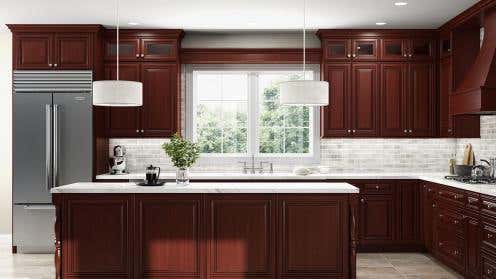
- Dark stained wood cabinets: a moody look without paint. Browse wood kitchen cabinets for stained options.
4. Metal: Brass, Gold and Black

Metal gives the eye a place to rest in a dark room. Brass and gold are the most common choice because their warmth stands out against black, green and navy. Aged or unlacquered brass looks softer than polished. For a quieter, more modern moody kitchen, matte black hardware on black cabinets almost disappears and lets the color do the work.
The easiest place to start is the cabinet pulls. See Lily Ann’s knobs and pulls by finish.
5. Stone, Tile and Texture
Better Homes & Gardens’ designers note that most traditional moody kitchens keep the countertops light, because a light horizontal surface reflects light back up and softens the room. Marble, quartzite and light quartz are the usual picks. The backsplash is where you can go darker: glossy handmade tile (like the green wall above), dark zellige, or a slab that runs up the wall.
Texture keeps a dark room from looking flat. House Beautiful’s designers suggest natural stone or butcher block counters, ceramic or lava stone tile, and interesting light fixtures. Soft things help too: a runner rug, linen shades and seat cushions.
Moody Cabinet Colors: Which Dark Finish?
We already have full guides for each dark cabinet color, so here is the short version and where to read more. Stock was checked on the live site on September 22, 2026.
| Cabinet color | Mood | Lily Ann line | Full guide |
|---|---|---|---|
| Black | The most dramatic; modern or traditional | Craftsman Black Shaker (445 items listed) | Kitchen ideas for black cabinets |
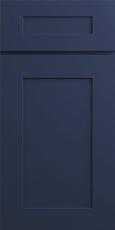
| Navy | Classic and calm; almost a neutral | Navy Blue Shaker | Navy blue kitchen ideas |
| Green | Natural and earthy | Craftsman Lily Green Shaker (a soft sage green, not a deep green) | Green kitchen ideas |
| Dark wood | Warm and traditional | See all dark kitchen cabinets | Kitchen ideas with dark cabinets |
Two notes before you pick. First, Lily Ann’s green line, Craftsman Lily Green Shaker, is a muted sage, so on its own it reads soft, not moody. For a deep green kitchen, pair it with a dark green wall or use a deeper paint on the walls and keep the sage on the cabinets. Second, most items in the Shaker Espresso line showed out of stock on September 22, 2026, so we don’t recommend planning a whole kitchen around it right now. For wall, backsplash and counter colors that go with any dark cabinet, see color schemes for kitchens with dark cabinets.
8 Moody Kitchen Ideas
1. Black Cabinets, Brass and Veined Marble
The classic moody kitchen: black shaker cabinets on every wall, brass pulls and pendants, and a white marble backsplash and island top with bold veining. The light stone and warm wood floor keep all that black from feeling heavy. This is the Lily Ann Craftsman Black Shaker line shown in the photo at the top of this page.
2. A Deep Green Tile Wall
Put the drama on the backsplash instead of the cabinets. In the green kitchen shown in the paint section, a glossy emerald herringbone tile covers the whole wall, black lower cabinets sit below, and warm wood shelves and a brass faucet warm it up. The glossy tile bounces light around, which helps in a dark room.
3. Glowing Glass-Front Uppers
In the lighting photo above, black cabinets with lit glass-front uppers and warm under-cabinet lights make the kitchen glow at night. Inside-cabinet lighting is one of the easiest ways to make a dark kitchen feel warm instead of closed in.
4. Black Lowers, Brass Pot Filler and a Black Hood
A black range hood is a strong focal point in a moody kitchen. Pair it with black lower cabinets, brass hardware and a marble backsplash, and use open wood shelves instead of upper cabinets to keep the wall lighter.
5. Matte Black With Wood and White Tile

Not every moody kitchen is dark from floor to ceiling. Here, matte black base cabinets are balanced by white tile and light wood shelves and a wood hood cover. It is a good “moody lite” option for a kitchen that doesn’t get much sun.
6. All-Black Shaker With a Light Floor

Black cabinets on every wall and the island, with white counters and a pale wood floor. The light floor and counters do the balancing, so the black reads as bold, not gloomy. A single oversized brass pendant adds the warmth.
7. Moody in Small Doses: Navy Lowers

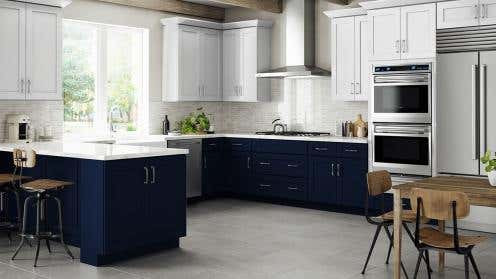
If a fully dark kitchen feels like too much, put the dark color on the lower cabinets and island only. Navy Blue Shaker base cabinets with white uppers keep the room bright while still giving it depth. Add brass pulls and a wood table to push it moodier.
8. Dark Walls, Light Cabinets
You can have a moody kitchen with white cabinets. Paint the walls and ceiling a deep color, like charcoal or forest green, keep the cabinets white or cream, and add wood and brass. The cabinets become the bright element instead of the dark one. It is also the easiest version to change later, since it’s only paint.
Small Moody Kitchen Ideas
- Go dark on the lowers only. Keep upper cabinets, or the wall above the counter, light.
- Use a light countertop. It reflects light onto the dark cabinets.
- Pick a glossy backsplash. Glossy tile bounces light around a small room.
- Add under-cabinet lighting first. In a small kitchen it does more than any other change.
- Color-drench it. In a tiny kitchen, painting the walls, trim and ceiling one dark color can make the corners disappear, so the room feels cozy instead of cramped.
How to Keep a Dark Kitchen From Feeling Gloomy
- Balance at least one big surface with a light color: counters, floor or ceiling.
- Layer at least three light sources, and put the main ones on dimmers.
- Add something warm: wood, brass or warm-white bulbs.
- Bring in plants. The Spruce suggests greenery on open shelves as a “feel-good element” in a moody kitchen.
- Mix sheens: matte walls, glossy tile, polished stone.
Plan Your Moody Kitchen
Dark colors look very different in a photo than in your own kitchen. Order free door samples to see a color in your light, or get a free 3D kitchen design to see a moody layout before you buy.
Frequently Asked Questions
A moody kitchen is a kitchen designed around dark, rich colors and soft, warm light so it feels cozy and dramatic instead of bright and airy. The dark color can be on the cabinets, walls or backsplash. It is balanced with natural wood, stone, brass or gold accents, and layered lighting.
Black, charcoal, deep green, navy and warm darks like chocolate brown, terracotta and plum all work. Designers quoted by House Beautiful favor earthy dark tones, while Better Homes & Gardens’ designers name forest green, dark navy, charcoal and black. Pair any of them with light counters, wood and brass.
Yes, if the room has some natural light or you add good lighting, and you like a cozy feel more than a bright one. It is harder in a small kitchen with no window. There, keep the counters, ceiling or upper cabinets light and add under-cabinet lighting.
For dark cabinets or walls, black, charcoal, navy and deep green are the most common choices. If your kitchen is already dark (little natural light), the best move is usually a light countertop and ceiling with the dark color kept to the lower cabinets or one wall.
Yes. Design sites are still publishing moody and dark kitchen guides in 2026, including House Beautiful’s 2026 guide to moody kitchens. The current take leans toward earthy darks (green, brown, deep blue) mixed with wood and stone, rather than an all-black, glossy look.
Recent moody kitchen guides highlight earthy dark colors like moss green and chestnut brown, dark stained wood cabinets, painted ceilings and trim in the same dark color, dark or black appliances, handmade tile, and warm, layered lighting.
Yes. Paint the walls, and even the ceiling, a deep color like charcoal or forest green, and keep the cabinets white or cream. Add wood, brass and warm lighting. The white cabinets become the light element that balances the dark walls.
Keep the dark color low (lower cabinets or one wall), use a light countertop, add a glossy backsplash to bounce light, and put in under-cabinet lighting first. In a very small kitchen, painting the walls, trim and ceiling one dark color can make the room feel cozy instead of cramped.
Warm woods like walnut and oak are the most common choices, used for floating shelves, a wood island, stools, floors or a butcher block counter. Warm wood keeps black, green or navy from feeling cold.
Add layered lighting (under-cabinet, pendants and in-cabinet lights), switch to a light countertop, use glossy tile that reflects light, and keep the ceiling or floor light. You don’t have to give up the dark color. Light and contrast are what stop it from feeling gloomy.









Comments