


Light rail molding is a trim strip that runs along the bottom front edge of wall cabinets. It hides under-cabinet lights and wires, cuts glare and gives the cabinet bottoms a finished edge. For shaker cabinets, pick a plain profile with straight lines. Lily Ann Cabinets' shaker lines list an Angle Light Rail Molding, sold in 96-inch lengths in the cabinet finish (checked September 22, 2026).
- What it does: hides under-cabinet lights and wires, cuts glare for people sitting nearby, and finishes the bottom edge of wall cabinets.
- Is it required? No. Skip it if you have no under-cabinet lights and like the plain cabinet bottom.
- For shaker cabinets: a plain angle profile (flat lines, sloped front) matches shaker doors. The standard profile has a curved front and looks more traditional.
- Sizes: sold in 96-inch (8-ft) sticks. Lily Ann listings that give a profile size run 1" to 1-1/4" tall and 1-1/2" deep.
- How much: add up the bottom front edge of every wall-cabinet run plus exposed sides (12" each), divide by 96, round up.
- Order of work: choose and install the lights first, then fit the rail.
- Lily Ann Cabinets lists Angle Light Rail Molding in Colorado White Shaker, Grey Shaker Elite and the Craftsman shaker lines (in stock September 22, 2026).
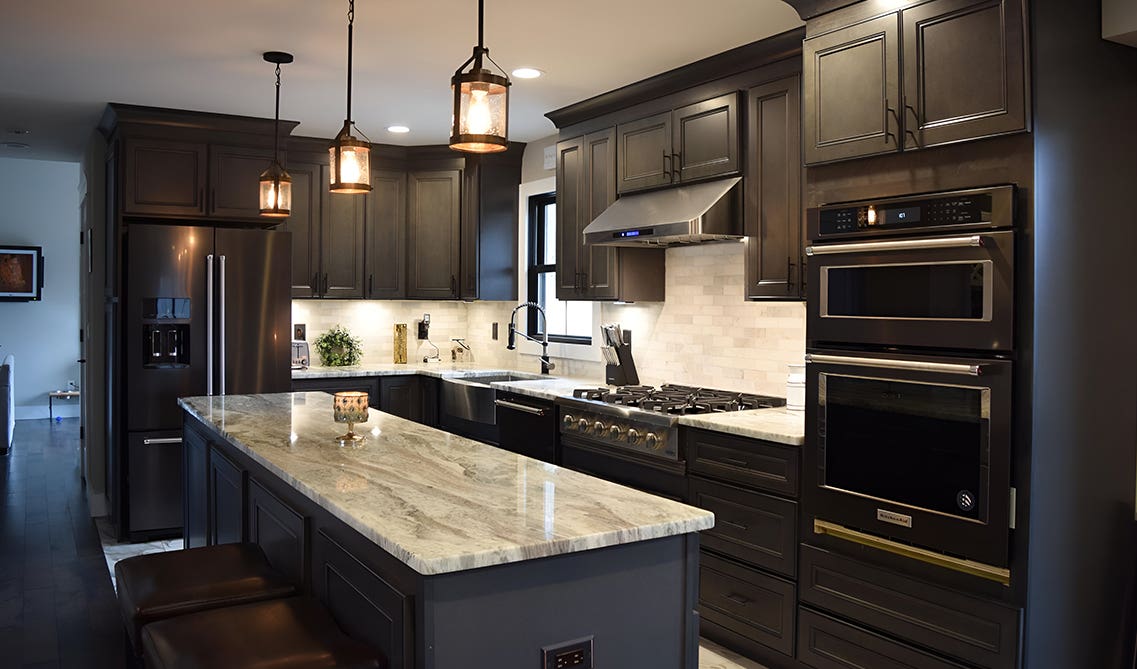
Under-cabinet lights make a kitchen easier to work in. But look up from a bar stool and you often see the thing that makes the light: a bright LED strip, a row of pucks, a dangling wire. Light rail molding is the small strip of trim that hides all of that.
This short guide covers what light rail molding is, whether you need it, which profile suits shaker cabinets, how much to order and how to install it. All Lily Ann sizes and stock below were checked on the live site on September 22, 2026.
What Is Light Rail Molding?
Light rail molding is a trim strip that runs along the bottom front edge of wall cabinets. Its main job is to hide under-cabinet lights and their wires, so you see the glow on the counter and not the bulb or LED strip. It also gives the bottom of the cabinets a finished edge, the same way crown molding finishes the top.
You'll also see it spelled light rail moulding, or called an under-cabinet light rail or a light skirt. Lily Ann's own listing sums it up: it "mounts to the bottom of the wall cabinet frame to conceal any under cabinet lighting."
Why Use Light Rail Molding?
- It hides the lights. The rail sits in front of the fixture, so you see an even glow instead of the light source.
- It cuts glare. Without it, anyone sitting at an island or table can look straight into the lights under the wall cabinets.
- It hides wires. Cords and connectors tucked behind the rail stay out of sight.
- It finishes the look. Even with no lights, a rail gives the bottom edge of the wall cabinets a thicker, more finished line.
Is Light Rail Molding Necessary?
No. Light rail molding is optional. You'll want it if you have, or plan to add, under-cabinet lights you can see from across the room. You can skip it if you have no under-cabinet lights, or if you use very slim lights that sit up out of view and you like the plain bottom edge of the cabinets.
It's also a style choice. A rail adds one more line of trim, which suits traditional and shaker kitchens. Some people with very modern, flat-door kitchens leave it off to keep the look as plain as possible.
Light Rail Molding for Shaker Cabinets: Which Profile?
For shaker cabinets, pick a simple profile with straight lines and no carving, so it matches the flat, square frame of shaker doors. Lily Ann's shaker lines list an Angle Light Rail Molding: a plain strip with a stepped back edge and a sloped front face, sold in 96-inch lengths in the cabinet finish.

Lily Ann sells two light rail profiles:
- Angle Light Rail Molding (SKU ending ALRM8): flat lines, a small step on the back that fits against the cabinet and a sloped front. This is the one listed in the shaker lines below.
- Light Rail Molding (SKU ending LRM8): a step on the back with a curved front, a slightly more traditional look. It's listed in lines like York, Charleston and Key Largo White, and in the Off-White and Mocha lines alongside the angle version.

Angle light rail, shaker lines (In Stock, September 22, 2026)
| Cabinet line | SKU | Size as listed |
|---|---|---|
| Colorado White Shaker | WSH-ALRM8 | 96" long |
| Grey Shaker Elite | GSH-ALRM8 | 96"W x 1"H x 1-1/2"D |
| Craftsman White Shaker | CSW-ALRM8 | 96" long |
| Craftsman Black Shaker | CSB-ALRM8 | 96" long |
| Craftsman Natural Shaker | CSN-ALRM8 | 96" long |
| Craftsman Lily Green Shaker | CSG-ALRM8 | 96" long |
| Off-White (Craftsman Off-White, Shaker Off-White) | MIST-ALRM8 | 8' long |
| Mocha (Mocha Shaker, Craftsman Mocha, Mocha Slim) | MOCHA-ALRM8 | 8' long |
Standard light rail (In Stock, September 22, 2026)
| Cabinet line | SKU | Size as listed |
|---|---|---|
| Off-White (Craftsman Off-White, Shaker Off-White) | MIST-LRM8 | 8' long |
| Mocha (Mocha Shaker, Craftsman Mocha, Mocha Slim) | MOCHA-LRM8 | 8' long |
| York Linen | YL-LRM8 | 8' long, 1-1/4"H x 1-1/2"D |
| York Driftwood Grey | YGR-LRM8 | 96"W x 1"H x 1-1/2"D |
| Charleston Linen | CL-LRM8 | 8' long, 1-1/4"H x 1-1/2"D |
| Key Largo White | LW-LRM8 | 96"W x 1-1/8"H x 1-1/2"D |
White Shaker Elite (angle), Charleston Saddle, Charleston Cherry, Bristol Linen light rail also showed in stock but marked Final Sale. The Shaker Espresso, Shaker Cinnamon, Charleston Toffee, Bristol Chocolate, Bristol Antique White, York Chocolate, York Saddle, Madison Chocolate, Madison Linen and Madison Toffee versions showed Out of Stock that day.
Not every listing gives a height and depth. The ones that do run 1 to 1-1/4 inches tall and 1-1/2 inches deep. Browse all our shaker cabinets, or open a line's trim section, like Colorado White Shaker panels, fillers and trim, to see its light rail next to the matching crown.
Pick Your Lights Before the Rail
The rail only works if it's tall enough to hide the light. So choose the lights first, check how thick they are, and compare that to the rail's listed height. A slim LED strip or low-profile fixture is the easiest to hide.

Lily Ann's cabinet lighting section sells linkable LED under-cabinet fixtures sized to cabinet widths, for example a 20" fixture that fits best in a 24-inch-wide cabinet. For help choosing, see our under-cabinet lighting ideas. If you also want to move outlets off the backsplash, our guide to under-cabinet outlets shows how lights, outlet strips and the rail share that space. If your sink sits under a window with no wall cabinet above it, see what to put over a kitchen sink instead.
How Much Light Rail Molding Do You Need?
Measure along the bottom front edge of every run of wall cabinets. Add the depth of any cabinet side that shows at the end of a run (Lily Ann wall cabinets are 12 inches deep). Divide the total by 96 and round up. For example:
- Wall cabinets along one wall: 120 inches
- Wall cabinets along the other wall of an L: 66 inches
- One exposed end side: 12 inches
- Total: 198 inches, or 2.1 sticks. Round up to 3 sticks.
Miters and cutting mistakes eat length, so if your total lands just under a full stick, add one more.
How to Install Light Rail Molding
- Install and test the lights first. Mount the fixtures, run the wires and make sure everything works before any trim goes on.
- Measure each run. Measure the bottom front edge of the cabinets from corner to corner, plus any exposed sides.
- Cut the corners. Where the rail wraps around an exposed end, cut matching 45-degree miters with a miter saw so the short side of each cut lines up with the cabinet corner.
- Dry fit. Hold the piece in place. On framed cabinets, the small step on the rail sits up against the bottom edge of the face frame, which lines it up and hides the seam.
- Fasten it. Pin-nail up through the rail into the cabinet frame, or nail down from inside the cabinet through the cabinet floor into the rail. Put a little glue in each miter, and clamp miters at eye level instead of nailing them, so no nail holes show.
- Fill the gaps at walls. Where a run ends at a wall or window, you may need a small filler block behind the rail's return so it has something to attach to.
- Touch up. Fill nail holes with the touch-up kit for your cabinet finish.
Check your clearance. The rail hangs below the cabinet, so it takes a little height out of the space above the counter. If a tall stand mixer or coffee maker lives under your wall cabinets, measure before you install.
Match the Rail to Your Crown
Light rail and crown molding frame the wall cabinets top and bottom, so they look best in the same finish and a similar style. Lily Ann's Colorado White Shaker trim section, for example, lists an Angle Crown Molding next to its Angle Light Rail Molding. See our cabinet crown molding guide for the top of the cabinets.
The Takeaway
Light rail molding hides under-cabinet lights, cuts glare and finishes the bottom edge of your wall cabinets. It's optional, but if you have lights you can see, it's the piece that makes them look built in. For shaker cabinets, choose a plain angle profile in the same finish as the cabinets, pick your lights first, and order enough 96-inch sticks to cover every run and exposed side.
Planning a kitchen? Get a free 3D design and we'll add the light rail and lighting to your layout.
Frequently Asked Questions
Light rail molding is a trim strip installed along the bottom front edge of wall cabinets. It hides under-cabinet lights and wires so you see the glow on the counter, not the light source, and it gives the cabinet bottoms a finished edge. It's usually sold in 8-foot lengths in the same finish as the cabinets.
No, it's optional. It's worth adding if you have under-cabinet lights that can be seen from the room, because it hides the fixtures and cuts glare. If you have no under-cabinet lights, or you prefer a very plain modern look, you can leave it off. It can also be added later, after the lights go in.
Install and test the lights first. Measure the bottom front edge of each run, cut 45-degree miters where the rail wraps an exposed end, and dry fit it so the rail's step sits against the bottom of the face frame. Pin-nail it up into the cabinet frame, or down through the cabinet floor from inside, and glue the miters. Fill nail holes with a matching touch-up kit.
Use simple trim with straight lines and little or no carving, so it matches the flat, square frame of a shaker door. That usually means a plain or angled crown on top, a plain or angled light rail on the bottom, and flat fillers and panels in the same finish. Lily Ann's shaker lines, like Colorado White Shaker, list an Angle Crown Molding and an Angle Light Rail Molding for this reason.
A simple crown with clean, straight lines usually looks best with shaker cabinets, because ornate curves fight with the plain door frame. An angled or flat crown is a common choice. Whatever you pick, match the light rail to it in style and finish so the top and bottom of the wall cabinets look like a set.
The best trim depends on what you need to finish. Crown molding finishes the top of wall cabinets, light rail finishes the bottom and hides under-cabinet lights, fillers close gaps between cabinets and walls, and scribe molding covers thin, uneven gaps. Buy all of it from the same cabinet line so the finish matches.
Keep the trim simple. Choose slim, angled profiles for the crown and light rail instead of curved or carved ones, or skip the light rail if you have no under-cabinet lights. Modern hardware, like slim bar pulls in black or brushed metal, and a solid-color finish also help. Under-cabinet LED lighting with a clean rail adds a modern touch without changing the doors.
Angle light rail molding is a light rail with flat, straight lines: a small step on the back that fits against the bottom of the cabinet and a sloped front face. It suits shaker and other simple door styles. Lily Ann lists it as Angle Light Rail Molding 96" (SKU ending ALRM8) in its shaker lines.
















Comments