


Outlets are still allowed on kitchen islands, but the newer National Electrical Code (NEC) editions changed where they can go. Under the 2023 NEC, Section 210.52(C), an island outlet is optional. If one is installed to serve the countertop, it has to be on or above the counter (no more than 20 inches above it) or built into the counter with a unit listed for countertops. The side outlet just under the countertop is the one that's no longer allowed where that edition is enforced. States and cities adopt the NEC on their own schedules, so check with your building department and a licensed electrician.
- Still allowed: yes. The 2023 NEC makes an island outlet optional, but if you skip it, a way to add one later has to be provided.
- Where it can go: on or above the countertop, up to 20 inches above it, or in the countertop with a unit listed for countertops (Section 210.52(C)(3)).
- What changed: the 2020 edition allowed a side outlet within 12 inches below the counter. The 2023 edition dropped it. EC&M reports the 2026 edition requires any under-counter outlet to be at least 24 inches below the counter.
- Why: cords hanging off the side of an island were pulled or snagged, tipping hot appliances. The change followed injury reports from 1991 to 2020.
- Local rules win: each state or city chooses which NEC edition to enforce and can amend it. Ask your building department first.
- Options now: a listed pop-up, an outlet on a raised bar, a drawer outlet for charging, a low side outlet, or wiring left ready for later.
- Lily Ann Cabinets doesn't sell outlets, but the cabinet under the counter matters: a full height door base cabinet has no top drawer in a pop-up's way, and island end panels shouldn't be cut until the spot is confirmed.
For years, almost every kitchen island had an outlet on its side, tucked just under the countertop. Then word got around that island outlets were "banned." That's half right. Outlets are still allowed on islands. What changed is where they can go.
This guide covers what the National Electrical Code (NEC) says about island outlets, edition by edition, why it changed, and the options you have now: pop-up, raised, drawer and low side outlets. It also covers the part most guides skip, which is what each option means for the cabinets under your countertop.
One note before we start. We're a cabinet company, not electricians. Every code point below names its source and the date we read it (October 7, 2026). Your local building department and a licensed electrician have the final say on your kitchen.
Are Outlets Still Allowed on Kitchen Islands?
Yes. Under the 2023 NEC, Section 210.52(C)(2), an outlet on a kitchen island or peninsula is optional. If you install one to serve the countertop, it has to sit on or above the counter, or be built into the counter with a unit listed for that use. The outlet on the side of the cabinet, just below the countertop, is the one the newer code no longer allows. Older editions still allow it, and many places still use them.
So the honest answer to "are island outlets banned?" depends on three things: which edition of the NEC your state or city enforces, whether it changed that section, and where on the island you want the outlet.
What the Code Says: 2023 NEC, Section 210.52(C)
The NEC is written by the National Fire Protection Association (NFPA). NFPA lets anyone read the code online for free after a free sign-up, from its NFPA 70 (NEC) page. The summary below is based on the section as reproduced by ElectricalLicenseRenewal.com, a continuing-education site for electricians.
- Section 210.52(C)(2), islands and peninsulas. In plain words: an outlet is not required. If one is installed to serve the island or peninsula countertop or work surface, it has to follow the location rules in 210.52(C)(3). If none is installed, the builder still has to leave a way to add one at the island later.
- Section 210.52(C)(3), where the outlet can go. The first allowed spot reads: "On or above, but not more than 20 inches above, a countertop" or work surface. The other two allowed spots are inside a countertop, using an outlet assembly listed for use in countertops, and inside a work surface, using an assembly listed for work surfaces or countertops.
Notice what's missing. The 2020 edition had one more allowed spot: below the countertop, within 12 inches of it, as long as the counter didn't stick out more than 6 inches past its base. That line is gone from the 2023 list. That is the whole "island outlets are banned" story.
This is a plain-language summary with one short quote. Read the full section on NFPA's site before you rely on it.
2020 vs. 2023 vs. 2026: What Changed
| NEC edition | Is an island outlet required? | Where it can go | Side outlet just under the counter? |
|---|---|---|---|
| 2020 | Yes. At least one for the first 9 square feet of countertop, and one more for each extra 18 square feet. | On or above the counter (up to 20 inches above), in the counter with a listed assembly, or below the counter. | Allowed, within 12 inches below the counter, if the counter overhangs its base by 6 inches or less. |
| 2023 | No. It's optional, but a way to add one later has to be provided. | On or above the counter (up to 20 inches above), or in the counter or work surface with a listed assembly. | Not on the list of allowed spots. |
| 2026 | EC&M's review does not report a change to the 2023 "optional" rule. Confirm with your electrician. | Same idea as 2023, with one addition (next column). | Per EC&M: any outlet under a kitchen countertop has to be at least 24 inches below it. Outlets inside drawers are allowed but don't count as a required outlet. |
The 2020 and 2023 rows come from the code text as shown side by side by ElectricalLicenseRenewal.com. The 2026 row comes from EC&M magazine's review of the 2026 NEC changes, published September 15, 2026. EC&M names the new 2026 section as 210.52(C)(4). We could not open a public copy of that 2026 section itself, so treat that row as EC&M's summary, not the code's own words.
Why 24 inches? An outlet that far below the counter sits near the floor. A cord plugged in down there can't easily pull a pot off the countertop.
Why Were Side Outlets Taken Off the List?
Safety. A cord plugged into the side of an island hangs in the walkway. Someone walking past can snag it, or a small child can grab it, and a slow cooker or fryer full of hot food comes down with it.
ElectricalLicenseRenewal.com reports that the change was accepted after injury and burn reports gathered from 1991 to 2020, including ten deaths. EC&M says the data came from the U.S. Consumer Product Safety Commission, and describes the hazard as a documented, repeating one.
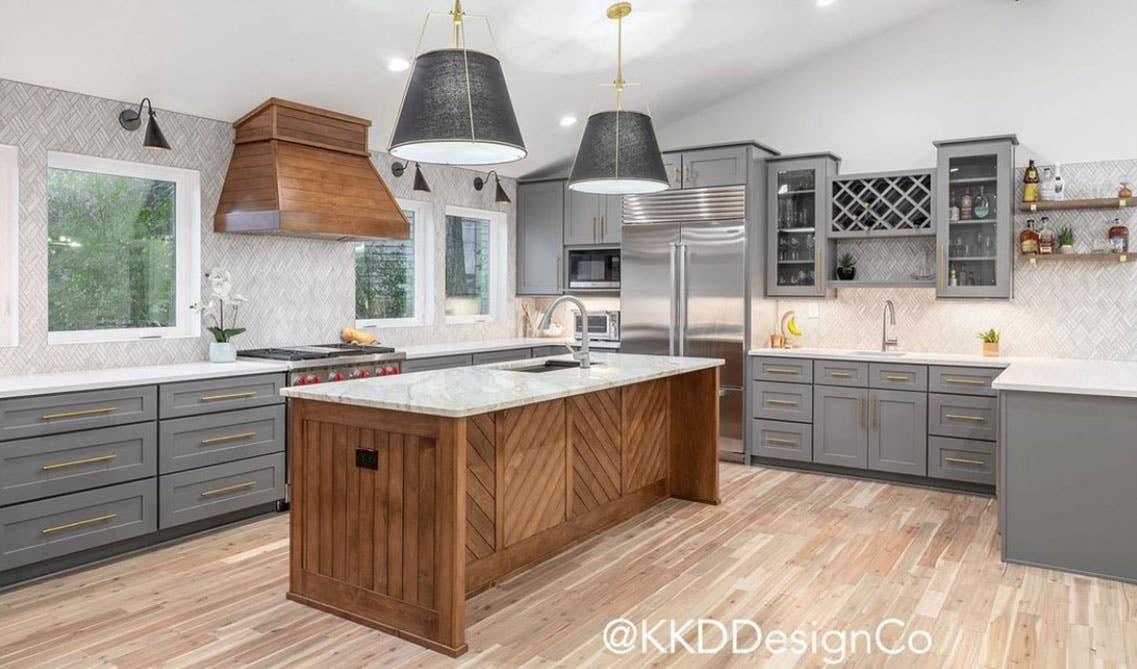
The island above shows the classic setup: an outlet on the end panel, a few inches under the counter. It's the kind of outlet the 2023 list leaves out.
Which Rule Applies to Your Kitchen?
The NEC is a model code. It only has force where a state, county or city adopts it. Many places adopt a new edition years after it comes out, and some change parts of it when they do. NFPA keeps maps of where each NEC edition is enforced.
The home builders' trade group NAHB made the same point in a March 2026 article (written by an outlet maker, Lew Electric): the side-outlet change applies in places that adopted the 2023 NEC without amending it.
Before you plan island power, ask your local building department three things:
- Which NEC edition is enforced here right now?
- Did the state or city amend Section 210.52(C), the island and peninsula rule?
- Does my remodel need a permit and an electrical inspection?
Your Options for Power on a Kitchen Island
| Option | Where it sits | Code note (source) | What it means for the cabinets |
|---|---|---|---|
| Pop-up or in-counter outlet | In the countertop | Allowed under the 2023 NEC if the unit is listed for use in countertops (210.52(C)(3)) | The unit's body hangs down into the cabinet below |
| Outlet above the counter | On a raised bar, ledge or second level | Allowed up to 20 inches above the counter (210.52(C)(3)) | The island needs a raised section to hold it |
| Drawer outlet | Inside a drawer | Allowed under the 2026 NEC but doesn't count as a required outlet (EC&M) | Needs a drawer base and room behind the drawer |
| Low side outlet | Near the floor, on a panel or toe kick area | 2026 NEC: at least 24 inches below the counter (EC&M) | Cut into an end panel or skin, low down |
| No outlet, ready for later | Wiring access left inside the island | Required by the 2023 NEC when no outlet is installed (210.52(C)(2)) | Decide which cabinet the wiring comes up in |
| Classic side outlet | On the side, just under the counter | Only where the local code still allows it (2020 NEC or older, or a local change) | Cut into an end panel or cabinet side |
Pop-up and in-counter outlets
A pop-up outlet sits flush in the countertop and rises when you press it. Other in-counter units stay flat with a cover. For a kitchen island, the key word is "listed." The 2023 NEC allows an outlet in a countertop only when the unit is listed for use in countertops.
That listing matters because counters get wet. The American Institute of Building Design (AIBD) explains that a countertop listing means the unit has to stand up to a half gallon of spilled liquid, while a work-surface listing only covers about a cup. A pop-up made for a desk is not the same product.
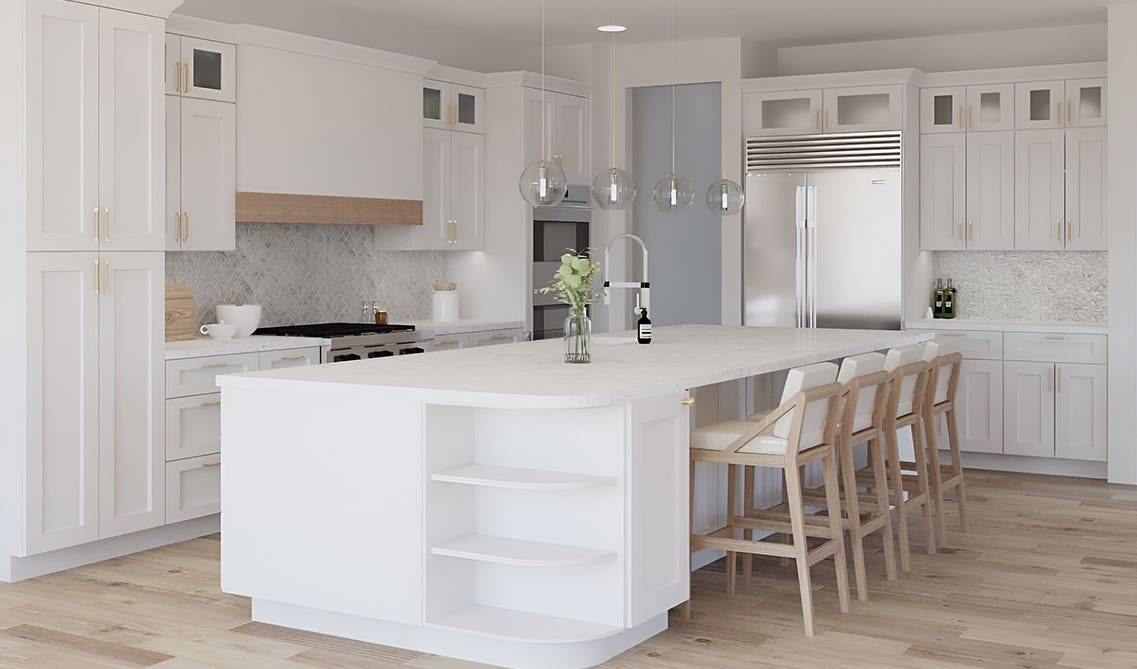
Lily Ann Cabinets: White Shaker Elite
An island like this one, flat across the top with no backsplash or raised bar, has nowhere above the counter to put an outlet. In a place that enforces the 2023 NEC, an in-counter unit is the usual way to get power for countertop appliances here.
An outlet above the counter
If your island has a raised bar, a ledge or a second, higher level, the short wall between the two levels can hold a regular outlet. The 2023 NEC allows it as long as it's no more than 20 inches above the counter it serves. This is the simplest option for the electrician, but it changes the shape of the island. A raised bar adds depth and height, so plan it with your island size and clearances.
Drawer outlets
A drawer outlet (also called a charging drawer) puts outlets inside a drawer, so phones, tablets or a hair dryer charge out of sight. EC&M's review says the 2026 NEC allows outlets in drawers but doesn't count them as a required outlet. Think of a drawer outlet as a convenience, not as your countertop power. Ask your electrician how your local code treats it.
A low side outlet
Some people want an island outlet for a vacuum or a laptop, not for a mixer. Per EC&M, the 2026 NEC allows an outlet under the countertop when it's at least 24 inches below the counter. Lily Ann base cabinets are listed at 34-1/2 inches tall before the countertop goes on, so that puts the outlet in roughly the bottom foot of the island. It isn't meant for countertop appliances.
No outlet now, ready for later
Under the 2023 NEC you can skip the outlet, but you can't skip the planning. The code calls for a way to add one later. ElectricalLicenseRenewal.com notes that inspectors read this differently: some want an empty conduit brought up into the island cabinet, others want a cable run to the island and left unconnected. Ask your inspector which they accept.
The classic side outlet
If your area still enforces the 2020 NEC or an older edition, or has amended the newer one, a side outlet under the counter may still be allowed. Under the 2020 text it has to be within 12 inches below the countertop, and not on a side where the counter overhangs its base by more than 6 inches. That overhang limit matters if you're planning island seating. Our guide to island overhangs covers how far a seating overhang usually sticks out.
What Each Option Means for Your Island Cabinets
Lily Ann Cabinets doesn't sell outlets, pop-ups or wiring parts. What we sell is the island itself: the base cabinets and the panels that finish it. Here's how the outlet choice changes the cabinet plan. All sizes and stock below are from the live listings on October 7, 2026.
- A pop-up needs empty space under the counter. The part you see is only the lid. The body hangs down into the cabinet. Get the depth below the counter and the cutout size from the maker's spec sheet. A standard base like the 36-inch base cabinet has drawers right under the countertop, so the unit can land in a drawer's path. A full height door base cabinet (18 inches wide, 24 deep, 34-1/2 tall, one door and one shelf) has no top drawer. A 24-inch version has two doors.
- A drawer outlet needs a drawer base. A 3 drawer base cabinet gives you a deep drawer to work with. The outlet kit's maker will list the drawer size and the space it needs behind the drawer box. Check that against the cabinet before you order either one.
- Side and low outlets get cut into a panel. The ends of an island are usually covered with a shaker decorative end panel or an X-pattern end panel (both 34 inches wide, 34-1/2 tall and 3 inches thick), and the back with a thin base skin panel (1/4 inch thick). Don't cut any panel for an outlet box until your electrician confirms the spot is allowed. Our guide to cabinet end panels explains the panel types.
- Wiring comes up through the floor. An island has no wall behind it, so the cable or conduit rises from below, inside one cabinet. That spot has to be set before the flooring and cabinets go in. Pick the cabinet with your electrician, and avoid one filled with drawers or a pull-out.
- The countertop is cut for a pop-up before it's installed. Tell your countertop fabricator about any in-counter unit before they measure, and give them the maker's cutout sheet.

Lily Ann Cabinets: Colorado White Shaker X Base Decorative End Panel
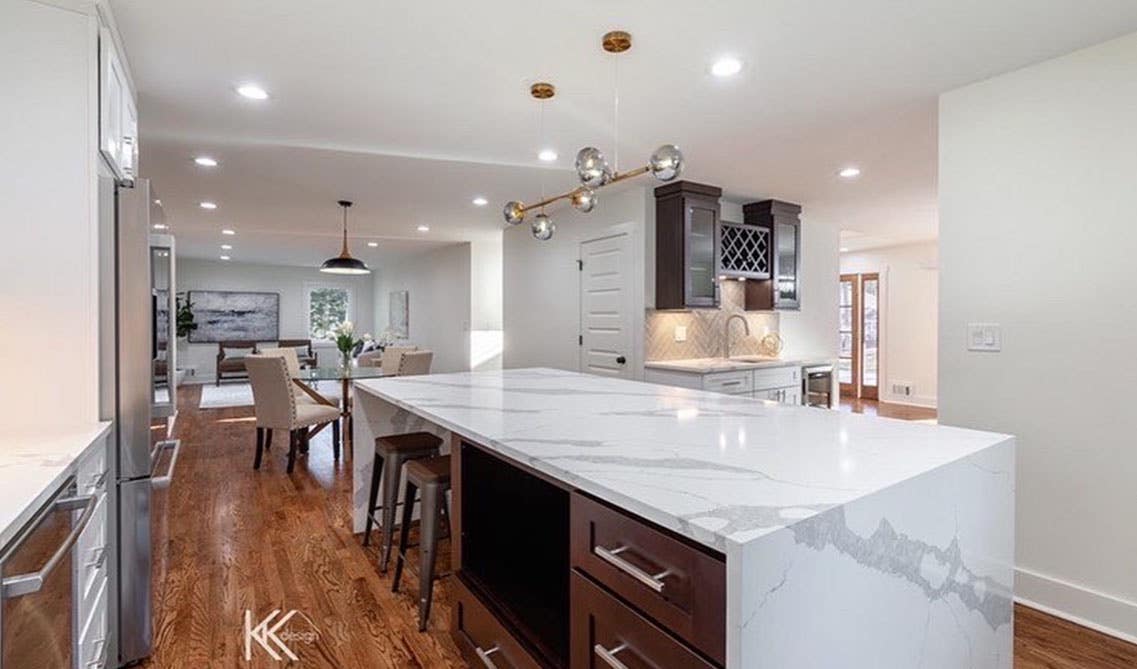
A waterfall countertop changes the picture again. The stone runs down the end of the island, so there's no wood panel there to hold an outlet at all.
If you're building the island yourself, our guide to making a kitchen island from base cabinets lists every panel and part. You can browse Colorado White Shaker base cabinets and the matching panels, fillers and trim to see the pieces named above.
Questions to Ask Your Electrician Before the Cabinets Go In
- Which NEC edition applies to my kitchen, and has Section 210.52(C) been changed locally?
- Do I want an island outlet at all? If not, what will the inspector accept as the way to add one later?
- If it's a pop-up: is this exact unit listed for use in countertops, and how much room does it need below the counter?
- Which cabinet will the wiring come up in, and where exactly on the floor?
- What protection does an island outlet need? (Outlet type and ground-fault protection are set by code. Your electrician will know the local rule.)
- Can my existing side outlet stay if I'm only replacing the cabinets or the countertop?
Outlets along the wall side of the kitchen are a separate job. The heights and spacing for those wall outlets and the light switches are in our switch and outlet height guide. Our guide to under cabinet outlets covers power strips, lighting and light rail molding for wall runs.
The Takeaway
Island outlets aren't banned. Under the 2023 NEC they're optional, and when you add one for the countertop it goes on or above the counter or into the counter with a listed unit. The side outlet just under the countertop is what the newer editions leave out, and EC&M reports the 2026 edition pushes any under-counter outlet at least 24 inches down. Your state or city decides which edition applies, so start with your building department and a licensed electrician.
Then plan the cabinets around the answer: empty space under a pop-up, a drawer base for a charging drawer, and no cuts in an end panel until the spot is confirmed.
Planning an island? Get a free 3D kitchen design and tell your designer where you want power, so the right cabinets end up in the right spots.
Frequently Asked Questions
Outlets are still allowed on kitchen islands. What changed is the location. Under the 2023 NEC, Section 210.52(C), an island outlet that serves the countertop has to be on or above the counter, no more than 20 inches above it, or built into the counter with a unit listed for countertops. The side outlet just under the countertop is no longer on the list. Places that still enforce an older edition may still allow it, so check with your building department.
Side outlets were dropped because of injuries. A cord plugged into the side of an island hangs where people walk, and a snagged or pulled cord can bring a hot appliance down. ElectricalLicenseRenewal.com reports the change followed injury and burn reports gathered from 1991 to 2020, including ten deaths. EC&M magazine says the data came from the U.S. Consumer Product Safety Commission. Outlets on or in the countertop keep the cord on the work surface.
Yes. Under the 2023 NEC you can put an outlet in the island countertop itself, as long as the unit is listed for use in countertops. Most of these are pop-up outlets that sit flush when closed. You can also put a regular outlet on a raised bar or ledge, up to 20 inches above the counter. Have a licensed electrician choose and install the unit, because the listing is what makes it allowed.
Not under the 2023 NEC. That edition made island and peninsula outlets optional. If you leave the outlet out, the code still calls for a way to add one at the island later, such as wiring access left inside the cabinet. The 2020 edition was different: it required at least one outlet for the first 9 square feet of island countertop and another for each extra 18 square feet. Which one applies depends on the edition your area enforces.
The current rule is Section 210.52(C) of the National Electrical Code. In the 2023 edition, island outlets became optional, the under-counter side location was removed, and outlets that serve the counter have to be on or above it (within 20 inches) or in it with a listed unit. EC&M magazine reports that the 2026 edition adds that any outlet under a kitchen countertop has to be at least 24 inches below it. Your state or city may not have adopted either edition yet.
According to EC&M magazine's September 2026 review, the 2026 NEC clarifies that an outlet beneath a kitchen countertop has to be at least 24 inches below the countertop. EC&M names the new section as 210.52(C)(4). The same review says outlets in drawers are allowed but don't count as a required outlet. We couldn't open a public copy of the 2026 section itself, so confirm the exact wording with your electrician or on NFPA's free-access site.
No, not by themselves. An island outlet is against code only when it's in a spot your local code doesn't allow. Under the 2023 NEC, an outlet on the side of the island just below the countertop is no longer an allowed spot for serving the counter. An outlet in the countertop with a listed unit, or on a raised section within 20 inches above the counter, is allowed. Existing outlets and older local codes are a question for your building department.
Pop-up outlets for islands differ mainly in how they open and what's on them. Some rise when you press the lid and others are motorized. Many add USB ports, and some have a wireless charging pad on the lid. For a kitchen island, the feature that matters most is the listing: the unit has to be listed for use in countertops, which includes a spill test. Lily Ann Cabinets doesn't sell them, so ask your electrician which listed units they install.
A pop-up outlet is made to be safe in a kitchen when it's listed for use in countertops and installed by a licensed electrician. The American Institute of Building Design explains that a countertop listing means the unit has to handle a half gallon of spilled liquid, while a work-surface listing only covers about a cup. Units made for desks or furniture don't meet the countertop test. Check the listing on the spec sheet before anyone cuts the countertop.
















Comments