


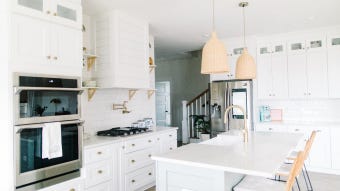
Start with what the island actually does: keep the workable part of the counter clear, and style only a small end of it with a tray, a bowl, and one item that shows some personality, grouped in odd numbers at different heights. Beyond the countertop, the cabinetry itself can carry the look — open shelving or a wine rack insert for display and storage in one, furniture-style legs or corbels for a built-furniture look, and a finished decorative end panel on any side that's on view. None of it needs to be seasonal to work.
- Style the end, not the whole counter. Keep the cooking/prep zone clear; group decor near one end in odd numbers (1, 3 or 5 items) at different heights.
- A tray does the real work. It contains the clutter and makes the whole grouping easy to move for meal prep and put back after.
- The cabinetry can be the decor. Open shelving, a wine rack insert, furniture-style legs/corbels and a finished end panel all read as styling, not just storage.
- 57 GSC impressions today, all fall-seasonal. They land on a different article; this guide is written to work year-round, and links out to the seasonal one for people who do want that.
- Real products, not stand-ins: the wine rack insert, leg post, corbel and decorative panel linked in this guide are live Lily Ann listings, checked in stock on September 19, 2026.
- Lighting finishes the look. One or two pendants sized to the island read as decor; a single oversized fixture usually blocks the sightline across the room.
Kitchen Island Decor Ideas at a Glance
The island is the one surface in the kitchen that gets used every single day, so decor that survives has to share space with real life: a cutting board mid-prep, mail dropped on the way in, a kid doing homework. The fix is the same one stylists use for any hardworking surface — keep most of it clear, style one end, and let a few of the island's own features (open shelving, a wine rack, its legs or panels) do some of the decorating instead of piling more onto the counter.
| Spot on the island | Good everyday decor | Skip this |
|---|---|---|
| Countertop, styled end | A wood or marble tray, a bowl for fruit or produce, one plant or seasonal item | A themed collection that needs daily dusting or rearranging |
| Countertop, work end | Nothing — leave it clear for prep | Anything you'll have to move before you can cook |
| Open ends or a shelf insert | A few pieces of everyday dishware or cookbooks, faced out | A stack of items nobody actually reaches for |
| The overhang | Two or three matching or coordinated stools | Mismatched chairs pulled from another room |
| Visible side panels | A finished decorative end panel or a furniture-style leg | Bare, unfinished plywood facing the room |
| Overhead | One or two pendants sized to the island's length | A single oversized fixture that blocks sightlines across the room |
The 3-5-7 Rule for Styling an Island
Interior stylists commonly reach for a simple rule when arranging any tight surface: group objects in odd numbers, at different heights, and let one item anchor the group while the others are smaller. On a kitchen island, that usually plays out as one taller piece (a vase, a stack of bowls, a cutting board propped upright), one medium piece (a smaller bowl or a candle), and one small piece (a single item like a pepper grinder or a piece of fruit) — three objects, three heights, one end of the counter. It reads as put-together without looking staged, and because it's only three things, it's fast to clear off before you actually cook.
What to Actually Put on Top of a Kitchen Island
The honest answer is: less than most photos suggest. A tray is doing more work than any single decor item — it defines a boundary, contains whatever you put inside it, and lets you pick the whole grouping up in one motion when you need the counter back. Inside the tray, a bowl for fruit, bread, or produce earns its space because it gets used, not just looked at. From there, one item that's actually yours — a cutting board you like the grain on, a small plant, a candle, a stack of cookbooks — finishes the look without adding a second thing to dust.
What doesn't hold up: anything fragile near the edge where a passing elbow or a kid's backpack will find it, anything that has to be moved before you can cook (defeats the point of an island), and large centerpieces that block sightlines to whoever's on the other side, whether that's a stool or the rest of the kitchen.
Let the Cabinetry Do Some of the Decorating: Open Shelving

Open shelving isn't only a wall-cabinet decision. Built into the end of an island, an open shelf or cubby turns storage into a display without adding anything extra to the counter above it — a few pieces of dishware, a stack of cookbooks, or a couple of serving bowls faced outward do the styling for you every day, because they're things you actually use. The tradeoff is the same one it is anywhere else in the kitchen: open shelving needs to stay a little curated, since anything you set there is on permanent display. For the fuller pros-and-cons breakdown, including how much upkeep it really takes, see our guide to open shelving vs. closed cabinets.
Add a Wine Rack Insert as a Built-In Decor Feature
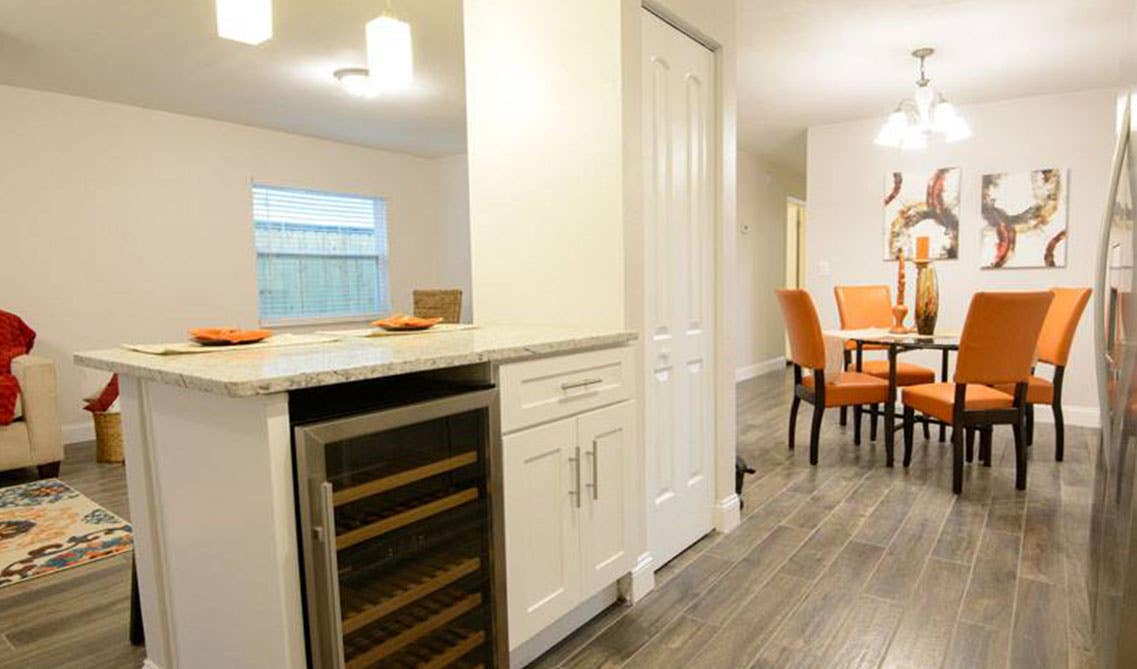
A wine rack insert does the same job as a tray, at a bigger scale: it gives a collection of bottles a defined, intentional place instead of letting them collect on the counter. Because it's built into the cabinet box rather than sitting on top, it doesn't compete for counter space at all, which is exactly the constraint this whole page is working around. Lily Ann's Wine Rack Insert for W3018 (Colorado White Shaker, checked in stock September 19, 2026) drops into a standard 30-inch wide base cabinet opening, which is a common width for an island end.
Give the Island a Furniture Look: Legs and Corbels
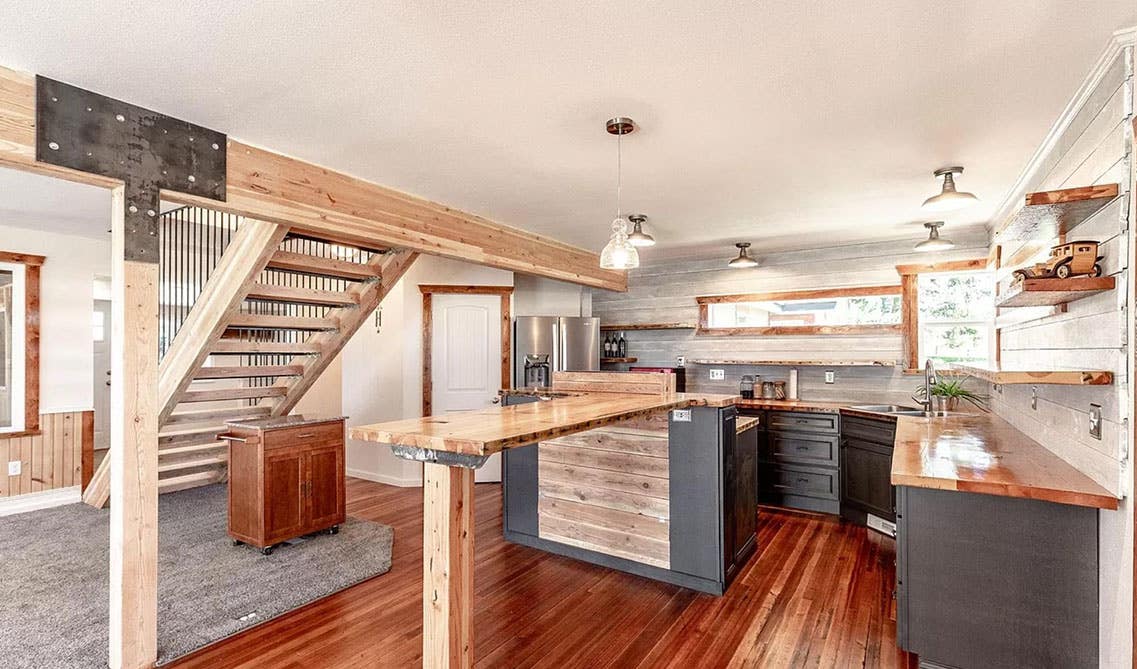
The fastest way to make an island read as a piece of furniture rather than a row of cabinets is to change what's holding it up. A furniture-style leg at the corners, or a corbel under an overhang, both break up the flat cabinet face and add the kind of detail that's usually reserved for freestanding furniture. It's a decor decision, not just a structural one — the leg or corbel is visible every day, so it's worth picking to match the rest of the room, not just the cabinet finish. Lily Ann lists a Colorado White Shaker Leg Post, 3"W x 42"H and, in White Shaker Elite, a CB9x9 Corbel, 9" — both checked in stock September 19, 2026.
Finish the Sides: Decorative End Panels
Any side of the island that's on view — the end facing the room, the back facing the sink run — reads as unfinished if it's left as bare cabinet-grade plywood. A decorative end panel in the cabinet's own finish closes that gap and is arguably the single highest-impact "decor" move on this whole list, because it's the one thing every single person in the kitchen will see, all the time, whether or not the counter is styled. Lily Ann's Colorado White Shaker Base Decorative Door Panel, 24" was in stock on September 19, 2026.
Decorate Around the Seating

If the island has an overhang, the stools are part of the decor whether you planned it that way or not — they're in every photo, every meal, every time someone sits down. Two or three matching or deliberately coordinated stools read as a decision; a mismatched set pulled from around the house reads as an afterthought. For seat count, overhang depth and the rest of the planning that goes into an island built for seating, see our guide to kitchen islands with seating.
Lighting That Finishes the Look

Pendant lighting over an island does double duty as task lighting and as decor — it's one of the only fixtures in the kitchen mounted low enough to actually be seen up close, rather than just lighting the room from a ceiling plane. One or two pendants, sized to the island's length rather than the room's, generally read better than a single oversized statement piece, which can end up blocking the view across the island instead of framing it. Our guide to choosing kitchen lighting goes through sizing and placement in more detail.
Common Kitchen Island Decor Mistakes
- Styling the whole counter. If there's no clear space left for a cutting board, the styling will get shoved aside the first time someone actually cooks — and probably won't go back.
- Matching the theme too literally. A full seasonal display (every item picking up the same holiday or color) tends to look more like inventory than decor. One or two seasonal touches read better than a full set.
- Ignoring the vertical surfaces. An island can have a styled countertop and still look unfinished if the side facing the room is bare plywood or a mismatched finish.
- Oversized centerpieces. A large arrangement in the middle of the island blocks sightlines and conversation across it — the opposite of what an island is usually for.
- One giant light fixture instead of a pair. It can look dramatic in a photo and get in the way every day the island is actually used.
What People Mean by "Replacing" Their Kitchen Island
This phrase shows up in search mostly as design-trend chatter — homeowners moving from one large single island to two smaller islands, or to a peninsula, in bigger kitchens — rather than as a documented, sourced statistic anyone can point to. If a layout change like that is genuinely on the table, it's a bigger decision than decor and worth working through with a designer against your actual kitchen's dimensions, not a trend headline. Our kitchen island size guide and 15 incredible kitchen islands cover layout and sizing if that's the actual question.
Should You Decorate the Island for Each Season?
The only real search demand this site currently gets for island decor is seasonal — specifically fall — and it already lands on a dedicated page. If seasonal styling is what you're after, our fall kitchen decor ideas covers it directly. This guide is built to work the other 11 months of the year: everything above (the tray-and-bowl approach, open shelving, the wine rack insert, legs and corbels, end panels, seating and lighting) holds up whether or not there's a pumpkin involved.
Shop the Real Features in This Guide
Every product linked on this page is a live Lily Ann listing, checked in stock on September 19, 2026: the wine rack insert, the fluted leg post, the corbel and the decorative end panel. None of them require a full kitchen remodel — each is a single-piece addition to an island that's already built.











Comments