


- Shop by cabinet, not by problem. "I need a spice organizer" leads to the wrong purchase; "I have a B15 base cabinet" leads to the right one.
- Measure three dimensions before you buy: the opening width (not the cabinet width), the interior depth, and the interior height. The opening is always narrower than the cabinet.
- Face-frame cabinets lose about an inch and a half of opening width to the frame. This is the single most common reason a pull-out does not fit.
- Corner cabinets are where organizers earn the most — a blind corner without a mechanism is the least accessible storage in any kitchen.
- Pull-outs need soft-close glides rated for the load. A fully-loaded pantry pull-out is heavy, and an under-rated glide sags within a year.
- Retrofit is possible but harder than ordering it fitted. Specifying organizers with the cabinets means the mounting is designed in rather than drilled in later.
Shop by Cabinet, Not by Problem
The right way to choose a cabinet organizer is to start from the cabinet it has to go in. Most organizers are sized to fit specific standard cabinet widths, and buying by the problem you want solved — spices, pans, waste — is how people end up with something that does not fit.
Cabinet organizers are made to standard cabinet dimensions, which is why product listings read like part numbers: "fits best in B18", "fits best in W1530 or W1536". Those codes are the cabinet, not the organizer. A B18 is an 18-inch-wide base cabinet; a W1530 is a wall cabinet 15 inches wide and 30 inches high.
So the sequence is: identify the cabinet, measure the opening, then choose what goes in it.
| Cabinet type | Organizers that fit it | Best for |
|---|---|---|
| Base cabinet | Pull-out shelves, roll-out baskets, tray dividers, waste containers, cookware organizers | Pans, food storage containers, cleaning supplies, bins |
| Wall cabinet | Pull-out organizers with adjustable shelves, door-mounted racks, shelf risers | Spices, glassware, tins, everyday dishes |
| Corner / blind corner | Lazy Susans, half-moon pivot shelves, blind-corner pull-outs | Anything currently unreachable |
| Sink base | Tip-out trays, under-sink caddies, pull-out waste bins, towel bars | Sponges, cleaning products, waste, bin bags |
| Drawer | Cutlery trays, knife blocks, peg systems, spice inserts, tray dividers | Utensils, knives, plates, spices, wraps |
| Tall / pantry | Full-height wood pull-outs, wire pantry pull-outs, door racks | Dry goods, bulk storage |
Measure the Opening, Not the Cabinet
Take three measurements before you order anything: the width of the cabinet opening, the interior depth from the back of the face frame to the back panel, and the interior height. The opening is always narrower than the cabinet, and on a face-frame cabinet it is narrower by roughly an inch and a half.
This is the single most common reason an organizer arrives and does not fit, and it is entirely avoidable.
- Width: open the door and measure between the inside edges of the face frame at the narrowest point. An 18-inch base cabinet does not have an 18-inch opening — the stiles of the face frame eat into it on both sides.
- Depth: measure from the back face of the frame to the interior back panel. Not from the front of the door.
- Height: measure from the cabinet floor to the underside of any fixed shelf or the frame's top rail. A pull-out has to clear both going in and coming out.
- Check for obstructions: hinge hardware, a centre stile on a double-door cabinet, plumbing in a sink base. A centre stile in particular halves the usable opening and rules out most full-width pull-outs.
Frameless cabinets are more forgiving
A frameless (European-style) cabinet has no face frame, so its opening is very close to its full internal width. That is a genuine practical advantage for organizers, and it is worth knowing which construction you have before shopping. If you are unsure, look at the front edge of the cabinet with the door open: a visible timber frame around the opening means face-frame construction.
Base Cabinets: Pull-Outs Do the Most Work
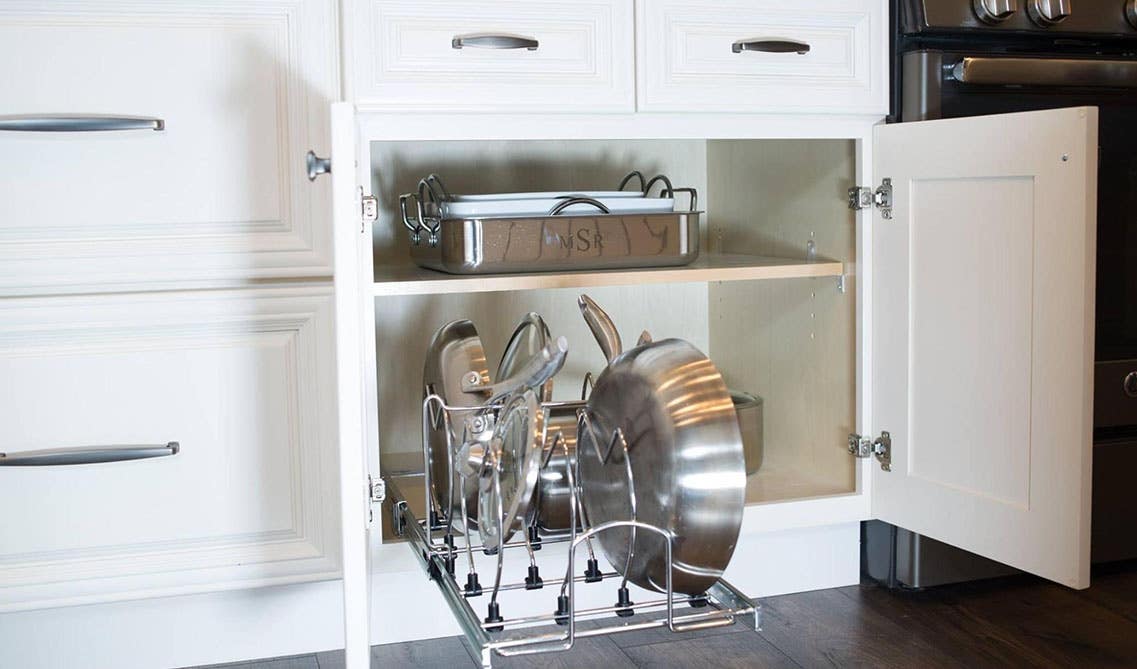
A base cabinet is a deep box with a door on the front, which means everything behind the first twelve inches is effectively invisible. A pull-out converts that depth from storage you have to reach into storage that comes to you.
This is the highest-value organizer category, and the reason is geometric rather than aesthetic: the back half of a base cabinet is otherwise reached by kneeling and using an arm as a probe.
- Pull-out shelves with adjustable heights — the general-purpose answer. Two or three tiers, adjustable, in a base cabinet holds pans, appliances and food storage where you can see all of it.
- Roll-out wire baskets — lighter, cheaper, and better for anything that benefits from air. Less good for small items, which fall through.
- Tray dividers — vertical dividers for baking sheets, cutting boards and pan lids, which store terribly flat and perfectly on edge.
- Cookware organizers — two-tier pull-outs sized for pots and pans with the lids stored separately.
- Base filler pull-outs — a narrow pull-out that fits behind a 3- or 6-inch filler strip. This turns dead space into a spice or utensil rack, and it is the most under-used organizer there is.
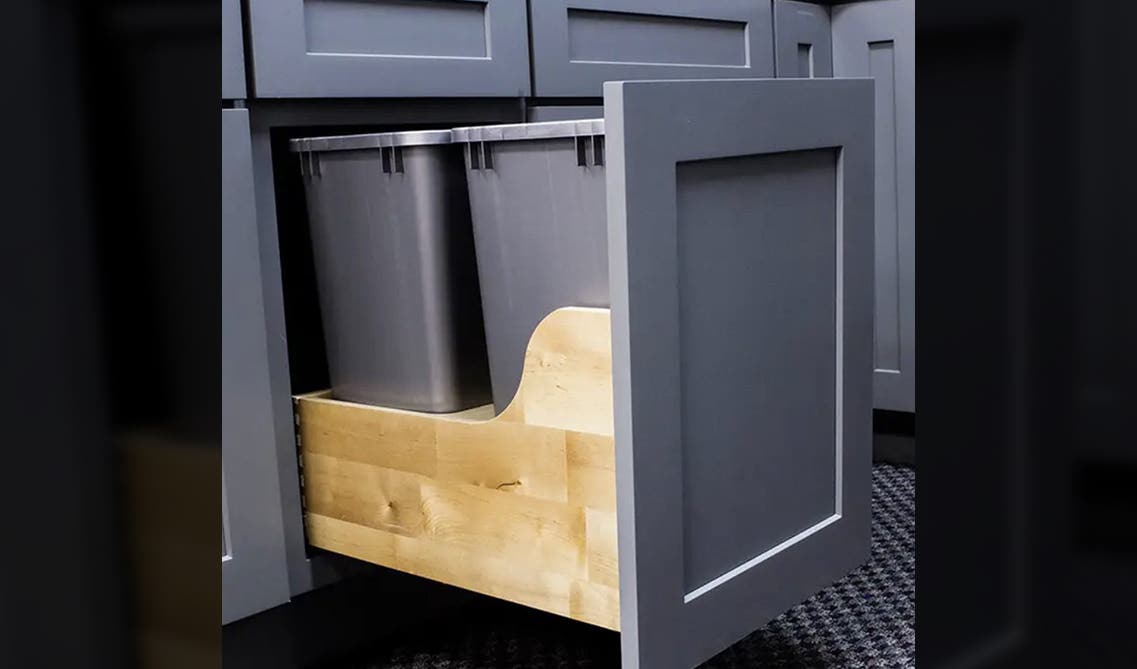
Waste containers deserve their own mention because they are the organizer people most often wish they had specified from the start. A pull-out double bin inside a base cabinet removes the freestanding bin from the floor, which in a small kitchen is a meaningful amount of floor space. Sizes are matched to cabinet width — a double 35-quart unit typically needs an 18-inch or wider base.
Glide ratings matter more than they sound
A loaded pull-out is heavy. A full pantry pull-out or a double waste container is genuinely heavy, and it is cantilevered out from its mounting when open — which is the worst case for the glides. Check the load rating, and prefer full-extension soft-close glides: full-extension so the back of the shelf actually clears the cabinet, soft-close so a heavy loaded shelf does not slam.
Corner Cabinets: Where Organizers Earn the Most
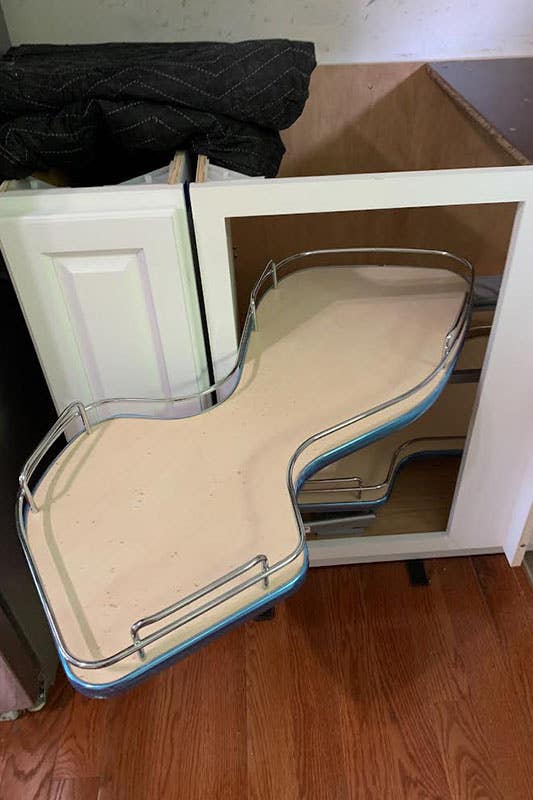
An inside corner cabinet is the least accessible storage in any kitchen — deep, dark, and reached past a door opening that is not in front of it. A corner organizer is not a convenience here; it is what makes the cabinet usable at all.
Three mechanisms, in rough order of cost:
- Lazy Susan / rotating carousel. A rotating shelf that brings the back of the corner to the front. The standard solution, available in full-circle, kidney and D-shape depending on whether the cabinet is a true corner or a blind one. Best value per dollar of any organizer in this article.
- Half-moon pivot shelves. Two D-shaped shelves that pivot out through the door opening — used in blind corners where a full carousel cannot turn. Some pivot only; better versions pivot and slide, which clears the opening properly.
- Blind-corner pull-out. A mechanism that slides the front basket out and then pulls the rear one around behind it. The most storage recovered and the most expensive.
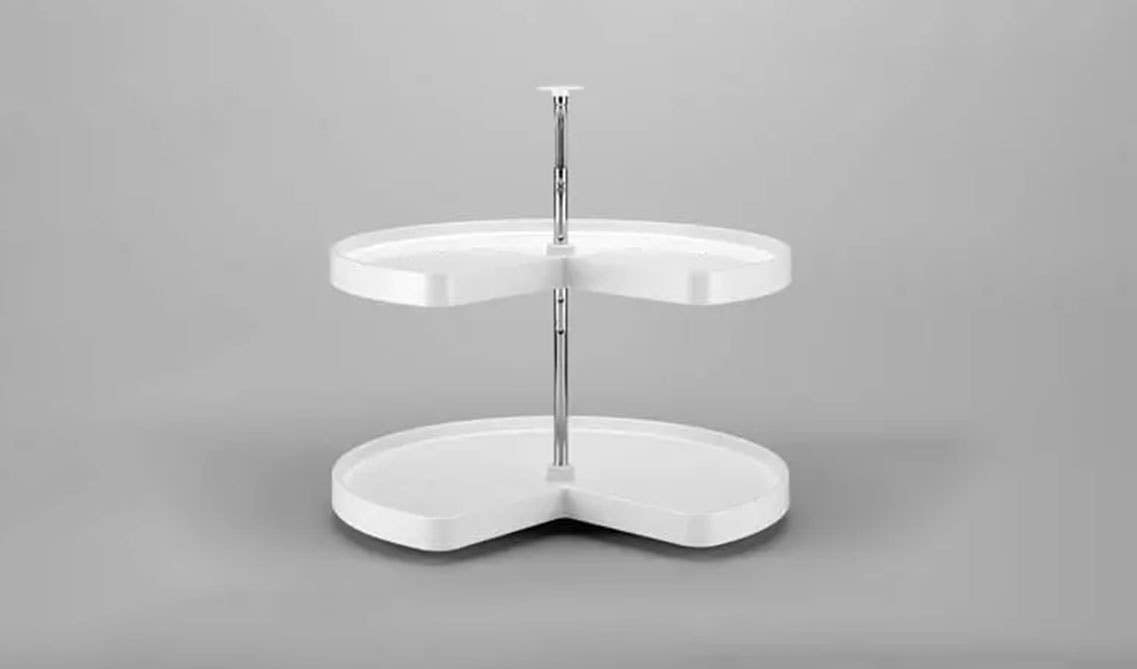
Blind corner versus true corner matters when ordering. A true corner cabinet has its door on the diagonal and takes a full carousel. A blind corner has a straight door on one run with the cabinet extending sideways behind the adjacent run — and the part behind the neighbouring cabinet is what needs the mechanism. Products are specified for one or the other, often with a left-hand or right-hand designation. Get that wrong and it does not fit.
The full set of corner options, including what to do instead of a corner cabinet, is in corner kitchen cabinet ideas.
Drawers: Inserts, Not Pull-Outs
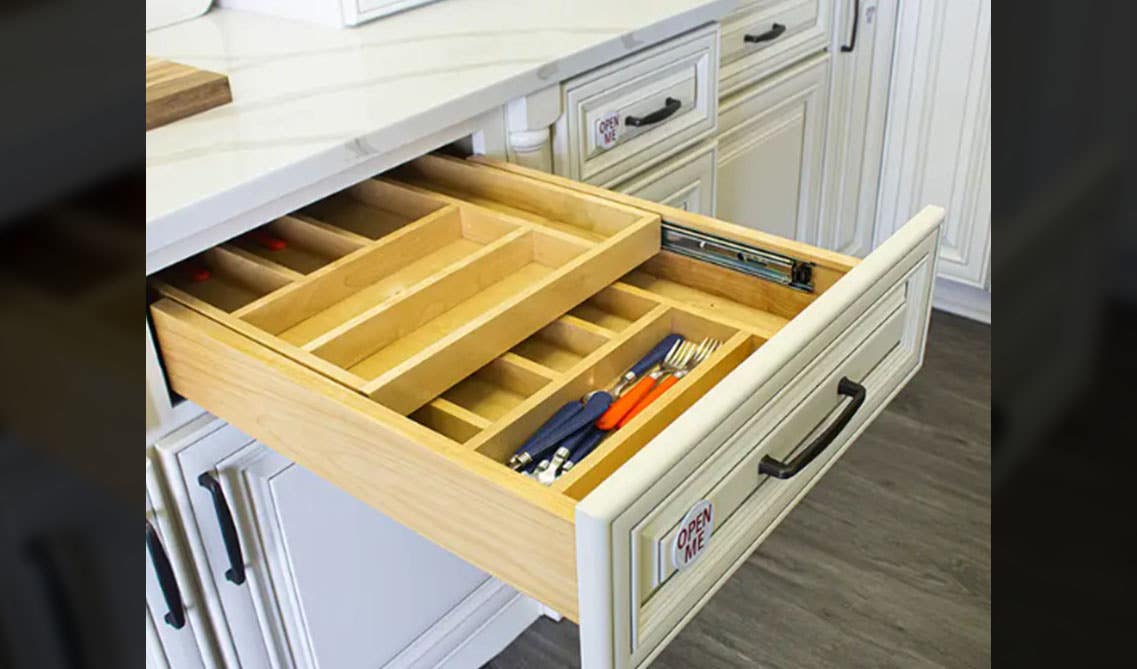
A drawer is already an organizer — it brings its contents out to you. What drawer inserts do is stop the contents migrating, which is a different and smaller problem than the one base-cabinet pull-outs solve.
- Cutlery trays — the default. Two-tier versions double the capacity in a deep drawer by putting a sliding upper tray over the main compartment.
- Knife blocks — an in-drawer block keeps knives edge-protected and off the counter. Safer than a loose knife in a utensil drawer, and it reclaims counter space from a block.
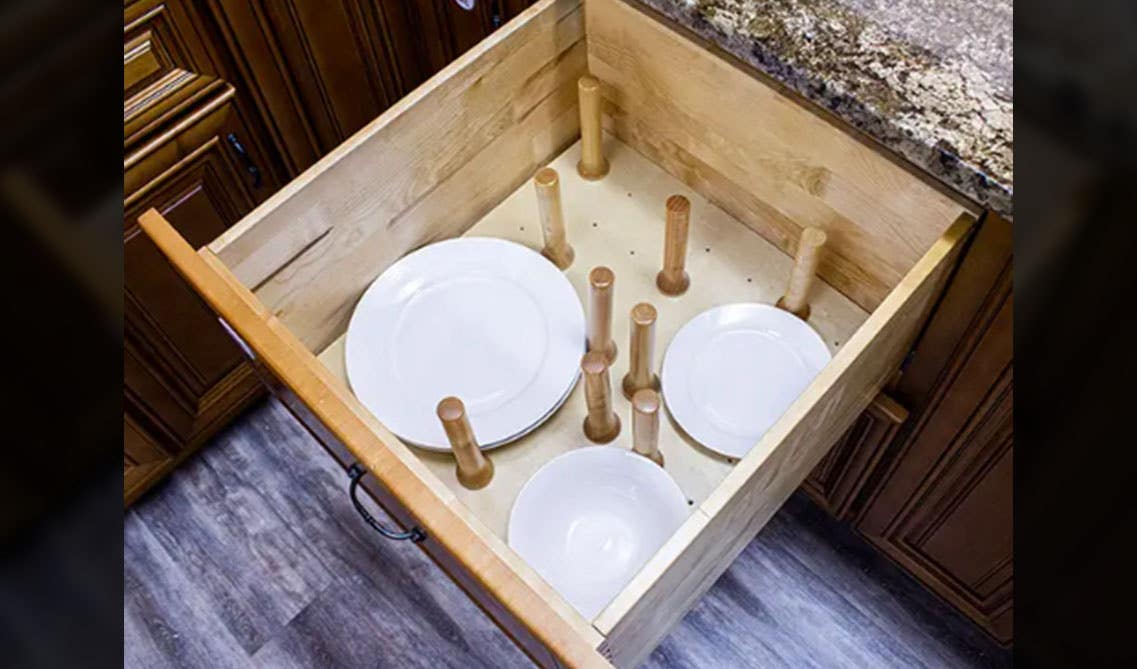
- Peg systems — a pegboard base with movable pegs that hold plates, bowls and containers in place. The most flexible insert, and the right answer for a deep drawer holding crockery.
- Spice inserts — angled tiers that let you read every label at once, which is the entire problem with spices in a drawer.
- Cut-to-size trays — sized down on site to fit a non-standard drawer. The answer when nothing off-the-shelf matches.
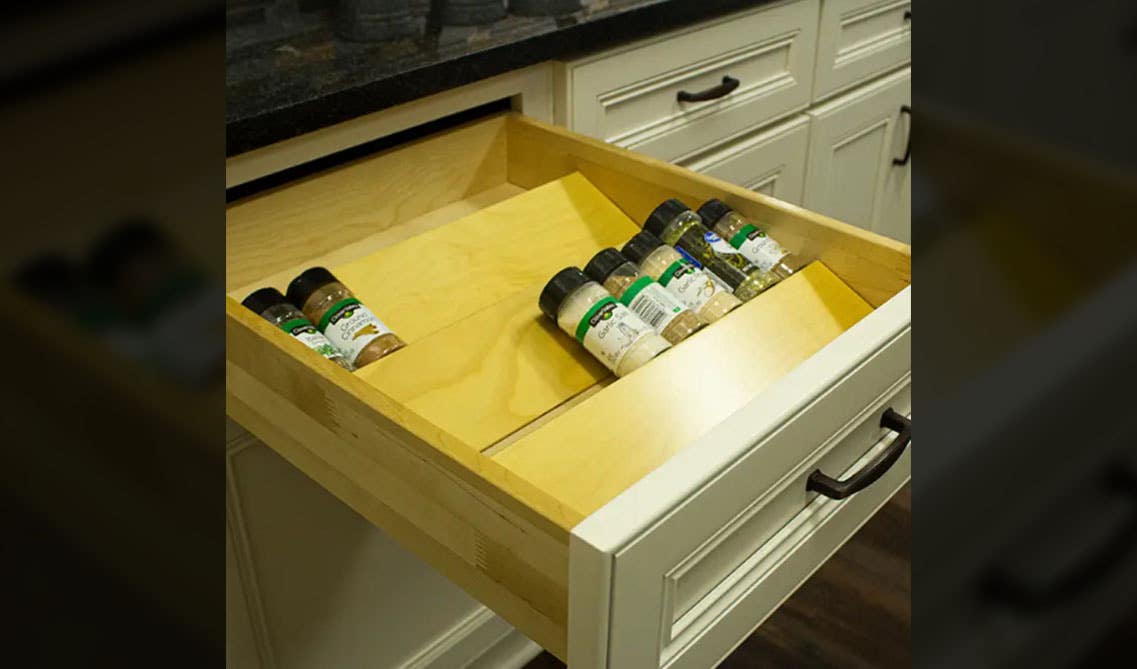
Drawer inserts are covered in more depth in kitchen drawer organizers. For a tall corner unit the mechanism choice is different again — see corner pantry cabinets.
Wall Cabinets and Sink Bases
Wall cabinets have the opposite problem to base cabinets — everything is visible but the top shelf is out of reach. Sink bases have an obstruction in the middle of them.
Wall cabinets
- Pull-out organizers with adjustable wood shelves — the wall-cabinet equivalent of a base pull-out, bringing the upper shelf down and out.
- Door-mounted racks — spice racks and mail organizers fixed to the inside of the door. They use space that is otherwise air, but they reduce the usable shelf depth behind them, so check that first.
- Wall filler pull-outs — the tall equivalent of the base filler pull-out, fitting behind a 3- or 6-inch filler in a 30, 36 or 42-inch-tall run.
Sink bases
The plumbing is the constraint. Nothing full-width fits under a sink, so sink-base organizers work around the trap:
- Tip-out trays — the false drawer front in front of the sink hinges down to hold sponges and brushes. The best square-inch-per-dollar organizer in the kitchen, because that panel is otherwise decorative.
- Removable under-sink caddies — a basket that clears the trap and slides out.
- Pull-out waste containers sized for a sink base.
- Pull-out towel bars — a small thing that ends the tea-towel-over-the-oven-handle problem.
Retrofit or Specify With the Cabinets?
Both work, and specifying organizers with the cabinets is easier. A retrofit means drilling into a finished cabinet interior and working around hardware that was not planned for it; a specified fit-out arrives designed to mount.
If you are retrofitting an existing kitchen:
- Measure every cabinet individually. Runs are not always uniform, especially where a filler strip has been used.
- Start with the corner and the sink base. These are where the gain is largest, so if the budget is limited, that is where it goes.
- Check the hinge type before ordering a pull-out. A concealed European hinge intrudes into the opening; an exposed hinge does not.
- Expect to drill. Most pull-outs mount to the cabinet floor or sides. Use the template supplied, and check nothing is behind the panel you are drilling into.
If you are ordering new cabinets, specify the organizers at the same time. Lily Ann's RTA kitchen cabinets ship with the same standard dimensions the organizer range is built to, and organizers are listed by the cabinet they fit — a pull-out that says "fits best in B18" fits a B18. Because the cabinets assemble in the room, an organizer can also be mounted before the cabinet's back panel is fixed, which is considerably easier than doing it inside a finished box. Assembly is covered in RTA cabinet assembly.
What Not to Buy
Three categories reliably disappoint: tension-rod and stick-on systems, anything that needs a perfectly square cabinet, and organizers bought before the cabinet was measured.
- Tension-fit and adhesive organizers. They fail under load and take the finish with them when they let go. Anything holding weight should be mechanically fixed.
- Full-width pull-outs for a double-door cabinet with a centre stile. The stile halves the opening. Two narrow pull-outs work; one wide one does not.
- Anything bought before measuring. Most organizer returns are a fit problem rather than a quality problem, and the fit was knowable in advance.
- Deep wall-cabinet risers. A riser that fills a 30-inch-tall wall cabinet just moves the reaching problem up a shelf. A pull-down or pull-out solves it.
And one that is often skipped and should not be: a plan for what actually goes where before buying anything. An organizer imposes a structure, and a structure that does not match how the kitchen is used gets abandoned. Empty two cabinets, see what you genuinely reach for daily, and buy for that.
















Comments