


Yes, if the surface is sound. Degrease it, scuff-sand it, apply a bonding primer made for slick surfaces, then add thin coats of cabinet paint and give them days to cure. Do not paint laminate that is peeling, bubbling or swollen: the paint will lift with it, and the door needs replacing.
- Know your surface first: laminate, melamine, thermofoil and wood veneer behave differently under paint.
- Skip peeling doors: peeling, bubbling, delaminating or swollen doors will not hold paint. Replace them.
- Sand or test: Benjamin Moore says sand with 150 to 220 grit. Zinsser and Sherwin-Williams say some primers need no scuffing, but neither sheet names laminate.
- Primer matters most: use a bonding primer. Benjamin Moore names Fresh Start 046 for laminate.
- Timing (Benjamin Moore Advance): dry to the touch in 4 to 6 hours, recoat in about 16 hours, then several days to cure.
- Prefer no film at all? Lily Ann sells factory-painted wood-based lines, not laminate or thermofoil.
Yes, you can paint laminate cabinets. It is harder than painting wood, because laminate is a smooth, slick plastic surface and paint has little to grip. Most of the work is not the painting. It is the cleaning, the scuffing and the primer underneath.
This guide walks through it in order: how to tell what your cabinets are really made of, which ones should not be painted at all, the prep, the primer and paint, how long to wait, and when replacing the doors is the smarter move. The timing and prep figures come from paint makers' own guides, linked where used. We read them on October 29, 2026.
Can You Paint Laminate Cabinets?
Yes, if the surface is in good shape. Degrease it, scuff-sand it, coat it with a bonding primer made for slick surfaces, then add thin coats of cabinet paint and give it days to cure. If the laminate is already peeling, bubbling or swollen, paint will not fix it, and it will lift with the old surface.
There is one honest limit. The paint sits on plastic, so it chips more easily than a factory finish. A well-prepped door can look great for years in a low-heat kitchen. A door next to the oven or dishwasher is the first place a painted edge will fail. Our guide to laminate vs wood cabinets explains why edges are the weak spot.
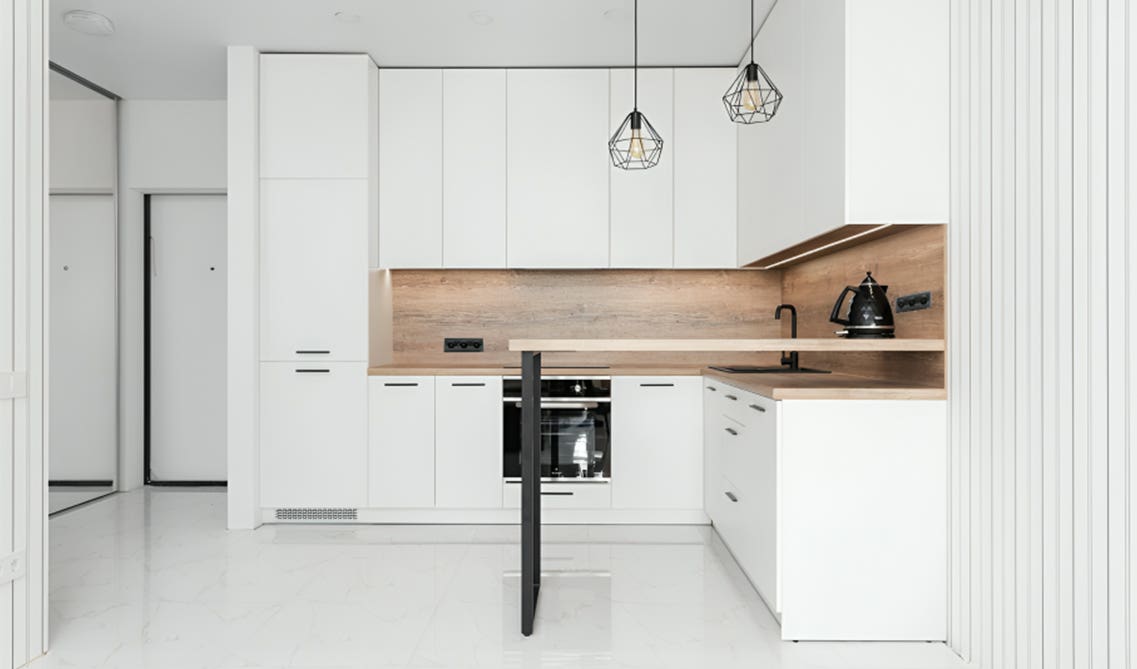
Step 1: Find Out What Your Cabinets Are Made Of
"Laminate" gets used for several different surfaces. They all look like a smooth, finished door, but they behave differently under paint. Look at the edges, the back of a door and the holes drilled for hinges, then match what you see to the table.
| Surface | How to spot it | Can you paint it? |
|---|---|---|
| High-pressure laminate | A hard, thin plastic sheet glued to a particleboard or MDF core, often on flat slab doors. A cut edge may show dark layers, or a glued-on edge strip. | Yes, if it is flat and sound. Edges are the weak spot. |
| Melamine (low-pressure laminate) | Resin-soaked paper fused to particleboard or MDF. Common on box sides, shelves and budget cabinets. It is thin: a chip goes straight to the core. | Yes, if sound. Paint will not hide a chipped or swollen core. |
| Thermofoil | A vinyl film heat-pressed over a shaped MDF door, so it can copy a Shaker or raised-panel profile. Film that bubbles or lifts near the oven or dishwasher is a giveaway. | Only with care. Paint will not stop peeling, and a peeled door is usually replaced. See thermofoil cabinets. |
| Wood veneer | A thin slice of real wood. The grain changes from door to door and carries around the edges. It does not repeat. | Yes. It paints like wood, but sand lightly because the layer is thin. |
Printed wood grain on laminate repeats. Real veneer does not. If you are still unsure, open a door and compare the front, the edge and the back.
Which Cabinets Cannot Be Painted?
Skip painting, and plan to replace the door, when you see any of these:
- Peeling or bubbling film (thermofoil especially). Paint lifts with it.
- Delaminating laminate, where the surface is pulling away from the core.
- Swollen or water-damaged edges. Particleboard and MDF that have soaked up water do not shrink back, and paint shows the swelling.
- Doors that are warped. Paint cannot flatten them.
A lifting edge that is otherwise solid can sometimes be re-glued first. If the core is crumbling, it cannot. Our cost to paint kitchen cabinets guide notes that a painter will usually want these problems fixed before starting.
Step 2: Gather What You Need
- A degreaser and clean, lint-free rags, plus a scouring pad for stubborn spots.
- Sandpaper in the 150 to 220 grit range, or a liquid deglosser. See our sandpaper grit chart and liquid sandpaper guide.
- Sandable wood filler for chips and old hardware holes.
- A bonding primer made for slick, glossy surfaces.
- Cabinet-grade enamel paint. Our paint sheen guide helps you choose the finish.
- A good synthetic brush (nylon or polyester) for waterborne paint, painter's tape, a vacuum and a tack cloth.
- Good ventilation. Open windows or run fans. If you spray, wear a respirator and eye protection and close off the room, as Benjamin Moore advises in its Cabinet Refinishing Guide.
We do not sell paint, and the products named below are examples taken from the makers' own sheets, not recommendations. Read the label on whatever you buy.
Step 3: Remove, Label and Clean
Take off the doors, drawers and hardware. Benjamin Moore suggests labeling each piece in an out-of-sight spot, such as where the hinge attaches, so everything goes back where it came from. Painting doors lying flat also lets the paint level out.
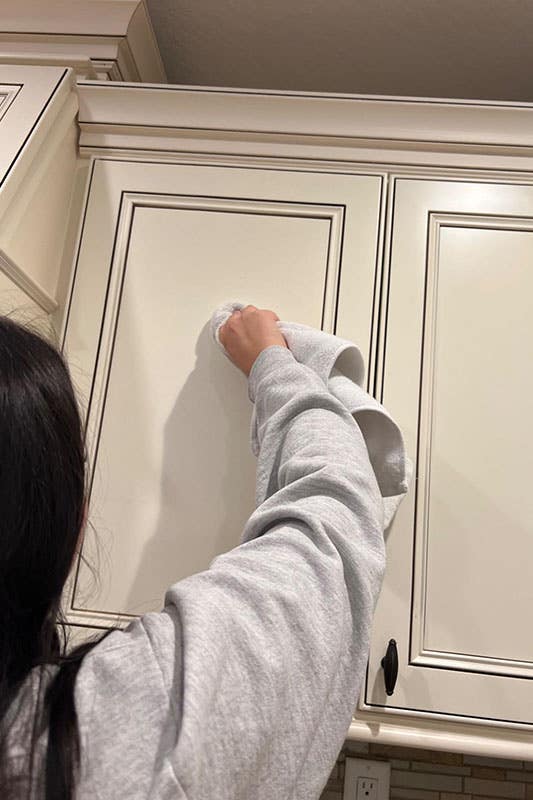
Then clean every surface you plan to paint. Kitchen cabinets collect cooking grease, so wipe with a degreaser on a clean rag and use a scouring pad on rough spots. Benjamin Moore stresses cleaning before sanding, because sanding a dirty surface can push grime deeper and hurt adhesion. Let everything dry fully.
Check your primer's own sheet for cleaner advice. Zinsser's data sheet for its Bulls-Eye 1-2-3 primer says to use an ammoniated cleaning solution or solvent and not to use TSP as a cleaner, which differs from advice you will see elsewhere.
Step 4: Repair Chips and Lifting Edges First
Paint shows every flaw. Fix these before priming:
- Lifting edges: re-glue them and clamp until set. Any edge that is already lifting will peel the paint with it.
- Chips and old hardware holes: fill with sandable wood filler. Most fillers shrink as they dry, so sand and refill as needed, as Benjamin Moore notes.
- Deep gouges: filler helps, but a chipped laminate corner has no clean fix. If a door is badly damaged, plan to replace it.
For more on repairs, see how to repair scratches, dents and damage on your cabinets.
Step 5: Scuff-Sand, or Try to Skip It?
Lightly scuff-sand. Benjamin Moore's guide says to sand with 150 to 220 grit until the old finish is rough. Some primers claim to bond to glossy surfaces without scuffing, but none of the sheets we read promise that for laminate itself.
The paint makers do not agree, and that is worth knowing before you decide:
| Maker and product | What it says | What it does not say |
|---|---|---|
| Benjamin Moore Advance with Fresh Start primer 046 | Lists "Formica and other laminates" as surfaces to refinish. Wash off dirt and grease, sand with 150 to 220 grit until the finish is rough, and use Fresh Start High-Hiding All-Purpose Primer (046) on laminate. Do not use lacquer-based primers. Sand the dry primer lightly with 220 grit or finer. | Nothing about skipping the sanding. |
| Zinsser Bulls-Eye 1-2-3 primer (data sheet dated 2013) | "Bonds to glossy surfaces without scuff sanding." Recoat in under 1 hour. Apply between 50 and 90 degrees F, at no more than 85 percent humidity. | Laminate and melamine are not in its list of surfaces it bonds to (wood, plaster, concrete, gloss enamels, hardboard, glass and tile). |
| Sherwin-Williams Extreme Bond Primer | Made for hard, glossy surfaces such as tile, glass panels and plastic piping with minimal prep. Says sanding may not be necessary for most clean, paintable surfaces. | Laminate is not named on the page we read, and it gives no dry times. |
Our advice: scuff-sand lightly. It adds minutes, and it removes the question. If you want to skip it, test first. Prime and paint the back of one door, let it cure, then scratch the edge with a fingernail. If it lifts, sand the rest.
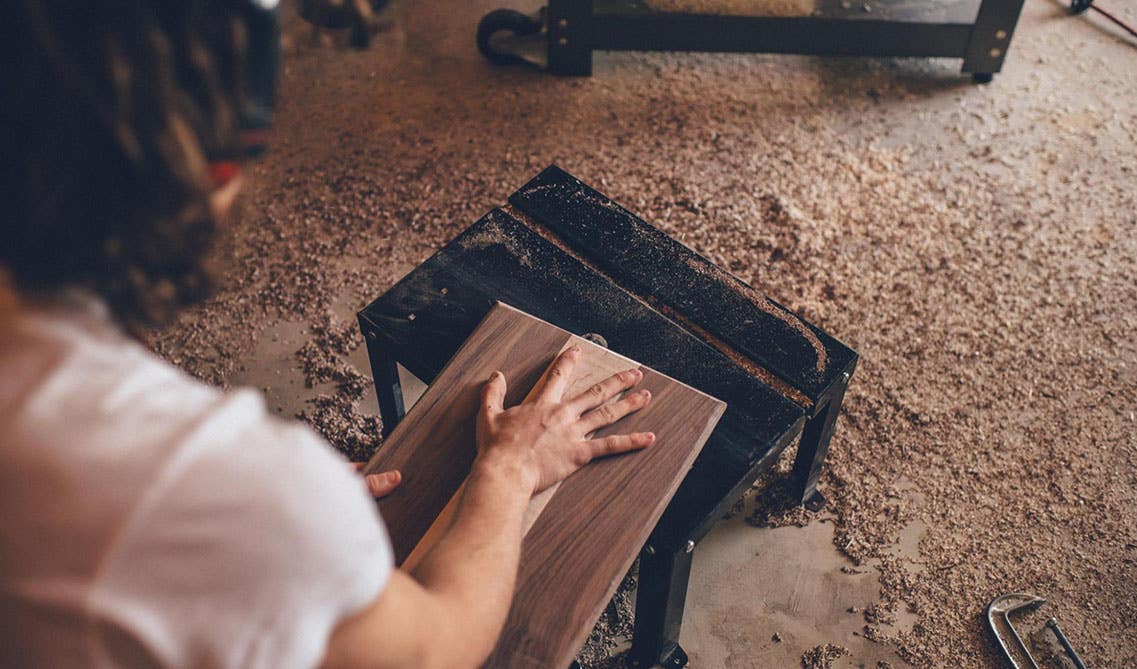
After sanding, vacuum, then wipe with a tack cloth. Benjamin Moore suggests mineral spirits or a tack cloth for the last dust.
Step 6: Prime With a Bonding Primer
Primer is what lets paint stay on plastic. Use one made for slick surfaces, not a plain wall primer. Benjamin Moore specifically names Fresh Start High-Hiding All-Purpose Primer (046) for laminate. Zinsser's Bulls-Eye 1-2-3 and Sherwin-Williams' Extreme Bond are other bonding primers whose makers describe them as sticking to glossy surfaces.
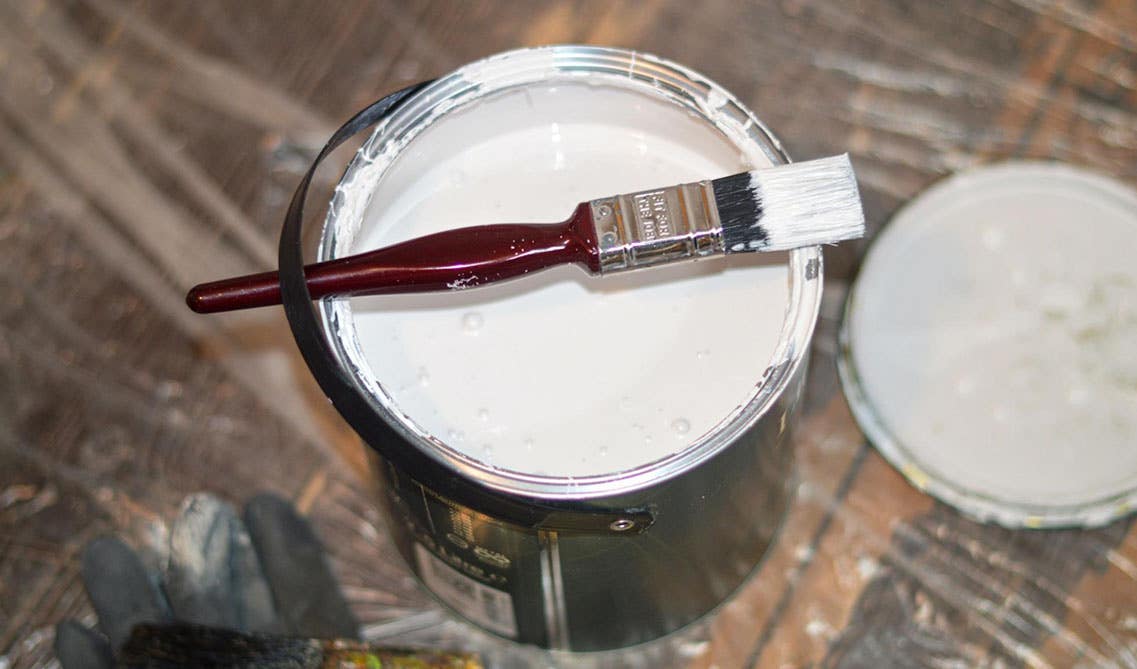
- Brush the edges and corners first, then the flat areas. One coat is usually enough; check your can.
- Let the primer dry fully. Benjamin Moore then says to sand lightly with 220 grit or finer, focusing on drips and corners, and to vacuum the dust.
- Paint within the window on the label. Zinsser's sheet allows a recoat in under an hour.
Avoid painting in cold or very humid rooms. Benjamin Moore warns against both, and Zinsser's sheet sets a range of 50 to 90 degrees F.
Step 7: Paint in Thin Coats
Benjamin Moore's guide says to use one coat of primer and at least one finish coat, and notes that more coats may be wanted depending on the surface. Our own how to paint kitchen cabinets guide recommends two thin coats, which is a good target on laminate because thick coats sag and take longer to cure.
- Stir the paint. Use a nylon or polyester brush for waterborne paint, because natural bristles soak up water and hurt coverage (Benjamin Moore).
- Paint two-sided pieces lying flat. Work from top to bottom, then tip off with long strokes along the grain pattern.
- Wait until the first side is dry to the touch before you flip the piece.
- When the first coat is completely dry, sand it lightly with fine paper, vacuum and wipe, then apply the next coat. Benjamin Moore says to sand between coats for a smooth finish.
Brush, Roller or Spray?
Benjamin Moore recommends an HVLP spray gun with a fine-finish tip for the smoothest finish, though a brush works too. Spraying needs a masked, enclosed, well-ventilated space and a respirator. For one kitchen, a brush is simpler and safer for most people.
Step 8: Let It Cure Before You Use It
Under good conditions, Benjamin Moore says its Advance paint dries to the touch in 4 to 6 hours and can be recoated in about 16 hours. It then wants several days to cure before you reassemble the cabinets and put them back in use.
That timeline is for one product. Others differ, so check your can. "Dry to the touch" and "cured" are not the same thing: a painted door can feel dry and still scratch easily. Be gentle, do not stack or lean fresh doors against each other, and keep wet cloths and cleaners away from them until the cure time has passed. When it is time to reassemble, put the hinges back on the doors you labeled.
Why Painted Laminate Peels, and How to Prevent It
Paint that peels from laminate almost always comes down to one of these:
- Skipped cleaning. Grease keeps primer from gripping.
- No bonding primer. Plain wall primer does not stick to slick plastic.
- Recoating or reassembling too soon. A painted door can feel dry long before it is cured.
- Heat and steam at the edges. Oven heat and dishwasher steam soften the glue line first. A painted edge by the dishwasher is the most likely to lift.
- A lifting edge painted over. The paint went on, but the edge was never fixed.
If it has already started peeling, sand the lifting area back to a firm edge, re-prime with a bonding primer and repaint. If the film itself is lifting in sheets, that door needs replacing.
When to Replace the Doors Instead
Painting is a refresh, not a repair. Here is a plain way to decide:
| Your situation | Best move |
|---|---|
| Sound doors, outdated color, little heat or water near them | Paint, with full prep. |
| A few bad doors (peeling thermofoil, swollen edge) and the rest are fine | Replace those doors and paint the rest to match, or replace all the fronts. See the cost of replacing kitchen cabinet doors. |
| Boxes are swollen, sagging or water-damaged | Replace the cabinets. New doors will not fix a failed box. |
| You are deciding between painting, refacing and replacing | Read refinish, reface or replace kitchen cabinets and should I paint my kitchen cabinets. |
Lily Ann does not sell laminate, melamine-faced or thermofoil cabinets. Our kitchen lines use plywood boxes and engineered doors under a factory paint or stain finish, as listed on each collection page as of September 2026. If you want a smooth, painted look without a plastic film, Colorado White Shaker is a good place to start. Our free kitchen design service can help you plan a replacement.
The Takeaway
You can paint laminate cabinets if the surface is sound. Work out whether you have laminate, melamine, thermofoil or veneer, then degrease, repair, scuff-sand, prime with a bonding primer and paint in thin coats. Benjamin Moore's guide gives about 4 to 6 hours to dry to the touch, about 16 hours between coats and several days to cure. Do not paint peeling, bubbling or swollen doors. For those, a new door is the better fix.
Frequently Asked Questions
Yes, if the laminate is sound. Clean off grease, scuff-sand, apply a bonding primer made for slick surfaces, then add thin coats of cabinet paint. Benjamin Moore's cabinet guide lists laminates such as Formica among the surfaces its Advance paint can refinish. Do not repaint laminate that is peeling, bubbling or swollen.
Maybe, but test first. Zinsser's data sheet says its Bulls-Eye 1-2-3 primer bonds to glossy surfaces without scuff sanding, and Sherwin-Williams says sanding may not be needed on most clean surfaces with Extreme Bond. Neither sheet we read names laminate, and Benjamin Moore's laminate guide says to sand with 150 to 220 grit. Prime and paint the back of one door first and check the edge after it cures.
A bonding primer under cabinet-grade enamel is what holds. Benjamin Moore names Fresh Start High-Hiding All-Purpose Primer (046) for laminate under its Advance paint, and warns against lacquer-based primers. Whatever you choose, check that the can lists glossy or slick surfaces and follow its recoat times.
Use the same steps as for laminate: degrease, scuff-sand, prime with a bonding primer and paint in thin coats. Melamine is a thin layer, so a chip goes straight to the core, and paint will not hide a swollen core. Fix chips with filler and re-glue lifting edges before you prime.
Cabinets with peeling or bubbling film, delaminating laminate, warped doors and swollen or water-damaged edges. Paint cannot hold on a surface that is coming apart, and it will lift with it. Replace those doors instead.
Look at the grain on the edge and back of a door. Printed wood grain on laminate repeats, and the edge may show a seam or a thin colored layer over a paler core. Real wood veneer has grain that changes from door to door and carries around the corners.
You can, but it is a workaround and not a fix. Thermofoil is a vinyl film over MDF. Paint needs a thorough degrease, a light scuff-sand and a bonding primer, and it will not stop the film from peeling. A peeled door usually needs replacing.
It depends on the paint. Benjamin Moore says its Advance paint dries to the touch in 4 to 6 hours and can be recoated in about 16 hours in good conditions, then needs several days to cure before the cabinets go back into use. Check your own can, because other paints differ.
Spraying gives the smoothest finish, but it needs an enclosed, ventilated space and a respirator. Benjamin Moore recommends an HVLP gun with a fine tip for spraying and a nylon or polyester brush for brushing. For a single kitchen, a brush is simpler and safer for most people.
Painting is usually the cheaper job if the doors and boxes are sound, because you keep what you have. It stops being the cheaper choice if many doors are peeling, swollen or warped, since you pay for repairs and still need new doors. Our guides on the cost of painting and the cost of replacing doors have the detail.
Fill the chip with sandable wood filler, let it dry, sand it flush and then prime. A chip in laminate shows the core and has no perfect fix, so painting hides it but does not repair it. If the edge is lifting, re-glue it first.















