


Empty the cabinet, match every base to a lid, and let go of anything cracked, warped or missing its partner. Keep only what fits one drawer or one shelf. Nest the bases by shape with the largest at the bottom, and stand the lids on edge in a divider or bin beside them. A deep drawer near the fridge is the easiest home, because you see everything from above.
- Cut down first: toss cracked or warped pieces and any lid or base with no partner. Donate matched sets you never use.
- One home: a single drawer or shelf, close to where you pack leftovers.
- Lids off saves space: bases nest and lids stand on edge. Lids on is faster to grab but takes more room.
- Sort by shape: rounds with rounds, squares with squares, largest at the bottom.
- Drawers beat doors: you look down on everything. In a cabinet with doors, add a pull-out or use two bins.
- Lily Ann Cabinets sells a pull-out Food Storage Container Organizer for 18-inch and 24-inch base cabinets, plus drawer base cabinets from 24 to 36 inches wide (in stock October 9, 2026).
You open the cabinet and plastic slides out. You find five bases and two lids, and none of them match. Most people call them all Tupperware, whatever the brand on the bottom, and almost every kitchen has a cabinet like this.
The fix is not a bigger cabinet. It's fewer containers, one home for them, and a simple rule for the lids. This guide walks through the steps, then shows how to set them up in a deep drawer, a shallow drawer, a base cabinet with doors, or a pantry shelf. Lily Ann Cabinets sizes and stock below were checked on the live site on October 9, 2026.
How Do You Organize Food Storage Containers?
Empty the cabinet, match every base to a lid, and let go of anything cracked, warped or missing its partner. Keep only what fits one drawer or one shelf. Nest the bases by shape with the largest at the bottom, and stand the lids on edge in a divider or bin beside them. A deep drawer near the fridge is the easiest place to keep them, because you can see everything from above.
Those are the same steps home organizers give in guides from The Spruce and Martha Stewart. What those guides skip is the cabinet itself: which cabinet to use, and what to do when yours has doors instead of drawers. That part is below.
Step 1: Empty, Match and Cut Down
Take every container and lid out and put them on the counter. Then:
- Match each base to its lid. Snap them together to be sure. A lid that "almost fits" doesn't count.
- Toss the orphans. Martha Stewart's guide is blunt about this: if a container broke and you kept the lid, or the other way around, you are not likely to find a new partner for it.
- Let go of damaged pieces. The Spruce says to purge containers that have no lid or that warped in the dishwasher. Cracked and badly stained ones can go too.
- Donate matched sets you never use. Martha Stewart suggests a thrift store or a soup kitchen, where volunteers can use them to box up leftovers.
Now look at what's left and at the space you have. The simplest limit is the space itself: keep what fits in one drawer or on one shelf with the lids, and no more. Most homes use the same few sizes again and again. The huge one at the back of the cabinet can usually go.
Step 2: Give Them One Home
Containers end up in three cabinets because nobody chose one. Pick a single drawer or cabinet and keep every food container there.
The best spot is close to where you pack leftovers, which is usually between the fridge and the dishwasher. You fill containers at the counter, carry them to the fridge, and unload them clean from the dishwasher, so a home in that triangle saves steps. Our guide on how to organize kitchen cabinets explains how to set up zones like this for the whole kitchen.
A drawer or a low shelf is better than a high one. Containers are light, so they are safe down low, and you want to see into the stack from above.
Step 3: Lids On or Lids Off?
Store containers with the lids off if space is tight, and with the lids on if you have room to spare. Lids off lets the bases nest inside each other, so the whole set takes far less space. Lids on takes more room, but every container is ready to grab and no lid goes missing.
Organizers disagree on this, and both sides have a point. The Spruce says to nest the bases and store lids on edge, and adds that keeping every lid on makes sense when you have plenty of space, like a full cupboard. A Real Simple writer makes the case for lids on: she stacks containers with their lids in order of size and says the limit on space helped her cut down how many she keeps.
| Lids off (nested) | Lids on (stacked) | |
|---|---|---|
| Space it needs | Least. Bases nest inside each other | Most. Every container keeps its full height |
| Finding a match | Two grabs: a base, then its lid | One grab |
| Best for | One drawer, a small kitchen, a big collection | A spare shelf or cabinet, a small matching set |
| What goes wrong | Loose lids slide around unless they have a divider | Stacks get tall and tip over |
If you can't decide, go lids off. It works in almost any space, and the next two steps fix its one weak spot.
Step 4: Nest the Bases and Stand the Lids Up
Sort the bases by shape first: rounds with rounds, squares with squares, rectangles with rectangles. Then nest each shape with the largest at the bottom and the smallest on top. Keep the stacks short enough to lift out with one hand.
Lids are the hard part. Don't lay them flat in a pile. Stand them on edge, like files in a folder, from largest to smallest. You can see every lid at once and pull one without moving the rest. A lid rack, a drawer divider, a small bin or even a dish rack will hold them up.
Glass containers are heavier and don't nest as tightly. Give them a low drawer or a low shelf, and don't stack them more than two or three high.

Step 5: Set It Up for Your Space
The steps above work anywhere. How you set them up depends on what kind of cabinet you have.
In a deep drawer
A deep drawer is the best home for food containers. You look down on everything, nothing hides at the back, and one pull brings the whole set to you. Split the drawer in two: nested bases on one side, lids standing on edge on the other.
To keep the two sides apart, use a divider across the drawer or a peg system. A peg system is a board with rows of holes and movable wood pegs. You set the pegs around each stack so nothing slides when the drawer closes. Lily Ann's Large Drawer Peg System comes with one pegboard insert and 16 wood pegs and is listed for 36-inch drawer bases. The 30" Drawer Peg System is listed for a 30-inch drawer base and "can be trimmed to fit smaller drawers." Both were in stock on October 9, 2026. See our kitchen drawer organizers guide for more inserts.
In a shallow drawer
A shallow drawer won't hold stacks of bases, but it's a good home for lids. Lay a divider insert in the drawer and file the lids in its channels by size. Lily Ann's Shallow Drawer Divider Insert is made for the shallow drawer of an 18-inch base cabinet and is listed at 16-1/4 inches wide, 19-5/8 inches deep and 2-3/8 inches high. Keep the bases in the cabinet right below it.
In a base cabinet with doors
This is where most container avalanches happen. A base cabinet with doors is deep and dark, so things get pushed to the back and stacked too high. You have three ways to fix it:
- Add a pull-out made for containers. Lily Ann's Food Storage Container Organizer is a soft-close wood pull-out. In the listing photo it has a wire rack on top that holds lids on edge and a lower tray with movable chrome dividers for the bases. There is one for an 18-inch base cabinet and one for a 24-inch base cabinet.
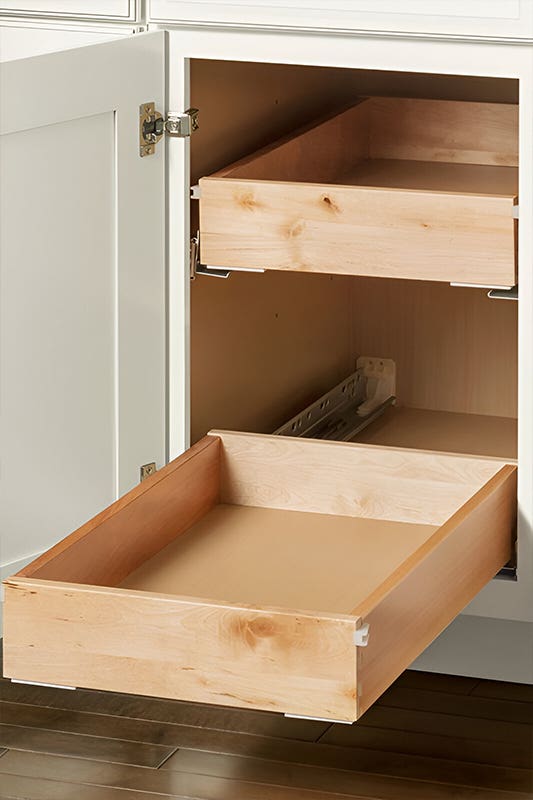
- Add plain pull-out drawers. A double drawer pull-out for an 18-inch base cabinet (there is a 24-inch one too) puts two sliding drawers behind the door: bases in one, lids in the other. Our pull-out cabinet organizer guide compares the types.
- Use two bins. No hardware needed. Put the nested bases in one bin and the lids in another, and slide the bins out like drawers.

Lily Ann Cabinets: Food Storage Container Organizer
On a wall cabinet or pantry shelf
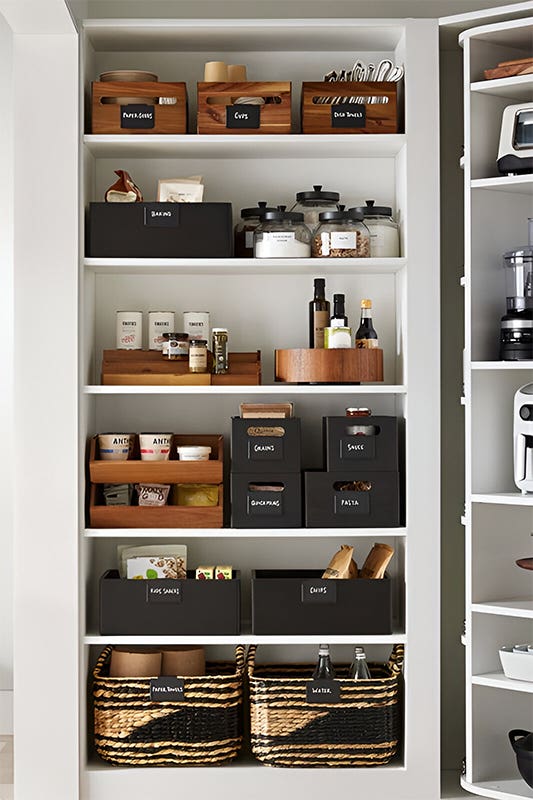
If the only free space is a shelf, use the two-bin method. One bin holds the nested bases and one holds the lids. The Spruce suggests giving containers their own shelf, sorted by size, when you have more than a drawer can hold. Label the bins so everyone in the house puts things back in the right one.
A shelf above eye level only works with bins you can lift down. For more shelf ideas, see our pantry organization ideas.
Built-In Container Organizers at Lily Ann
These are the Lily Ann Cabinets organizers that suit food containers. Each one showed In Stock on October 9, 2026. Sizes are copied from the listings. Where a listing gives no size, the table says so.
| Organizer | Listed to fit | Size as listed (W x D x H) |
|---|---|---|
| Food Storage Container Organizer w/ Soft-Close (LAC4FSCO-18SC-1) | B18, an 18" base cabinet | 14-1/2" x 21-1/2" x 18" |
| Food Storage Container Organizer w/ Soft-Close (LAC4FSCO-24SC-1) | B24, a 24" base cabinet | 20-1/2" x 21-1/2" x 18" |
| Large Drawer Peg System (LAC4DPS-3921) | DB36-3 or DB36-2, 36" drawer bases | 39-1/4" x 21-1/4" x 6-5/8" |
| 30" Drawer Peg System (4DPS-30) | DB30-3, a 30" drawer base | 25" x 19-5/8" x 6" |
| Shallow Drawer Divider Insert (4WUT-18SH) | Shallow drawer of B18 or DB18-3 | 16-1/4" x 19-5/8" x 2-3/8" |
| Double Drawer Pull Out, 18" and 24" | 18" or 24" base cabinet | Not listed |
| Double Drawer Peg Board Pull Out (DDPOPEG24) | B24 or B24FHD | Not listed |
Two things to check before you order. The large peg board is listed at 39-1/4 inches wide, which is wider than a 36-inch cabinet, so ask our team how it is trimmed to fit. And measure the clear opening of your own cabinet, not the outside of the box, because hinges and face frames take up room. Our guide to which organizer fits which cabinet shows how to measure. The small and medium drawer peg systems (for 24-inch and 30-inch drawer bases) showed out of stock that day. You can browse the rest in cabinet and drawer inserts.
Planning New Cabinets? Give Containers a Drawer
If you are remodeling, the easiest fix is to plan for it. Swap one door-and-shelf base cabinet for a drawer base, and put it next to the fridge or the dishwasher. A drawer base is a base cabinet that is all drawers. The deep lower drawers hold nested bases, and a peg system or divider keeps the lids standing.
In the Colorado White Shaker line, every drawer base below is listed at 24 inches deep and 34-1/2 inches high, and each showed In Stock on October 9, 2026:
| Drawer base | Width | Drawers |
|---|---|---|
| 2 Drawer Base Cabinet 24" | 24" | 2 deep drawers |
| 3 Drawer Base Cabinet 24" | 24" | 3 drawers |
| Drawer Base Cabinet 30" | 30" | 3 drawers |
| 2 Drawer Base Cabinet 36" | 36" | 2 deep drawers |
| 3 Drawer Base Cabinet 36" | 36" | 3 drawers |
A 24-inch drawer base is enough for most households. Go to 30 or 36 inches if you pack lunches for a family or batch-cook. If you'd rather keep doors, an 18-inch base cabinet with the container organizer inside does the same job in less width. The same cabinets come in other finishes. Start with the Colorado White Shaker base cabinets to see every size.

Step 6: Keep It Organized
A tidy container drawer falls apart for one reason: bases and lids come back at different times. A few habits stop that.
- Wash each base and lid together. Martha Stewart's guide calls this the key habit. If there's no room in the dishwasher for both, wait for the next load or wash them by hand.
- One in, one out. When a new container comes home, an old one leaves. Takeout tubs count.
- Leave a little empty space. A drawer packed to the top is hard to put things back into, so it stops being used the right way.
- Do a two-minute check each season. Pull any lid with no base and any base with no lid.
- Buy one system next time. When your containers wear out, replace them with one matching set. Same-shape bases nest tightly, and some sets use one lid size for several bases.
Containers that hold leftovers in the fridge need a system too. Our guide on how to organize the refrigerator covers that side.
Common Mistakes
- Organizing before you cut down. No divider can fix a collection that is twice the size of the drawer.
- Stacking lids flat. The one you need is always at the bottom.
- Keeping them up high. A top shelf turns every leftover into a reach and a stretch.
- Buying an organizer before you measure. Measure the inside of the drawer or the clear opening of the cabinet first.
- Mixing in water bottles and lunch boxes. Give those their own bin, or they'll take over the space.
The Takeaway
Organizing food storage containers comes down to four moves: cut down, pick one home, nest the bases, and stand the lids on edge. A deep drawer near the fridge makes all four easy. In a cabinet with doors, a pull-out or a pair of bins does the same job.
Planning a new kitchen? Get a free 3D design and ask our designers to put a drawer base or a container pull-out right where you pack leftovers.
Frequently Asked Questions
Either works, and the right choice depends on your space. With the lids off, the bases nest inside each other and the whole set takes much less room, which is why most organizing guides suggest it. With the lids on, every container is ready to grab and no lid gets lost, but the set takes more space. If you have one drawer, go lids off and stand the lids on edge. If you have a spare shelf and a small matching set, lids on is fine.
Keep them all in one place, close to where you pack leftovers. For most kitchens that means a drawer or low cabinet between the fridge and the dishwasher. A deep drawer is the easiest to use because you see everything from above. If you only have a cabinet with doors, add a pull-out or use two bins so nothing gets lost at the back.
Measure the space first, then pick an organizer that stands lids on edge so you can see each one. For a drawer, check the inside width, depth and height, and choose a divider that is lower than the drawer is tall. Adjustable dividers are worth it if your lids are many sizes. In a cabinet, a small rack or bin does the same job. Lily Ann's Shallow Drawer Divider Insert, for example, is listed at 16-1/4 inches wide, 19-5/8 inches deep and 2-3/8 inches high.
Split the drawer into two zones. Nest the bases by shape on one side, largest at the bottom, and stand the lids on edge on the other side. A divider across the drawer or a peg system keeps the two zones apart and stops stacks from sliding when the drawer closes. If you have two small drawers, use one for bases and one for lids.
In a cabinet with doors, the goal is to bring the containers out to you. The simplest way is two bins on the shelf, one for nested bases and one for lids, that you slide out like drawers. A step up is a pull-out shelf or a pull-out organizer fixed inside the cabinet. Keep the containers on the lowest shelf you can, and never stack them higher than you can lift with one hand.
Give them one shelf and two bins. Sort the bases by size and nest them in the first bin, then stand the lids in the second. Label both bins. A pantry shelf suits big collections and the large containers you use only now and then, while the everyday ones stay in a kitchen drawer.
Yes. Lily Ann Cabinets sells a Food Storage Container Organizer with soft-close slides in two sizes. The one listed for an 18-inch base cabinet is 14-1/2 inches wide, 21-1/2 inches deep and 18 inches high. The one for a 24-inch base cabinet is 20-1/2 inches wide with the same depth and height. Both are a wood and wire pull-out, and both showed in stock on October 9, 2026. Measure your cabinet's clear opening before you order.
Sort them into three piles. Matched sets in good shape that you never use can be donated: Martha Stewart suggests a thrift store or a soup kitchen. Clean bases with no lid can be reused as small bins in a junk drawer, a workshop or a craft room. Cracked or warped pieces should leave the kitchen. Whether they can be recycled depends on the plastic and on your local program, so check your town's rules.
Use the narrow drawer for one job only. It is usually better for lids than for bases: stand the lids on edge from front to back, largest at the rear. Then keep the nested bases in the cabinet or drawer right next to it. If the narrow drawer is all you have, keep only one or two shapes of container so every base nests into the next.















