


Barn door installation takes four steps. First, check that the door overlaps the doorway by 1 to 2 inches on each side and hangs 1/2 inch above the floor. Second, screw a backer board into the wall studs and bolt the metal track to it. Third, attach the rollers and handle to the door. Fourth, lift the door onto the track, then add the anti-jump disks and a floor guide. A single interior barn door costs $400 to $1,400 installed on average, according to HomeGuide.
- Cost: $400 to $1,400 installed for a single interior barn door and $800 to $2,800 for double doors, per HomeGuide. Labor alone is $100 to $1,000.
- Four steps: plan the clearances, mount the backer board and track, attach the rollers and handle, then hang the door and add the anti-jump disks and floor guide.
- Clearances: overlap the doorway 1 to 2 inches per side and about 1 inch at the top. Leave 1/2 inch above the floor and about 1 inch off the wall.
- The track must hit framing: the door's whole weight hangs from the track, so the backer board is screwed into studs, never drywall alone.
- No bottom track: a barn door hangs from the top. A small floor guide keeps the bottom from swinging.
- Lily Ann Cabinets lists a 37" x 84" knotty pine barn door (local orders only) and three hardware kits. The kits were out of stock on October 6, 2026.
Interior sliding barn doors instantly add charm and character to any room. These doors also offer a functional and space-saving alternative to traditional doors. Thanks to their growing popularity, hanging barn doors is now straightforward.
A single interior barn door costs $400 to $1,400 installed on average, according to HomeGuide's barn door installation cost guide. The parts for this style include the door itself and mounting hardware such as the track. A hinged door is sold differently, either on its own or already hung in a frame; our prehung vs. slab door comparison explains the difference. This is a small improvement that could make a huge difference in the look and feel of your home, while also being a cheaper way to add overall value to your home.
Here are some tips on how to install a barn door in your home! This guide covers what barn door installation costs, the tools and parts you need, the clearances to check, the four install steps, and the barn door and hardware Lily Ann carries.
How Much Does Barn Door Installation Cost?
Barn door installation costs $400 to $1,400 on average for a single interior sliding door, including the door, the hardware and the labor, according to HomeGuide's cost guide. Double barn doors run $800 to $2,800. Labor alone ranges from about $100 for a simple job to $1,000 or more for a large, heavy door that needs extra support.
| What you're paying for | Typical cost | Notes |
|---|---|---|
| Single barn door, installed | $400 – $1,400 | Closets, bathrooms and pantries |
| Double barn doors, installed | $800 – $2,800 | Two panels, twice the hardware and labor |
| Bypass barn doors, installed | $500 – $1,500+ | For openings with little wall space beside them |
| Labor only | $100 – $1,000 | More for heavy or oversized doors |
| Track hardware kit | $100 – $300+ | Rail, hangers and mounting hardware |
| Floor guide | $10 – $60 | Keeps the bottom of the door in line |
Source: HomeGuide, "How Much Does It Cost to Install a Barn Door?" (dated September 19, 2024; read October 6, 2026). These are national averages. Prices in your area will vary.
Four things move the price the most, according to the same guide:
- The door material. MDF and vinyl doors cost the least. Hardwood, metal and glass doors cost the most.
- The door size. Bigger, heavier doors need stronger hardware and more labor.
- The wall. The track needs a solid mounting surface. If the wall needs a header board or other support, that adds to the bill.
- Who does the work. If you have the tools and skills, installing the door yourself takes the labor cost off the total.
Tools and Parts You Need
Most of the parts come in one barn door hardware kit. Lay everything out and read the maker's instructions before you drill.
Parts:
- Barn door
- Metal track (rail)
- Hangers with roller wheels
- Spacers and lag bolts
- Track stops for each end
- Anti-jump disks
- Floor guide
- Door handle or pull
- Backer board (a solid wood board about 1 inch thick)
- Wood screws
Tools:
- Stud finder
- Level
- Tape measure and pencil
- Drill and drill bits
- Wrench
- Clamps
- Saw, to cut the backer board
- Wood filler or touch-up paint
- A helper, to lift the door onto the track
As an example, each single-door hardware kit on Lily Ann's site lists a 78-3/4-inch track, two hangers with wheels, spacers and lag bolts, two track stops and one bottom guide (listings checked October 6, 2026). Kits from other makers differ, so count your parts against the list in the box.
1. Things To Consider Before Installing A Barn Door
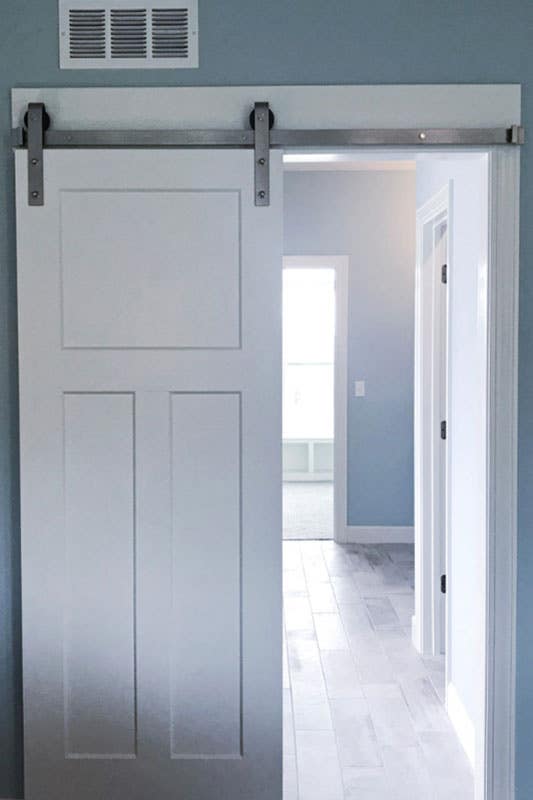
- Is there enough wall space for your door?
- Be aware of any electrical units such as light switches or outlets on the walls which your open barn door might cover.
- The barn door should completely cover the doorway with an inch or two overhangs on either side and an inch at the top.
- There should be a 1/2 inch of space between the bottom of the door and the floor when it’s hung on the track.
Two more checks save trouble later:
- Track length. The track is usually about twice as wide as the door, so the door can slide all the way clear of the opening. Our barn door sizes and types guide shows how to size the door and the track for single, double and bypass doors.
- Trim thickness. The door hangs out from the wall on spacers. Fine Homebuilding notes that the spacers have to be long enough for the door to slide past the door casing without hitting it. Thick trim needs longer spacers or a thicker backer board.
Barn Door Clearances at a Glance
A barn door should overlap the doorway by 1 to 2 inches on each side and about 1 inch at the top. It should hang 1/2 inch above the floor and sit about 1 inch off the wall.
| Where | Clearance | Why it matters |
|---|---|---|
| Each side of the doorway | 1 to 2 inches of overlap | Covers the gap at the edges when the door is closed |
| Top of the doorway | About 1 inch of overlap | Covers the top of the opening |
| Bottom of door to floor | 1/2 inch | Leaves room for the floor guide and lets the door slide freely |
| Door to wall | About 1 inch | Lets the door clear the trim. The backer board creates this gap |
| Handle height | Center about 36 inches from the bottom of the door | A comfortable reach for most people |
| Wall beside the doorway | At least as wide as the door | The door needs somewhere to slide. Keep it clear of switches and outlets |
The side, top, floor, wall and handle numbers come from the steps in this guide. Fine Homebuilding's installer uses the same 1/2-inch gap above the finished floor. If your hardware maker's instructions give different numbers, follow those.
Installing the door before the finished floor goes in? Fine Homebuilding's advice is to raise the door by the thickness of the finished floor before you mark and cut, so the 1/2-inch gap is still there once the flooring is down.
2. Installing the Backer Board and Metal Track
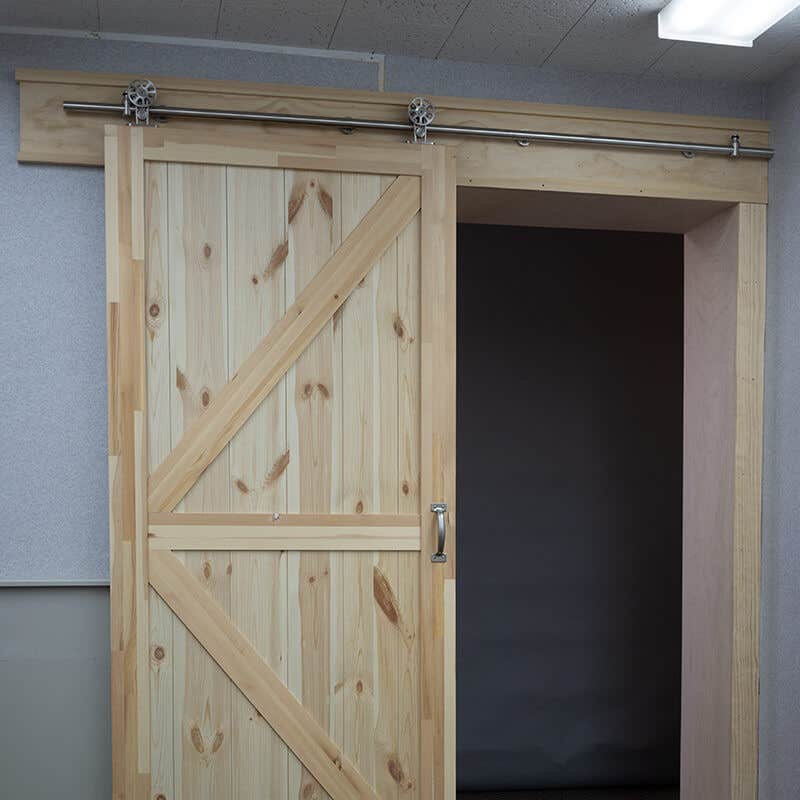
Installing the metal track is the first step in installing your barn door’s hardware. If you do not have concrete walls you will need to install a backer board beneath the metal track. This is because the barn door requires 1 inch of space between it and the wall. Installing the backer board beneath the metal track will create the 1-inch gap you need. You can make a backer board using a piece of solid lumber that is 1 inch thick.
Then cut the board to the length and width needed to accommodate your barn door’s track. Once the backer board is cut, using a stud finder locate the studs in your wall. Mark the locations of the said studs on your wall then transfer them onto your backer board.
Pre-drill holes where your board is marked, as well as where your wall has been marked. Clamp the metal track to the backer board, per the manufacturer’s instructions. Drill starter holes at each hole in the track.
Why the backer board matters: a swinging door is partly held up by its frame, but a barn door's whole weight hangs from the track. Fine Homebuilding points out that a barn door relies only on its hardware and how well that hardware is tied into the wall framing. That is why the board is screwed into studs and never into drywall alone.
Attach the backer board to the wall:
- Screw one end of the board to the studs using a wood screw. The screw heads should be just below the surface of the wood.
- Keeping the board level, screw in the remainder of the wood screws.
- You can use wood filler or touch-up paint if necessary.
Attach metal track to backer board:
- Align the metal track with the holes you drilled in the backer board. Attach the track to the backer board using the provided spacers, lag bolts, and washers. Use a wrench to tighten the lag bolts.
- Install stoppers on the metal track. Slide the door stoppers onto each end of the track.
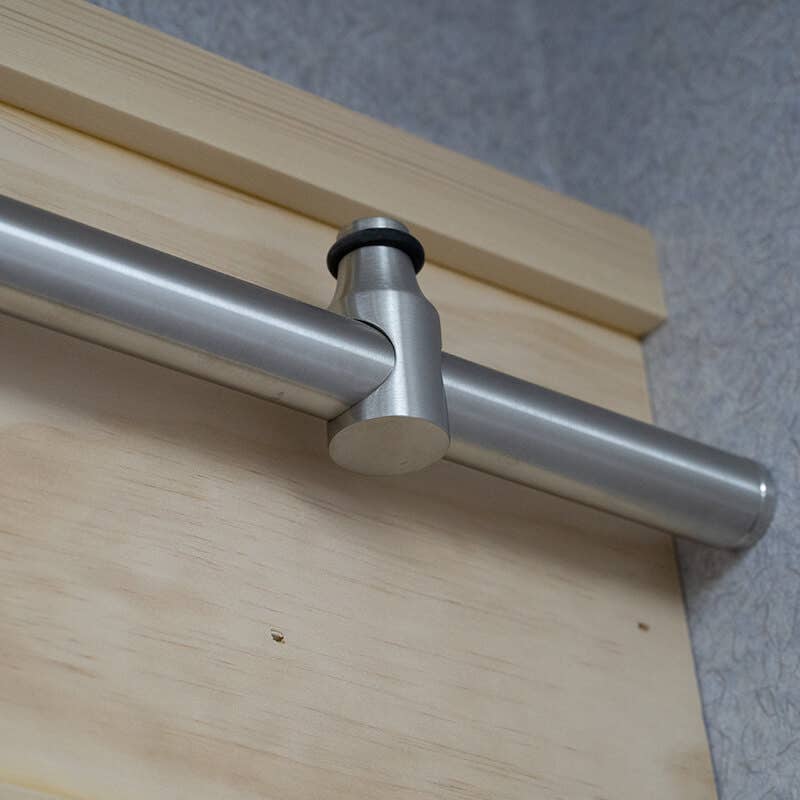
Three ways to mount a barn door track
A backer board is the usual choice for a finished wall, but it is not the only one. Fine Homebuilding describes three ways to anchor the track:
| Method | How it works | Best when |
|---|---|---|
| Blocking inside the wall | Solid 2x lumber is fitted between the studs behind the drywall, and the track bolts into it | The wall is open, as in new construction or a remodel |
| Backer board on the wall | A solid board is fastened to the studs on the finished wall, and the track bolts to the board | The wall is finished. This is the method in this guide |
| Straight into the studs | The track is bolted through the drywall into the studs | The holes in the track line up with your studs, or you can drill the track to match |
3. Add Hardware
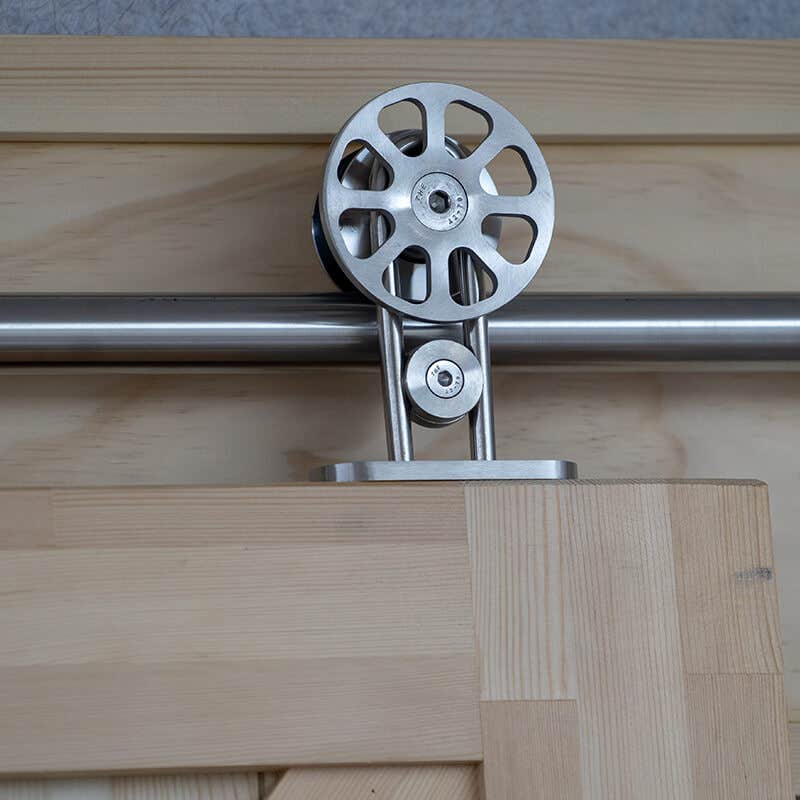
Whether you’re using a complete barn door kit or purchasing the barn door hardware and door separately, attach all the hardware before you try to hang the door.
- Start by installing your rollers.
- Install the door handle.
- The center of the handle should be about 36 inches from the bottom of the door.
- Place the outside handle near the edge of the door.
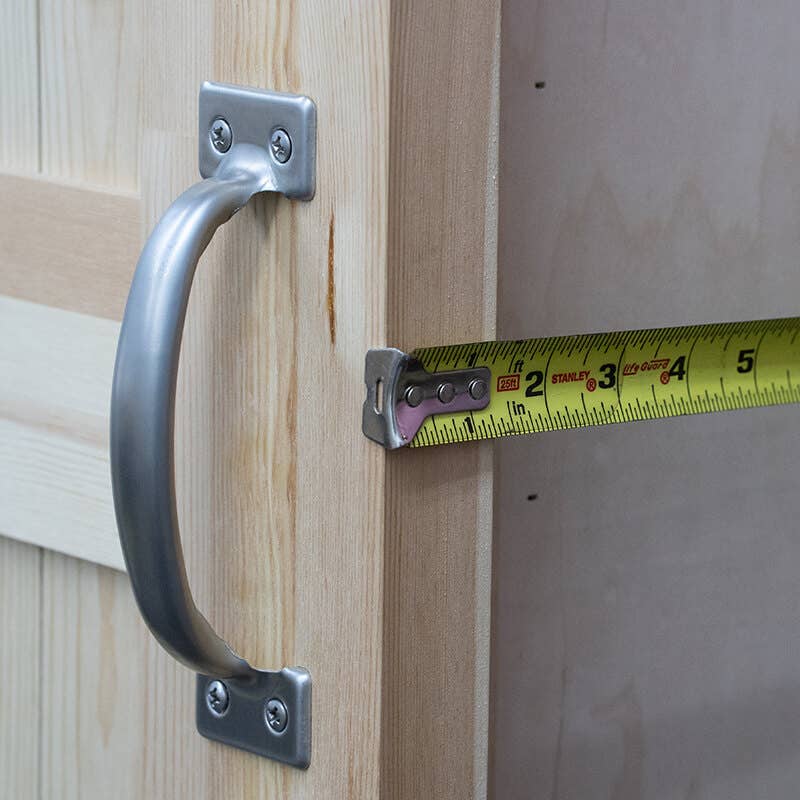
Keep the hanger brackets square to the edge of the door and the same distance in from each end, so the door hangs level.
4. Hang the Barn Door
After prepping you are now ready to hang your new sliding barn door.
- Lift the door and place the wheels on the metal track.
- Once on, test your door to make sure it is sliding correctly.
- Attach the anti-jump disks. These are small rubber blocks that are screwed to the top edge of the door. They keep the door in place if the roller wheels ever jump off the track. Hence the name anti-jump disks.
- Next, install the door guides. These guides are attached to the floor and keep the door from wobbling when it is open or closed. Some guides fit into a groove that is milled in the bottom of the door. Others are installed so that they guide the door from the sides.
- The final step is to make sure your door glides and feels safe and secure. Congratulations you’ve installed your barn door!
Tip for the floor guide: line it up with the track above, and place it so the door still sits in the guide when it is fully open and fully closed. Fine Homebuilding's installer also positions it so its screws can be reached with the door in place. That way the door can come down later for painting or repairs.
Do Sliding Barn Doors Need a Bottom Track?
No. A sliding barn door hangs from the track at the top and does not need a bottom track. It does need a small floor guide, which keeps the bottom of the door from swinging in and out as it slides.
There are two common kinds of guide. One fits into a groove cut in the bottom edge of the door, so it is hidden. The other sits on the floor and hugs the door from both sides. HomeGuide notes that guides can be mounted to the floor or to the wall. Most hardware kits include one. Lily Ann's single-door kits list one bottom guide, and the bypass kit lists two (checked October 6, 2026).
Should You Install a Barn Door Yourself or Hire a Pro?
Barn doors are one of the easier doors to install yourself. HomeGuide rates them as generally easy for a homeowner with basic DIY skills and tools such as a drill, a level and a stud finder. You are not cutting into the wall or setting a door frame.
Think about hiring a door company or a handyperson when:
- The door is large or heavy, or you are hanging double doors.
- There is no solid framing where the track needs to go, so the wall needs extra support.
- The wall is angled or the ceiling is vaulted.
- You don't have a helper to lift the door.
Still deciding whether a barn door is right for the room? Our sliding barn doors vs. traditional doors comparison covers privacy, sound and wall space.
Lily Ann Cabinets' Barn Door

Installing a barn door inside your home not only creates a modern farmhouse feel but also acts as a statement piece in any space. Lily Ann carries the perfect barn door, with its rich pine coloring that can be painted over if needed.
The Lily Ann knotty pine door is a great addition to any modern or traditional home, with its unfinished wood that is ready to be installed or painted to the desired finish. Two of these barn doors can be installed side by side for larger, more dramatic openings. By installing just a single barn door in your home, you can increase the resale value of your entire house.
Not only do we carry this barn door, but we also have the hardware to install it available to buy online. Our hardware comes in three different stylistic options to choose from.
Here is what the listings showed on October 6, 2026:
| Product | What the listing says | Stock on Oct 6, 2026 |
|---|---|---|
| Knotty Pine Wood Barn Door (MYJ-13784PWBD) | 37" wide x 84" tall x 1-3/8" thick, flat panel, 24 lbs, ready to finish, hardware sold separately | In stock, local orders only |
| Modern Single Opening Sliding Door Hardware (MM-10F) | Satin SS304 stainless steel, 2 modern wheels, 78-3/4" track, spacers and lag bolts, 2 track stops, 1 bottom guide | Out of stock |
| Vintage Single Opening Sliding Door Hardware (MM-20DO) | Black powder-coated finish, soft close, 2 classic straps and wheels, 78-3/4" track, spacers and lag bolts, 2 track stops, 1 bottom guide | Out of stock |
| Vintage Bypass Opening Sliding Door Hardware (MM-20D-L) | Black powder-coated finish, soft close, 4 classic straps and wheels, two 78-3/4" tracks, 4 track stops, 2 bottom guides | Out of stock |
Three things to know before you order:
- The door is listed as "Local orders only." Check the listing or call before you plan a project around it.
- Check the door thickness. The door is 1-3/8 inches thick. The three hardware listings say they fit doors 1-9/16 to 1-3/4 inches thick. Confirm with Lily Ann that a kit fits the door before you buy both.
- The hardware was out of stock on October 6, 2026. You can sign up for a back-in-stock email on each listing, browse the barn doors category, or see the finishes up close in the barn door hardware gallery.
We would be thrilled to help make your cozy barn door dreams come true!
The Takeaway
Barn door installation comes down to four steps: plan your clearances, mount a backer board and track into the studs, attach the rollers and handle, then hang the door and add the anti-jump disks and floor guide. Budget $400 to $1,400 for a single door installed, per HomeGuide, or less if you do the work yourself. Before you buy, use our barn door sizes and types guide to pick the right door and track for your opening.
Planning a kitchen or pantry around a barn door? Get a free 3D kitchen design, and we'll leave room for the door to slide.
Frequently Asked Questions
A single interior barn door costs $400 to $1,400 installed on average, according to HomeGuide's cost guide. Double barn doors run $800 to $2,800. Labor alone is about $100 to $1,000, depending on the size and weight of the door and whether the wall needs extra support.
No. A sliding barn door hangs from the track at the top and has no bottom track. It needs a small floor guide instead, which keeps the bottom of the door from swinging in and out. Some guides fit into a groove in the bottom of the door, and others hold the door from both sides. Most hardware kits include one.
A barn door should hang about 1/2 inch above the finished floor. That leaves room for the floor guide and lets the door slide without dragging. If the finished floor is not in yet, allow for its thickness before you mark and cut, so the 1/2-inch gap is still there afterward.
A barn door does not need a rough opening, because it hangs on the wall in front of the doorway and not inside a frame. What matters is the finished opening it covers. The door should be 1 to 2 inches wider than the opening on each side and about 1 inch taller at the top. See our barn door sizes guide for door and track sizes by opening width.
Installing a barn door is generally easy for a homeowner with basic DIY skills and tools such as a drill, a level and a stud finder, according to HomeGuide. The parts that need the most care are fastening the track into solid framing, keeping the track level, and lifting the door onto the track, which is easier with a helper.
The main downsides are privacy and wall space. A barn door does not seal against the wall the way a hinged door seals in its frame, so it lets more sound and light through. It also needs clear wall beside the doorway to slide open, with no switches or outlets in the way. Our sliding barn doors vs. traditional doors comparison goes through each one.
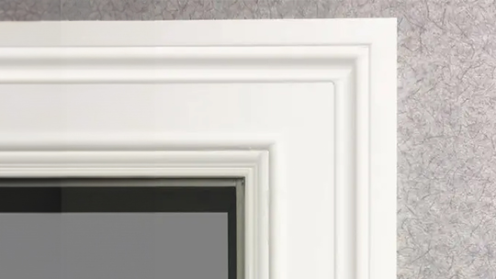
You do NOT need to remove the trim! All you need to do is use Spackle to fill the area where you removed the previous door hinges. A barn door hangs in front of the doorway, so it can go over the top of the existing door trim. Just make sure the door sits far enough off the wall to slide past the trim without rubbing.
You can follow the same steps used for installing an interior sliding barn door for your exterior! The difference is in the materials. HomeGuide notes that exterior barn doors are typically built from weather-resistant materials such as solid wood, metal or composite, so choose a door and hardware made for outdoor use.







Comments