


Yes, in many homes, but check your local code and your machines' manuals first. A garage laundry needs a spot that stays above freezing, a dryer vent that runs outdoors, the right outlets and a dry floor. Wall cabinets, a tall cabinet and a folding counter then turn the hookups into a real laundry area. Indoor cabinets belong only in a garage that stays dry.
- Check first: some codes limit laundry machines in garages. Call your building department before you move or add hookups.
- Cold: one Whirlpool guide says not to run or store its machine below 32°F, because water left inside can cause damage.
- Height: the model code wants an appliance's ignition source at least 18 inches above a garage floor, which is one reason for a platform.
- Vent: the dryer must vent outdoors. The model code caps the duct at 35 feet, less for each bend, unless the dryer maker says otherwise.
- Best upgrades: wall cabinets above the machines, one tall cabinet, a folding counter, a utility sink and real lighting.
- Cabinets: indoor cabinets are fine in a dry, finished garage. In a damp or unheated one, wood moves and can be damaged.
- Lily Ann Cabinets does not make a garage line. Our laundry room cabinets are our kitchen lines, so ask us before ordering for an unheated garage.
In a lot of homes, the washer and dryer sit in the garage because that is where the builder put the hookups. It works, but it rarely feels like a room. The machines stand on bare concrete, the detergent sits on top of the dryer, and clean clothes come out next to the lawn mower.
Below are 11 garage laundry room ideas, from a simple wall of cabinets to a walled-off room. Before the ideas, we cover the checks that matter more in a garage than indoors: cold, the dryer vent, outlets and moisture. After them, we explain what happens to indoor cabinets in a garage, because Lily Ann Cabinets does not make a garage storage line and you should know that before you order.
Can You Put a Laundry Room in the Garage?
Yes, in many homes, but check your local code and your machines' manuals first. A garage laundry needs a spot that stays above freezing, a dryer vent that runs outdoors, the right outlets and a plan for moisture. Some codes limit laundry machines in garages, so call your building department before you move or add hookups.
That warning comes from the machine makers themselves. One Whirlpool installation guide for a washer-dryer says: "Some codes limit, or do not permit, installing washer/dryer in garages, closets, mobile homes, or sleeping quarters. Contact your local building inspector."
If the hookups are already in your garage, most of this was settled when the house was built. The checks below still help you decide where cabinets, a counter and a sink can go.
Four Checks Before You Plan a Garage Laundry
These are the points that are different in a garage. The numbers come from one manufacturer guide and from the model residential code. Your own manuals and your local code are the final word.
| Check | What the source says | Source |
|---|---|---|
| Cold | Do not install, store or run the machine where it is exposed to weather or to temperatures below 32°F. Water left inside can cause damage in the cold. | Whirlpool dimension guide, washer-dryer model YWFC8090GX |
| Height off the floor | In a garage, an appliance with an ignition source must have that source at least 18 inches above the floor, unless the appliance is listed as flammable-vapor-ignition resistant. The same Whirlpool guide says to place its machine at least 18 inches above the floor in a garage. | 2021 IRC G2408.2, as printed in the 2021 Seattle Residential Code, Chapter 24; Whirlpool guide |
| Cars | Appliances in a private garage must be protected from being hit by a vehicle, or be mounted high. | 2021 IRC G2408.3, same chapter |
| Dryer vent | The dryer exhaust must carry its moisture outdoors on its own duct. The model code caps the duct at 35 feet, less for each bend, unless the dryer maker's instructions give a different length. The flexible piece behind the dryer can be no longer than 8 feet and cannot be hidden inside a wall. | 2021 IRC M1502, as printed in the 2021 Seattle Residential Code, Chapter 15 |
Two more things to ask about:
- Outlets. The model code lists both garages and laundry areas among the places where outlets need ground-fault (GFCI) protection. Ask a licensed electrician what your local code requires for the washer outlet and the dryer circuit.
- Moisture. The EPA's guide to mold and moisture says to keep indoor humidity below 60 percent, ideally between 30 and 50 percent, and to vent clothes dryers to the outside. A garage that feels damp needs that fixed before cabinets go in.
The 18-inch rule is written for appliances that have an ignition source. Whether it applies to your dryer depends on the model and on your inspector, so ask before you build a platform or skip one.
11 Garage Laundry Room Ideas
1. Put It on the Wall Next to the House Door
The best spot is usually the wall the garage shares with the house, close to the door you walk through. You carry baskets a shorter distance, and you are not walking around the car with clean clothes. If your hookups are already there, plan the cabinets around them. If they are on a far wall, get a plumber's price for moving them before you design anything.
2. Raise the Machines on a Platform
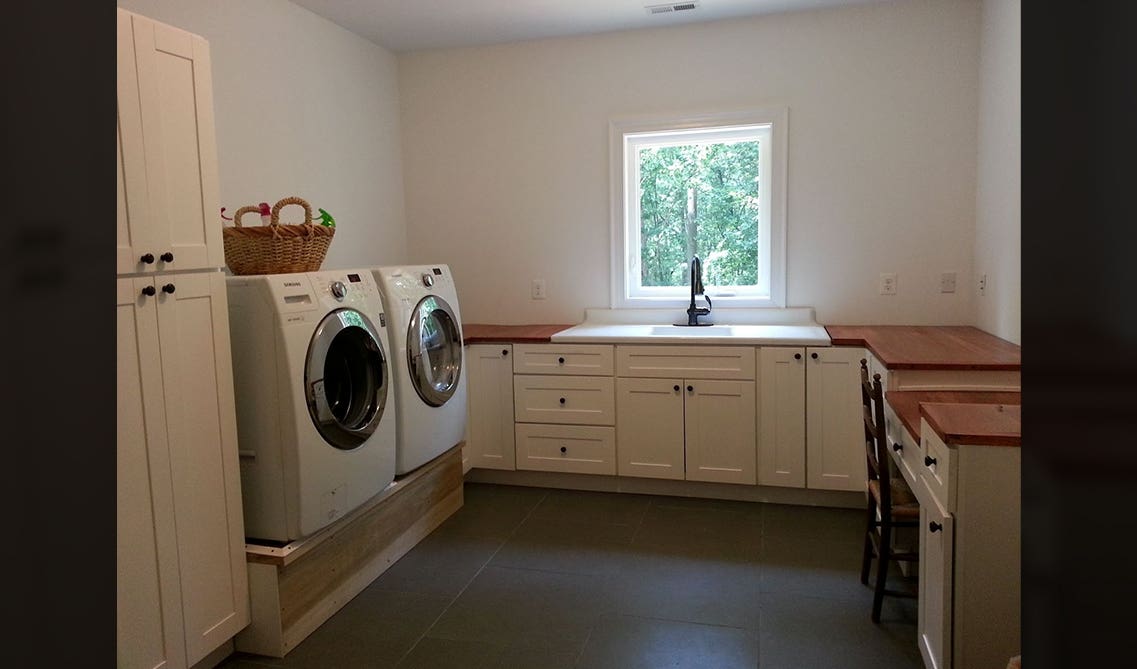
A platform lifts the doors of front-load machines so you bend less. In a garage it can also help with the code point above, when your dryer has to sit higher off the floor. The room in this photo is indoors, but the idea is the same: a sturdy, level base with a tall cabinet beside it.
Have the platform built for the weight. The Whirlpool guide we read lists 400 pounds for its machine when it is full of water and clothes, and asks for a level floor. Garage floors often slope toward the door, so check yours with a level.
3. Hang Wall Cabinets Above the Machines

Lily Ann Cabinets: White Shaker Elite
Wall cabinets are the safest cabinets to put in a garage, because they hang well above a wet floor. A row above the machines hides detergent, stain remover and dryer sheets behind doors, where dust from the garage can't settle on them.
Leave room to reach the water valves and the dryer vent. Our guide to cabinets around a washer and dryer lists the clearances the machine makers ask for.
4. Add a Tall Cabinet for Brooms and Bulk Supplies
A tall utility cabinet turns 18 inches of wall into a closet. It holds the mop, the ironing board and the big boxes of detergent. Put it at the end of the run, on the side away from the garage door, so it stays out of the weather when the door is open.
5. Give Yourself a Folding Counter

Lily Ann Cabinets: Grey Shaker Elite
Without a counter, clean laundry ends up on the hood of the car. You can run a counter over front-load machines, or set base cabinets with a top beside them, as in this photo. Our laundry room countertop guide covers height, depth and how to support a top over the machines.
6. Add a Utility Sink
A deep sink is more useful in a garage than anywhere else in the house. You can soak muddy sports gear, rinse paint brushes and wash your hands after yard work without going inside. A sink base cabinet next to the washer keeps the plumbing in one place. A plumber should tie in the drain and the water lines.
7. Stack the Machines to Save a Parking Space
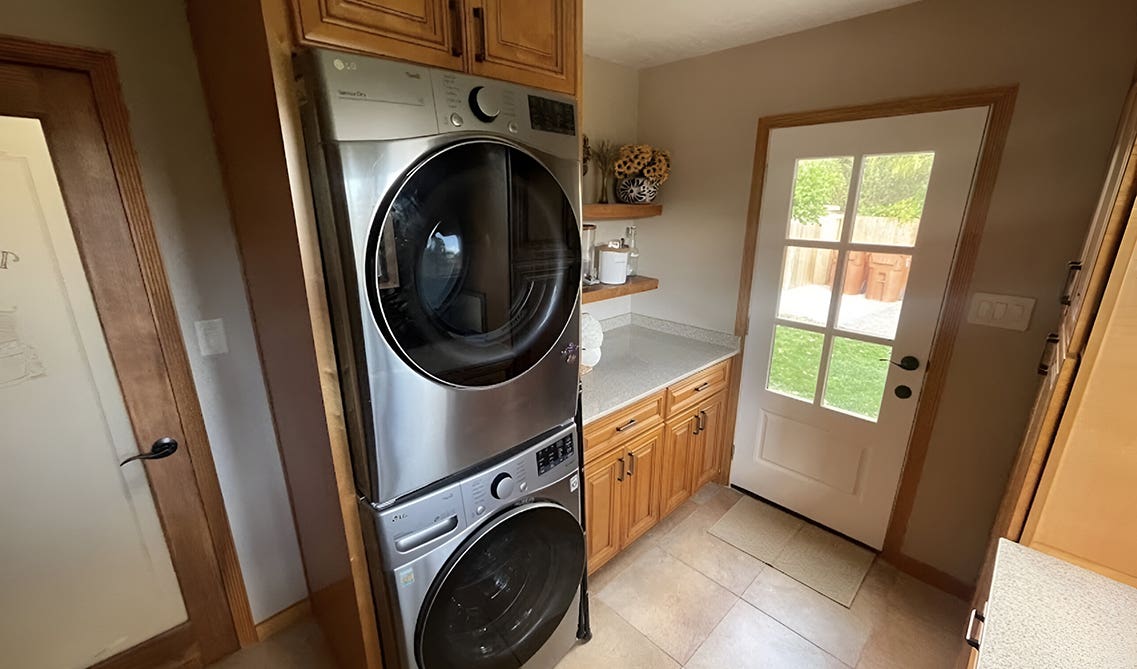
A stacked pair uses the floor space of one machine. In a one-car garage, that can be the difference between parking inside and parking in the driveway. Only stack machines that their maker says can be stacked, and use the maker's stacking kit.
Our laundry room dimensions guide works out that a side-by-side pair needs about 54 to 60 inches of wall, while a stacked pair fits in under 30 inches.
8. Mark Off the Laundry Zone
A garage laundry feels like a room once it has an edge. From least to most work:
- Paint and a rug. A different wall color behind the machines and a washable mat in front.
- A curtain. A ceiling track and a heavy curtain hide the machines when guests walk through.
- A half wall or a full wall. Framing and drywall make a real room and keep car dust off the clothes. A wall also protects the machines from the car, which the model code asks for. Building one usually needs a permit.
9. Finish the Walls and Floor
Bare studs and a stained slab are what make a garage laundry feel like a chore. Drywall and a coat of light paint change that fast. For the floor, plain concrete is fine in a laundry area. Our laundry room flooring guide compares concrete, tile and vinyl, and explains what goes under the machines.
10. Add Real Lighting
One bare bulb in the middle of the garage puts your own shadow on the stain you are trying to see. Add a ceiling fixture over the laundry wall and a light under the wall cabinets. Our laundry room lighting guide explains how bright the light should be and which color to buy.
11. Hang-Dry Space and Hooks
A rod between two wall cabinets, a fold-down rack or a retractable line gives you a place to air-dry clothes. Wet clothes add moisture to the air, so use them when the garage is dry and aired out. Hooks on the side of the tall cabinet hold the laundry bag, the lint brush and the step stool.
For more storage ideas that work in any laundry space, see our laundry room organization ideas.
Will Indoor Cabinets Hold Up in a Garage?
It depends on the garage. In an insulated, dry garage that stays close to indoor temperatures, kitchen-style cabinets behave much as they do in a laundry room. In an unheated or damp garage, wood swells and shrinks with the seasons, painted joints can crack, and a cabinet that sits in water can be ruined.
Lily Ann Cabinets does not make a garage storage line. Our laundry room cabinets are our kitchen cabinet lines, built for the inside of a house. The Grey Shaker Elite line, for example, lists a 1/2-inch birch plywood box and an engineered door.
Here is what our own pages say, read on October 11, 2026:
- Care page: "As with any wood product, avoid exposing your cabinetry to excessive moisture. Lily Ann Cabinetry is designed for use inside the home or other buildings, not for outdoor applications."
- Warranty, on climate: "It is the nature of wood to expand and contract to varying degrees depending on climate conditions." It adds that painted cabinets "may show fractures in the paint at joints" and that this "is normal and is not considered a defect."
- Warranty, on what is not covered: the list includes "improper handling/storage" and "environmental conditions."
The warranty page does not mention garages. So ask our team before you order cabinets for a garage that is not heated and cooled like the house.
| Your garage | What to expect | What to do |
|---|---|---|
| Insulated, dry, stays near indoor temperatures | Much like an indoor laundry room | Plan wall, base and tall cabinets as you would inside |
| Unheated but dry | Wood moves with the seasons. Doors may need adjusting, and painted joints can show fine cracks | Favor wall cabinets. Ask about warranty cover before you order |
| Damp, or the floor gets wet from rain, snow melt or hosing | Cabinet parts that sit in water can swell and stay damaged | Fix the moisture first. Keep cabinets off the floor, or use storage made for garages |
| Open to the weather, or drops below freezing | Not a place for indoor cabinets, and not a place for a washer either | Enclose and heat the laundry area, or move the laundry indoors |
The table is our own guidance, based on the care and warranty wording above. Our garage makeover ideas article shows how kitchen-style cabinets are used along a garage wall.
Cabinets That Fit a Garage Laundry Wall
These are standard sizes from the Grey Shaker Elite line. Each one showed In stock on October 11, 2026. Sizes are copied from the listings.
| Job | Cabinet | Size as listed |
|---|---|---|
| Above the machines | Wall cabinet 30 x 15 or 36 x 15 | 30"W or 36"W x 15"H x 12"D, 2 doors |
| Brooms and bulk supplies | Utility cabinet 18 x 84 | 18"W x 84"H x 24"D, 2 doors, 3 adjustable shelves, 1 stationary shelf |
| Utility sink | Sink base 30 | 30"W x 34-1/2"H x 24"D |
| Folding counter beside the machines | Base cabinet 36 | 36"W x 34-1/2"H x 24"D |
The same sizes come in our other lines. Start at laundry room cabinets to compare finishes, or browse all wall cabinets.
Mistakes to Avoid
- Ordering cabinets before checking the garage. Watch the space through one wet week and one cold week first.
- Setting base cabinets where water runs. Look at where rain and snow melt drip off the car and where the floor slopes.
- Forgetting the car. Open the car doors and the machine doors at the same time before you fix anything to the wall.
- Venting the dryer into the garage. The vent has to go outdoors.
- Boxing in the hookups. Leave the water valves, the drain and the vent easy to reach.
- Skipping the permit question. New plumbing, wiring, gas lines and walls usually need one.
The Takeaway
A garage laundry works when the basics are right: a spot that stays above freezing, a dryer vent to the outdoors, safe outlets and a dry floor. After that, wall cabinets, a tall cabinet, a counter and good light turn a corner of the garage into a place you don't mind doing laundry.
Be honest about your garage before you buy cabinets for it. If it is dry and finished, send us the wall measurements and get a free 3D design for the laundry wall. If it is damp or unheated, talk to our team first, and order free door samples to see the finishes in your own light.
Frequently Asked Questions
It can be, when the machines are installed the way their manuals and your local code require. The main risks in a garage are freezing, a dryer vent that does not reach the outdoors, and an appliance with an ignition source that sits too low. One Whirlpool guide warns that some codes limit or do not permit a washer-dryer in a garage. Call your building inspector if you are adding or moving hookups.
Often yes. You can turn one wall into a laundry area, or frame off part of the garage as a separate room. Either way you need a water supply, a drain, the right electrical circuits and a dryer vent to the outdoors, and the work usually needs a permit. Start with a call to your building department, then get prices from a plumber and an electrician.
Plan it in this order. First, pick the wall, usually the one next to the house. Second, have a plumber and an electrician rough in the water, drain, outlets and dryer vent. Third, close up and paint the walls, and build a wall around the area if you want a separate room. Last, set the machines, then add cabinets, a counter and lighting.
Start with the three things that change it most: storage, a counter and light. Hang wall cabinets above the machines, add a counter to fold on, and put a bright fixture over the laundry wall. Then finish the wall behind the machines with drywall and paint. A rug, a hanging rod and a curtain or half wall make it feel like a room and not a corner of the garage.
A single wall is the best layout for most garages, because it leaves the floor free for the car. Put the pieces in the order you use them: a tall cabinet or hamper space, the washer, the dryer, then a counter or sink. If the wall is short, stack the machines and use the space beside them for a tall cabinet.
Four feet is too narrow for a washer and dryer side by side, which need about 54 to 60 inches. It is enough for a stacked pair, which is under 30 inches wide, with room left for a narrow cabinet. Measure your own machines before you plan, because depths and widths vary by model.
It can. Water stays in a washer's pump and hoses after a cycle, and it can freeze and cause damage. A Whirlpool guide for one washer-dryer says not to install, store or run the machine where temperatures drop below 32°F. If your garage gets that cold, heat the laundry area, or follow your manual's steps for winterizing the machine.
Yes, in a garage that is dry and stays close to indoor conditions. Kitchen cabinets are made for the inside of a house. In a damp or unheated garage the wood swells and shrinks, and a cabinet that sits in water can be damaged for good. Wall cabinets are the safer choice because they hang above the floor. Ask about warranty cover before you order for an unheated garage.
Go up, not out. Stack the machines if they are made to stack, hang wall cabinets above or beside them, and use one tall cabinet in place of several low ones. A fold-down drying rack and hooks use wall space that would be empty anyway. Keep the floor in front of the machines clear so the doors, and the car doors, can open.















