


A European-style kitchen is built around clean, flat-looking cabinet fronts, slim or hidden hardware, tall storage units and appliances that sit flush with the cabinets, with almost no decoration. The cabinets are traditionally frameless, built on the 32-mm "European system" that started in Europe after World War II. Lily Ann Cabinets sells framed cabinets with full overlay doors, not frameless or slab doors, so this guide shows how close you can get and where the limits are.
- What it is: plain or slab doors, tight even gaps, slim or hidden hardware, tall units, built-in appliances and very little trim.
- How it's built: true European cabinets are frameless (full access). There's no face frame, so the hinges mount to the box side.
- Framed can get close: a full overlay door covers almost all of the frame, so the fronts read as one surface until you open a door.
- What framed can't do: a real slab, handle-less front, or the extra opening width you get without a roughly 1-1/2-inch frame.
- The biggest levers: the slimmest door, one color or wood, one slim pull, tall units, built-in appliances, no crown or corbels.
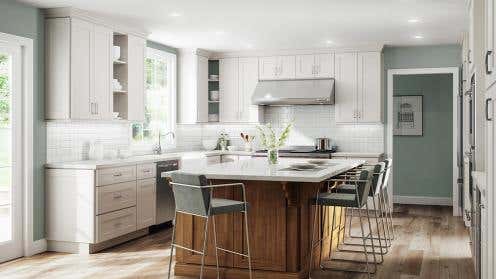
- At Lily Ann Cabinets: Off-White Slim Shaker and Mocha Slim Shaker have our slimmest Shaker frame, full overlay. We don't sell slab, frameless or handle-less cabinets.
Search for European kitchen design and you get the same picture over and over: smooth cabinet fronts, no crown molding, tall walls of storage and appliances you can barely see. It looks calm. It also looks expensive, and most of what you see is built by European cabinet makers you can only buy through a showroom.
This guide explains what actually makes a kitchen look European, how "European cabinets" are built, and how close you can get with framed cabinets. We'll be straight about one thing up front: Lily Ann Cabinets sells framed cabinets with full overlay doors. We don't sell frameless cabinets, slab doors or a handle-less system. You can still borrow most of the look, and we'll show you where the line is.
What Is a European Kitchen?
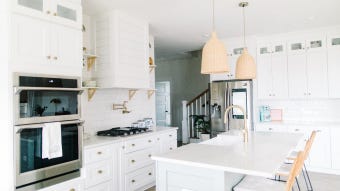
A European kitchen is a style built around clean, flat-looking cabinet fronts, slim or hidden hardware, tall storage units and appliances that sit flush with the cabinets. Decoration is kept to a minimum: no crown molding, no corbels, no raised panels. Most of what you own lives behind doors, so the room reads as calm, even surfaces.
You'll see six things in almost every example:
- Flat or very plain doors. The purest version is a slab door with no frame at all.
- Tight, even gaps between doors and drawers, so a run of cabinets reads as one surface.
- Little visible hardware. Long slim pulls, finger grooves or push-to-open doors.
- Tall units. Floor-to-ceiling pantry and oven columns instead of a run of short wall cabinets.
- Built-in appliances. Ovens stacked in a tall cabinet, and a refrigerator set into its own bay.
- A limited palette. White, greige, grey, black or one wood tone, repeated across the room.
European vs. American Kitchens: The Real Differences
The biggest difference isn't color or style. It's how the cabinets are built and how much of the kitchen is on display.
| Typical European kitchen | Typical American kitchen | |
|---|---|---|
| Cabinet box | Frameless: no face frame, the door hinges to the box side | Framed: a wood face frame on the front of the box |
| Doors | Slab or very plain, full overlay | Shaker or raised panel, full or partial overlay |
| Hardware | Hidden grooves, push-to-open or one long slim pull | Knobs and pulls as part of the look |
| Trim | No crown, flat toe kick | Crown molding, light rail, sometimes corbels |
| Storage | Tall units, deep drawers, almost everything behind doors | More wall cabinets, glass fronts, open shelves |
| Appliances | Built in, often hidden behind cabinet panels | Often freestanding, stainless steel on show |
These are tendencies, not rules. Plenty of American kitchens are sleek, and plenty of European kitchens are warm and traditional. But when people say "European," this left-hand column is what they mean.
"European Cabinets" Usually Means Frameless
European cabinets are frameless cabinets, also called full-access cabinets. There is no wooden face frame on the front of the box, so the door hinges mount straight to the inside of the cabinet side, and the full width of the box is open when you swing the door. In North America this build is often simply called "European cabinetry."
The common way to build them started in Europe after World War II. It's known as the 32-mm system, after the 32-millimeter spacing of the rows of holes drilled inside the box for hinges, drawer runners and shelves (Wikipedia, "Frameless construction"). Because there's no frame to stiffen the front, frameless boxes use thicker side panels and have to be installed very square.
A framed cabinet is the traditional American build. It has a solid wood face frame, about 1-1/2 inches wide, across the front of the box, and the hinges screw into that frame. Our guide to framed vs. frameless cabinets walks through storage, cost and installation for both.
"European" also gets used for design styles, not just the build. German kitchens are known for precise, handle-less frameless systems. Italian kitchens lean on stone and bold finishes. Scandinavian kitchens use light wood and white. They're all "European," and they don't all look the same (more on that below).
Can Framed Cabinets Look European?
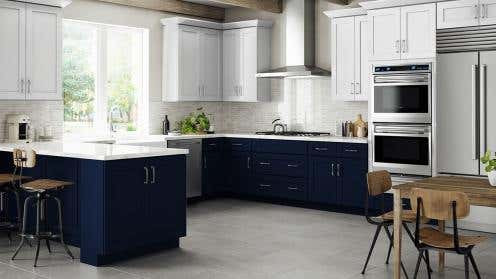
Yes, mostly. A full overlay door covers almost the whole face frame and leaves a narrow, even gap between doors, so from a step back a run of framed cabinets reads as one flat surface. The frame only shows when a door is open. What framed cabinets can't give you is a true slab, handle-less front or the extra inch or so of opening you get without a frame.
The door position matters more than anything else here. There are three ways a door can sit on a framed cabinet:
- Partial overlay shows about two inches of frame between doors. It reads traditional.
- Inset sets the door inside the frame, so the frame is fully on show. It reads furniture-like and classic, the opposite of European.
- Full overlay covers nearly all of the frame. This is the one that gets you close to the European look, and it's how every Lily Ann kitchen line is built.
Our inset vs. overlay guide explains the trade-offs in detail.

One naming note, because it trips people up: Lily Ann's spec sheets list the door style as "Full Overlay, Flat Panel." Here, "flat panel" means the flat center panel set inside the Shaker frame. It does not mean a slab door. Every Lily Ann kitchen door is a framed door: a Shaker door with a recessed flat center or, on some lines such as Navy Blue Shaker, a raised panel.
So here's the honest comparison:
| European feature | True European (frameless) | With Lily Ann framed cabinets |
|---|---|---|
| Door front | Slab, no frame | Slim-frame Shaker, full overlay (closest), or standard Shaker |
| Gaps between doors | Very tight and even | Narrow and even with full overlay; adjust hinges after install |
| Hardware | Handle-less groove or push-to-open | Long slim pulls in one finish (no handle-less option) |
| Box | Frameless, full access | Framed, 1/2" plywood box, face frame on the front |
| Tall units | Floor-to-ceiling columns | 84", 90" and 96" tall utility and oven cabinets |
| Appliances | Fully hidden behind matching panels | Built into tall cabinets and bays; appliance door panels not sold by Lily Ann |
| Crown and trim | None | Leave it off, or run cabinets to the ceiling |
How to Get the European Look With Framed Cabinets: 8 Moves
1. Pick the plainest door you can
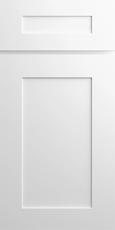
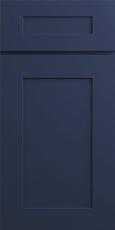
The door does more of the work than anything else. A slab door isn't available on framed Lily Ann cabinets, so go for the thinnest Shaker frame you can find. Two Lily Ann lines are built for this. Off-White Slim Shaker has what Lily Ann calls "a newly designed slim-frame Shaker door for a more refined, contemporary look." Mocha Slim Shaker uses "a slimmer, more refined Shaker profile" in a warm wood stain. Order a sample door first: the Off-White Slim Shaker sample and Mocha Slim Shaker sample are full-size doors, so you can see how thin the frame really is.
For more on the two door types, see Shaker vs. slab cabinets.
2. Keep the gaps tight and even
European kitchens look calm because every gap lines up. Full overlay doors start you close. After the cabinets are installed, take the time to adjust each soft-close hinge so the gaps are even top to bottom and across the run. Our guide on how to adjust cabinet doors shows the three screws that do it.
3. Choose slim hardware, and use one line of it
Lily Ann doesn't sell a handle-less door, so plan on pulls, and make them quiet. Long, thin bar pulls in one finish do the most work. The Black Contemporary Metal Pull (12-3/4 in) was in stock on September 24, 2026, and the same pull comes in shorter lengths and in champagne gold in our knobs and pulls collection. Use one pull style everywhere, and mount it in the same spot on every door and drawer. Cabinet hardware placement has the measurements.
4. Go tall
Swap a run of short wall cabinets for full-height units. Tall cabinets give you a clean vertical line and a lot of hidden storage. The Off-White Slim Shaker pantry and oven cabinets include utility cabinets 84, 90 and 96 inches tall, in 18- and 24-inch widths. Where the walls stay short, run the wall cabinets up to the ceiling so there's no dusty gap on top. See stacked kitchen cabinets for how to plan that.

5. Build the appliances in
Nothing breaks up a European kitchen like a freestanding appliance sticking out of the run. Stack wall ovens in a tall oven cabinet, like the Off-White Slim Shaker oven cabinet (33"W x 96"H). Put the refrigerator in its own bay with a cabinet above it and tall end panels on each side, so it reads as built in. Our guides to wall oven cabinets, the cabinet above the refrigerator and refrigerator and dishwasher panels cover the sizes.
One limit: a fully hidden refrigerator or dishwasher needs a panel-ready appliance and a door panel sized to that model. Lily Ann sells end panels for the sides of the opening, not appliance door panels.
6. Skip the decoration
Leave off corbels, heavy crown molding and decorative valances. If you want trim at the top, keep it flat and simple, or run the cabinets to the ceiling instead. Pick flat-center Shaker lines over raised-panel ones.
7. Stick to one color, or one wood
European kitchens usually use a tight, tonal palette. Good matches from Lily Ann's lines:
- White: Colorado White Shaker, which Lily Ann describes as suited to "a modern, minimalistic kitchen," or Off-White Slim Shaker. See all white cabinets.
- Grey: Grey Shaker Elite. See all grey cabinets.
- Black: Craftsman Black Shaker. See all dark cabinets.
- Wood: Craftsman Natural Shaker or Mocha Slim Shaker. See all wood cabinets.
A two-tone kitchen can still feel European if both tones are quiet, for example a wood island with off-white perimeter cabinets.

8. Hide the clutter
The calm look only works if the counters stay clear. Plan for closed storage: deep drawers, pull-outs, and a tall pantry. The Craftsman Black and Craftsman Natural lines include a Hidden Pantry Doors cabinet (36"W x 96"H in black, and in natural wood), listed for use as a hidden pantry or broom closet. See all Craftsman Black Shaker pantry and oven cabinets.
German, Italian and Scandinavian: Three Kinds of European Kitchen
- German kitchens are the textbook "European" look: precise frameless systems, handle-less fronts, neutral colors and a lot of engineered storage.
- Italian kitchens put the design first: dramatic stone, rich wood or glossy finishes, and a statement island.
- Scandinavian kitchens are light and simple: pale wood, white, and very little decoration. Our guide to Scandinavian kitchens covers the look, and the Japandi kitchen guide shows its warmer, Japanese-influenced cousin.
With framed cabinets, the Scandinavian and Italian directions are the easiest to get close to, because they rely more on color, wood and stone than on a handle-less door. The strict German look is the hardest.
Lily Ann Lines That Come Closest
Every line below is framed with full overlay doors, a 1/2" plywood box, 5/8" dovetailed solid wood drawers and soft-close hinges and glides, per each line's spec list. None of them is a slab door.
| Line | Why it works | Best for |
|---|---|---|
| Off-White Slim Shaker | Slim-frame Shaker door, the plainest face we sell | Light, Scandinavian-leaning kitchens |
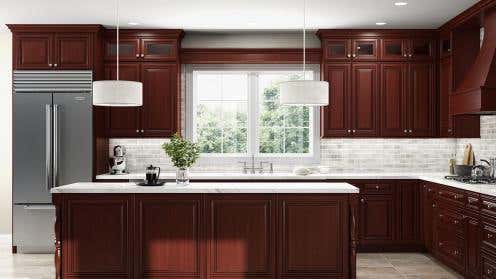
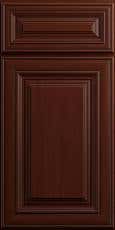
| Mocha Slim Shaker | Slim Shaker profile in a warm wood stain | Warm, wood-led kitchens |
| Colorado White Shaker | Crisp white, flat center panel | All-white, tonal kitchens |
| Grey Shaker Elite | Mid grey, flat center panel | Greige and grey palettes |
| Craftsman Black Shaker | Deep black, flat center panel | Dark, dramatic kitchens |
| Craftsman Natural Shaker | Natural wood grain on show | Wood-led and two-tone kitchens |
Browse the full range of Shaker cabinets, or see how these lines work in a modern kitchen, a contemporary kitchen or a minimalist kitchen.
When You Should Buy True Frameless Instead
Framed cabinets get you most of the way. But if one of these is a must-have, a frameless maker is the right call, and Lily Ann isn't:
- You want slab doors with no frame at all, in lacquer, laminate or veneer.
- You want a fully handle-less kitchen with a finger groove or push-to-open doors throughout.
- You want the widest possible drawers, with no face frame narrowing the opening.
If what you want is the calm, built-in feel and you'd rather have a forgiving install, framed full overlay cabinets are a good fit. Framed cabinets are easier to fit on walls that aren't perfectly straight, which describes most remodels.
European Kitchen Planning Checklist
- Door: the slimmest Shaker frame available, full overlay.
- Palette: one color or one wood, plus one accent at most.
- Hardware: one slim pull style and one finish, mounted in the same spot everywhere.
- Height: tall units where you can, wall cabinets to the ceiling where you can't.
- Appliances: ovens in a tall cabinet, refrigerator in a bay with a cabinet above and end panels.
- Trim: no corbels, no heavy crown.
- Storage: enough closed storage that the counters stay clear.
- After install: adjust every hinge so the gaps line up.
The Takeaway
A European kitchen is about calm, even surfaces: plain doors, tight gaps, quiet hardware, tall storage and built-in appliances. The true version is frameless with slab, handle-less doors. Framed cabinets with full overlay doors, a slim Shaker frame and disciplined planning get you close to that look for most kitchens, and we'd rather tell you where the line is than have you find out after delivery.
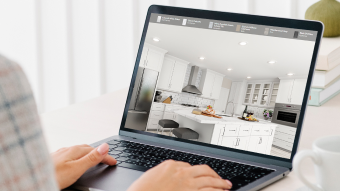
Want to see it before you buy? Order free samples of the slim Shaker doors, or get a free 3D kitchen design and ask our designers to lay it out European-style.
Frequently Asked Questions
A European kitchen style uses clean, flat-looking cabinet fronts, slim or hidden hardware, tall storage units and built-in appliances, with very little decoration. Most items are kept behind doors so surfaces stay clear. The cabinets are traditionally frameless, and the palette is usually limited to white, grey, black or one wood tone.
The main differences are the cabinet build and how much is on display. European kitchens usually have frameless cabinets, slab or very plain doors, hidden or slim hardware, tall units and built-in appliances. American kitchens more often use framed Shaker or raised-panel cabinets, crown molding, visible knobs and pulls, and freestanding stainless appliances. These are tendencies; many American kitchens borrow the European look.
European-style cabinets are usually called frameless or full-access cabinets. You'll also see them called 32-mm system cabinets, after the 32-millimeter hole spacing used to build them, or just "Euro" cabinets. The name refers to the build: there's no face frame on the front of the box, so the door hinges mount to the inside of the cabinet side.
American cabinets are usually framed: a wood face frame about 1-1/2 inches wide sits on the front of the box and the hinges screw into it. European cabinets are frameless: no face frame, so the hinges mount to the box side and the whole opening is usable. Framed cabinets are more forgiving on uneven walls; frameless cabinets give a flatter face and slightly wider access, especially in drawers.
Not because of the build itself. Within one brand and one material, framed and frameless cabinets land close together in price. European cabinets often cost more because many are imported German or Italian systems sold through showrooms, with premium finishes like lacquer and specialty hardware. The material, finish and brand move the price far more than the frameless box does.
A German style kitchen is the strictest version of the European look. It uses precisely built frameless cabinets, handle-less or very minimal fronts, neutral colors and a lot of engineered storage such as deep drawers, pull-outs and lift-up doors. The focus is on precision, ergonomics and durability rather than decoration.
Scandinavian kitchen style is light, simple and practical: pale wood, white or soft neutral cabinets, little decoration and plenty of natural light. It's one of the European styles that's easiest to get with framed cabinets, because it depends more on color and wood than on a handle-less door. See our guide to Scandinavian kitchens for ideas.
Shaker is the most-installed cabinet door style, and slab (flat-panel) is the main modern alternative. Shaker's simple frame works in traditional, transitional and modern kitchens depending on color and hardware. Slab doors dominate contemporary and European-style kitchens. A slim-frame Shaker door sits between the two.
Yes, if you keep everything else minimal. Choose a slim-frame Shaker door with full overlay, one color or wood tone, long slim pulls in one finish, tall units and built-in appliances, and skip crown molding and corbels. A Shaker door will never look exactly like a slab, but a slim frame gets close from a few steps away.





Comments