


An epoxy countertop is a two-part resin coating poured about 1/8 to 1/4 inch thick over an existing counter, such as laminate, wood or tile, and left to harden into a glossy, seamless surface. A DIY kit costs about $100 to $350, and a professional job about $50 to $150 per square foot, according to HomeGuide (November 2023). It can last for years, but it is hard to pour well, needs a week or more to cure, can be marked by hot pans, and won't fix a counter that is swollen or coming loose.
- What it is: a resin coating poured over the counter you already have. It is not a new slab.
- Cost: $100–$350 for a DIY kit, or $50–$150 per sq. ft. for a professional stone-look job (HomeGuide, Nov. 2023). A thin rolled-on epoxy coating is priced far lower: $4–$8 (Fixr, Jan. 2025) to $6.50–$12.68 (Homewyse, Sept. 2026).
- How long it lasts: 10–30 years with care, says HomeGuide. Bob Vila says epoxy over old laminate may need attention after about 5 years.
- Heat: one maker claims 450°F and still says to use a trivet. Another lists a heat deflection temperature of 118°F. Use trivets.
- Downtime: light use after about 3 days, full cure in 7 to 30 days depending on the product (Bob Vila). The sink comes out first.
- Replace instead when: the laminate is lifting, the board under it is swollen, or you want a new layout or sink style.
- Lily Ann Cabinets sells the cabinets under the counter, not epoxy. If you're replacing, check the bases first, such as Colorado White Shaker base cabinets (In Stock October 7, 2026).
Epoxy countertops look like a shortcut. You keep the counter you have, pour a glossy resin over it, and end up with something that passes for marble from across the room. The videos make it look like a weekend job.
Sometimes it is. Sometimes it's a sticky, expensive mistake on top of a counter that needed replacing anyway. This guide covers what epoxy countertops really cost, how long they last, the downsides people run into, what makers say about heat and food safety, and how to tell when a worn counter means it's time to replace it instead. Every number below comes from a named source with its date.
One thing up front: Lily Ann Cabinets doesn't sell epoxy kits or countertop paint, and no kitchen countertops were listed in our catalog when we checked on October 7, 2026. We sell the cabinets that sit under the counter, so that's the part of this decision we know first-hand.
What Is an Epoxy Countertop?
An epoxy countertop is a two-part resin coating, a resin and a hardener, that is mixed and poured over an existing counter and left to harden into a glossy, seamless surface. It usually goes on about 1/8 to 1/4 inch thick over laminate, wood, tile or concrete. It is a coating, not a new slab, so the old counter stays underneath.
Most kitchen epoxy jobs are "pour-on" coatings like this. Bob Vila's 2026 buying guide says epoxy works over laminate (including Formica), solid wood, concrete and stone, and that most people build up a total thickness of 1/8 to 1/4 inch. Colors and metallic powders are mixed in to copy marble or granite.
That's different from a factory-made epoxy resin slab, the kind used in school science labs. Those are a separate product and aren't what most people mean when they search for epoxy kitchen countertops.
How Much Do Epoxy Countertops Cost?
A DIY epoxy countertop kit costs about $100 to $350, and a professional epoxy countertop costs about $50 to $150 per square foot installed, according to HomeGuide's cost guide (updated November 29, 2023). For a kitchen with 30 to 40 square feet of counter, HomeGuide puts a professional job at $1,500 to $6,000.
Not every source agrees, mostly because they are pricing different jobs. Here is what each one says and what it is counting.
| Source and date | What it prices | Cost |
|---|---|---|
| HomeGuide, Nov. 29, 2023 | Professional stone-look epoxy countertop, installed | $50–$150 per sq. ft. |
| HomeGuide, Nov. 29, 2023 | DIY epoxy countertop kit | $100–$350 per kit |
| Caesarstone US blog, updated Sept. 27, 2023 (a quartz maker, so it has a stake) | Kit; professional install | $100–$200 and up per kit; up to $100 per sq. ft. |
| Fixr, updated Jan. 31, 2025 | Refinishing an existing counter with an epoxy coating | $4–$8 per sq. ft. |
| Homewyse, September 2026 | Refinishing a counter with bonding primer and two rolled coats of two-part epoxy paint | $6.50–$12.68 per sq. ft. |
Sources: HomeGuide "How much do epoxy countertops cost?", Fixr "Cost to Refinish Countertops", Caesarstone US "Epoxy Countertops: Read This Before You Buy" and Homewyse "Cost to Refinish Countertops", all read October 7, 2026. These are national estimates, not quotes. HomeGuide, Fixr and Caesarstone are named as sources and not linked.
The gap between $4 and $150 per square foot is real, and it comes down to the job. The low figures are for a thin epoxy coating rolled on like paint. The high figures are for a hand-poured, stone-look finish, where HomeGuide says $45 to $140 of every square foot is labor and only $5 to $10 is material. When you get a quote, ask which of those two jobs it covers.
It's also worth comparing with new stone. The same HomeGuide page lists quartz at $50 to $200 per square foot and granite at $80 to $150 installed. So a professional epoxy job is not clearly cheaper than a new slab. The real savings are in doing it yourself with a kit. For how the main slab materials compare, see our guide to kitchen countertop materials and our quartz vs. granite comparison.
How Long Do Epoxy Countertops Last?
Sources give two very different answers. HomeGuide says epoxy countertops last 10 to 30 years with proper care. Bob Vila's guide is more cautious about coatings over old counters: it says refinished laminate countertops may need attention after about 5 years.
Both can be true. How long the finish lasts depends on how well it was poured, how hard the kitchen is used, and what is underneath. A thick, well-cured coating on a solid counter in a light-use kitchen is at the long end. A first-time pour over tired laminate beside a busy sink is at the short end.
Epoxy can also be refreshed. Bob Vila notes that a dull surface can usually be brought back with mineral oil or a countertop polish, and one maker's primer is sold to bond to existing epoxy for a recoat.
What Are the Downsides of Epoxy Countertops?
Epoxy has real strengths: no seams, no grout, a non-porous surface and almost any color you want. The downsides are the part the videos skip.
- It's hard to pour well. Family Handyman's own project writer, an experienced builder, ended up with drips down one edge and a patch of orange-peel texture. Bob Vila lists the difficulty for beginners as a main disadvantage.
- You're on the clock. Bob Vila says most epoxies give you about 45 minutes of working time after mixing. Family Handyman warns that once the primer goes on, a trip to the store means trouble.
- The kitchen is down for days. The sink has to come out. Bob Vila says counters are ready for light use in about 3 days, and a full cure takes 7 to 30 days depending on the product.
- Hot pans can damage it. See the heat section below. Plan on trivets for the life of the counter.
- It can yellow. HomeGuide says standard epoxy tends to yellow under UV light. One kit maker, Stone Coat Countertops, says on its own FAQ page that yellowing has been one of the biggest limits of epoxy coatings, mostly on white and light designs.
- Cleaning takes care. Bob Vila says to avoid bleach, which can stain epoxy, and abrasive cleaners, which leave fine scratches that dull the shine.
- Quality varies by brand. HomeGuide lists uneven quality between makers as a drawback, and not every epoxy is rated for food contact.
- It doesn't fix the counter underneath. Epoxy is a thin skin. Whatever is wrong below it is still there.

Can Epoxy Countertops Take Heat?
Not like stone. Epoxy handles a hot coffee mug, but a pan straight from the oven or burner can mark or soften it. Makers publish very different heat numbers, and even the highest one comes with advice to use a trivet.
| Who says it | What they say about heat |
|---|---|
| Stone Coat Countertops (kit maker), FAQ page | Says its countertop epoxy is heat resistant up to 450°F, but that setting hot pans straight on it is not a recommended practice. It advises a trivet or hot pad, and gives 30 days as the full cure. |
| TotalBoat (epoxy maker), TableTop Epoxy product page | Lists a heat deflection temperature of 118°F for its table-top epoxy. |
| Bob Vila, "The Best Epoxy for Countertops" (updated Feb. 24, 2026) | Says a pan straight from the oven can burn epoxy, though it copes with cups of hot drinks. Notes one kit needs 30 days of curing for full heat resistance. |
Sources: Stone Coat Countertops "Frequently Asked Questions" page and TotalBoat TableTop Epoxy product page, both read October 7, 2026 and named as maker sources, not linked; Bob Vila's guide by Bob Beacham. Heat deflection temperature is a lab measure of when a cured plastic starts to soften under load. It is not the same test as a maker's "resists up to" number, which is why the two figures are so far apart.
The safe reading is simple. Check the heat rating on the exact product you plan to buy, wait the full cure time before you trust it, and use trivets anyway.
Is Epoxy Safe for Kitchen Countertops?
Cured epoxy is a hard, inert plastic. Bob Vila's guide says epoxy resins are nontoxic once cured but are not automatically rated as food safe, and that many products state they comply with the federal rule for food-contact coatings.
That rule is 21 CFR 175.300, "Resinous and polymeric coatings," in the FDA's food additive regulations. It sets the conditions under which a coating may be used as a food-contact surface. If food contact matters to you, look for a maker's written statement that its cured product meets that rule, and follow its mixing and cure directions exactly, because the claim only applies to a fully cured coating.
Brands differ here. Bob Vila's review notes that one table-top epoxy it tested is rated for limited food contact only, and suggests it may not be the best pick for a kitchen counter. Whatever you choose, cut on a cutting board. That protects the finish and keeps knives out of the coating.
While the epoxy is wet, follow the label. TotalBoat's page, for example, says to wear gloves and work in a well-ventilated space, or wear a respirator in a confined one.
Can You Put Epoxy Over Laminate Countertops?
Yes. Laminate is the most common surface people coat. Bob Vila calls it a popular fix for tired counters, and Family Handyman's step-by-step project is done over an old laminate top. The laminate has to be clean, scuffed and firmly bonded first.
Here is the job in short, based on Family Handyman's 16-step epoxy countertop project (updated January 24, 2023):
- Clear the counter. Remove the sink. Cutting off the attached backsplash is optional.
- Round the edges. Epoxy won't bond to or flow over a sharp corner, so square edges are rounded over with a router.
- Fill seams and gaps with all-purpose body filler, including any exposed particleboard.
- Sand the whole top with coarse sandpaper so the epoxy can grip.
- Mask everything. Plastic goes over the cabinets, the floor and the sink opening. Epoxy drips.
- Roll on the two-part primer and wait about an hour until it's tacky.
- Pour and spread the base coat to an even layer about 1/8 inch thick, then add the veining.
- Watch it for an hour. Scrape drips off the bottom edge and pick out dust.
- Topcoat the next day, then let it cure. Family Handyman says a full cure takes at least a week.
Step 2 matters if you like a crisp edge. A coated counter ends up with a soft, rounded front. Our guide to countertop edge profiles shows what eased and bullnose edges look like. And because the sink comes out and goes back in, it helps to know what sink installation costs if you plan to hire that part out.
Epoxy or Replace? When a New Countertop Makes More Sense
Epoxy changes how a counter looks. It doesn't change what the counter is made of. So the first question isn't "do I like the look?" It's "is this counter worth coating?"
| What you see | Coat it or replace it? | Why |
|---|---|---|
| Laminate is flat, tight and dry, but the color is dated | Epoxy can work | This is the case the kits are made for. |
| Laminate is lifting at an edge, a seam or around the sink | Fix the bond first, or replace | A coating is only as stuck as the layer under it. The Spruce's laminate painting guide says to check edges, the backsplash joint and the sink for loose or poorly bonded areas before coating anything. |
| The board under the laminate is swollen or soft | Replace | That is water damage inside the counter. A skin on top hides it. It doesn't stop it. |
| You want an undermount sink, a bigger island or a new layout | Replace | Epoxy keeps the counter's shape, cutouts and overhangs exactly as they are. |
| The cabinets under the counter are worn out too | Replace both, cabinets first | See the next section. |
The laminate check is from The Spruce, "How to Paint Formica Countertops" (updated July 27, 2023). The rest of this table is our own summary of what a coating can and can't change. Our guide to the best kitchen counter materials notes that laminate is prone to scratching, chipping and heat damage, which is why older tops often reach this point.

What's Under the Counter: Your Base Cabinets
A countertop sits on the base cabinets. That's the part of this decision we know best, and it's where an epoxy project and a replacement split.
If you're coating: the cabinets stay, so protect them. Family Handyman drapes plastic over the cabinet fronts, tapes it under the counter's front edge, tucks it into the toe kick and puts cardboard on the floor to catch drips. The article warns that epoxy is very messy, so don't skip this.
If you're replacing: look hard at the cabinets before the new top goes on. In a remodel, cabinets go in before countertops. Our kitchen remodeling guide lists the order as flooring, cabinets, countertops, then backsplash. Once a new stone top is set on old cabinets, changing those cabinets later means taking the top off again. A Bob Vila writer who chose to recoat his laminate instead of replacing it gave this as one reason: he had heard of countertop removal damaging the base cabinets underneath.
So if the doors are peeling, the drawers stick or the sink cabinet floor is water-stained, the time to deal with it is before you pay for a new counter, not after.

Lily Ann Cabinets Colorado White Shaker 30-inch base cabinet
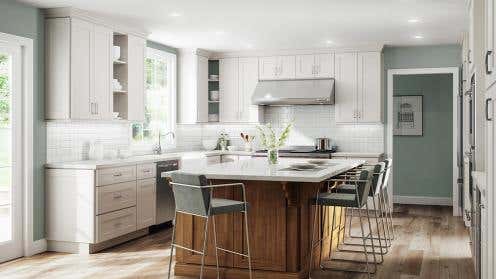
For reference, a standard Lily Ann base cabinet such as the Colorado White Shaker 30-inch base (WSH-B30) is listed at 30 inches wide, 24 inches deep and 34-1/2 inches high, with two doors, two drawers and one shelf. It showed In Stock on October 7, 2026. You can browse Colorado White Shaker base cabinets, or start wider with shaker kitchen cabinets and white kitchen cabinets. A new counter is also the easy moment to change the sink, and we do sell stainless steel kitchen sinks.
If you're setting cabinets yourself, our guide to installing kitchen cabinets covers leveling the bases, which every countertop depends on.
The Takeaway
Epoxy is a fair choice when the counter underneath is solid, you're comfortable with a tricky pour, and you can live without the kitchen for a week or more. A DIY kit runs about $100 to $350. A professional stone-look job runs about $50 to $150 per square foot, which is in the same range as new quartz or granite. Use trivets, check the food-contact statement, and expect to refresh the finish in time.
If the laminate is lifting, the board is swollen, or you want a different layout, skip the coating and replace the counter. And if the cabinets under it are tired too, start there.
Planning new cabinets? Get a free 3D kitchen design from Lily Ann Cabinets, or order free door samples to hold against the countertop you're considering.
Frequently Asked Questions
The main downsides are a difficult pour, a long cure and limited heat resistance. Bob Vila lists three: not every epoxy is food safe, epoxy is less durable than many other counter surfaces and may crack or turn brittle over time, and pouring it is hard for beginners. HomeGuide adds that quality varies between makers and that standard epoxy can yellow in UV light. It also only covers the old counter. It doesn't repair it.
HomeGuide's cost guide (updated November 29, 2023) puts professional epoxy countertops at $50 to $150 per square foot installed, or $1,500 to $6,000 for a kitchen with 30 to 40 square feet of counter. A DIY kit costs $100 to $350. Guides that price a thin rolled-on epoxy coating are far lower: Fixr lists $4 to $8 per square foot (January 2025) and Homewyse $6.50 to $12.68 (September 2026). Ask any installer which type of job the quote covers.
It depends on the pour and what is underneath. HomeGuide says epoxy countertops last 10 to 30 years with proper care. Bob Vila says refinished laminate countertops may need attention after about 5 years, while solid counters could last much longer. A dull surface can usually be revived with mineral oil or countertop polish, and worn epoxy can be recoated.
For everyday use, yes, if it was mixed and cured properly. Bob Vila says fully cured epoxy resists water, general wear, scratches and cracking, and Family Handyman's tester dragged heavy pots across a finished counter without damage. Its weak points are high heat, abrasive cleaners, bleach and, for standard formulas, yellowing in sunlight. Treat it more gently than stone.
Yes. Bob Vila calls it a popular way to revive tired laminate, and Family Handyman's project pours epoxy over an old laminate top. The laminate must be clean, sanded and firmly bonded. Seams and any exposed particleboard are filled first, sharp edges are rounded, and a primer goes on before the epoxy. Expect the counter to be out of use for at least a week.
It depends on how thick you pour. At a full 1/8 inch, 2 gallons covers about 25 square feet, because a gallon of mixed epoxy is 231 cubic inches (Bob Vila). Thinner coats go much further. Stone Coat Countertops suggests 3 ounces of mixed epoxy per square foot for simple finishes, which is about 85 square feet from 2 gallons, and 5 to 6 ounces for detailed ones, about 43 to 51 square feet. Check the coverage chart for your own kit.
An epoxy countertop is an existing counter coated with a two-part resin that hardens into a glossy, seamless surface. The resin and hardener are mixed, poured over laminate, wood, tile or concrete, and spread about 1/8 to 1/4 inch thick. Pigments and metallic powders are added to copy marble or granite. It's a refinishing method, not a new slab.
Cured epoxy is an inert plastic, but it isn't automatically rated for food contact. Bob Vila says many products state they comply with 21 CFR 175.300, the FDA rule for resinous and polymeric food-contact coatings, and that some are rated for limited contact only. Look for the maker's written statement, follow the mix and cure directions exactly, and use a cutting board. While the epoxy is wet, wear gloves and keep the room ventilated, as the label directs.
Only if you do it yourself. HomeGuide lists professional epoxy at $50 to $150 per square foot installed and quartz at $50 to $200, so the ranges overlap almost fully. A DIY kit at $100 to $350 is where the savings are. Quartz is a new slab with a factory finish, while epoxy is a coating over the counter you already have.










Comments