


A dual fuel range is one range with a gas cooktop on top and an electric oven below. You get flame burners for boiling and searing and an electric oven for baking. It needs two hookups: a gas line with a reachable shut-off valve, and a grounded 240-volt, four-prong outlet. An all-gas range needs only the gas line and a standard 120-volt outlet.
- What it is: a gas cooktop and an electric oven in one range.
- Who it suits: cooks who want a gas flame on top and bake often.
- Vs. a gas range: same burners; the oven is electric instead of gas, so it needs 240 volts instead of a 120-volt outlet.
- Hookups: a 3/4" gas supply line with a reachable shut-off valve, plus a grounded four-prong 240-volt outlet (NEMA 14-50P plug), per the Forno manual.
- Codes: the manual points to the National Electrical Code (NFPA 70) and National Fuel Gas Code (NFPA 54) where local code is silent.
- Cabinets: leave an opening equal to the range width and set it level with 36" counters.
- Lily Ann Cabinets listed 69 Forno dual fuel ranges from 30" to 60" on September 25, 2026, like the Marco 30" and Galiano 36" (both in stock).
Shopping for a range, you keep seeing the words "dual fuel." It sounds like a feature, but it's really a type of range, and it changes what your kitchen needs behind the stove. Before you pick one, it helps to know what it is, who it's right for, and what an installer will need.
This guide explains what a dual fuel range is, how it compares with an all-gas range, and what hookups and cabinet space it needs. Every spec below comes from the live Forno listings on our site and the Forno installation manuals linked on them, checked September 25, 2026.
What Is a Dual Fuel Range?
A dual fuel range is a single range with a gas cooktop on top and an electric oven below. You get flame burners for boiling, searing and simmering, and an electric oven for baking and roasting. Because it uses both fuels, it needs two hookups: a gas line and a 240-volt electrical outlet.
The name trips people up. "Dual fuel" is about the two energy sources, not about having two ovens. A range with two ovens is a double oven range, and some large dual fuel ranges have two ovens too.

How a Dual Fuel Range Works
On top, it's a gas range. Sealed burners run on natural gas or propane, and you control the flame with a knob. For example, the Forno Marco 30-inch dual fuel range lists 4 sealed burners with 37,000 BTU in total, from a 4,000 BTU simmer burner up to 15,000 BTU.
Below, it's an electric oven. Heating elements do the baking and broiling, and on convection models a fan and a third element move the heat around. The same Marco listing gives a 4.32 cu. ft. true convection oven with a 1,500-watt convection element and fan, and says it gives "fast, precise temperature control for consistent cooking."
It plugs into 240 volts. An all-gas range only needs a small 120-volt outlet for its igniters and light. A dual fuel range's electric oven needs a 240-volt circuit, the same kind an electric range uses.

Dual Fuel vs. Gas Range: What's the Difference?
Both have gas burners on top. The difference is the oven: a gas range bakes with a gas burner, and a dual fuel range bakes with electric elements. That means a dual fuel range needs a 240-volt circuit on top of the gas line, while a gas range only needs a standard 120-volt outlet.
Forno makes a Marco 30-inch in both versions, so here they are side by side, from the listings and manuals:
| Marco 30" gas range | Marco 30" dual fuel range | |
|---|---|---|
| Cooktop | Gas burners | Gas burners (4 sealed, 37,000 BTU total) |
| Oven | Gas, convection with a single fan | Electric, true convection |
| Oven size | 4.32 cu. ft. | 4.32 cu. ft. |
| Power | Grounded 120 volts on a 15 or 20 amp dedicated circuit | Grounded 240 volts; max connected load 3.6 kW |
| Plug | 3-prong (NEMA 5-15P) | 4-prong (NEMA 14-50P) |
| Gas hookup | 3/4" supply line to a 1/2" inlet | 3/4" supply line to a 1/2" inlet |
| Propane | Convertible, LP kit included | Convertible, LP kit included |
What does the electric oven change for cooking? Many cooks and appliance makers say an electric oven gives drier, steadier heat for baking, while a gas oven's heat is a little moister. That's a general rule, not something we've tested, and a good convection fan narrows the gap on either type. If you mostly cook on the burners and rarely bake, an all-gas range may be all you need.
Who Is a Dual Fuel Range Right For?
It's a good fit if:
- You want a gas flame for cooking and bake often (bread, cakes, cookies, roasts).
- Your kitchen already has a gas line and a 240-volt range outlet, or you're remodeling and can run both.
- You want a pro-style look with an electric oven.
Think twice if:
- You have no gas line. Running one adds work and cost. An all-electric or induction range gives you an electric oven without gas, like the Forno Torino 30-inch induction range.
- You have gas but no 240-volt circuit. An all-gas range only needs a 120-volt outlet.
- You rarely use the oven. You'd be paying for a feature you don't use. Compare the gas and dual fuel versions of the same model before you decide.

What a Dual Fuel Range Needs: 240 Volts and a Gas Line
This is the part to settle before you buy. Here's what the Forno Marco dual fuel manual calls for. Other models and brands will be similar, but always follow your own range's manual and local code.
Electrical
- A grounded 240-volt, 60 Hz supply with a four-prong grounding-type receptacle. The factory cord ends in a NEMA 14-50P plug.
- Grounding per local code or, where there isn't one, the National Electrical Code (ANSI/NFPA 70).
- If your old outlet is three-prong, the manual says to have it replaced with a grounded four-prong one.
- Max connected load: 3.6 kW for the Marco 30-inch. The Galiano dual fuel manual lists 3.6 kW for the 30-inch, 7.025 kW for the 36-inch and 7.2 kW for the 48-inch, so bigger ranges can draw much more.
Gas
- Installation per local code or, where there isn't one, the National Fuel Gas Code (ANSI Z223.1/NFPA 54).
- A 3/4-inch supply line to the range. Where local code allows, the manual recommends a certified 3-foot, 1/2-inch flexible metal connector to the range's 1/2-inch NPT inlet.
- An approved gas shut-off valve near the range, where you can reach it.
- The pressure regulator comes pre-installed, set for 5 inches water column on natural gas or 10 inches on propane.
- The range ships set up for natural gas, with propane nozzles included. The manual says a trained professional must do the conversion.
The manual also says the range should be installed and grounded by a qualified installer. If you're swapping an all-gas range for dual fuel, the gas is already there; the new part is usually the 240-volt circuit, so get an electrician's quote early.
Fitting a Dual Fuel Range Into Your Cabinets
- Leave the exact opening. The Marco manual lists the opening between cabinets as 30 inches for the 30-inch range and 36 inches for the 36-inch. If your cabinet widths leave a gap, a filler strip closes it.
- Match the counter height. The manual says the range can sit right beside 36-inch-high countertop cabinets, with legs you adjust so the cooktop lines up with the counter. The listings give the range: 35.5 to 36.5 inches on the Marco, 36 to 37 inches on the Galiano 36.
- Plan for depth. The Marco and Galiano listings give a 25-inch cutout depth and a 29-inch overall depth with the handle, so the front of the range sits forward of the cabinet faces.
- Keep the hookups in the recess. The manual shows a cavity at the lower back of the range for the outlet and gas connection, so it can sit flush to the wall. Keep the shut-off valve reachable.
- Size the hood to the burners. Only the gas burners count toward a hood's BTU sizing, since the oven is electric. See our range hood size guide and range hood height guide.
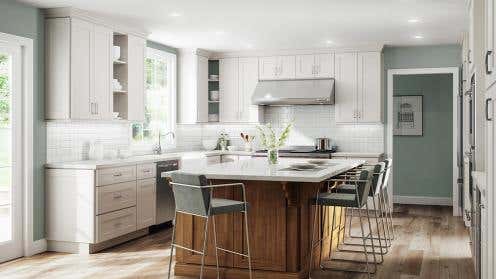
The cabinets on either side are usually standard base cabinets, such as a drawer base for pots and pans, in the same line as the rest of your kitchen, like our shaker cabinets.

Dual Fuel Ranges at Lily Ann
We sell Forno dual fuel ranges from 30 to 60 inches wide. On September 25, 2026 our freestanding range section listed 69 dual fuel models, and 62 of them showed In Stock. They sit in our gas and dual fuel ranges section. These showed In Stock that day:
| Model | Width | From the listing |
|---|---|---|
| Forno Marco 30" dual fuel | 30" | 4 burners, 4.32 cu. ft. true convection oven |
| Forno Massimo 30" dual fuel | 30" | 5 burners, 4.32 cu. ft. oven |
| Forno Galiano 30" French door dual fuel | 30" | 5 burners, 4.32 cu. ft. oven, French doors |
| Forno Massimo 30" dual fuel, white | 30" | White with brass handles, 4-prong plug |
| Forno Galiano 36" dual fuel | 36" | 6 burners, 5.36 cu. ft. oven |
| Forno Capriasca 36" dual fuel | 36" | 6 burners, 5.36 cu. ft. oven |
| Forno Capriasca 36" French door dual fuel, white | 36" | White with antique brass, 4-prong plug |
| Forno Galiano 48" dual fuel | 48" | 2 electric ovens |
| Forno Massimo 60" dual fuel | 60" | 2 electric ovens |
Every one we checked lists 240 volts and comes with an LP (propane) kit. Want to know more about the brand? Our Forno appliances review covers who makes Forno, the warranty and what owners report. If you'd rather split the cooktop and oven, see our cooktops, built-in ovens and wall oven cabinet guide.
Is a Dual Fuel Range Worth It?
It's worth it if you cook on gas and bake a lot, and your kitchen has, or can get, both a gas line and a 240-volt circuit. You get flame control on top and an electric oven below in one appliance. It's not worth it if you rarely bake, or if adding a gas line or a 240-volt circuit would be a big job. In those cases, an all-gas range or an electric or induction range is simpler.
The Takeaway
A dual fuel range pairs a gas cooktop with an electric oven. It suits cooks who want both, but it needs two hookups: a gas line with a reachable shut-off valve, and a grounded 240-volt, four-prong outlet. Leave an opening that matches its width, set it level with 36-inch counters, and size the hood to the burners.
Planning a kitchen around a new range? Get a free 3D design and we'll lay out the cabinets around it.
Frequently Asked Questions
A dual fuel range combines a gas cooktop with an electric oven in one appliance. The burners run on natural gas or propane, and the oven bakes and broils with electric elements. It needs both a gas line and a 240-volt electrical outlet. Lily Ann's Forno dual fuel ranges come in 30- to 60-inch widths.
The point is to get a gas flame on the cooktop and an electric oven in one range. Many cooks like gas for quick, visible control when boiling and searing, and electric heat for baking. If you want both and your kitchen can supply both fuels, a dual fuel range gives you that without a separate cooktop and wall oven.
It's better if you bake often and have a 240-volt circuit; an all-gas range is simpler if you don't. Both have gas burners, so cooktop cooking is the same. The difference is the oven: electric in a dual fuel range, gas in an all-gas range. A gas range also needs only a standard 120-volt outlet.
The main drawback is that it needs two hookups: a gas line and a 240-volt circuit. If your kitchen has only one, you'll need an electrician or a gas fitter before you install it. Larger dual fuel ranges can also draw a lot of power; Forno's Galiano manual lists 7.2 kW for the 48-inch. And if you rarely bake, you may not use the electric oven's advantages.
Yes. "220" is the older name people still use for a 240-volt outlet. Forno's dual fuel manual calls for a grounded 240-volt, four-prong receptacle, and the range's cord ends in a NEMA 14-50P plug. If you only have a three-prong range outlet, the manual says to have it replaced with a grounded four-prong one.
Look for gas burners on top and electric elements inside the oven, often a coil at the top for broiling. Then check behind the range: a dual fuel range has both a gas connection and a thick four-prong 240-volt plug, while an all-gas range has a gas line and a small three-prong plug. The model number, listed inside the range, will confirm it in the manual.
A dual oven (double oven) range is a different thing from dual fuel, though some are both. Two ovens are worth it if you often cook two dishes at different temperatures, like a roast and a dessert. They usually come on wider ranges; Lily Ann's Forno Galiano 48-inch and Massimo 60-inch dual fuel ranges each list two electric ovens. On a 30-inch range, one larger oven is the norm.
The best one is the one that fits your opening, your hookups and how you cook. Compare the width, burner count and BTUs, oven size, the power it draws, and the warranty. Also compare the gas-only version of the same model, since you only need dual fuel if the electric oven matters to you. For Forno models, our Forno appliances review covers the warranty and what owners report.










Comments