


A dishwasher air gap is a small fitting on the sink deck or countertop that puts an open break of air in the dishwasher's drain line, so dirty water from the sink or disposer can't flow back into the dishwasher. Whether you need one depends on your local plumbing code. The Uniform Plumbing Code requires an air gap fitting, while the International Plumbing Code and International Residential Code also accept a high loop, where the drain hose is fastened up under the counter. Rules vary by state and city, so check with your building department.
- What it is: a small fitting by the faucet that breaks the dishwasher drain line with open air, so drain water can't flow back into the dishwasher.
- Code, short version: the Uniform Plumbing Code (807.3) requires an air gap fitting. The IPC (802.1.6) accepts an air gap or a high loop. The IRC (P2717.2) asks for a high loop.
- It varies by state: California's code keeps the air gap rule. Minnesota, also UPC-based, changed it to allow a high loop. Always ask your building department.
- Air gap vs. high loop: the air gap protects better and shows you a clog, but needs a hole in the counter. The high loop is hidden and needs no hole.
- The hole: one maker's install sheet calls for a 1-3/8 inch hole in the sink deck or countertop. Tell your fabricator before the counter is cut.
- The cabinet: the hoses run in the top of the sink base, behind the false drawer fronts. Check that tip-out trays and pull-outs clear them.
- Lily Ann Cabinets: we sell the sink base cabinets, sinks and dishwashers around it, not air gaps or plumbing parts.
You're planning a kitchen, and someone asks, "Do you want an air gap hole in the countertop?" It's a small part, but the answer has to come before the countertop is cut. It also depends on your local plumbing code.
This guide explains what a dishwasher air gap is, what the plumbing codes actually say, how it compares with a high loop, and where the hole and the hoses go in your countertop and sink base cabinet. Lily Ann Cabinets sells the sink base cabinets, not air gaps or plumbing parts, so there is nothing here to sell you on. Code text was read on a public code site on October 5, 2026.
What Is a Dishwasher Air Gap?
A dishwasher air gap is a small fitting, usually a short metal cylinder, that sits on the sink deck or countertop next to the faucet. It puts an open break of air in the dishwasher's drain line, so dirty water from the sink or disposer can't flow back into the dishwasher.
Here is how it works:
- The dishwasher pumps its dirty water up a hose to the air gap, above the counter.
- Inside the cap, the water crosses a small open space. That space is the "air gap."
- The water drops into a second, larger hose and runs down by gravity to the garbage disposer or the sink drain.
Because the two hoses are not joined, water can't be pulled or pushed backward from the drain into the dishwasher. If the drain side clogs, the water spills out of the cap into the sink, where you can see it. That spill is the warning, not a failure.
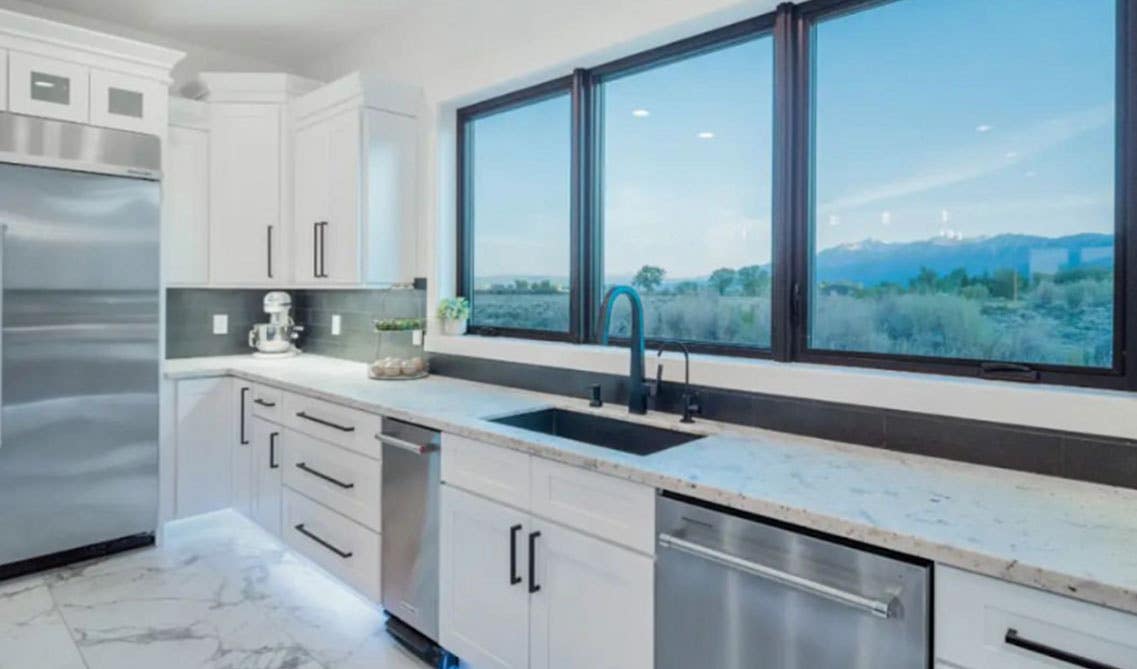
Fittings like a soap dispenser or an air gap sit through their own hole in the countertop, behind or beside the sink.
Is a Dishwasher Air Gap Required by Code?
It depends on which plumbing code your state or city uses, and on how they changed it. The Uniform Plumbing Code requires an air gap fitting. The International codes also accept a high loop. Requirements vary by state and local code, so confirm with your building department.
The United States has no single plumbing code. Most places start from one of the model codes below and then adopt it with their own changes. Here is what each model code says, word for word, as published on UpCodes.
| Model code | What the text says | What it means |
|---|---|---|
| Uniform Plumbing Code (UPC), Section 807.3 | "No domestic dishwashing machine shall be directly connected to a drainage system or food waste disposer without the use of an approved dishwasher air gap fitting on the discharge side of the dishwashing machine." (807.3, Hawaii Plumbing Code 2021, a UPC adoption) | Air gap required. A high loop alone doesn't meet this text. |
| International Plumbing Code (IPC), Section 802.1.6 (2015 edition) | The waste line "shall connect to a deck-mounted air gap or the waste line shall rise and be securely fastened to the underside of the sink rim or counter." (802.1.6, Alabama Plumbing Code 2015, an IPC adoption) | Air gap or high loop. Either one is allowed. |
| International Residential Code (IRC), Section P2717.2 | "The dishwasher discharge pipe or tubing shall rise to the underside of the counter and be fastened or otherwise held in that position before connecting to the head of the food-waste disposer or to a wye fitting in the sink tailpiece." (P2717.2, 2018 IRC as adopted in Texas) | High loop required. No air gap fitting is named. |
Newer editions keep the same idea. The 2024 IRC wording says the dishwasher waste line "shall rise and be securely fastened to the underside of the sink rim or countertop" (P2717.2, 2024 IRC as adopted).
The UPC adds one more rule that matters for where the fitting sits: "Listed air gaps shall be installed with the flood-level (FL) marking at or above the flood level of the sink or drainboard, whichever is higher." In plain words, the air gap goes above the rim of the sink, not under the counter.
It varies by state: two examples
Both of these states base their plumbing code on the UPC, and they landed in different places.
- California: air gap. The 2022 California Plumbing Code adopts the UPC, and its Section 807.3 keeps the air gap sentence quoted above.
- Minnesota: air gap or high loop. Minnesota changed the same section. Its rule says no dishwasher shall connect "without the use of an approved dishwasher air gap fitting on the discharge side of the dishwashing machine or run the discharge line as high as possible under the countertop, securely fastened" (Minnesota Rules 4714.0807).
That is why a list of "states that require an air gap" can be wrong. Several pages that rank for this topic list Minnesota as an air gap state. The state's own rule text allows the high loop. Cities and counties can add their own changes too.
How to find your rule
Call or email your city or county building department and ask three things:
- Which plumbing code and edition do you enforce?
- Did you change the dishwasher drain section?
- For a new dishwasher, do you want an air gap fitting, or is a high loop accepted?
If your kitchen remodel has a permit, the plumbing inspector's answer is the one that counts.
Dishwasher Air Gap vs. High Loop
An air gap is a fitting above the counter that breaks the drain line with open air. A high loop is just the drain hose itself, run up to the underside of the counter and fastened there before it drops to the drain. The air gap gives stronger protection. The high loop is hidden and needs no hole.
| Air gap | High loop | |
|---|---|---|
| What it is | A fitting on the sink deck or countertop | The drain hose, looped up and fastened under the counter |
| How it protects | An open break of air between two hoses | Height: the hose rises above the drain connection |
| Hole in the counter or sink | Yes | No |
| Can you see it? | Yes, a small cap by the faucet | No, it is inside the sink base |
| If the drain clogs | Water spills from the cap into the sink | No sign above the counter |
| Upkeep | Clear food bits from the cap now and then | Check that the hose is still fastened up high |
| Model codes that accept it | UPC, IPC | IPC, IRC (and some amended UPC states, such as Minnesota) |
How high is "high"? The codes say the hose must rise to the underside of the counter or sink rim. They don't give a number. KitchenAid's dishwasher help page says the drain loop should be at least 20 inches above the floor and adds, "If under 20", make sure to use an air gap." Check your own dishwasher's install manual for its figure.
A factory loop may not be enough. Some dishwashers ship with the hose already clipped in a loop on the side of the machine. The code text still asks for the hose to rise to the underside of the counter, so ask your inspector whether the factory loop counts.
You need one or the other. A drain hose that runs flat along the cabinet floor to the disposer has no protection at all.
Where the Air Gap Goes: Countertop, Sink Deck and Sink Base
An air gap needs two things from your kitchen: a hole in the sink deck or countertop, and a clear path for two hoses inside the sink base cabinet. Decide both before the countertop is measured.
The hole: sink deck or countertop
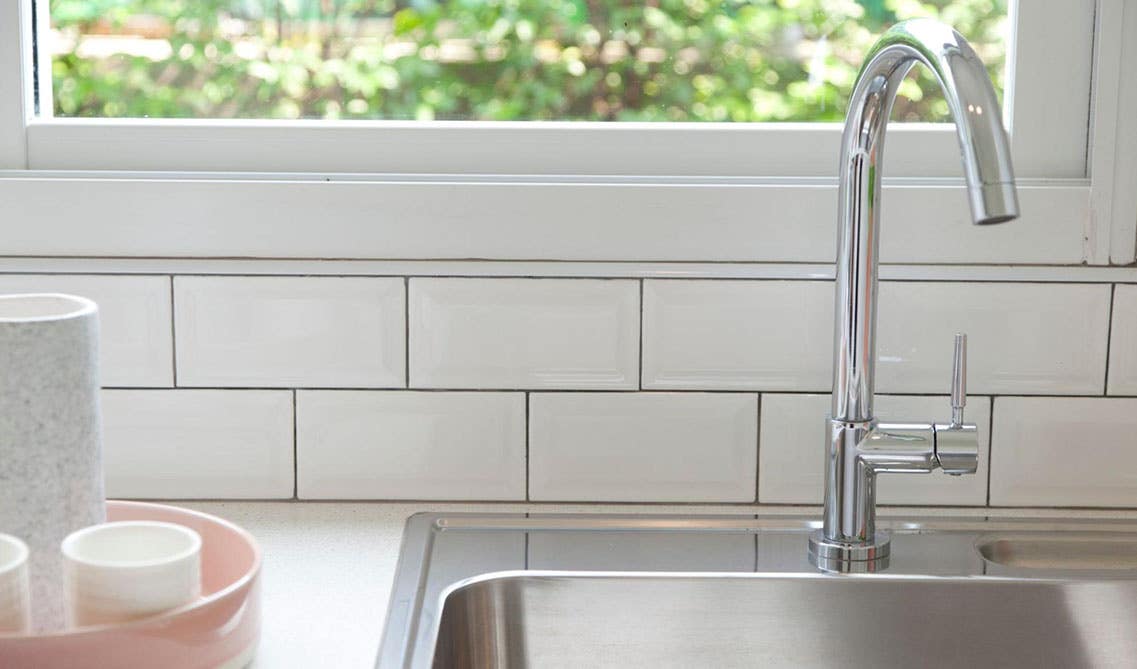
Where the hole goes depends on your sink.
- Drop-in sinks have a flat deck behind the bowl, often with spare punched holes. The air gap can use one of them.
- Undermount and farmhouse sinks have no deck, so the hole is drilled through the countertop. Lily Ann's F002HK2 stainless steel sink is listed as an undermount, for example.
How big is the hole? One maker, Air Gap International, says in its install sheet that its fitting "requires a 1-3/8 inch hole in the sink or countertop." Other brands can differ, so give your fabricator the install sheet for the exact air gap you bought.
A few planning tips:
- Tell the countertop fabricator early. Stone and quartz holes are drilled in the shop or by the installer. Adding one after the counters are in is harder, and Mr. Appliance's guide says to hire a professional for granite or marble.
- Keep it next to the sink. If the drain clogs, the cap spills. You want that water to land in the sink, not on the counter.
- Count every hole. Faucet, sprayer, soap dispenser, filtered-water tap and air gap each need one. Our kitchen sink sizes guide and undermount vs. drop-in comparison help you pick the sink first.
- No air gap needed in your area? Then skip the hole. A hole you don't need has to be capped.
Routing the hoses inside the sink base

Lily Ann Cabinets: Navy Blue Shaker Sink Base Cabinet 36"
Under the counter, an air gap has two hose connections. The same Air Gap International sheet describes them:
- A 5/8-inch hose runs from the dishwasher up to the air gap's inlet.
- A 7/8-inch hose runs from the air gap's outlet down to the garbage disposer or the sink drain. The sheet's diagram says to "avoid any low spot" in this hose, so water can't sit in it.
All of this happens in the top of the sink base cabinet, behind the false drawer fronts. A Lily Ann 36-inch sink base is 36 inches wide, 34-1/2 inches high and 24 inches deep, with two doors and two false drawer fronts and no drawers or shelf in the way (Navy Blue Shaker SB36 listing, checked October 5, 2026). That open box is what makes room for the sink bowl, the disposer, the trap and the dishwasher hoses.
What to check in the cabinet:
- The side the dishwasher is on. The drain hose comes through the side panel of the sink base from the dishwasher next door. Follow your dishwasher's manual for the hole size and place, and cut it after the cabinets are set.
- Tip-out trays. A sink front tip-out tray kit uses the same space behind the false fronts. Make sure the tray clears the air gap body and both hoses. Our tip-out tray guide shows how the trays mount.
- Pull-outs and caddies. An under-sink pull-out needs a clear floor and a clear path. Hoses should be fastened up high, out of its way.
- The drain height in the wall. The hose from the air gap has to run downhill to the disposer or drain. Our kitchen sink drain height guide covers the rough-in.
- A high loop needs a fastening point. If your area accepts a high loop, the hose is strapped to the underside of the counter or high on the cabinet wall. Plan where that strap goes.
Lily Ann sells sink bases in each cabinet line. These were in stock on October 5, 2026:
- Colorado White Shaker Sink Base Cabinet 36"
- Navy Blue Shaker Sink Base Cabinet 36"
- Grey Shaker Elite Sink Base Cabinet 36"
- Colorado White Shaker Farm Sink Base Cabinet 36", for an apron-front sink. See our farmhouse sink base guide.
- Colorado White Shaker Diagonal Corner Sink Base Cabinet 36", for a corner sink.
If the dishwasher sits at the end of a cabinet run, it also needs a finished panel beside it. Our guide to refrigerator and dishwasher panels explains which one.
Common Air Gap Problems and Fixes
The usual problem is water coming out of the air gap cap while the dishwasher drains. That almost always means a clog, either in the air gap or in the hose between the air gap and the disposer.
Air Gap International's install sheet says an air gap "may become clogged with leftover food debris escaping the dishwasher filter." Its cleaning steps are short:
- Pull off the decorative cap.
- Take off the inner top cover.
- Remove any trapped food bits.
- Snap the cover and the cap back on.
Two more things to check:
- The hose to the disposer. Look for a kink, a clog or a low spot where water sits.
- A new garbage disposer. The same sheet warns: "Remove the garbage disposal knock-out plug if still present." A new disposer has a plug inside its dishwasher inlet. If nobody removed it, the dishwasher can't drain. Turn off power to the disposer before you reach inside.
If the water still backs up after cleaning, call a plumber or an appliance repair service.
Checklist Before the Countertop Is Measured
- Ask the building department: air gap, or high loop?
- Pick the sink: drop-in with a deck, or undermount.
- If you need an air gap, buy it and give its install sheet to the fabricator.
- Count the holes: faucet, sprayer, soap, filtered water, air gap.
- Decide which side of the sink the dishwasher goes on.
- Check that tip-out trays and pull-outs clear the hoses.
- Confirm the drain in the wall is low enough for the hose to run downhill.
Sources
- 807.3 Domestic Dishwashing Machine, Hawaii Plumbing Code 2021 (UPC) (UpCodes)
- 802.1.6 Domestic Dishwashing Machines, Alabama Plumbing Code 2015 (IPC) (UpCodes)
- IRC P2717.2, Sink and Dishwasher, 2018 and IRC Section P2717, Dishwashing Machines, 2024 (UpCodes)
- California Plumbing Code 2022, Chapter 8 (UpCodes)
- Minnesota Rules, part 4714.0807 (Minnesota Office of the Revisor of Statutes)
- Air Gap International, AG300 single dishwasher air gap installation instructions (hole size, hose sizes, cleaning steps)
- KitchenAid Product Help, "Checking the Drain Loop Height" (20-inch loop height)
- Mr. Appliance, "What Is a Dishwasher Air Gap and Do You Need One?" (drilling stone counters)
The Takeaway
A dishwasher air gap is a small fitting with a simple job: keep dirty drain water out of your clean dishes. Whether you need one depends on your local code. UPC areas such as California require it, IPC and IRC areas usually accept a high loop, and some states have changed the rule. Ask your building department before the countertop is cut, because the air gap needs its own hole.
Lily Ann Cabinets sells the base cabinets, kitchen sinks and dishwashers around it. We don't sell air gap fittings, hoses or other plumbing parts. Planning a kitchen? Get a free 3D design and we'll place the sink base and dishwasher for you.
Frequently Asked Questions
You need either an air gap or a high loop, and your local code decides which. The Uniform Plumbing Code (Section 807.3) requires an approved air gap fitting. The International Plumbing Code and International Residential Code accept a drain hose that rises to the underside of the counter and is fastened there. Ask your building department which rule applies to you.
Yes. California's plumbing code is based on the Uniform Plumbing Code, and Section 807.3 of the 2022 California Plumbing Code says no domestic dishwashing machine shall be directly connected to a drainage system or food waste disposer without an approved dishwasher air gap fitting. Cities can add their own rules, so confirm with your local building department.
There is no reliable short list, because it depends on which model code a state uses and how the state changed it. States on the Uniform Plumbing Code start from an air gap rule, and California keeps it. Minnesota also uses the UPC but changed the section to allow running the hose as high as possible under the countertop. States on the International codes generally accept a high loop. Check with your building department.
Yes, the high loop. The dishwasher's drain hose is run up to the underside of the countertop and fastened there before it drops to the disposer or sink drain. The International Residential Code and International Plumbing Code accept it. The Uniform Plumbing Code does not, unless your state changed that section, so check locally before you skip the air gap.
Ask your city or county building department which plumbing code it enforces and whether a high loop is accepted for dishwashers. If the answer is the Uniform Plumbing Code with no local change, you need an air gap fitting. Also read your dishwasher's manual. KitchenAid, for example, says to use an air gap if the drain loop would be under 20 inches above the floor.
If the drain hose has a proper high loop and your code accepts that, nothing bad happens. If it has neither an air gap nor a high loop, dirty water from the sink or disposer can flow back into the dishwasher. In an area that requires an air gap, a missing one can also fail a plumbing inspection.
The main sign is water spilling out of the air gap cap into the sink or onto the counter while the dishwasher drains. A dishwasher that drains slowly or leaves water in the bottom is another. If the dishwasher also smells or has a film inside, clean the filter and run a cleaning cycle first: see how to clean a dishwasher with vinegar and baking soda. In most cases the air gap isn't broken. It is clogged with food bits, or the hose from the air gap to the disposer is blocked.
Clean it first. Pull off the decorative cap, remove the inner cover and clear out any trapped food. Then check the hose that runs from the air gap to the garbage disposer for clogs, kinks or low spots. If the disposer is new, make sure the knock-out plug inside its dishwasher inlet was removed. If water still backs up, call a plumber.
Only if your local code accepts a high loop instead. In that case the drain hose is rerouted up to the underside of the counter and fastened, and the old hole is capped or reused for something like a soap dispenser. Where the code requires an air gap fitting, as in California, removing it breaks the code. Check with your building department first.
















Comments