


Usually not. Vanity cabinets are sold in fixed widths — commonly 24, 27, 30, 33, 36 and 42 inches for sink bases — and the gaps between them are filled with a drawer base or a filler strip rather than a custom-width box. That combination reaches almost any wall opening. Genuine custom is worth paying for in three situations: a non-rectangular wall, a fixed obstruction like a window or radiator the cabinet has to work around, or a depth or height that differs from standard. If none of those apply, a stock combination gets the same finished look at a fraction of the cost and lead time.
- Fixed widths plus a filler cover most "custom" requests. A 36" sink base beside an 18" drawer base with a 2" filler is a 56" run — assembled from stock parts, no shop drawings.
- Custom earns its cost in three cases: a wall that isn't square, an obstruction the cabinet must work around, or a non-standard depth or height. Width alone almost never justifies it.
- "Custom" and "semi-custom" are not the same product. Semi-custom means stock boxes with expanded finish and configuration choices. Full custom means a shop builds to your drawing. The price gap between them is much larger than the visible difference.
- Nobody can quote you a real figure from a web page. Cost is driven by construction, finish, top material and whether plumbing moves — a published average that ignores all four is not a quote.
- Buying beats building for most people. Shop-built is cheaper in materials and more expensive in tools, finishing space and time. If you'd be buying a table saw for the job, you're not saving money.
- Lily Ann builds vanities in 25 finish lines matching the kitchen programs, in sink bases from 24" to 42" plus drawer bases from 12" and 18"/24" linen cabinets — the stock range that removes most reasons to go custom.
What People Usually Mean by "Custom"
Three different products get called a custom bathroom vanity, and they cost very different amounts. Stock means fixed sizes and a set finish list. Semi-custom means the same stock boxes with a much wider choice of finishes, door styles, interior fittings and modifications. Full custom means a cabinet shop builds a one-off box to your dimensions from a drawing.
Most people asking for a custom vanity actually want one of the first two. They have a specific width in mind, or a finish they cannot find, or a drawer configuration a display model did not have. All three of those are semi-custom problems, and semi-custom is a fraction of the cost of a shop build.
The tell is in how the requirement is phrased. "I need it to be 54 inches" is a stock-plus-filler problem. "I need it to be 54 inches, 19 inches deep, and to notch around a soil pipe in the back-left corner" is a genuine custom problem.

The Arithmetic That Removes Most Custom Requests
Vanity cabinets come in fixed widths and are designed to be combined. Lily Ann's sink bases are 24, 27, 30, 33, 36 and 42 inches; drawer bases add 12, 15, 18, 21, 24 and 30 inches; filler strips are cut on site to take up whatever is left. Between those three you can land within an inch of almost any wall opening.
Worked examples, using real stock modules:
| Wall opening | Stock combination | Filler needed |
|---|---|---|
| 38" | 36" sink base | 2", split as 1" each side |
| 48" | 36" sink base + 12" drawer base | none |
| 54" | 36" sink base + 18" drawer base | none |
| 56" | 36" sink base + 18" drawer base | 2" |
| 60" | 42" sink base + 18" drawer base | none |
| 63" | 36" sink base + 24" drawer base | 3" |
| 72" (double) | two 36" sink bases | none |
Fillers are the piece most people have not heard of. They are strips of matching finished material, supplied in the same line as the cabinet, cut to width on site and used to take up the slack between a cabinet and a wall. They also solve the problem of a drawer that cannot open because it is too close to a corner — you push the cabinet away from the wall with a filler and the drawer clears.
Once you have seen that table, the useful question stops being "can I get a custom width?" and becomes "is my problem actually width?"
The Three Cases Where Custom Is Genuinely Worth It
Custom earns its cost when the room forces a dimension or a shape that no combination of stock modules can reach. In practice that comes down to three situations: a wall that is not square, a fixed obstruction the cabinet must accommodate, and a depth or height outside the standard.
1. The wall is not square, or the room is not rectangular
An angled wall, a chamfered corner, a bay, or a run that has to die into a slope under a staircase. Stock cabinets are rectangular prisms; fillers can hide a small deviation but not an angle. Measure your opening at the back wall, the middle and the front edge — if those three numbers differ by more than about half an inch, you are in this case.
2. Something fixed is in the way
A soil stack in the corner, a radiator, a window that comes down below counter height, a low sill, a structural post. Any of these means the cabinet has to be notched, shortened or built around, and that is shop work. Note that a plumbing stub-out in a normal position is not this case — sink bases have open backs precisely to clear them.
3. Standard depth or height does not work
A narrow hallway bathroom where a full-depth vanity blocks the door. A room where the vanity has to be taller or shorter than standard for a specific reason. Depth in particular is where stock runs out, because there is far less variation in depth than in width across manufacturers.
If none of these three describe your room, the honest answer is that custom is buying you a longer lead time and a larger invoice for a result a stock combination would have matched.

What Actually Drives the Cost
There is no meaningful single price for a custom bathroom vanity, because four independent variables move the number and a published national average holds none of them constant. Ranked by how much they swing the total: whether plumbing moves, the countertop material, the box and drawer construction, and the finish.
We do not publish a cost range for custom cabinetry, and you should be sceptical of any page that does without saying what it is holding constant. What we can give you is the list of things to ask about when you get a real quote, in the order they matter:
- Does the plumbing move? This is the biggest single swing and it has nothing to do with the cabinet. Relocating a drain means opening a wall or a floor. A vanity that fits the existing stub-outs is a fundamentally cheaper project than one that does not.
- What is the top, and who is templating it? Stone tops are usually measured, cut and installed by the fabricator as a separate trade with its own minimum charge. A cultured-marble or laminate top is a fraction of that and arrives with the cabinet.
- How is the box built? Plywood carcass versus particleboard, solid hardwood face frame versus none, dovetailed drawer boxes versus stapled, soft-close hardware versus basic. These are the specifications that decide whether the vanity is still tight in fifteen years, and they are also where quotes quietly differ.
- What finish, and is it a stock colour? A stock finish is already in production. A matched or specified colour means a separate finishing run, and that is priced accordingly.
Ask a supplier those four questions and two quotes become comparable. Without them, a lower number usually just means a thinner box.
For the kitchen-side version of the same reasoning, see how much kitchen cabinets cost per linear foot, which walks through the same variables at a larger scale.
Buying Versus Building It Yourself
Building a vanity yourself is cheaper in materials and more expensive in everything else. The materials for a simple plywood vanity carcass are modest. The table saw, the edge banding, the hinges and slides, the finishing space and the twenty-plus hours are not.
The honest split:
- Build it if you already own the tools, you have somewhere dust-free to finish doors, you want an unusual shape anyway, and you value the making. This is a real and good reason.
- Buy it if you would be acquiring tools for this one job, you need it done inside a weekend, or the finish quality matters to you. A factory finish on a door is sprayed and cured under conditions a garage cannot reproduce.
There is a middle path that gets overlooked: buy the cabinet, do the install. A ready-to-assemble vanity arrives flat, assembles in under an hour and installs in a day, which captures most of the labour saving without the finishing problem. We cover that route in detail in RTA bathroom vanity: sizes, install time and what it really takes.
How to Get a Custom Look From Stock Cabinets
Most of what reads as "custom" in a finished bathroom is not the box — it is the top, the hardware, the configuration and the finish. All four are available on stock cabinets, and choosing them deliberately is what separates a vanity that looks specified from one that looks bought.
- Configure rather than accept. A sink base flanked by two drawer bases stores far more usefully than one wide sink base with doors, and costs about the same. Add an 18" linen cabinet at one end if the ceiling allows — vertical storage is the thing every bathroom lacks.
- Spend on the top. The countertop is at eye level and gets touched every day. It carries more of the perceived quality than the cabinet under it. Our guide to vanity top materials covers what each surface actually costs you in maintenance.
- Change the hardware. The knobs and pulls supplied with any cabinet are a default, not a recommendation. Swapping them is the highest-impact, lowest-cost change available, and it is what makes a shaker door read as modern or traditional.
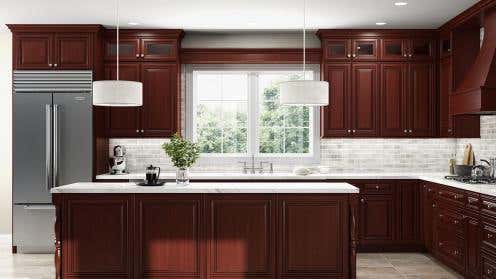
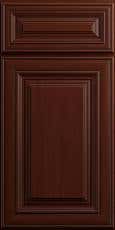
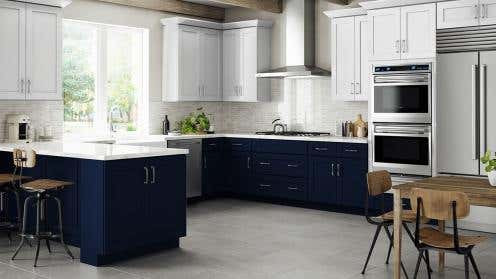
- Pick a finish with intent. A dark or coloured vanity in a small bathroom is a low-risk bet, because the surface area is small enough that a bold choice never overwhelms the room. Navy Blue Shaker, Shaker Espresso and Craftsman Black Shaker all do this. On the warm side, York Saddle, Charleston Cherry and Hickory Shaker read as furniture rather than fixture.
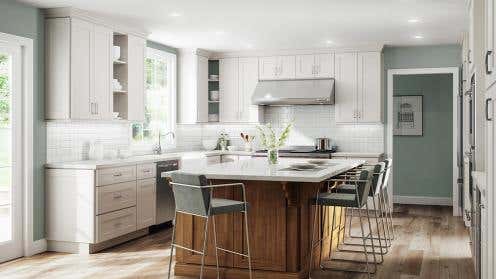
- Match the kitchen if the rooms are visible from each other. Because the vanity lines and the kitchen lines are the same door programs, that is a specification choice rather than a lucky match.
Do those four things and the finished room is indistinguishable from a shop build to anyone who is not measuring it.

The Questions to Ask Before You Commit
Whichever route you take, these five answers decide whether the project goes well:
- Where exactly are the stub-outs? Distance from the left edge of the opening to the drain centre, and heights off the finished floor for the drain and both supply valves.
- Is the opening the same width at the back, the middle and the front? If not, by how much.
- What does the door swing hit? Both the room door and the vanity doors and drawers.
- Is the top included, and is its width the same number as the cabinet's? It usually is not — tops overhang.
- What is the lead time, and what happens if a panel arrives damaged? On a stock line the answer is a replacement part in days. On a shop build it is a re-run.
If you want a broader walk-through of the choosing process itself, our guide to choosing the perfect bathroom vanity covers layout, style and storage in more depth than this page does — this one is specifically about the custom decision.
To see the stock range this page keeps referring to, browse bathroom vanities or the wider bathroom products range.









Comments