


Usually not. Concrete countertops cost about $65 to $135 per square foot installed, according to Concrete Network, while basic granite starts around $40 and runs up to about $175. The Spruce puts full-service concrete at $135 or more. Most of concrete's cost is skilled labor: each counter is cast, reinforced, polished and sealed by trained technicians.
- Cost: about $65–$135 per sq. ft. installed (Concrete Network), $135+ for full service (The Spruce).
- vs. granite: usually not cheaper; basic granite starts around $40 per sq. ft.
- Why it costs that much: the material is cheap, the hand-casting, reinforcing and polishing aren't.
- Cracks: a few hairline cracks are normal; large ones usually mean uneven cabinets underneath.
- Upkeep: seal it, then wax every 9–12 months; use trivets unless the sealer is heat-rated.
- Weight: about 19–25 lb per sq. ft., so your base cabinets must be level and strong enough first.
- Lily Ann Cabinets sends free door samples so you can hold lines like Craftsman Black Shaker or Craftsman Natural Shaker against a concrete sample.
Concrete countertops look like they should be cheap. They're made from the same stuff as a sidewalk, after all. In a kitchen they're not. A concrete counter is cast, reinforced, ground, polished and sealed by trained technicians, and that labor puts it in the same price range as granite and quartz, often higher.
This guide is for buyers, not DIYers. It covers what concrete countertops cost and why, how they compare with granite, the real downsides (cracking, staining and sealing), what your base cabinets need before the concrete goes on, and which cabinet styles suit the look. Every number comes from a named source, linked where it's used.
Concrete vs. Granite Countertops at a Glance
| Concrete | Granite | |
|---|---|---|
| What it is | Cement mix cast in a mold, reinforced with fiber or metal mesh, then sealed | Natural stone quarried and cut into slabs |
| Installed cost per sq. ft. | $65–$135 (Concrete Network); $135+ full service (The Spruce) | $40–$175 (Concrete Network) |
| Heat | Concrete is heat resistant, but the sealer can discolor | Heat resistant |
| Needs sealing | Yes, plus wax every 9–12 months | Yes |
| Seams | Large counters have seams, hidden with a color-matched filler | Long runs may need several pieces, so seams show |
| Shape and color | Almost any color, shape, edge or inlay | Many natural colors, cut from slabs rather than cast |
Sources: cost, heat, sealing, seams and shape from Concrete Network's countertop comparison; full-service cost and the wax schedule from The Spruce. Each row is explained below.
What Are Concrete Countertops?
A concrete countertop is a slab of cement-based mix that is cast in a mold, reinforced with fiber or metal mesh, cured, ground to a finish and sealed. Most are made in a shop and delivered as finished pieces; some are poured in place on top of the cabinets. A typical slab is 1-1/2 to 2 inches thick.
According to The Spruce, shop-made (precast) counters are the more common route: a technician measures your kitchen, the counters are poured with the sink cutouts already in them, and the finished slabs are installed once they've cured. Concrete takes several days to cure, so plan for a gap between demolition and a usable kitchen. Thicker-looking counters are usually a 1-1/2-inch slab with a deeper drop edge, not a solid block.
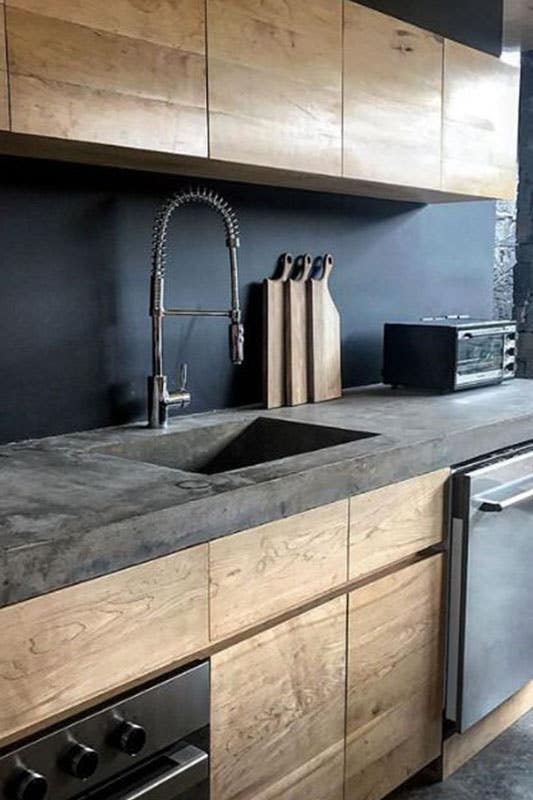
Because it starts as a liquid, concrete can be tinted almost any color, from light gray to black, navy or terracotta. It can be acid-stained, polished to a gloss or left matte, and set with glass, stones or shells. For how it compares with other surfaces, see our guide to kitchen countertop materials.
How Much Do Concrete Countertops Cost?
Installed concrete countertops cost about $65 to $135 per square foot for a standard 1-1/2-inch-thick counter, according to Concrete Network. The Spruce says to expect $135 per square foot or more for full-service fabrication and installation, and Homewyse's national estimate for September 2026 starts at $127 to $181 per square foot.
The ranges don't agree because they measure different things, but they all point the same way: this is a premium surface. The materials are inexpensive. The labor isn't. Concrete Network calls concrete counters "an artisan product" with higher labor costs. Things that push the price up:
- Add-ons. Houzz's cost guide lists integrated sinks and backsplashes, embedded items, color, curves and pours thicker than the usual 1-1/2 inches as extras that raise the price. It puts a typical project at $5,000 to $10,000, or $70 to $130 per square foot.
- Reinforcing cabinets and floors. The Spruce warns that installers sometimes have to strengthen the cabinets, and even the floor, to carry the weight, which can raise the cost "significantly."
- Where you live. Labor rates vary by area, which is why Homewyse adjusts its estimate by location.
Homewyse's figure is for basic mid-range work in easy site conditions, and it notes you should add 13 to 22 percent if a general contractor supervises the job. Treat these ranges as starting points for a quote, not a price.
Sources: Concrete Network, The Spruce, Homewyse (September 2026 estimate) and Houzz's concrete countertop cost guide, all checked October 2, 2026.
Is Concrete Cheaper Than Granite?
Usually not. Concrete Network, a concrete-industry site, says plainly that concrete countertops are generally not cheaper than granite: concrete starts at about $65 per square foot, while basic granite can be as low as $40. High-end granite can cost more than concrete, so the overlap is wide.
Concrete Network's chart puts granite at $40 to $175 per square foot and concrete at $65 to $135. In other words, budget granite beats concrete on price, but a rare or exotic granite slab can cost more than a mid-range concrete counter. If cost is the deciding factor, get a quote for both on the same layout. For granite's own care and pricing, see quartz vs. granite countertops.
Pros of Concrete Countertops
- Custom everything. Concrete can be cast to the exact size of your kitchen, in almost any color, shape and edge. The Spruce says only ceramic tile comes close to the same range of choices.
- Fewer visible seams. Concrete Network notes that large counters still have seams, but a color-matched filler keeps them from standing out.
- Integrated sinks and drainboards. A sink can be cast as one piece with the counter, because concrete can be cast in almost any shape.
- Heat and scratch resistance. The concrete itself handles heat well and, per The Spruce, resists scratches far better than laminate or solid surface.
- Character that grows. Concrete Network says concrete develops a warm patina over time. If you like a lived-in look, that's a plus.
- Resale in the right house. The Spruce calls it a premium material, on par with quartz or natural stone, that can help resale value in a home where the style fits.
Cons of Concrete Countertops
- Cost. As above, it's rarely the budget choice.
- It's porous. Unsealed concrete stains easily. Its protection is only as good as its sealer.
- Ongoing upkeep. The Spruce says concrete needs resealing at least once a year.
- Weight. At roughly 19 to 25 pounds per square foot, it can strain cabinet frames and floors.
- Hairline cracks. They're common and usually cosmetic, but they're there.
- Hard to repair yourself. Major repairs generally need a pro.
The stone industry is blunter. The Natural Stone Institute calls concrete counters a short-lived trend from the early 2000s and says they can stain easily even with sealer. For an industrial look in stone, it suggests granite with a brushed or water-washed finish instead. Keep in mind who is speaking: that's a stone trade group, just as Concrete Network is a concrete one.
Do Concrete Countertops Crack?
Most concrete countertops develop a few hairline cracks over time, because concrete shrinks slightly as it dries. These are normal and mostly cosmetic. Large cracks are different: The Spruce says they're usually caused by poor installation, such as setting the counter on cabinets that aren't level.
Many owners like the hairline cracks and see them as character, the same way a butcher block counter picks up marks. A large crack can be filled, but The Spruce warns it will likely come back if the cause underneath isn't fixed. That puts a lot of weight on what's below the counter, which is your cabinets (see the cabinet section below).
Sealing and Everyday Care
Concrete is only as stain-proof as its sealer. Here's the care routine The Spruce lays out:
- Start with a good sealer. Fabricators often apply a hard epoxy sealer before install.
- Wax or reseal every 9 to 12 months. A good water-based wax sealer keeps the surface resisting stains.
- Wipe spills right away. Red wine, citrus juice, tomato sauce and curry can stain anywhere the sealer is scratched.
- Clean with mild soap and water. Skip abrasive cleaners, which wear the sealer.
- Use a cutting board. Knives are unlikely to hurt the concrete, but they can cut through the sealer and expose the concrete to stains.
- Use a trivet unless you know the sealer is heat-rated. Concrete handles heat; many sealers don't and can discolor under a hot pan.
Care steps from The Spruce; heat and sealing notes also from Concrete Network.
Concrete vs. Granite: Which Should You Choose?
- Choose granite if you want the lowest starting price, a natural pattern, and fewer worries about cracks.
- Choose concrete if you want an exact color, a custom shape, an integrated sink or a matte, industrial look, and you're fine waxing it every year.
- On a tight budget? Basic granite starts lower than concrete in Concrete Network's own chart.
- Want the look with less upkeep? The Natural Stone Institute points to brushed granite or concrete-look quartz.
Still deciding? Our guide to the best kitchen counter materials compares concrete with granite, quartz, marble, butcher block and laminate.
Before the Concrete Goes On: Your Base Cabinets
A concrete counter is only as good as the cabinets under it. Three things to settle before the fabricator measures:
- Weight. At about 19 to 25 pounds per square foot (The Spruce), concrete is heavy. Ask your installer whether your base cabinets and floor can carry it, or whether they need extra support. That's a question for the person installing the counter, not a guess.
- Level. Uneven cabinets are a common cause of large cracks. Install, shim and fasten the cabinets level before anyone measures for the counter.
- The sink. The Spruce says installers may build a support frame for the sink, because the counter shouldn't carry the sink's weight. An undermount sink is set first and the counter goes on over it, so choose the sink and sink base before the template.
Planning cabinets and counters together also lets you see the colors side by side. Lily Ann sends free door samples, so you can hold a door next to a concrete sample in your own kitchen light.

Lily Ann Cabinets Craftsman Black Shaker
Cabinet Styles That Pair With Concrete Countertops
Concrete reads modern and industrial, especially in gray. The Spruce's advice is to choose the counter's color and finish with the cabinets and flooring already in mind. These pairings are our own suggestions, built on that advice:
- Black cabinets for an industrial look. Gray concrete with black Shaker doors and metal fixtures is the classic loft kitchen. Craftsman Black Shaker pairs a Shaker door with what Lily Ann describes as a modern, sleek black finish.
- Gray on gray, kept calm. Gray cabinets with a lighter or darker gray counter give a quiet, tone-on-tone kitchen. Lily Ann calls Grey Shaker Elite "classic yet modern." Browse more grey cabinets or dark grey kitchen cabinets.
- Natural wood to warm it up. Wood takes the chill off a cool gray slab, and it's the pairing in the integrated-sink photo above. Craftsman Natural Shaker shows the wood grain in a warm finish.
- Slim Shaker for a modern kitchen. A slim-frame door keeps lines clean next to a matte counter. Lily Ann's Off-White Slim Shaker is described as a refined, contemporary look for a minimalist kitchen, and Mocha Slim Shaker pairs the same slim door with a deep mocha stain.
- White cabinets for a softer look. White Shaker doors and subway tile with a gray concrete counter, like the featured photo, lean farmhouse rather than loft. See more white cabinets.

Lily Ann Cabinets Craftsman Natural Shaker

Lily Ann Cabinets Mocha Slim Shaker
For more ideas, see our industrial-style kitchen must-haves, or browse wood cabinets and Shaker cabinets.
The Takeaway
Concrete countertops are custom, heat-tolerant and full of character, but they aren't cheap, they need sealing and waxing every year, and a few hairline cracks come with the material. Granite usually starts lower and asks less of you. If you go with concrete, make sure your base cabinets are level and strong enough first, then pick a cabinet finish that suits the gray.
Planning the whole kitchen? Get a free 3D kitchen design and see your cabinets with the countertop you have in mind.
Frequently Asked Questions
Usually not. Concrete Network puts installed concrete at about $65 to $135 per square foot and granite at $40 to $175, and says basic granite can be as low as $40. Concrete costs more because most of its price is skilled labor. A rare granite slab can still cost more than mid-range concrete, so compare quotes on the same layout.
The main downsides are cost, upkeep and cracks. Concrete is porous, so it stains unless it's sealed, and The Spruce says it needs resealing at least once a year. It weighs about 19 to 25 pounds per square foot, which can strain cabinets and floors. Hairline cracks are common over time, and major repairs need a pro.
Yes, if you want a custom look and don't mind upkeep. Concrete can be cast in almost any color, shape or edge, resists heat and scratches well, and can include an integrated sink. It needs sealing and regular waxing, and it may develop hairline cracks. If you want the lowest upkeep, quartz or granite is easier to live with.
Expect roughly $65 to $135 per square foot installed (Concrete Network), and $135 or more for full-service work (The Spruce). Homewyse's September 2026 national estimate starts at $127 to $181 per square foot. Integrated sinks, custom edges, extra thickness and reinforcing cabinets all add to the price.
The concrete can take the heat, but the sealer may not. The Spruce and Concrete Network both warn that a hot pan can discolor a sealer that isn't made for heat. Unless you know your counter has a heat-resistant sealer, use a trivet.
A well-made concrete countertop can last for decades. The Spruce calls it a very durable material that will last many decades if cared for properly. Care is the key part: keep it sealed and waxed so stains can't soak in, and make sure the cabinets under it are level so large cracks don't form.
Laminate and tile are the lower-cost options. Concrete Network's chart puts laminate at $20 to $50 and tile at $20 to $70 per square foot, below concrete's $65 to $135. Concrete isn't the budget pick it sounds like. Whether a cheaper counter looks expensive depends on the pattern and finish, so look at full-size samples next to your cabinet door.
No single material wins every test. Granite and concrete both handle heat well, and The Spruce says concrete is hard as granite or slate and resists scratches better than laminate or solid surface. But concrete needs sealing to resist stains, while engineered quartz doesn't. Pick by the kind of wear your kitchen gets most: heat, knives or spills.
Sometimes. Concrete Network's chart puts engineered quartz at $80 to $140 per square foot and concrete at $65 to $135, and calls concrete the more cost-efficient choice. Concrete Network is a concrete-industry site, and other sources give quartz a lower starting price, so get quotes for both.
















Comments