


Laminate is the cheapest kitchen countertop, at about $15 to $40 per square foot installed in the 2026 cost guides we read. Tile and butcher block come next, then solid surface, then entry-level granite and quartz. The ranges overlap, and installation is a large part of any stone's price, so compare installed quotes, not slab prices.
- Cheapest: laminate, about $15 to $40 per square foot installed (Stonify, Fox Granite, 2026).
- Next in line: tile ($15 to $60, one guide), butcher block ($35 to $100), solid surface ($40 to $110), then entry-level granite and quartz.
- Installation is most of a stone's price: fabrication and installation run about $25 to $50 per square foot whatever the stone (Stonify).
- The weak point of each: laminate can't be repaired, tile grout stains, butcher block hates water, solid surface scratches, stone edges chip (Consumer Reports).
- Check the cabinets: 3 cm granite is 18 to 20 pounds per square foot, so level boxes and overhang limits matter before you order.
- Spend less: mix materials, use a remnant for a small area, keep the edge plain, and compare two installed quotes.
"Cheapest" sounds like one answer, but it is really three: the lowest price per square foot, the lowest total for your kitchen, and the lowest cost over the years you will use it. A top that is cheap to buy and gets replaced in ten years is not the cheapest one. This guide ranks the low-cost kitchen countertops by what they cost installed, then adds the two things most price lists leave out: what each one gives up, and what your cabinets have to carry underneath.
The prices below come from three 2026 cost guides, linked in the table notes. All three are published by countertop software or fabrication businesses, and none says how it collected its numbers, so read every figure as a range for planning, not a quote. The strengths and weak points come from Consumer Reports' countertop buying guide (updated May 22, 2025), which tested the materials in its lab. Prices were read on October 30, 2026.
Cheapest Kitchen Countertops, Ranked
Laminate is the cheapest kitchen countertop: about $15 to $40 per square foot installed in the guides we read. Ceramic or porcelain tile and butcher block come next, then solid surface, then entry-level granite and quartz. The ranges overlap, so a basic granite can cost less than a premium butcher block. What you pay depends on the grade, the edge and where you live more than on the material name.
| Rank | Top | Installed price per sq ft | The one weak point (Consumer Reports) |
|---|---|---|---|
| 1 | Laminate | $15 to $40 (Stonify $15 to $35 post-form; Fox Granite $15 to $40). SlabWise runs higher: $25 to $65 from budget to premium. | Easily scratched and nicked, and it can't be repaired. Water can get into seams. |
| 2 | Tile (ceramic or porcelain) | $15 to $60 (Fox Granite; the only one of the three guides that prices tile) | Grout is likely to stain even when sealed. Edges and corners can chip. |
| 3 | Butcher block | $35 to $75 (Fox Granite), $40 to $100 (Stonify), $35 to $120 (SlabWise) | Heat, cuts, scrapes and impacts make it high maintenance. Humidity makes it a poor choice near a sink or dishwasher. |
| 4 | Solid surface | $45 to $100 (Stonify), $40 to $110 (SlabWise) | Scratches and cuts easily, though scratches and small nicks can be buffed out. |
| 5 | Granite, entry level | $40 to $100 (Stonify), $40 to $130 for Level 1 and 2 (SlabWise) | Edges and corners can chip, and it needs periodic sealing. |
| 6 | Quartz, entry level | $50 to $150 (Stonify), $50 to $110 for Level 1 (SlabWise) | Edges and corners can chip, and only a pro can repair them. |
Sources: Stonify, "Countertop cost by material" (updated October 3, 2026); SlabWise, "Countertop Prices by Material" (updated March 13, 2026); Fox Granite, "Affordable Countertop Options" (October 8, 2026); Consumer Reports (May 22, 2025). "Installed" means the guide's all-in price: material, a standard edge, templating, usually one sink cut-out, and installation. The ranking is ours: we ordered the tops by the low end and the typical range across those guides. Tile is ranked on one guide, so treat its place as the least certain.
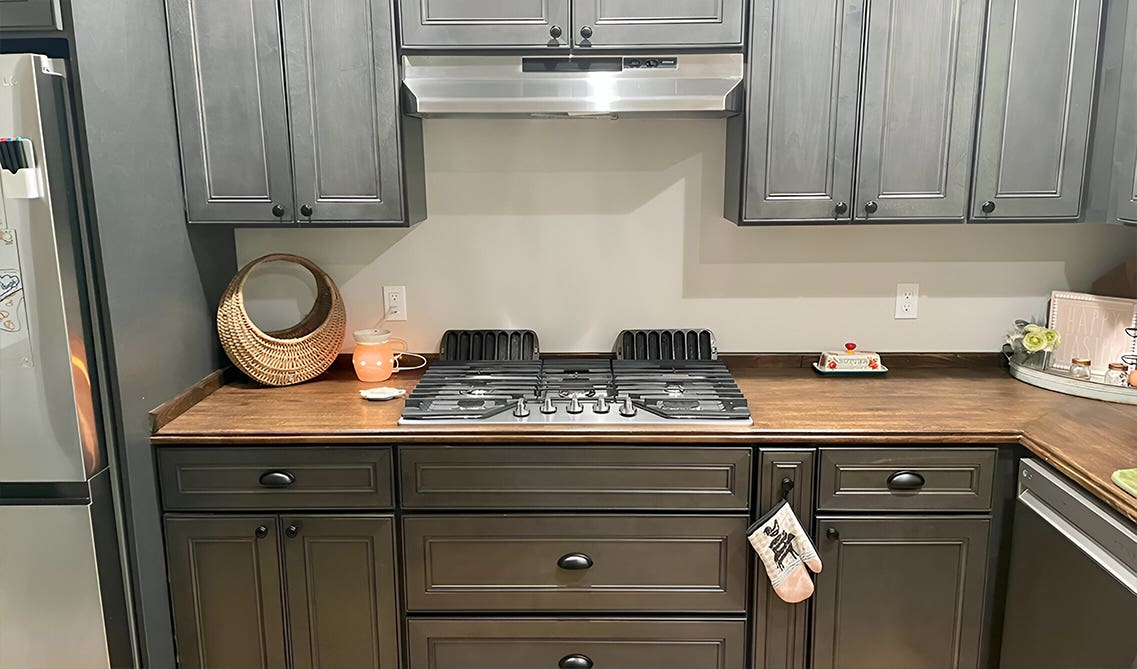
Lily Ann Cabinets: Craftsman Natural Shaker and Craftsman White Shaker
Why the Slab Is Not the Whole Bill
The material is only part of an installed price. Stonify says fabrication and installation run roughly $25 to $50 per square foot whatever the stone, and Fox Granite puts professional labor at $30 to $50. SlabWise lists the slab price a fabricator pays: $8 to $18 per square foot for Level 1 granite and $14 to $20 for Level 1 quartz. So even the cheapest stone lands near $40 to $50 installed, because labor and fabrication are most of the bill.
That is why the gap between the cheapest top and the cheapest stone is smaller than most people expect, and why it pays to compare installed prices and not slab prices. Here is what that looks like on a kitchen of about 40 square feet, the size Stonify uses in its worked example. The totals below are our multiplication of the guides' ranges, not quotes.
- Laminate: 40 sq ft at $15 to $40 is about $600 to $1,600.
- Entry-level granite: Stonify's own example works out to about $54 per square foot for Level 1 granite, or about $2,160 for 40 sq ft.
- Mid-range quartz: the same example gives about $93 per square foot, or about $3,720.
Two things can move any of these numbers. Stonify says prices run 20% to 40% higher in high-cost metro areas, and it warns that many of its ranges were collected before the July and August 2026 duties, so imported granite, marble and quartz may sit at the high end. Ask every quote whether it includes templating, the sink cut-out, the edge profile and taking out the old top. Once the old top is out, our guide to attaching a countertop to cabinets shows what holds each type down.
Laminate
Consumer Reports calls laminate inexpensive, easy to clean and a good choice for a tight budget. The trade-off is repair: it scratches and nicks easily and a damaged spot can't be fixed, and water can work into the seams. That makes the seams and the area around the sink the places to check before you buy. If an old laminate top is still sound and you only want a new look, our guide to painting laminate countertops covers the lower-cost route and its limits.
Tile
Consumer Reports calls tile inexpensive and relatively easy to install, and says it has excellent heat resistance. The grout is the catch: it is likely to stain even when sealed, and tile edges and corners can chip. Darker grout helps. Tile can look good on an island or a low-traffic run and is harder to live with as the main prep surface. See our tile countertop guide for how it holds up in a real kitchen.
Butcher Block
Wood is the budget pick that looks the least like one. The price range is wide because the species, thickness and grain pattern change it, and Consumer Reports notes the upkeep: heat, cuts, scrapes and impacts all mark it, and humidity makes it a poor match for a spot beside the sink or over a dishwasher. A common budget move is to use it on the island only. Our butcher block pros and cons covers oiling and sealing.
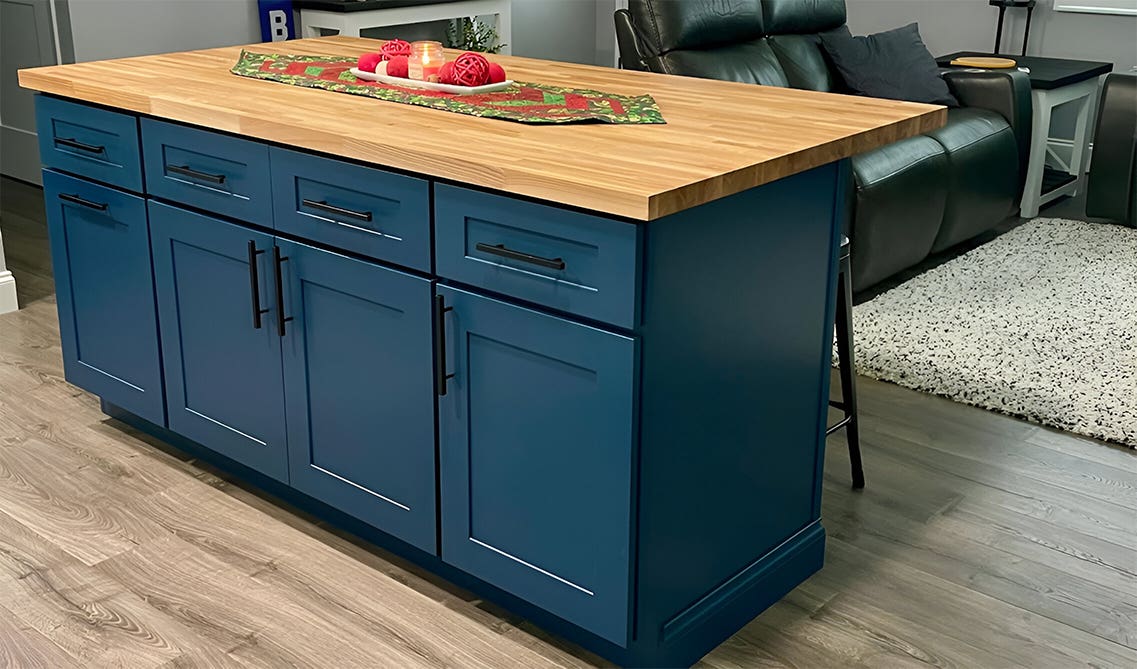
Lily Ann Cabinets: Navy Blue Shaker
Solid Surface
Solid surface, the category that includes Corian, sits in the middle of the price list. Consumer Reports says it resists heat and impacts, and that scratches and small nicks can be buffed out, but that it scratches and cuts easily. So a scratch is a fixable problem here, which laminate can't say. It is a good fit where you want a seamless top or a built-in sink. Our solid surface guide compares it with quartz and laminate.
Entry-Level Granite
Granite is priced by grade. SlabWise's installed ranges for Level 1 and 2 granite run from $40 to $65 at the budget end and up to $130 at the premium end, while Level 3 and higher can start at $95. If you want granite on a budget, look for a Level 1 or 2 color, a plain edge and a small remnant for a vanity or island. Consumer Reports gave granite top scores for spills, hot pots and knives, but says its edges and corners can chip and that it needs periodic sealing. Our guide to sealing granite countertops shows a simple water test for when to reseal.
Entry-Level Quartz
Quartz is the most expensive of the six, and entry-level quartz still costs more than the same grade of granite in these guides. Consumer Reports gave it top scores in its spill, hot-pot and knife tests, and says it does not have to be sealed. Its weak point is the same as granite's: edges and corners can chip, and only a pro can repair them. Rounded edges help.
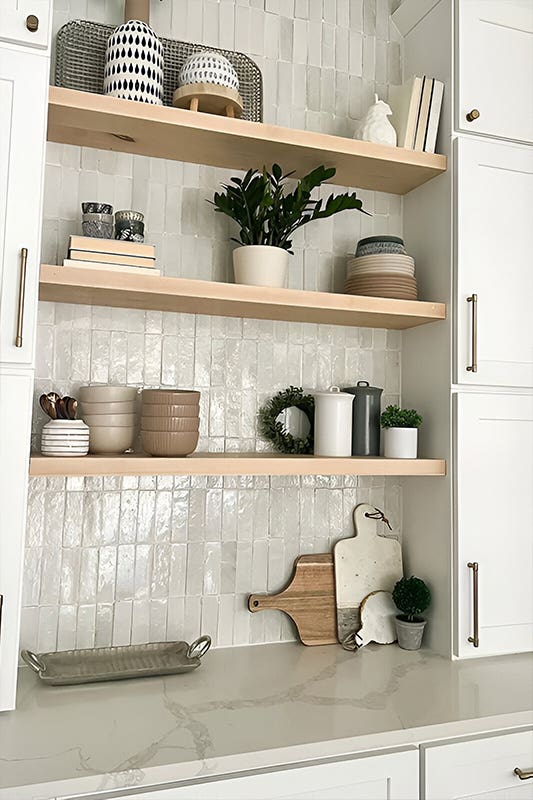
Lily Ann Cabinets: Charleston Linen
What Your Cabinets Have to Carry
Price lists skip the part that sits under the top. A countertop is a load on the cabinet boxes, and the heavier and longer it is, the more that matters. One countertop-tool supplier's guide gives these weights for stone: 3 cm granite at 18 to 20 pounds per square foot, 3 cm engineered quartz at 15 to 20, and a 12 mm porcelain slab at 6 to 8. On 40 square feet that is roughly 720 to 800 pounds of 3 cm granite against 240 to 320 pounds of porcelain (our multiplication). SlabWise adds that concrete weighs 18 pounds per square foot at 1.5 inches thick. We did not find a weight figure we trust for laminate, tile or butcher block, so we do not give one.
Three things matter more than the weight itself:
- Level boxes. Fox Granite says that if your cabinets are out of level by more than 1/4 inch, the fabricator may need to shim before installation. A level run costs nothing to check and can save a call-back. Our attach guide shows how to check and shim.
- Overhang. A seating overhang is where a cheap top becomes an expensive project. Countertop makers cap how far a top can stick out past the cabinets, and the cap is lower for thin slabs. Cambria's installation guideline, as summarized in our kitchen island overhang guide, allows 12 inches on 2 cm material and 15 inches on 3 cm before extra structural support, and caps any overhang at about a third of the base cabinet depth. A 24-inch-deep base tops out near 8 inches. Ask your fabricator for their limit in writing before the template visit.
- The thickness you pick. A 2 cm slab is lighter than 3 cm but gives you less overhang before you need support. If the budget pushes you to 2 cm, our overhang guide says to add corbels every 36 inches.
If you are planning new base cabinets with the new top, Lily Ann's free kitchen design service can lay out the run and check overhangs before you order a slab, and our RTA kitchen cabinets and free samples let you see the door finish next to your top choice.
How to Spend Less on Any Top
Consumer Reports lists three habits that cut the cost of any material:
- Watch for sales and mix materials. Use the cheaper top on the long run and a better one on the island. Our kitchen countertop ideas show how two materials look together.
- Look at remnants for small areas. Consumer Reports says remnants are a possibility for smaller areas, such as a vanity or a small island.
- Keep the edge simple. Rounded edges are safer than squared edges and may not cost extra, while beveled or bull-nosed edges may raise the price.
Beyond those three, compare at least two installed quotes, ask which grade of stone each one covers, and ask whether removal of the old top and the sink cut-out are included. Our kitchen countertop materials guide compares all 12 types side by side if you are still deciding.
Which Cheap Countertop Fits Your Kitchen?
| If this is you | Look at | Why |
|---|---|---|
| Tight budget, low-traffic kitchen or a rental | Laminate | Lowest price, easy to clean. Replace it when it wears out because it can't be repaired. |
| You want a heat-resistant top and can live with grout | Tile | Inexpensive and heat resistant, with stain-prone grout. |
| You like a warm look and don't mind oiling | Butcher block | Mid-range price. Keep it away from the sink and dishwasher. |
| You want a seamless top or a built-in sink | Solid surface | Scratches and small nicks can be buffed out. |
| You want a top that stands up to spills, hot pots and knives | Entry-level granite or quartz | Top scores in Consumer Reports' lab tests, with higher installed prices. |
The Takeaway
Laminate is the cheapest kitchen countertop, at about $15 to $40 per square foot installed, followed by tile, butcher block, solid surface and entry-level granite and quartz. The ranges overlap, labor and fabrication make up much of the price of any stone, and the lowest price is not the lowest cost if the top has to be replaced early. Before you commit, get two installed quotes, check that the cabinets are level, and know how far your top can overhang. A free kitchen design can put the cabinets and the countertop on the same plan.
Frequently Asked Questions
Laminate. The guides we read price it at about $15 to $40 per square foot installed (Stonify and Fox Granite), and Consumer Reports calls it inexpensive, easy to clean and a good choice for a tight budget. Tile and butcher block usually come next. The catch is repair: laminate scratches and nicks easily and a damaged spot can't be fixed, so the cheapest top is not always the cheapest over many years.
In the 2026 cost guides, the inexpensive group is laminate ($15 to $40 per square foot installed), ceramic or porcelain tile ($15 to $60) and butcher block ($35 to $100, depending on the guide). Solid surface and entry-level granite start near $40 to $45. Consumer Reports calls laminate and tile inexpensive. Prices vary by grade, edge and region, so get two installed quotes.
Quartz earned top scores in Consumer Reports' tests for spills, hot pots and knives, and it does not have to be sealed. Its downsides are the price and the edges: installed quartz runs about $50 to $150 per square foot in the guides we read, and edges and corners can chip, with repairs left to a pro. Rounded edges help. It is the most expensive of the six tops in this guide, even at entry level.
There is no single trade name. Granite-look surfaces are usually one of two things: engineered quartz, which is made in a factory from stone chips and resin, or laminate printed with a granite pattern. Quartz is much more durable and costs more. If a listing says only 'granite look', ask which it is before you compare prices.
Laminate is cheaper in every guide we read: about $15 to $40 per square foot installed against $35 to $75 for butcher block in Fox Granite's numbers, and $40 to $100 in Stonify's. SlabWise's laminate range overlaps the low end of butcher block ($25 to $65 against $35 to $120). Butcher block costs more but can be sanded and refinished, while laminate can't be repaired.
For stone, often yes. Stonify says fabrication and installation run roughly $25 to $50 per square foot whatever the stone, and SlabWise lists Level 1 granite slabs at $8 to $18 per square foot to the fabricator. That is why the cheapest stone still lands near $40 to $50 installed. Ask a quote to separate material from labor.
That depends on the cabinets, how level they are and the overhang, so check all three. One supplier's guide puts 3 cm granite at 18 to 20 pounds per square foot, which is roughly 720 to 800 pounds on 40 square feet. Level the cabinets first, since Fox Granite says a fabricator may need to shim if they are out of level by more than 1/4 inch, and ask for overhang limits in writing.
It depends on the maker and the thickness. Cambria's installation guideline, as summarized in Lily Ann's island overhang guide, allows 12 inches on 2 cm material and 15 inches on 3 cm before extra structural support, and caps any overhang at about a third of the cabinet depth under it. A 24-inch-deep base tops out near 8 inches. Ask your fabricator for their limit in writing.
For a budget, multiply the length by the depth of each run and add the runs together, counting any overhang in the depth. A fabricator then measures exactly: Fox Granite says they template directly off your existing cabinets, and Stonify says templating is part of the installed price. So you only need a rough square footage to compare quotes.
Yes. Stonify says prices run 20% to 40% higher in high-cost metros. It also warns that many of its ranges were gathered before the July and August 2026 duties, so imported granite, marble and quartz may sit at the high end. Use the ranges here to compare materials, and use local quotes to budget.
Sometimes. Laminate works well for a tight budget or a short-term kitchen, but Consumer Reports says it is easily scratched and nicked and can't be repaired. If you plan to stay for years, a mid-range top that can be repaired or resealed may cost less over time. Our guide to kitchen countertop materials compares upkeep for all 12 types.















