


Butcher block countertops look warm, are gentle on dishes, can be sanded to fix scratches and burns, and usually cost less than stone (Bob Vila puts materials at $20 to $60 per square foot). The downsides: oiled wood stains and can warp if water sits on it, it dents more easily than stone, and it needs oiling about once a month. A sealed finish resists stains but can't take hot pans.
- What it is: strips of hardwood (often maple) glued into a thick slab; edge grain looks striped, end grain looks like a checkerboard.
- Pros: warm look, sand-out repairs, quiet and gentle on dishes, and usually cheaper than stone.
- Cons: water can warp it, oiled wood stains easily (Poor in Consumer Reports' test), it dents, and it needs regular oil.
- Finish: oil if you'll chop on it and set hot pans down; sealed (varnish) if you want fewer stains, but then use trivets and cutting boards.
- Rule of 7: on a new oiled top, oil daily for 7 days, weekly for 7 months, monthly for 7 months.
- Not outdated: butcher block was the most popular island top in Houzz's 2024 trends study, per Southern Living.
- Lily Ann Cabinets doesn't make the top, but it makes the cabinets under it: navy, grey, white and green shaker lines all pair well with wood.
Butcher block countertops look warm, feel soft under your hands and cost less than most stone. They also scratch, stain and need oil. Whether they're right for you comes down to how you cook and how much upkeep you're happy to do.
This guide covers what butcher block is, its real pros and cons, oiled vs. sealed finishes, how to care for it (including the "rule of 7"), what it costs according to named sources, and which cabinet colors pair best with it. Care advice comes from Consumer Reports and the publishers named in each section.
What Is a Butcher Block Countertop?
A butcher block countertop is a work surface made from strips of hardwood glued together into one thick slab. It's named after the chopping blocks used in butcher shops. Maple, walnut, cherry and oak are common woods, and the strips can be laid in different patterns, called grains.
Our butcher block glossary entry explains the two main styles. Edge grain looks like long, narrow stripes, because the boards are glued side by side with their edges up. End grain looks like a checkerboard, because short blocks stand on end. End grain is the strongest and the most expensive.
Which wood? A John Boos & Co. sales manager told Country Living that hard rock maple is "the overall surface of choice" because it's dense and closed-grain, and that it costs less than cherry and walnut. He also said oak, an open-grain wood, isn't ideal for direct food prep, though it's fine when lacquered or varnished.
Butcher Block Pros
- Warm, natural look. Wood softens a kitchen full of painted cabinets, tile and stainless steel. It suits farmhouse, cottage and modern rustic kitchens, and it works as an accent on an island.
- Lower cost than most stone. Bob Vila puts butcher block materials at $20 to $60 per square foot, below marble and quartz in its comparison. See the cost table below for other sources' ranges.
- Repairable. Scratches, dents and even burn marks can be sanded out and re-oiled. A John Boos representative told Country Living that sanding "reveals an entire fresh new cutting surface."
- Gentle and quiet. Consumer Reports notes wood makes for a quieter kitchen because dishes don't clink against it.
- Oiled wood takes heat and knives. Consumer Reports says oiled butcher block is the only countertop you can chop on directly, and it's safe to set hot cookware on. Bob Vila still suggests a cutting board, since chopping on the top wears it faster.
- DIY-friendly. Bob Vila says a DIY install isn't tricky for handy homeowners: cut it with a circular saw and screw it down over the cabinets, saving the $5 to $10 per square foot a pro would add.
Butcher Block Cons
- Water is its enemy. Consumer Reports says oiled wood is easily damaged by water: liquid left sitting can soak in and make the top warp. The area around the sink takes the most punishment.
- It stains. Oiled butcher block scored Poor in Consumer Reports' staining test. Varnished butcher block scored Excellent.
- It dents and scratches. Bob Vila notes wood is softer than stone, so knives, cans and heavy pots leave marks.
- It needs regular oiling. Consumer Reports says to re-oil oiled butcher block at least once a month to keep it from warping or cracking.
- It moves with the seasons. Bob Vila says wood can expand about 1/8 inch in summer and shrink the same in winter, so installers leave room around the edges.
- Varnish has limits. A sealed (varnished) top resists stains, but Consumer Reports found the varnish can get scratched or melt under heat. Use trivets and cutting boards on it.
- It doesn't last as long as stone. Architectural Digest says you may get about two decades from it, while stone can last for generations.
Pros and cons at a glance
| Pros | Cons | |
|---|---|---|
| Look | Warm, natural, works with most cabinet colors | Marks and dents show more than on stone |
| Cost | Usually below stone and quartz | Premium woods and end grain cost more |
| Durability | Sand out scratches, dents and burns | Dents, scratches and stains more easily than stone |
| Water | Fine if wiped dry | Can warp if water sits, especially by the sink |
| Upkeep | Simple soap and water daily | Oil regularly (oiled) or refinish when damaged (varnished) |
| Lifespan | About 20 years with care (Bob Vila, Southern Living, HomeGuide) | Shorter than granite or quartz |
Oiled vs. Sealed Butcher Block: Which Finish?
Choose an oil finish if you want to cut and prep food right on the wood, and a sealed (varnished or polyurethane) finish if you want fewer stains and less upkeep. Consumer Reports found oiled wood handles knives and hot pans but stains easily, while varnished wood resists stains but can't take heat or knife cuts.
| Oiled (food-grade mineral oil) | Sealed (varnish, lacquer or polyurethane) | |
|---|---|---|
| Cut on it? | Yes | No, use a cutting board |
| Hot pans? | Safe, per Consumer Reports | No, heat can melt the finish |
| Stains | Poor in CR's test | Excellent in CR's test |
| Upkeep | Re-oil at least monthly (CR) | No oiling; sand and recoat if damaged |
| Best for | Islands and prep zones | Areas near the sink, or tops used as a dining surface |
The John Boos representative quoted by Country Living gives the same split: an oil finish for food-prep areas, and a lacquer finish for a general or dining surface, since oil can come off on clothing or paper.
How to Care for Butcher Block Countertops
Daily care is simple. The oiling schedule is the part people get wrong.
- Scrape, then wash. Scrape off food with a plastic spatula or bench scraper. Wipe with warm, soapy water on a cloth or sponge.
- Dry it right away. Consumer Reports says to dry it thoroughly after each use. Never leave water or a wet dish rack sitting on oiled wood.
- Sanitize when needed. Consumer Reports suggests 1 teaspoon of bleach in 1 quart of water to sanitize, for example after raw meat.
- Oil it. Rub on an even coat of food-grade mineral oil with a cloth, let it soak in overnight, then wipe off the excess, per Consumer Reports. A beeswax-based wood cream on top adds extra protection.
- Never use cooking oil. Consumer Reports warns olive or vegetable oil can turn rancid in the wood.
- Move your prep spot around. Consumer Reports notes oiled tops wear unevenly if you always chop in one place.
How often should you oil butcher block?
Sources give different schedules, so watch the wood too: when it looks pale or dry, or water stops beading, it's time.
| Source | Oiling schedule |
|---|---|
| Consumer Reports | At least once a month |
| Bob Vila | Right after install, then once a month or so |
| Country Living | Every few weeks |
| Architectural Digest | Every two months or so |
| Hardwood Reflections (butcher block maker) | The "rule of 7" for a new top, then 1 to 2 times a year |
What is the rule of 7 for butcher block?
The rule of 7 is an oiling schedule for a new oil-finished butcher block: oil it once a day for 7 days, once a week for 7 months, then once a month for 7 months. After that, butcher block maker Hardwood Reflections says it only needs oil 1 to 2 times a year, or whenever it looks dry.
New wood soaks up a lot of oil at first, and each coat lasts longer as the wood fills up. The rule is a maker's rule of thumb, not a standard, and it only applies to oil finishes. A sealed top doesn't get oiled at all. You may also see "rule of 7" used for something else: one builder's guide uses it for air-drying lumber (7 days per inch of thickness) before the block is made. When people ask about it for countertops, they almost always mean the oiling schedule.
Removing stains, dents and burns
- Stains on oiled wood: Consumer Reports says to sprinkle salt on the spot and rub it with a damp sponge. For stubborn ones, sand with fine-grit sandpaper along the grain and re-oil.
- Stains on varnished wood: buff lightly with fine sandpaper or steel wool, then recoat if you've gone through the finish.
- Dents and burns: Bob Vila suggests sanding with 220-grit or finer and re-oiling the spot.
- A full refresh: Bob Vila suggests sanding the whole top about every 10 years, or when it's stained, starting at 80 to 100 grit and finishing at 220, then oiling.
For more on wood surfaces in the kitchen, see our guide to reclaimed wood countertops.
How Much Do Butcher Block Countertops Cost?
Ranges vary a lot by wood, grain, thickness and whether installation is included. These are national figures from named sources, not Lily Ann prices. Lily Ann Cabinets makes the cabinets the top sits on.
| Source | Range given | What it covers |
|---|---|---|
| Bob Vila | $20 to $60 per sq ft | Materials; pro installation adds $5 to $10 per sq ft |
| Southern Living | $30 to $70 per sq ft | Average; premium woods like cherry or oak can reach $200+ |
| Architectural Digest | $25 to $100 per sq ft | Including purchase and installation |
| Country Living | About $35 to $38 per sq ft | A standard edge-grain maple island top, retail, per a John Boos rep |
| HomeGuide | $50 to $150 per sq ft | Depending on wood type and thickness |
Bob Vila, Country Living and Southern Living all describe butcher block as cheaper than most stone, and Country Living's quote puts it above laminate. HomeGuide notes its range overlaps some high-end materials, and Southern Living says premium woods can push it past $200 per square foot.
Is Butcher Block Outdated?
No. Southern Living, citing the Houzz 2024 U.S. Kitchen Trends Study, reports that engineered quartz was the most popular countertop overall, but butcher block was the most popular choice for the island. That's the way most kitchens use it now: stone or quartz on the perimeter, where the sink and cooktop are, and wood on the island as a warm accent.
Get your FREE 3D kitchen design today!
Start NowWhat Color Cabinets Go With Butcher Block Countertops?
Blue, grey, white and green cabinets are the most popular pairings with butcher block, because cool or light paint colors contrast with the warm wood. Navy and grey are the two people search for most. Black cabinets give a bolder contrast, and wood cabinets work if the two wood tones are clearly different.
Wood is a warm, mid-tone surface, so it stands out most next to cooler or lighter paint colors. Here's how each color works, with our deeper guides for each.
Navy and blue cabinets with butcher block
This is the pairing people search for most. Navy is cool and deep, and a honey or natural wood top warms it up without fighting it. Light blue reads softer and more coastal. Use it on the whole kitchen or just the island. See our blue kitchen cabinet ideas and navy blue kitchen ideas, or browse Navy Blue Shaker cabinets.
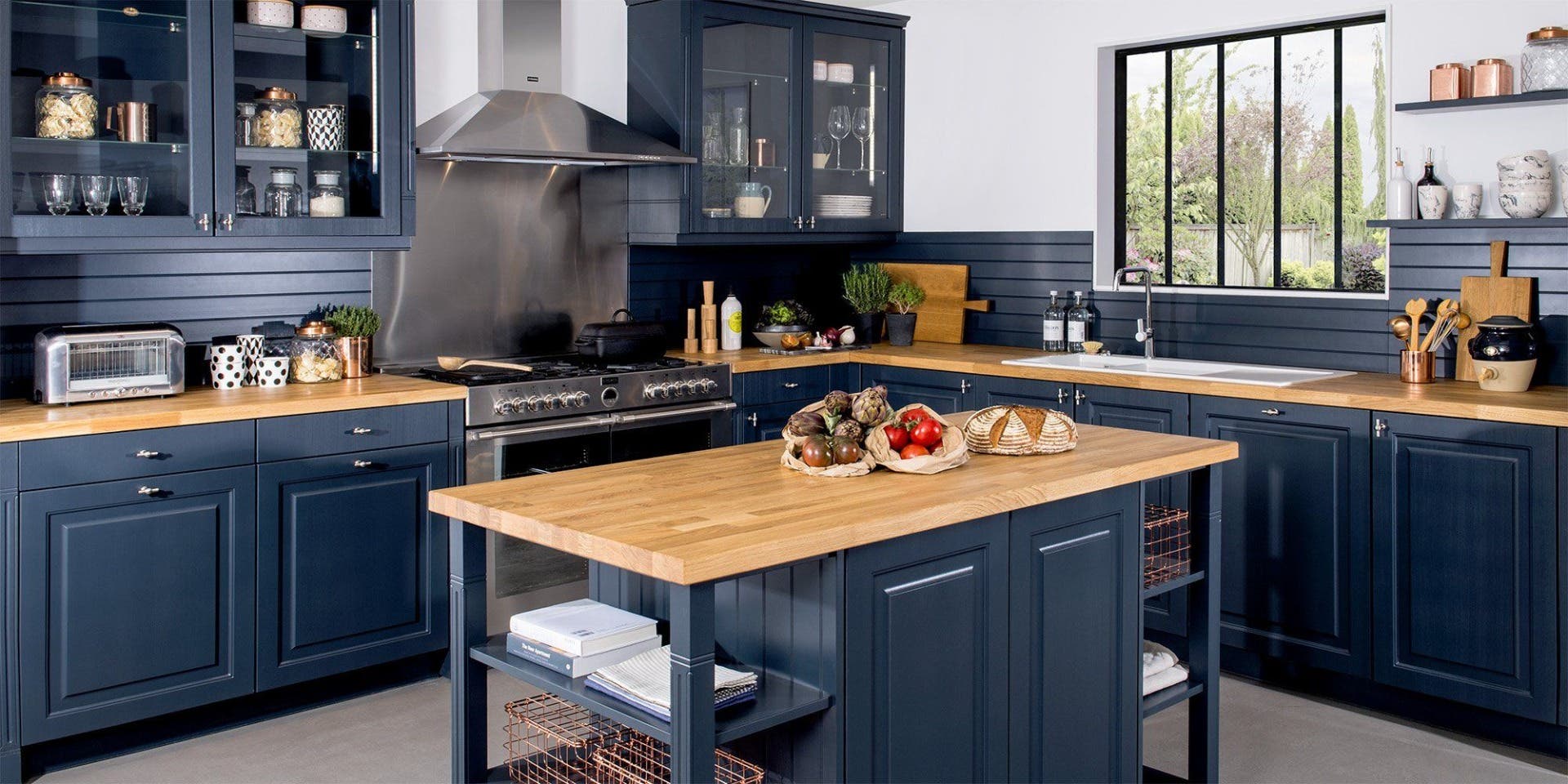
Photo: Pinterest
Grey cabinets with butcher block
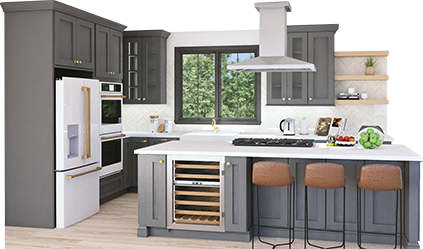
Light grey and wood is a classic farmhouse combination: the wood keeps grey from feeling cold, and grey keeps the wood from looking too rustic. Dark grey with a lighter maple top gives more contrast. Our grey kitchen cabinet ideas show more examples, and Grey Shaker Elite is one light grey option among our grey cabinets.

Photo: Sincerely Marie Designs
White cabinets with butcher block
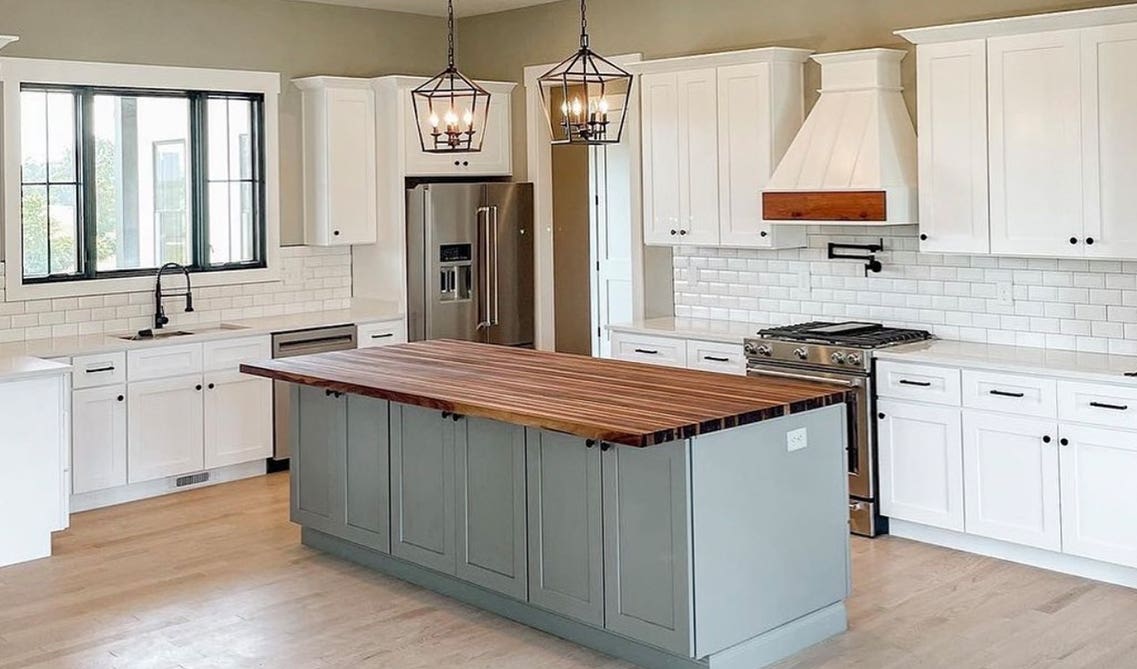
White cabinets with a wood island top, like the kitchen in the photo near the top of this page, is the easiest version to get right. The wood adds warmth to an all-white room. Colorado White Shaker is a plain white shaker that suits it; see more white cabinets.
Green and sage cabinets with butcher block
Green and wood are both natural colors, so they sit together easily, especially in cottage and farmhouse kitchens. See our sage green kitchen cabinets guide and the Craftsman Lily Green Shaker line.
Black, cream and wood cabinets
- Black: the boldest contrast. A light maple or oak top keeps a black kitchen from feeling heavy. See black kitchen cabinet ideas and Craftsman Black Shaker.
- Cream: soft and traditional. See cream kitchen cabinets.
- Wood cabinets: wood on wood can work, but pick a top that's clearly lighter or darker than the cabinets so they don't blur together. Browse wood cabinets or rustic cabinets, and see our modern rustic kitchen guide.
Butcher Block and Your Cabinets: Island, Sink and Install Tips
Because butcher block is wood, it behaves differently from stone over the cabinets below it.
- Put it where the water isn't. Consumer Reports' warnings about warping and staining all come back to water. That's why many kitchens use wood on the island and stone or quartz around the sink.
- If it does go around a sink, choose a sealed finish there and wipe the area dry every time. Keep the sink base cabinet's doors dry too, since water that runs off the edge lands on them.
- Leave room to move. Bob Vila says the wood can grow and shrink about 1/8 inch with the seasons, so it needs a small gap at the walls.
- Plan the overhang. An island top with seating hangs past the cabinets. See our kitchen island overhang guide for how far, and kitchen island with seating ideas.
- Fasten it from below. Bob Vila describes mounting the segments over the cabinets with screws.
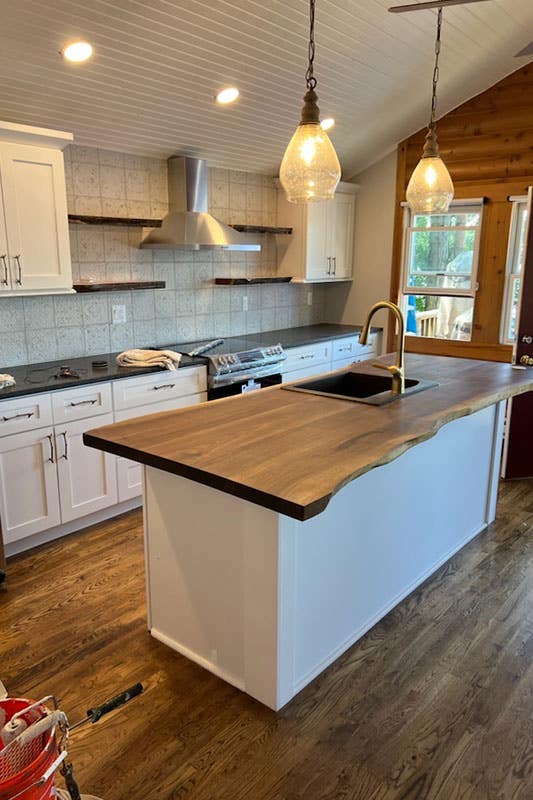
This island uses a solid live-edge wood slab rather than glued strips, but the sink rules are the same: seal the top, and dry it every time.
Butcher Block vs. Granite, Quartz and Laminate
| Butcher block | Granite | Quartz | Laminate | |
|---|---|---|---|---|
| Material cost (Bob Vila) | $20–$60/sq ft | — | $50–$200/sq ft | — |
| Lifespan (Bob Vila) | 20+ years with care | At least 20 years | — | 10–15 years |
| Sealing or oiling (Consumer Reports) | Oil monthly, or a sealed finish | Sealer makes it more moisture-resistant | Doesn't need sealing | — |
| Repairs at home (Consumer Reports) | Sand and re-oil or recoat | Small chips with a repair kit | Small chips with a repair kit | — |
A dash means that source doesn't give a figure.
For the stone options, see quartz vs. granite countertops and our guide to kitchen countertop materials. If you want ideas that mix materials, our kitchen countertop ideas cover 15 options.
The Takeaway
Butcher block is warm, repairable and usually cheaper than stone, and it's still the most popular island top in Houzz's 2024 survey. In return it asks for regular oiling, quick drying and a little patience with marks. Use an oil finish where you prep food and a sealed finish near water, follow the rule of 7 on a new oiled top, and pair it with cabinets that contrast with the wood: navy, grey, white or green.
Planning the cabinets under it? Get a free 3D kitchen design and see your cabinet color next to a wood top.
Frequently Asked Questions
The main downsides are water damage, stains and upkeep. Consumer Reports says oiled wood can warp if water sits on it and scored Poor in its staining test, and it needs oiling at least once a month. Wood also dents and scratches more easily than stone, and it expands and shrinks with the seasons. A sealed (varnished) finish resists stains but can't take hot pans or knife cuts.
It's an oiling schedule for a new oil-finished butcher block: oil it once a day for 7 days, once a week for 7 months, then once a month for 7 months. Butcher block maker Hardwood Reflections says that after this, the top only needs oil 1 to 2 times a year, or when it looks dry. It's a maker's rule of thumb, and it doesn't apply to sealed or varnished tops.
Consumer Reports' method for sanitizing butcher block is a measured bleach solution: 1 teaspoon of bleach in 1 quart of water, after cleaning it with warm soapy water. It doesn't cover disinfecting wipes. Whatever you use, don't leave the wood wet: wipe it dry right away, and re-oil an oiled top regularly so it doesn't dry out.
No. Southern Living, citing the Houzz 2024 U.S. Kitchen Trends Study, reports that butcher block was the most popular countertop choice for kitchen islands, even though engineered quartz was the most popular overall. Many kitchens now use it as an accent on the island, with stone or quartz around the sink and cooktop.
About 20 years with good care. Bob Vila says 20 years or longer, Southern Living says 20 years and possibly decades beyond, and HomeGuide says 20 years or more. Architectural Digest says you may get about two decades from it. Regular oiling, quick drying and an occasional sanding are what get it there.
Hard maple is the most common pick. A John Boos & Co. sales manager told Country Living that hard rock maple is the overall surface of choice because it's dense and closed-grain, and it costs less than cherry or walnut. Walnut and cherry give a darker, richer look. Oak is open-grain, so it's better with a lacquer or varnish finish than for direct food prep.
Usually, yes. Bob Vila puts butcher block materials at $20 to $60 per square foot, compared with $50 to $200 for quartz in the same article. A John Boos representative quoted by Country Living called a standard maple island top cheaper than granite but more expensive than laminate. Premium woods and end grain can cost as much as stone.
On an oiled top, yes. Consumer Reports says oiled butcher block is safe for hot cookware. On a varnished or sealed top, no: heat can melt the finish, which happened in Consumer Reports' tests, so use a trivet. Burn marks on oiled wood can usually be sanded out and re-oiled.
Roughly once a month for an oiled top, and more often when it's new. Consumer Reports says at least once a month, Country Living says every few weeks and Architectural Digest says every couple of months. For a brand-new top, the rule of 7 front-loads the oiling. Oil it whenever the wood looks pale or dry.
Yes, if you clean and dry them properly. Consumer Reports' routine is warm soapy water after each use, a thorough dry, and a bleach solution (1 teaspoon per quart of water) when you want to sanitize. Avoid leaving water or food sitting on the wood, and keep an oiled top oiled so it doesn't dry out and crack.
















Comments