


A beadboard cabinet is a cabinet whose door or side panel is made of beadboard: narrow vertical boards separated by a small rounded ridge called a bead. On a beadboard door, the grooved panel sits inside a plain frame, the way a flat panel sits inside a Shaker door. It reads casual and cottage-like rather than formal, and it is most common in coastal, farmhouse and country kitchens. Most kitchens get the look with beadboard panels on island backs and cabinet ends rather than with beadboard doors.
- Beadboard = narrow vertical boards with a small rounded bead between each one. On a cabinet door, that panel sits inside a plain frame.
- Still in style, but as an accent. This Old House lists it among cabinet styles that don't date. A whole kitchen of beadboard doors does.
- The downside is cleaning: grooves trap grease and dust, which is why the look survives best on surfaces nobody touches.
- Lily Ann does not sell beadboard doors. We sell a matching bead board plywood panel, 96"W x 42"H x 1/4"D, in twelve finishes.
- Best five places for it: island back, exposed cabinet ends, behind glass doors, a range hood, and walls or ceilings.
- Keep it out of wet and hot spots — not directly behind a sink or range. Tile there instead.
- Search tip: our site search spells it "bead board", two words. "Beadboard" returns nothing.
Beadboard cabinets keep turning up in cottage, coastal and farmhouse kitchens, and the look is easy to fall for: narrow vertical grooves that add texture without carving or moulding. What is harder is working out how to actually get it, because "beadboard cabinets" can mean two completely different things.
It can mean cabinet doors with a beadboard panel set into the frame. Or it can mean ordinary cabinets with beadboard panels used around them, on island backs, cabinet ends, walls and ceilings. The second one is cheaper, easier to change your mind about, and is what most of the kitchens you have saved on Pinterest are actually doing.
Straight answer before we go further: Lily Ann Cabinets does not sell a beadboard door line. Site search returns no beadboard doors, and none of our door styles is a beadboard door. What we do sell is a matching bead board plywood panel, 96 inches wide by 42 inches tall and 1/4 inch thick, in the same finishes as our cabinets. This guide is about getting the look with that panel and with paint, not about a door we do not make.
What Is a Beadboard Cabinet?
A beadboard cabinet is a cabinet whose door or side panel is made of beadboard: narrow vertical boards separated by a small rounded ridge called a bead. On a beadboard door, that grooved panel sits inside a plain frame, the same way a flat panel sits inside a Shaker door. The look is casual and cottage-like rather than formal, and it shows up most in coastal, farmhouse and country kitchens.
Beadboard itself is older than the cabinets. Family Handyman describes it as "a type of wood paneling characterized by vertical rows of wood strips, with a little indentation, or 'bead,' between each plank," and traces it to the 1800s, when it was used to protect walls in high-traffic rooms. It is sold today as solid wood, MDF, PVC or vinyl, and in sheet form the standard is 48 inches wide and 1/2 inch thick, in lengths of eight to sixteen feet.
Lily Ann's bead board panel is thinner and sized differently on purpose: 1/4 inch thick so it can be applied over an existing cabinet end or island back without bulking it out, and 96 by 42 inches so it covers a standard island back in one piece.
Are Beadboard Cabinets Still in Style?
Yes, but as an accent more than as a whole kitchen. Beadboard is treated as a lasting style rather than a trend: This Old House lists beadboard among cabinet styles that do not go out of fashion, calling it "an excellent choice for those seeking an inviting, casual, country-inspired kitchen aesthetic." What has changed is the dose. A full kitchen of beadboard doors reads as 1990s country; beadboard on an island back, a range hood or behind glass doors reads as current.
The honest counterweight is maintenance. The grooves catch what flat doors shed. Family Handyman quotes cabinet designer Mason: "One downside is maintenance, because dirt and grease get trapped in the crevices." That is a bigger problem on a door you open with greasy hands forty times a day than on an island back nobody touches, which is another reason the accent approach has outlasted the all-over one.
Beadboard Doors vs. Beadboard Panels
These two routes cost different amounts, take different skills, and fail in different ways.
| Beadboard doors | Beadboard panels around plain cabinets | |
|---|---|---|
| What it is | Every door and drawer front has a grooved centre panel | Standard doors; grooved panels on island backs, cabinet ends, walls, ceilings, hood |
| Who sells it | Specialist door makers and some full-line brands. Not Lily Ann | Most cabinet lines, including ours, as a trim item |
| Cleaning | Grooves on every hand-touched surface | Grooves only where nobody touches them |
| If you change your mind | New doors for the whole kitchen | Pry off a panel, patch, repaint |
| Matching your cabinets | The doors are the cabinets, so it matches by definition | Buy the panel in your cabinet line's finish and it matches |
Family Handyman puts beadboard cabinets at roughly $4,200 to $11,000 for a 10-foot by 10-foot kitchen, which is a whole-kitchen door number, not a panel number. A panel approach is a handful of trim pieces on top of cabinets you were buying anyway.
Five Ways to Get the Beadboard Look
1. The back and sides of an island
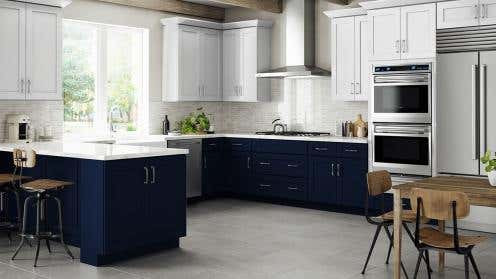
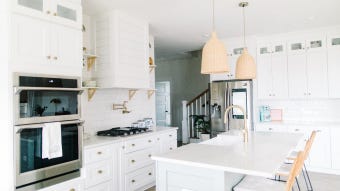
This is the highest-impact, lowest-risk place to put beadboard, and it is the one that shows in photos. The back of an island is a large flat surface at eye level that nobody touches with dirty hands. A 96" x 42" panel covers the back of most islands in one piece, cut to height. Because the panel comes in your cabinet finish, the island reads as one built piece rather than an add-on.

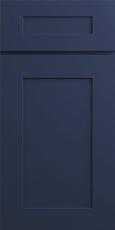
Lily Ann Cabinets: Navy Blue Shaker bead board plywood panel
2. Exposed cabinet ends
The end of a run of base or wall cabinets, where it meets a walkway or a doorway, is the other place a flat side looks unfinished. A piece of bead board panel cut to the cabinet's height and depth turns it into a finished end with texture. This works on a peninsula end, on the side of a tall pantry, and on the exposed end of a bathroom vanity.
3. Behind glass doors
Instead of putting beadboard on the doors, put it behind them. Line the back of a glass-door wall cabinet with the panel in the cabinet finish, or in a contrasting one, and the grooves show through the glass. It is the beadboard look on about two square feet of material, and it only appears in the cabinets you chose to make a feature of. Lily Ann sells open-frame glass door wall cabinets that suit this.

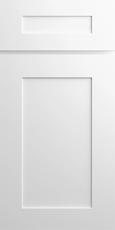
Lily Ann Cabinets: Colorado White Shaker
4. A range hood
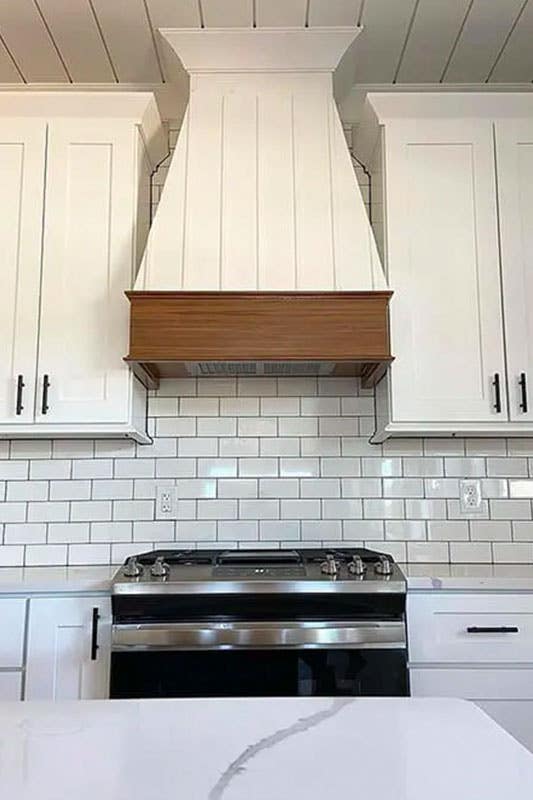
A custom hood surround clad in narrow vertical planks is one of the most common farmhouse kitchen features, and it is a surface nobody scrubs. The panel goes on the chimney of the hood, above the working area, with a wood or painted band at the bottom.
5. Walls, ceilings and the space under an eating bar
Beadboard on a wall below a chair rail, on a ceiling, or on the knee wall under an eating bar gives the room the texture without involving the cabinets at all. One caution from Family Handyman: beadboard "might not be the best choice for areas exposed to extreme heat or consistent wetness, like behind a stove or sink." Tile the splash; put the beadboard where it stays dry.
The Panel Lily Ann Actually Sells
Lily Ann's bead board plywood panel is 96 inches wide, 42 inches tall and 1/4 inch thick, sold as a single flat panel in the same finish as the cabinet line it belongs to. It is a trim item, filed under panels, fillers and trim, not a door and not a cabinet. It was in stock in twelve finishes on September 23, 2026.
| Finish | Panel | Stock on 2026-09-23 |
|---|---|---|
| Colorado White Shaker | 96"W x 42"H x 1/4"D | In stock |
| Navy Blue Shaker | 96"W x 42"H x 1/4"D | In stock |
| Grey Shaker Elite | 96"W x 42"H x 1/4"D | In stock |
| Craftsman Natural Shaker | 96"W x 42"H x 1/4"D | In stock |
| Craftsman Black Shaker | 96"W x 42"H x 1/4"D | In stock |
| Craftsman Lily Green Shaker | 96"W x 42"H x 1/4"D | In stock |
| Charleston Cherry | 96"W x 42"H x 1/4"D | In stock |
| York Driftwood Grey | 96"W x 42"H x 1/4"D | In stock |
| York Linen | 96"W x 42"H x 1/4"D | In stock |
| Mocha | 96"W x 42"H x 1/4"D | In stock |

Lily Ann Cabinets: Craftsman Natural Shaker bead board plywood panel
Two finishes, White Shaker Elite and Shaker Espresso, showed out of stock on September 23, 2026. Check stock in your own finish before you plan around the panel, and browse the rest of the trim items for your line on its panels, fillers and trim page.
One search tip. Our site search spells it as two words. Searching "beadboard" returns nothing; searching "bead board" finds the panels. That is a catalog quirk, not a sign we stopped selling them.
What to Pair Beadboard With
- White or off-white cabinets. The safest and most common pairing. Grooves read as texture rather than pattern, and the shadow lines do the work. If the cabinets are white, a white panel in the same finish is not boring, it is the point.
- A painted island against plain perimeter cabinets. Navy, green or black on the island, with the bead board panel in that same colour on the island back, gives you the texture and the colour break in one move.
- Natural wood. A wood-toned panel on an island back against painted cabinets is the current version of the look, and it avoids the all-white cottage cliche.
- Shaker doors, not raised panel. Beadboard and a raised-panel door are two kinds of detail competing on the same wall. Flat Shaker doors give the beadboard room to be the texture.
- Matte or satin paint, not high gloss. Gloss in a groove shows every brush mark. A satin sheen hides fingerprints better and is easier to wipe.
How the Panel Goes On
- Measure the surface, not the panel. Island backs are rarely exactly 96 by 42. Measure the height from the floor (or from the top of the toe kick) to the underside of the countertop overhang, and the full width including the returns.
- Cut with the grooves running the way you want them. Vertical grooves are the classic look. Cut with a fine-tooth blade and score the face first so the finish does not chip.
- Dry-fit before glue. Hold the panel up and check the fit at both ends and the top. Trim the side that meets the wall, not the side that shows.
- Glue and pin. Construction adhesive on the cabinet back plus a few pin nails is the normal method for a 1/4-inch panel. Pin into the cabinet frame, not into the open back.
- Finish the edges. A quarter-round or a base shoe at the floor and a light scribe or trim at the top hides the cut edges. A touch-up pen in the cabinet finish takes care of the pin holes.
If you are also closing gaps where the run meets a wall, our guides to cabinet toe kicks and personalising standard cabinets cover the rest of the trim pieces that make a stock kitchen look built in.
Beadboard, Shiplap and Wainscoting: What's the Difference?
| Beadboard | Shiplap | Wainscoting | |
|---|---|---|---|
| What it is | Narrow boards with a rounded bead between each one | Wider boards with a flat overlapping joint and a visible gap | Any panelling on the lower part of a wall |
| Board width | Narrow, repeating every inch or two | Wide, usually 5 to 8 inches | Depends on the style |
| Usual direction | Vertical | Horizontal | Either |
| Feel | Cottage, coastal, older | Modern farmhouse | Formal to casual, depending on the panel |
The overlap is real: beadboard used on the lower half of a wall is a kind of wainscoting. That is why some cabinet writers use the words interchangeably. The difference that matters for a kitchen is board width and the bead, not the name.
The Takeaway
If you want beadboard in your kitchen, decide first whether you want it on the doors or around them. Doors mean going to a specialist door maker and accepting grooves on every surface you touch, at whole-kitchen prices. Panels mean buying a 96" x 42" x 1/4" bead board panel in your cabinet finish and putting the texture where it photographs well and nobody scrubs it: the island back, the exposed cabinet ends, behind glass doors, the range hood.
Lily Ann does not make beadboard doors. We do make the panel, in the same finishes as our cabinets, which is what makes the second route look deliberate instead of stuck on. Browse our RTA kitchen cabinets, order free samples so you can see the finish in your own light, or use the free 3D design tool and we will lay the panels into the plan with you.
Frequently Asked Questions
A beadboard cabinet is a cabinet with a beadboard panel in its door or side: narrow vertical boards separated by a small rounded ridge called a bead. On a door, the grooved panel sits inside a plain frame. The style reads casual and cottage-like, and it is most common in coastal, farmhouse and country kitchens.
Yes, and they are usually described as a lasting style rather than a trend. This Old House lists beadboard among cabinet styles that do not go out of fashion, calling it a good choice for an inviting, casual, country-inspired kitchen. The change is in how much of it people use: beadboard as an accent on an island, a hood or behind glass doors is current, while a whole kitchen of beadboard doors dates the room.
Cleaning is the main one. The grooves trap dust and cooking grease, and a cabinet designer quoted by Family Handyman puts it plainly: "One downside is maintenance, because dirt and grease get trapped in the crevices." Beadboard also does poorly with constant wet or high heat, so it is a bad choice directly behind a sink or a range. And a full kitchen of it can read dated, which is why most current kitchens use it as an accent.
It is not really a choice between two things. Wainscoting means any panelling on the lower part of a wall; beadboard is one of the materials you can use for it. So beadboard used below a chair rail is wainscoting. If the real question is beadboard versus a framed raised or flat panel wainscot, beadboard is cheaper, easier to install and more casual; a framed panel is more formal and more work.
Beadboard has the longer history: it dates to the 1800s as a practical wall covering, while shiplap's current popularity is a 2010s revival. That does not make beadboard automatically safer in a kitchen. Both age best as accents on one surface rather than all over a room. If you want the choice that looks least of its moment, narrow vertical beadboard on a single feature is the safer bet.
People do, usually by cutting a beadboard panel to fit and gluing it onto the face of an existing flat slab door, or by building a frame and setting the panel into it. The catch is thickness: adding a panel to the front of a door changes how it sits against the frame and can throw off the hinges and the gaps between doors. It also means the grooves are now on the surface you touch most. Doing it on island ends and panels instead avoids both problems.
No. There is no beadboard door style in our lines, and a site search for a beadboard door returns no products. What we sell is a bead board plywood panel, 96" wide x 42" tall x 1/4" thick, in the same finishes as our cabinets, filed under panels, fillers and trim. It is meant for island backs, exposed cabinet ends, wall and ceiling panelling and the backs of glass-door cabinets.
Wall beadboard is usually sold in sheets 48 inches wide and 1/2 inch thick, in lengths of eight to sixteen feet. Cabinet-matching panels are different: Lily Ann's bead board plywood panel is 96 inches wide, 42 inches tall and 1/4 inch thick, which is sized to cover an island back in one piece and thin enough to apply over an existing cabinet end.
Work along the grooves, not across them. A soft brush or an old toothbrush with warm water and a little dish soap lifts what a cloth skips over, and a dry microfibre cloth pulled down each groove afterwards stops water sitting in the bead. Do the hood and the island back a couple of times a year, and the areas near the range more often. A satin or semi-gloss finish is easier to keep clean than a matte one.
White and off-white are the default, because the shadow in the grooves supplies the contrast on its own. After that, the pairings that work are a painted island in navy, green or black with a matching panel on its back, or a natural wood panel against painted perimeter cabinets. Keep the doors flat or Shaker: a raised-panel door and beadboard compete for attention on the same wall.







Comments