


Bathroom faucets come in four types, sorted by how they mount. A single-hole faucet needs one hole. A centerset has a spout and two handles on one base over three holes 4 inches apart. A widespread has three separate pieces, usually 8 inches apart. A wall-mount faucet comes out of the wall with no counter holes. The number and spacing of the holes in your sink or vanity top decide which one fits.
- Four types by mounting: single-hole (1 hole), centerset (3 holes, 4" spread), widespread (3 holes, usually 8"), wall-mount (no counter holes).
- Check first: count the holes and measure center to center between the outer two.
- Swaps: a single-hole faucet can cover a 4" three-hole sink with a deck plate; it can't cover a widespread layout.
- Widespread vs. centerset: widespread looks more custom and is easier to wipe around; centerset is compact and often cheaper.
- Vessel sinks need a tall vessel faucet or a wall-mount faucet.
- Match the top: holes, deck thickness, spout reach and handle clearance to the backsplash.
- Lily Ann Cabinets sells single-hole bathroom faucets in brushed nickel and matte black (in stock on September 28, 2026), rated 1.5 gpm and WaterSense-certified.
A faucet looks simple until you try to buy one. Then you find out the one you like needs three holes and your sink has one. Or it needs holes 8 inches apart and yours are 4. The style you pick matters less than one boring fact: how many holes are in your sink or vanity top, and how far apart they are.
This guide covers the four bathroom faucet types by how they mount (single-hole, centerset, widespread and wall-mount), plus vessel faucets, how to tell which one you have, and how to match a faucet to a vanity top. Kitchen faucets are a different topic; see our kitchen sink and faucet guide for those. Lily Ann specs and stock below were checked on the live site on September 28, 2026.
Start With the Holes in Your Sink or Vanity Top
Bathroom faucets are sorted by how they mount. A single-hole faucet needs one hole. A centerset faucet needs three holes with 4 inches between the outer two. A widespread faucet needs three holes, usually 8 inches apart. A wall-mount faucet comes out of the wall and needs no holes in the counter at all. Match the faucet to the holes you already have.
To check what you have, look under the sink or at the old faucet:
- Count the holes. Family Handyman says most sinks have three: one for hot, one for cold and one under the spout. Some have just one.
- Measure the spread. Measure from the center of the left hole to the center of the right hole. About 4 inches means centerset. About 8 inches or more means widespread.
- Look for a base plate. If the handles and spout sit on one plate, it's a centerset. If they're three separate pieces, it's a widespread.
Don't plan on drilling new holes. Consumer Reports warns against buying a faucet that needs more holes than your sink has, and against drilling extra holes into an existing sink or countertop. Fewer holes is easier to solve, with a cover plate.

The 4 Types of Bathroom Faucets at a Glance
| Type | Holes | Spread | Handles | Best for |
|---|---|---|---|---|
| Single-hole | 1 | None | Usually one lever | Small vanities, modern looks, easy cleaning |
| Centerset | 3 | 4" | Two, on one base with the spout | Small sinks, simple replacements |
| Widespread | 3 | About 8" (6" to 12" per Bob Vila; up to 16" per Moen) | Two, separate from the spout | Larger vanities, a more custom look |
| Wall-mount | 0 in the counter | Varies | One or two, on the wall | Vessel and pedestal sinks, remodels with open walls |
Spreads come from Bob Vila's bathroom faucet guide and Moen's support pages. A fifth name you'll see is the vessel faucet: it's usually a single-hole faucet with an extra-tall spout, made for a bowl that sits on top of the counter.
Single-Hole Faucets
A single-hole faucet mounts through one hole in the sink or countertop. The spout and handle are one piece, usually with a single lever that controls both temperature and flow. It takes up the least counter space, it's easy to wipe around, and it's the easiest type to install, because there's only one opening to feed it through.
Can you put a single-hole faucet on a three-hole sink? Often, yes. Bob Vila says a deck plate (a cover plate) can hide the two extra holes. But Family Handyman notes that some single-handle faucets include a cover plate and some don't, so check the box. And if you have a widespread faucet now, Family Handyman says you can't switch to a single-handle model, since a plate won't cover holes that far apart.
Lily Ann's single-hole faucets: Lily Ann sells two bathroom faucets, both single-hole, and both showed In Stock on September 28, 2026: the B231-01-16 in brushed nickel and the B231-01-31 in matte black. Their listings give the same specs:
| Spec | B231-01-16 / B231-01-31 |
|---|---|
| Installation holes required | 1 |
| Overall height | 6-3/16" |
| Spout height | 4-3/16" |
| Spout reach | 4-9/16" |
| Fits countertops up to | 1-1/2" thick |
| Flow rate | 1.5 gpm max (1.2 gpm max in California) |
| Valve | Ceramic |
| Listed certifications | cUPC, AB1953, NSF/ANSI 61, WaterSense, "ADA for lever handle" |
| Included | Drain assembly and mounting hardware |
Neither listing mentions a deck plate, so plan on a one-hole sink or top.

Centerset Faucets
A centerset faucet (also written "center-set" or "centreset") has a spout and two handles mounted on one base, sitting over three holes with a 4-inch spread. According to Bob Vila, centerset faucets are often less expensive and suit smaller sinks and vanities. The downside is cleaning: soap scum builds up in the small gaps on the base plate and around the handles.
If your sink has three holes 4 inches apart and you'd rather have one lever, a single-hole faucet with a deck plate is the usual swap.
Widespread Faucets
A widespread faucet comes in three separate pieces: a spout in the middle and a hot and a cold handle on either side. The outer holes are usually 8 inches apart. Moen says flexible hoses underneath let its widespread faucets fit spreads of 8 to 16 inches, and Bob Vila gives a range of 6 to 12 inches, so check the range on the box against your measurement.
Widespread faucets look more custom, and Bob Vila notes the open counter between the pieces is easier to wipe clean than a centerset base. They also need more room: three holes across 8 inches or more, behind the sink. Make sure the vanity top is drilled to match, and that there's room for all three pieces behind the bowl. They often cost a bit more than a comparable centerset.
You may also see mini-widespread faucets. Faucet sellers use the name for separate-handle faucets made to fit a 4-inch, centerset-style hole pattern, for a widespread look on a smaller sink. Check the listed spread before you buy one.
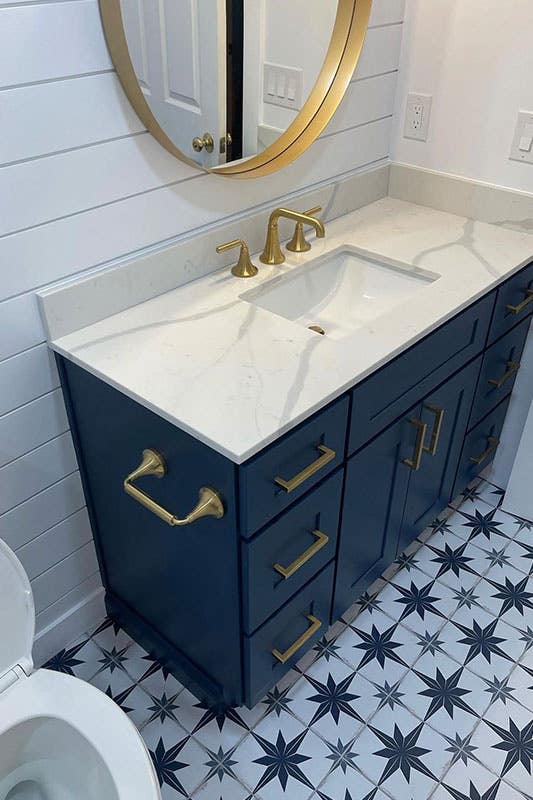
Widespread vs. Centerset: Which Should You Choose?
If your sink or top is already drilled, the holes decide for you. If you're buying a new top, here's how they compare:
| Centerset | Widespread | |
|---|---|---|
| Hole spread | 4" | About 8" (6" to 16" depending on the model) |
| Pieces | One base with spout and handles | Three separate pieces |
| Counter space needed | Less | More, across the back of the sink |
| Cleaning | Grime collects on the base (Bob Vila) | Open counter between pieces is easier to wipe |
| Cost | Often lower | Often a bit higher |
| Can swap to single-hole? | Yes, with a deck plate | No; the holes are too far apart for a plate (Family Handyman) |
Can you put a widespread faucet on a centerset sink? Usually not. A standard widespread needs about 8 inches between the outer holes, and a centerset sink has 4. Even Bob Vila's lowest widespread spread, 6 inches, won't reach. Your options are another centerset, a mini-widespread made for 4-inch holes, or a single-hole faucet with a deck plate.
Wall-Mount Faucets
A wall-mount faucet comes out of the wall above the sink, so nothing sits on the counter. Bob Vila says it needs a separate wall-mount valve and drain, and a spout long enough to put water in the bowl without splashing. It suits a pedestal sink or a vessel sink, and Bob Vila suggests avoiding it for basins that already have holes drilled.
The cabinet angle matters here. A wall-mount faucet needs its valve inside the wall, so it has to be planned before the wall is closed up and before you order the vanity top. The top needs no faucet holes at all. Lily Ann's quartz vanity tops are drilled for a single-hole faucet, so a wall-mount faucet would need a different top. Their listings say "call for more options," so ask before you order.
Vessel Faucets
A vessel sink sits on top of the counter instead of below it, so a regular faucet's spout would be too short to clear the rim. Vessel faucets have an extra-tall neck and usually one handle, according to Bob Vila. The other choice for a vessel sink is a wall-mount faucet. Either way, the spout has to reach far enough over the bowl that water lands in the middle, not on the back edge.
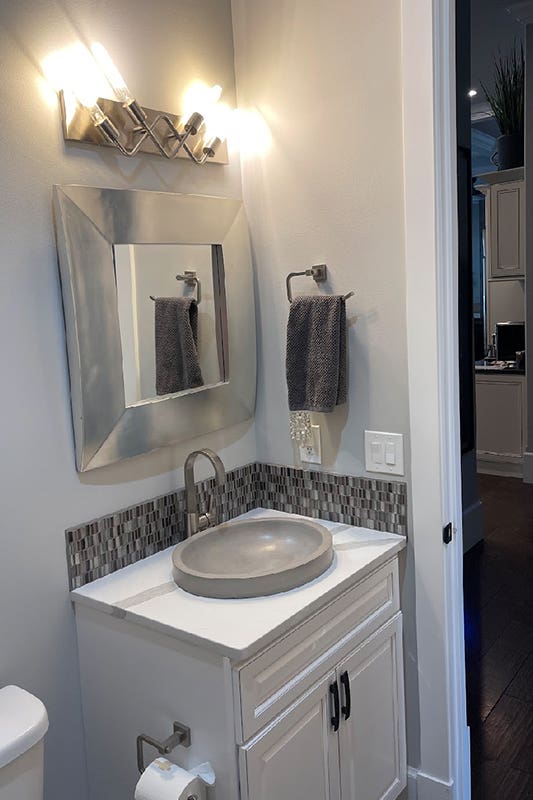
One Handle or Two? What's Inside Counts Too
Type describes how a faucet mounts. The valve inside decides how it feels and how it holds up. The Spruce sorts faucets into four valve types:
- Ball: a single handle over a rounded cap. Affordable, but more prone to leaks because of its many parts. More common in kitchens.
- Ceramic disc: a single lever over two ceramic discs. Reliable and easy to operate, but costs more.
- Cartridge: one or two handles with a moving cartridge inside. Fewer parts, though hard water can affect the cartridge.
- Compression: two handles that squeeze a rubber washer shut. Easy to fix, but prone to drips as the washer wears.
Consumer Reports notes that ceramic disc valves, once a high-end feature, are now mainstream. Plumbing contractor Kelly Russum told Bob Vila that "the optimal choice for most homes is a single-handle faucet with a ceramic cartridge," because single handles take less force and wear the cartridge less. Two handles give finer temperature control and suit traditional bathrooms.
Accessibility: the 2010 ADA Standards (section 309.4) require controls that work with one hand, without tight grasping, pinching or twisting of the wrist, and with no more than 5 pounds of force. Lever handles are the usual way faucets meet that. Lily Ann's B231 listings say "ADA for lever handle." See our ADA bathroom vanity guide for the rest of an accessible sink area.
Matching the Faucet to Your Vanity Top
This is where most faucet mistakes happen, because the faucet and the top are often bought separately. Check these before you order either one:
- Holes and spread. Pick the faucet first, then order the top drilled for it. Our vanity top guide explains why the two decisions go together.
- Counter thickness. Faucets list a maximum deck thickness. Lily Ann's B231 faucets fit counters up to 1-1/2 inches thick, and Lily Ann's quartz vanity tops are 1-3/16 inches thick, so the two work together.
- Spout reach. Family Handyman warns that a bath faucet with a short reach can make you slop water behind the spout when you wash your hands. Hold the spout's listed reach against the distance from the faucet hole to the middle of the bowl.
- Handle clearance. Consumer Reports says to check the distance to the backsplash or window ledge, because a single handle's swing can hit what's behind it. Lily Ann's quartz tops come with a backsplash, so test the lever's swing.
- Height under the mirror or cabinet. A tall faucet can crowd a mirror or medicine cabinet hung low. Lily Ann's B231 stands 6-3/16 inches tall.
Lily Ann's quartz vanity tops: Lily Ann lists undermount single-sink quartz tops in Aries (31" x 22", 37" x 22" and 49" x 22") and Carrara White (49" x 22"), made to fit 30-inch, 36-inch and 48-inch vanities. Each is 1-3/16 inches thick with a centered sink, a backsplash and one reversible sidesplash. The faucet mount type is listed as "Single hole (call for more options)." All four showed Out of Stock on September 28, 2026, so check the faucets, sinks and quartz tops page before you plan around one.
Setting the top and faucet is also covered step by step in our bathroom vanity installation guide.
Flow Rate and the WaterSense Label
According to the EPA's WaterSense program, the standard bathroom faucet flow is 2.2 gallons per minute, and WaterSense-labeled bathroom faucets use a maximum of 1.5 gallons per minute, cutting flow by 30 percent or more. The EPA estimates that replacing old faucets and aerators with WaterSense models can save the average family 700 gallons of water a year. Lily Ann's B231 faucets are listed at 1.5 gpm and WaterSense-certified.
Finishes
Finish doesn't change how a faucet mounts, but it's the part everyone sees. Bob Vila's plumbing source says matte black and brushed nickel are very popular right now, which are the two finishes Lily Ann's single-hole faucet comes in. For matching the faucet with cabinet pulls, towel bars and lights, see our bathroom hardware ideas.
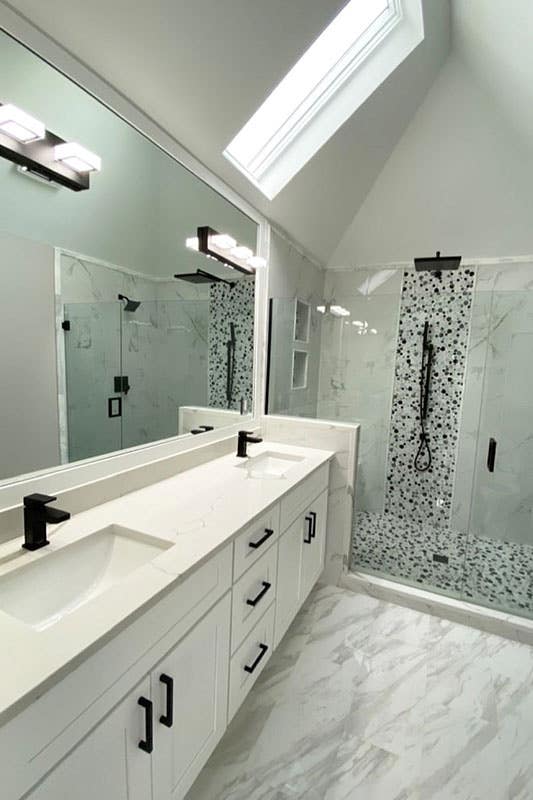
The Takeaway
Count the holes and measure the spread before you shop. One hole means a single-hole faucet. Three holes 4 inches apart means centerset, or a single-hole faucet with a deck plate. Three holes about 8 inches apart means widespread. No holes means a wall-mount faucet, planned before the wall is closed. Then check the faucet's reach, height and deck thickness against your top.
Lily Ann's bathroom faucets are single-hole models in brushed nickel and matte black. Planning a new vanity? Browse Lily Ann bathroom vanities and pick the faucet and top together.
Frequently Asked Questions
By how they mount, there are four: single-hole (one hole), centerset (three holes 4 inches apart on one base), widespread (three separate pieces, usually 8 inches apart) and wall-mount (out of the wall, no counter holes). Vessel faucets are a tall version, usually single-hole, for sinks that sit on the counter. Within each type you'll find one or two handles and many finishes.
When people talk about the four types of faucets, they usually mean the valve inside: ball, ceramic disc, cartridge and compression. Ball and disc faucets have a single handle; cartridge faucets have one or two; compression faucets have two handles and a rubber washer. By how they mount on a bathroom sink, the four types are single-hole, centerset, widespread and wall-mount.
Look at how it mounts. One piece through one hole is a single-hole faucet. A spout and two handles on one base plate over three holes is a centerset. Three separate pieces is a widespread. A spout coming out of the wall is a wall-mount. To confirm, look under the sink, count the holes, and measure center to center between the outer two: about 4 inches is centerset, about 8 or more is widespread.
There's no single answer, but plumbing contractor Kelly Russum told Bob Vila that for most homes the best choice is a single-handle faucet with a ceramic cartridge. Single handles take less force to use and put less strain on the cartridge, so they tend to last longer. Consumer Reports adds that ceramic disc valves, which have no washers to wear out, are now standard on mainstream faucets.
Usually not. A widespread faucet needs about 8 inches between the outer holes, and a centerset sink has 4 inches. Even adjustable widespreads start around 6 inches, per Bob Vila. For a 4-inch sink, use a centerset faucet, a mini-widespread made for 4-inch holes, or a single-hole faucet with a deck plate to cover the extra holes.
Neither is better in general; it depends on your holes and your look. A single-hole faucet has one lever, takes the least space and is easiest to clean around. A centerset has two handles on one base, which some people find easier for fine temperature control and which suits traditional styles. If your sink has three holes 4 inches apart, you can use either, as long as the single-hole faucet comes with a deck plate.
The best type is the one that fits the holes in your sink or vanity top. After that, pick by size and use: single-hole for small vanities and easy cleaning, centerset for small sinks and simple replacements, widespread for larger vanities and a custom look, and wall-mount or a tall vessel faucet for vessel sinks. Inside, a ceramic valve with a lever handle is a durable, easy-to-use choice.
It's a faucet with separate handles and spout, like a widespread, but sized to fit a 4-inch hole pattern like a centerset. It gives a widespread look on a smaller sink. Spreads vary by brand, so measure your holes and check the listed spread before you buy.
We couldn't find published sales figures that settle it. What the sources do agree on: single-hole and centerset faucets suit most small and mid-size vanities, widespreads are common on larger vanities, and for finishes, a plumbing contractor quoted by Bob Vila said matte black and brushed nickel are very popular right now.
















Comments