


The National Kitchen & Bath Association recommends centering a toilet paper holder 26 inches above the floor and 8 to 12 inches in front of the edge of the toilet bowl. For an ADA bathroom, the paper outlet must be 15 to 48 inches above the floor and 7 to 9 inches in front of the toilet, and never behind a grab bar. Towel bars usually go at 48 inches and grab bars at 33 to 36 inches.
- Toilet paper holder: 26" to the center, 8"–12" in front of the bowl (NKBA). ADA: outlet 15"–48" high, 7"–9" in front, not behind a grab bar.
- Towel bar: 48" to the center of the mounts, Bob Vila's industry standard. Leave 4" from outlets and switches.
- Towel ring: bottom of the ring at about 48", so the mount sits a few inches higher.
- Robe hook: about 70" (House Digest). ADA hooks: 48" or lower.
- Grab bars: 33"–36" to the top of the bar (ADA 609.4, NKBA), horizontal, rated for 250 lb, into studs or blocking.
- Measure from the finished floor, after tile, and tape each spot before you drill.
- Lily Ann Cabinets vanities are 34-1/2" tall before the top, so a toilet paper holder at 26" fits on the side panel; a pull-out towel bar adds towel space inside the vanity (in stock September 30, 2026).
You've got the drill out and a toilet paper holder in your hand. How high does it go? How far from the toilet? And while you're at it, where do the towel bar and the robe hook go?
There's no single building code for most bathroom accessories in a private home. There are, though, two solid references. The National Kitchen & Bath Association (NKBA) publishes Bathroom Planning Guidelines that designers use for homes. The 2010 ADA Standards for Accessible Design set the rules for public and accessible bathrooms. For towel bars and hooks, where neither gives a single number, we use the heights that home guides like Bob Vila and House Digest report as standard practice. Every number below says where it comes from.
Bathroom Accessory Heights at a Glance
All heights are measured from the finished floor, so measure after the tile or flooring is down.
| Accessory | Typical home height | Accessible (ADA) rule |
|---|---|---|
| Toilet paper holder | 26" to the center, 8"–12" in front of the bowl (NKBA) | Outlet 15"–48" high, 7"–9" in front of the toilet, not behind a grab bar (ADA 604.7) |
| Towel bar | 48" to the center of the mounts (Bob Vila) | No ADA towel-bar rule; NKBA's access guidance puts accessories 15"–48" high |
| Towel ring | Bottom of the ring about 48", so the mount sits higher (Bob Vila) | Same 15"–48" reach range |
| Robe or towel hook | About 70" (House Digest) | Within the 15"–48" reach range (ADA 603.4) |
| Grab bar | 33"–36" to the top of the bar (NKBA) | 33"–36" to the top of the gripping surface (ADA 609.4) |
| Mirror over the vanity | Center near eye level; see our medicine cabinet guide | Bottom of the glass 40" max over a sink or counter (ADA 603.3) |
| Shelf | Where it's easy to reach and clears the fixture below | 40"–48" high (ADA 603.4) |

Toilet Paper Holder Height
The NKBA recommends centering a toilet paper holder 26 inches above the floor and 8 to 12 inches in front of the edge of the toilet bowl. That puts the roll within easy reach while you're seated, without twisting or leaning back.
The front-of-bowl rule matters as much as the height. A holder mounted behind you, level with the tank, is the most common mistake: you have to twist around to reach it. Measure from the front edge of the bowl, not from the wall behind the toilet.
Where you mount it depends on what's beside the toilet:
- A side wall. Mount it on the wall at 26 inches, 8 to 12 inches ahead of the bowl. This is the NKBA layout.
- A vanity beside the toilet. Many people mount the holder on the vanity's side panel. A Lily Ann vanity sink base like the Craftsman White Shaker 30-inch is 34-1/2 inches tall before the countertop, so a holder at 26 inches lands on the side panel with room to spare. Use short screws so they don't poke through into the cabinet.
- Open space. A freestanding holder works when there's no wall or cabinet within reach.
Planning where the toilet itself goes? Our small bathroom layouts guide covers toilet clearances, and our one-piece vs. two-piece toilet guide covers rough-in.

ADA Toilet Paper Holder Rules
In an ADA bathroom, section 604.7 of the ADA Standards says the dispenser must be 7 to 9 inches in front of the toilet, measured to the center of the dispenser. The outlet, where the paper comes out, must be 15 to 48 inches above the floor and "shall not be located behind grab bars." The dispenser must also allow continuous paper flow.
If the holder goes above the side grab bar, the ADA's advisory note says the outlet must still be no higher than 48 inches. Section 609.3 also requires 12 inches of clear space above a grab bar, so plan the holder and the bar together.
Towel Bar Height
The standard towel bar height is 48 inches from the floor to the center of the mounts. Bob Vila calls this the industry standard. It keeps a folded bath towel off the floor and within easy reach for most adults.
A few rules from Bob Vila's towel bar height guide help when 48 inches doesn't fit your room:
- Stacking two bars. Fold your largest towel in half, add 2 inches, and hang the lower bar at that height. Then hang the upper bar that same 2 inches plus the folded towel length higher, so the top towel clears the bar below.
- Outlets and switches. Leave about 4 inches between a towel bar and any outlet or light switch, so a wet towel isn't hanging over them.
- Over a vanity. Bob Vila's 48 inches assumes a vanity 30 to 32 inches tall, which leaves 16 to 18 inches for a hand towel to hang. Lily Ann vanity cabinets are 34-1/2 inches tall before the countertop, so a bar at 48 inches would sit less than 14 inches above the cabinet, and less once the top is on. Over a taller vanity, raise the bar until a folded hand towel clears the counter.
- Kids' bathrooms. Bob Vila suggests no higher than 36 inches for ages 3–4, 40 inches for ages 5–8 and 44 inches for ages 9–12.

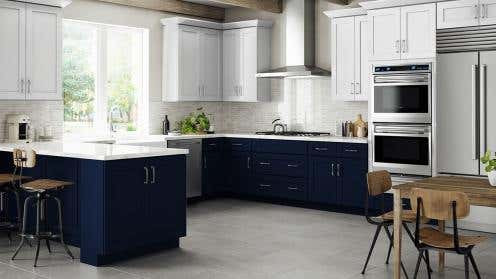
Lily Ann Cabinets Navy Blue Shaker
Towel bars for accessible bathrooms
The ADA doesn't set a towel bar height, but it does set reach ranges. With nothing in the way, the highest point a seated person can reach forward is 48 inches (ADA 308.2.1). Reaching over a counter is harder: if the reach is more than 20 inches deep and up to 25 inches, the maximum drops to 44 inches (ADA 308.2.2).
That matters for a towel bar on the wall behind or over a vanity. Lily Ann vanity sink bases are 21 inches deep before the countertop, so a bar you reach across the vanity for belongs at 44 inches or lower if someone in the house uses a wheelchair. Our ADA bathroom vanity guide covers the vanity side of an accessible bathroom.
Towel ring and hand towel height
A towel ring hangs below its mount, so measure to the bottom of the ring. Bob Vila's rule is to put the bottom of the ring at 48 inches, then add the distance from the bottom of the ring to the center of its mount. For example, a ring that hangs 6 inches below its mount goes up at 54 inches.
Put a hand towel ring or short bar within arm's reach of the sink, on the wall beside the vanity or on the vanity's side panel. A ring beside the mirror keeps the hand towel next to the sink without taking counter space.
Towel storage inside the vanity
If wall space is tight, some towels can live inside the vanity instead. Two Lily Ann cabinet organizers showed In Stock on September 30, 2026:
- The Pull-Out Towel Bar (LAC563-51-C) fits sink and vanity cabinets. It's listed at 12-7/8 inches deep, 3-7/8 inches wide and 1-1/2 inches high, and slides out to dry a hand towel.
- The chrome Towel Holder (LAC563-32 C) mounts on the inside of a cabinet door and fits best on doors 14-1/2 inches wide or wider. It's listed at 12-3/4 inches wide, 6-1/2 inches high and 3-1/2 inches deep.
These hold hand towels and cloths. A bath towel still needs a bar or hook on the wall.

Robe and Towel Hook Height
House Digest puts the general placement for a robe hook at 70 inches above the floor, and says to adjust it for your family's heights. That's high enough that a long robe doesn't drag on the floor. Hooks on the back of a door follow the same rule, as long as the door can still swing open all the way.
In an ADA bathroom, coat hooks must be within the reach ranges in section 308, which means 48 inches or lower (ADA 603.4). For kids, a low second hook is easier than asking them to reach a 70-inch one.
Hooks also dry towels faster than a bar, because the towel hangs loose instead of folded over itself. Our bathroom hardware ideas cover finishes and styles for hooks, bars and holders.
Grab Bar Height and Placement
Grab bars go 33 to 36 inches above the floor, measured to the top of the bar. That's the rule in the ADA Standards (section 609.4) and the height the NKBA recommends for homes. Bars in public bathrooms must be horizontal, 1-1/4 to 2 inches thick, 1-1/2 inches from the wall, and strong enough to hold 250 pounds.
Here's where they go, from the ADA Standards:
| Location | Height | Length and position |
|---|---|---|
| Toilet, side wall | 33"–36" | 42" long minimum, starting 12" max from the back wall and reaching at least 54" from it (604.5.1) |
| Toilet, rear wall | 33"–36" | 36" long minimum, reaching at least 12" past the toilet's center on one side and 24" on the other (604.5.2) |
| Bathtub, back wall | One bar at 33"–36", one 8"–10" above the tub rim | Two bars on the back wall, plus a 24" bar on the control end (607.4) |
| Transfer shower | 33"–36" | Across the control wall and along the back wall to 18" from the control wall (608.3.1) |
| Roll-in shower | 33"–36" | On the back wall and the wall opposite the seat, not above the seat, within 6" of the adjacent walls (608.3.2) |
| Children's toilet | 18"–27" | For toilets designed for children's use (609.4) |
Keep 12 inches of clear wall above a grab bar and 1-1/2 inches below and at its ends (ADA 609.3). Shower controls and fittings may sit as close as 1-1/2 inches above it.
Do homes have to follow these rules?
No federal rule requires grab bars in a private home. The ADA Standards cover public and commercial buildings, and even there, section 604.5 lets residential dwelling units skip the bars as long as the walls are reinforced so bars can be added later.
That reinforcement is the step to copy at home. The NKBA recommends preparing tub and shower walls during construction so grab bars can be installed to support 250 pounds. If the walls are open for a remodel, adding solid blocking between the studs now costs little. Drilling for it later means opening tile.
Towel bars are not grab bars. A towel bar held up by drywall anchors can pull out of the wall if someone grabs it to catch a fall.
Mirror, Medicine Cabinet and Shelf Heights
A mirror or medicine cabinet over the vanity is set by eye level, not by a fixed number. Our medicine cabinet size guide walks through it: Bob Vila puts the center of the mirror at about 64 inches from the floor, and Family Handyman puts the top at about 70 inches. Our vanity mirror size guide covers widths.

For accessible bathrooms, the ADA sets two limits (603.3). Over a sink or counter, the bottom of the mirror glass can be no higher than 40 inches. The ADA's advisory note adds that the top of a mirror should be at least 74 inches up, so it works for both standing and seated users. ADA shelves go 40 to 48 inches above the floor (603.4).
The vanity sets the starting line for all of this. A standard vanity and a comfort-height one put the counter, sink and mirror at different heights. Our bathroom vanity height guide explains the difference.
Before You Drill
- Measure from the finished floor. If new tile or flooring is going in, wait until it's down, or add its thickness to every mark.
- Find the studs. Heavy or often-used items like towel bars and every grab bar should be screwed into studs or solid blocking.
- Check for pipes and wires. The wall behind a toilet or vanity often carries plumbing. Use a detector before you drill.
- Tape it first. Mark each spot with painter's tape and have everyone in the house try it. Moving tape is easier than patching holes.
- Plan around the vanity. Make sure a bar or holder on the wall doesn't block a vanity door or drawer from opening.
The Takeaway
For most homes, put the toilet paper holder 26 inches up and 8 to 12 inches in front of the bowl, towel bars at 48 inches, robe hooks near 70 inches, and grab bars at 33 to 36 inches to the top of the bar. For an accessible bathroom, follow the ADA numbers above, keep towels and hooks within 48 inches, and reinforce the walls for grab bars before the tile goes up.
Choosing a vanity for the same bathroom? Browse Lily Ann's bathroom vanities, including the Key Largo White and Navy Blue Shaker lines.
Frequently Asked Questions
The NKBA recommends centering a toilet paper holder 26 inches above the floor. That height is easy to reach from a standard or comfort-height toilet. In an ADA bathroom, the paper outlet can be anywhere from 15 to 48 inches above the floor, but not behind a grab bar.
Put it beside the toilet, 8 to 12 inches in front of the edge of the bowl, centered 26 inches above the floor, per the NKBA. It should be reachable while seated without twisting. A side wall is ideal, but the side panel of a vanity next to the toilet works too.
The NKBA says 8 to 12 inches in front of the edge of the toilet bowl, measured forward from the bowl's front edge. For an ADA bathroom, the rule is 7 to 9 inches in front of the toilet, measured to the center of the dispenser. Either way, it goes ahead of you, not behind you beside the tank.
ADA section 604.7 says the dispenser must be 7 to 9 inches in front of the toilet, measured to its centerline. The paper outlet must be 15 to 48 inches above the floor and not behind a grab bar. The dispenser must allow continuous paper flow, and if it sits above the side grab bar, the outlet still can't be higher than 48 inches.
Mount a towel bar 48 inches above the floor, measured to the center of the mounts. Bob Vila calls this the industry standard. For young children, go lower, about 36 to 44 inches depending on age. For an accessible bathroom, keep it at 48 inches or lower, and 44 inches or lower if you reach over a vanity to get to it.
Under the ADA Standards, shower grab bars go 33 to 36 inches above the floor, measured to the top of the bar. In a transfer shower they run across the control wall and along the back wall to 18 inches from the control wall. In a roll-in shower they go on the back wall and the wall opposite the seat, not above the seat. Private homes aren't bound by the ADA, but local codes may apply, so check with your building department.
Put a horizontal bar on the back wall at 33 to 36 inches and one on the wall with the controls, where you steady yourself while adjusting the water. The ADA layouts are a good template even at home. Keep bars clear of the seat if there is one, and within 6 inches of the adjacent walls in a roll-in shower.
The ADA calls for two grab bars on the back wall of a tub: one 33 to 36 inches above the floor and a second 8 to 10 inches above the rim of the tub. It also calls for a 24-inch bar on the control end wall at the front edge of the tub. The lower bar helps when you're sitting down or getting up from the tub floor.
For an ADA bathroom, grab bars must be straight and horizontal. Section 609.4 says they're installed "in a horizontal position" at 33 to 36 inches. In a private home you can choose, and some people add a vertical bar at the tub or shower entry to hold while stepping in, but a horizontal bar at the right height is the standard starting point.
A grab bar must be anchored to hold at least 250 pounds, which ADA section 609.8 requires and the NKBA recommends for homes. The reliable way is to screw it into studs or solid blocking added behind the wall. If there's no stud where you need the bar, add blocking during a remodel, or use a fastener the grab bar maker rates for that load.









Comments