


Bamboo is a legitimate cabinet material with one genuine advantage and two real caveats. The advantage is growth rate — bamboo is a grass that regenerates in a few years rather than the decades a hardwood takes, which is the entire environmental case for it. The caveats are that bamboo cabinets are not solid bamboo but strips laminated into panels with adhesive, so the emissions question applies exactly as it does to plywood or MDF; and that the visible strip pattern is distinctive enough that it dates a kitchen to a look rather than to a period. If you want the appearance, it performs well. If you want it purely for sustainability, the shipping distance and the adhesives deserve the same scrutiny as the growth rate.
- Bamboo is a grass, not a timber, and a bamboo panel is strips laminated together — never a solid slab.
- Three panel types, three different products. Horizontal shows the nodes, vertical shows fine pinstripes, strand-woven shows almost nothing and is by far the hardest.
- Strand-woven is the hard one. It is denser than most cabinet hardwoods, and also the most expensive and the heaviest.
- The adhesive question applies. Laminated bamboo panels use resins like any engineered panel, so ask about NAF or ULEF rather than assuming a natural material is emission-free.
- Growth rate is the real sustainability argument — weigh it against shipping distance from where bamboo is grown and processed.
- Lily Ann does not sell bamboo cabinets. The closest thing in our range is Craftsman Natural Shaker, a light natural hardwood finish.
What a Bamboo Cabinet Actually Is
Bamboo is a grass, not a tree, and its stems are hollow and round. That means a bamboo panel can never be a slab cut from a trunk — it is made by splitting stems into strips, flattening them, and gluing them together under pressure into a board. Every bamboo cabinet part is a laminate, and how the strips are arranged is what makes one bamboo panel look and behave completely differently from another.
This is the single most useful thing to understand before shopping, and it is why most articles about bamboo cabinets are unhelpful: they describe "bamboo" as though it were one material with one appearance and one price.
Two other consequences follow from the same fact. Bamboo panels contain adhesive, so the formaldehyde question applies exactly as it does to plywood or MDF. And bamboo can be carbonised — heat-treated to darken it — which produces the warm caramel colour many people picture, at the cost of some hardness.

The Three Panel Types
Horizontal, vertical and strand-woven are the three constructions, and the difference between them is larger than the difference between two hardwood species. They vary in appearance, hardness, weight and price, and a listing that just says "bamboo" has not told you which one you are buying.
| Type | How it is made | Appearance | Hardness | Relative cost |
|---|---|---|---|---|
| Horizontal | Wide strips laid flat, glued edge to edge | The classic look — visible nodes, wide grain pattern | Moderate | Lower |
| Vertical | Narrow strips turned on edge, glued face to face | Fine, even pinstripes; nodes barely visible | Moderate | Mid |
| Strand-woven | Shredded fibres compressed with resin under very high pressure | Dense, mottled, closest to a hardwood | Highest — harder than most cabinet hardwoods | Highest |
Horizontal is what people picture when they picture bamboo: the visible node lines are the distinctive signature. It is also the most obviously "bamboo" and therefore the most style-committing.
Vertical reads as a fine, regular pinstripe. Calmer than horizontal, more contemporary, and less immediately identifiable as bamboo — which is either the point or a waste, depending on why you wanted bamboo.
Strand-woven is the outlier. Because the fibres are shredded and compressed rather than laid in strips, it is far denser and reads more like a dark hardwood than like bamboo. It is the most durable and the most expensive, and it is heavy enough that it matters for wall cabinets.
Ask which of the three before anything else. It settles appearance, hardness and price in one question.
Carbonised Versus Natural
Bamboo's natural colour is pale blonde. The warm caramel-brown often marketed as bamboo is carbonised — heat-treated under pressure, which caramelises the sugars in the fibre and darkens it throughout. The catch is that the same heat treatment softens the material, so a carbonised panel is measurably less hard than a natural one of the same type.
Practical reading:
- Natural — blonde, harder, and the safer choice for anything taking wear.
- Carbonised — warmer and darker, softer, and better suited to doors and fronts than to shelving or work surfaces.
- Strand-woven carbonised — recovers most of the hardness loss because it starts from a much denser base. This is the combination worth paying for if you want the dark colour and the durability.
If a supplier offers a dark bamboo and cannot say whether it is carbonised or stained, that is a gap worth pressing on — they behave differently when scratched, because carbonisation goes through the material and a stain does not.
The Sustainability Case, Weighed Honestly
Bamboo's environmental argument rests almost entirely on growth rate: it is a grass that reaches harvestable size in a few years rather than the decades a cabinet hardwood needs, and it regrows from the existing root system without replanting. That is a real and substantial advantage. Two things sit on the other side of the ledger.
- Adhesives. Every bamboo panel is laminated, and strand-woven in particular uses a significant proportion of resin. "Natural material" does not mean "no added formaldehyde" — those are separate claims, and the second one has to be asked for by name. Ask about NAF or ULEF resins specifically.
- Distance. Most commercial bamboo is grown and processed in Asia. Whether that outweighs the growth-rate advantage depends on assumptions nobody publishes, so treat any confident claim in either direction with suspicion.
The honest summary is that bamboo has a genuinely good sustainability story and it is not a clean sweep. If environmental performance is the deciding factor for your kitchen, the largest variable is not the material at all — it is how long the kitchen lasts before it is replaced. We work through that in which eco-friendly cabinet claims are actually checkable.
Living With Bamboo Cabinets
Bamboo performs well in a kitchen with one caveat: it is dimensionally stable and hard, but it is sensitive to prolonged moisture at an unsealed edge in the same way any laminated panel is. The maintenance is unremarkable; the failure mode is the same as everything else — water at an edge nobody sealed.
- Clean with a mild detergent and a damp cloth. No abrasives, no solvent-based cleaners.
- Wipe standing water promptly, particularly around the sink base and dishwasher.
- Expect some colour change with light. Natural bamboo ambers slightly over time, so a cabinet that has been shaded by an appliance can differ from one that has not.
- Seal every site cut. Any hole drilled for plumbing or hardware exposes raw laminate.
- Check the interior finish. A bamboo face on a cabinet with a raw interior has the same problem as any other cabinet with a raw interior.
On scratching: strand-woven resists it better than most hardwoods, horizontal and vertical are roughly comparable to a mid-range hardwood, and carbonised versions of all three are softer than their natural equivalents.
Will It Date?
Bamboo's risk is not that it looks cheap — it does not — but that horizontal-grain bamboo is visually distinctive enough to read as a specific design choice rather than as a neutral background. A kitchen in horizontal bamboo will always be identifiably a bamboo kitchen.
That cuts both ways. If you want a kitchen with character and a material that is not another painted shaker, it is doing exactly what you asked. If you want cabinetry that recedes and lets other things in the room lead, the strip pattern will compete.
The lower-risk versions, in order:
- Vertical grain — the pinstripe is fine enough to read as texture rather than pattern.
- Strand-woven — reads as a dense hardwood; most people would not identify it as bamboo.
- Bamboo on part of the kitchen only — an island or a run of open shelving, with a quieter finish elsewhere. The two-tone approach applies here as well as anywhere.
Lily Ann Does Not Sell Bamboo Cabinets
We should say this plainly on a page about bamboo cabinets: Lily Ann does not make or stock them. Our range is birch, with plywood carcasses, in 25 finish collections. If bamboo specifically is what you want, you will need a supplier who specialises in it — several do, and the panel-type question above is the first thing to ask any of them.
If what you actually want is the look — a light, warm, natural-toned kitchen that is not painted — then there is a closer alternative in our range than the bamboo shopping trip suggests:
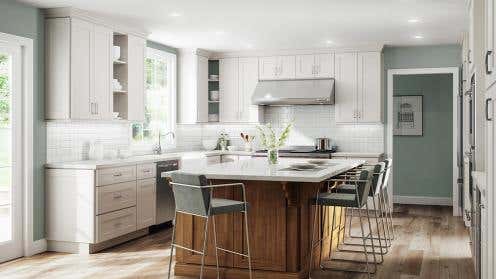
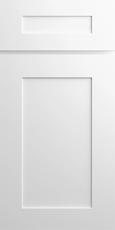
- Craftsman Natural Shaker — a light natural finish on a shaker door. The closest thing we make to the pale, warm, unpainted look people usually mean by bamboo, and in a door profile that will not date.
- York Driftwood Grey — if what appealed was bamboo's greyed-natural end rather than its warm end.
- York Saddle — warmer and mid-toned, closer to carbonised bamboo in colour if not in pattern.
The honest difference: none of these has bamboo's strip pattern. If the pattern is the point, they will not satisfy you and you should buy bamboo. If the colour and the warmth were the point, order a free full-size sample and compare it against the bamboo samples before committing — it costs nothing and it answers the question properly.

What to Ask a Bamboo Supplier
If you are going ahead, six questions separate a good bamboo cabinet from a poor one:
- Which panel type — horizontal, vertical or strand-woven? This settles appearance, hardness and price at once.
- Natural or carbonised? And if dark, carbonised or stained.
- Is the bamboo the whole cabinet or just the doors? Bamboo doors on a plywood carcass is common and perfectly reasonable — but it should be stated, not discovered.
- What resin, and is it NAF or ULEF? The natural-material framing does not answer this.
- What are the hinges and glides? Same question as for any cabinet: soft-close, adjustable, full-extension undermount.
- Is the interior finished? Also the same question as for any cabinet, and the answer matters more than the species.
Notice that three of those six are the questions you would ask about any cabinet. Bamboo is a material choice sitting on top of the ordinary construction decisions, not a replacement for them — a point worth holding onto, because it is easy to spend the whole conversation on the bamboo and none of it on the drawer boxes. Our guide to what actually fails first in a kitchen cabinet covers the rest.




Comments